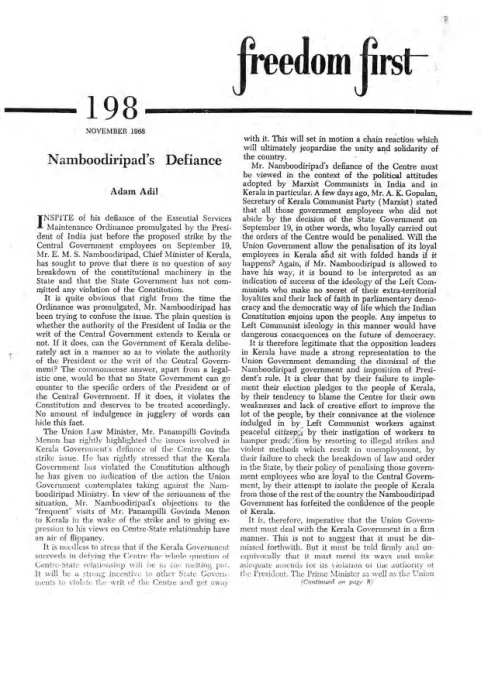
periodical issue
Freedom First
By M. D. Kini, "Atreya", A. G. Noorani, Bogaras Bruchman, N. D. N.
Printed at Inland ..., Bombay 7 and Edited and published for the Democratic Research Service by ... Road, Bombay ... (colophon largely illegible in scan) · Bombay · 1968
12 pages
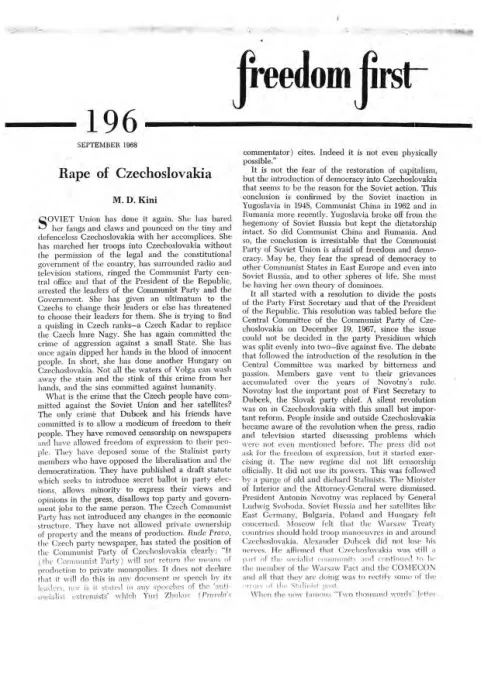
Freedom First
Summary
This September 1968 issue of Freedom First, published in the immediate aftermath of the Warsaw Pact invasion of Czechoslovakia, is dominated by anti-Soviet commentary. The lead article condemns the Soviet-led occupation as an act of imperial aggression against a small state, tracing the Prague Spring reforms under Dubcek and criticizing India’s official ambivalence at the United Nations. A companion piece analyses the internal fractures of Indian and international Communism — the CPI/CPI(M) split, the Naxalbari uprising, and Sino-Soviet polycentrism — reading the Czechoslovak invasion as a symptom of Communism’s broader disintegration. A first-person account by the wife of imprisoned Soviet dissident writer Yuri Daniel describes the punitive conditions of a Soviet labour camp, reinforcing the issue’s broader indictment of Communist authoritarianism. A review essay by A. G. Noorani surveys recent scholarship on the politics and law of the Vietnam War. The issue closes with reader letters, a book review of a study on Communist strategy in India, and a compilation of quoted commentary (‘With Many Voices’) on the Czechoslovak crisis from world press and public figures.
Key points
-
M. D. Kini’s lead article “Rape of Czechoslovakia” denounces the Warsaw Pact invasion as unprovoked aggression comparable to Hungary 1956, credits Dubcek’s liberalising reforms as the true trigger, and condemns India’s abstention at the UN and the defeat of Sucheta Kripalani’s parliamentary motion condemning the invasion.
-
Writing as “Atreya”, “Schism In Communist Movement” traces the 1964 CPI/CPI(M) split and the 1968 Naxalbari breakaway to a “polycentric” world Communist movement no longer disciplined by Moscow, reading the Czechoslovakia invasion as a symptom of that disintegration.
-
A. G. Noorani’s “Vietnam’s Politics And Law” reviews Dennis Duncanson’s history of Vietnam and law-focused studies by Richard Falk and by Hull and Novogrod, the latter concluding South Vietnam and the US were legally entitled to use force in self-defence against the North’s creation of the National Liberation Front.
-
Bogaras Bruchman, wife of imprisoned Soviet writer Yuri Daniel, recounts a bureaucratically cruel one-hour supervised visit to him at the Potma labour camp and a written refusal of a private visit from the camp commandant.
-
The lead article also faults Pravda’s justification of the invasion, an alleged NATO subversion plot, as fabricated pretext, framing the episode as evidence of Communism’s disintegration as a unified international movement.
-
The issue closes with reader letters, a review of a book on Communist strategy in India, and a “With Many Voices” compilation of quoted press commentary on the Czechoslovak crisis from world press and public figures.
Essays
Rape of Czechoslovakia
By M. D. Kini
M. D. Kini’s lead article denounces the Soviet-led Warsaw Pact invasion of Czechoslovakia on 20-21 August 1968 as an act of naked aggression comparable to the crushing of the Hungarian uprising in 1956. He narrates the run-up to the invasion — Dubcek’s rise to First Secretary, the lifting of censorship, the ‘Two Thousand Words’ manifesto, the Warsaw Pact ultimatum, and the Bratislava declaration — arguing that Czechoslovakia’s only ‘crime’ was allowing a modicum of freedom to its people. The piece is sharply critical of India’s official response, faulting the government for abstaining at the UN Security Council and for the treasury benches’ defeat of a parliamentary motion (moved by Sucheta Kripalani) condemning the Soviet violation of the UN Charter. Kini calls on India and the world to mobilise opinion and consider a boycott of the invading nations until they withdraw.
- Frames the Soviet invasion of Czechoslovakia as unprovoked aggression against a small, defenceless state, echoing Hungary 1956
- Credits Dubcek’s reforms — lifting censorship, permitting secret ballots in party elections, tolerating minority views — as the true trigger for Soviet intervention, not fear of capitalist restoration
- Details the Warsaw Pact ultimatum of 15 July and the Bratislava Declaration’s short-lived compromise before the 20-21 August invasion
- Criticizes Pravda’s justification (alleged NATO subversion plot, hidden American arms) as fabricated pretext
- Condemns the Government of India’s abstention at the UN and defeat of Sucheta Kripalani’s parliamentary motion as a national shame
- Calls for India and the world to mobilise opinion and consider boycotting the invading Warsaw Pact states
Schism In Communist Movement
By “Atreya”
Writing under the pseudonym ‘Atreya’, this essay analyses the recurring schisms within the Communist Party of India, framing the 1964 split into CPI and CPI(Marxist), and the 1968 breakaway of the Naxalbari group and Andhra’s Revolutionary Communist Party under T. Nagi Reddy, as products of a ‘polycentric’ international Communist movement no longer disciplined by a single Moscow-centred authority. The author argues that Indian Communists derived power parasitically from the nationalist movement and later from Soviet state patronage rather than genuine working-class revolution, and traces how China’s emergence as a rival pole of Communist authority after Sino-Soviet de-Stalinization fractured party loyalties in India (CPI as pro-Moscow ‘revisionist’, CPI-M as pro-Peking, and further splinters denouncing CPI-M itself as neo-revisionist). The piece closes by reading the Soviet invasion of Czechoslovakia as a ‘panic’ response to this same disintegration of monocentric Communism, predicting a bleak future for Communist organization generally.
- Argues Indian Communists have always derived power parasitically — first from the nationalist movement, later from Soviet state and diplomatic patronage — rather than organic working-class revolution
- Traces the 1964 split into CPI and CPI(Marxist), driven by rival Moscow and Peking loyalties following Sino-Soviet de-Stalinization schisms
- Describes the June 1968 breakaway of T. Nagi Reddy’s Andhra Revolutionary Communist Party and the earlier Naxalbari group in West Bengal as further splinters denouncing CPI(M) as ‘neo-revisionist’
- Notes competition among splinter groups for Chinese patronage and the possibility of a ‘Third Communist Party’ emerging from further integration
- Interprets the Soviet invasion of Czechoslovakia as a symptom of panic at the broader disintegration of monocentric international Communism
- Predicts a bleak future for Communist organization as polycentrism accelerates fragmentation
Vietnam’s Politics And Law
By A. G. Noorani
A. G. Noorani reviews four recent works on the Vietnam War: Dennis J. Duncanson’s ‘Government and Revolution in Vietnam’, Richard A. Falk’s edited collection ‘The Vietnam War and International Law’, and Roger H. Hull and John C. Novogrod’s ‘Law and Vietnam’. Noorani praises Duncanson’s history of Vietnam under French, Diem, and Communist rule as an outstandingly lucid and authoritative account, particularly its portrait of Diem as ‘the embodiment of his country’s soul, for good no less than for bad’ and its analysis of how the National Liberation Front’s dual character — civil-strife rhetoric for Western audiences, Marxist-Leninist orthodoxy for Communist ones — served Hanoi’s war aims. He then surveys Falk’s collection of legal essays on the international-law dimensions of U.S. involvement, and contrasts it with Hull and Novogrod’s more balanced law-school thesis, which concludes that South Vietnam and the U.S. were legally entitled to use force in self-defence given the North’s direction of the NLF’s creation.
- Praises Duncanson’s ‘Government and Revolution in Vietnam’ as a major, lucidly written contribution based on his direct experience advising in Saigon
- Highlights Duncanson’s portrait of Ngo Dinh Diem as a self-appointed patriarch and dictator whose personal failings compounded Vietnam’s post-independence crisis
- Describes the National Liberation Front as, in Duncanson’s account, a creation of Hanoi presenting two faces — civil-strife nationalism to the West, Marxist-Leninist orthodoxy internally
- Reviews Falk’s edited volume of legal essays on U.S. involvement as authoritative but focused on disagreements over facts and international legal consequences
- Notes Hull and Novogrod’s ‘Law and Vietnam’ concludes South Vietnam and the U.S. were legally entitled to use force in collective self-defence given the North’s role in creating the NLF
Yuri Daniel In Camp 17
By Bogaras Bruchman
Bogaras Bruchman, wife of imprisoned Soviet writer Yuri Daniel, recounts a personal visit to the Potma labour camp (Camp 17) in an excerpt reprinted from the Australian quarterly Quadrant (originally published in the German weekly Die Zeit). She describes the bureaucratic cruelty of the visit — promised a full day but granted only one hour under guard, forbidden even to pass her husband a packet of cigarettes — and the bleak, heavily fenced landscape of the men’s camp zone. The piece continues with her subsequent efforts to obtain a private visit and permission to give gifts, met with evasive non-answers from camp authorities, and closes with a written refusal signed by the camp commandant citing a ‘violation of visiting rules’, alongside her exchange with KGB Colonel Mikhail Bardin, who insists the camp’s punitive practices are lawful.
- Describes a one-hour supervised visit to her husband Yuri Daniel at the Potma forced labour camp, despite having hoped for and prepared for a full day’s visit
- Details the petty bureaucratic restrictions — forbidden to pass cigarettes, oranges, or cheese to her husband despite bringing provisions
- Contrasts the men’s camp zone as more heavily fortified and sinister than the women’s, with barbed wire, watchtowers, and a no-man’s land
- Recounts a written refusal from the camp commandant denying a private visit, citing ‘violation of visiting rules’ and lack of provision for receiving parcels
- Describes her exchange with KGB Colonel Mikhail Bardin, who insists the camp administration is following the rules and denies any mistreatment
- Frames the camp’s regime as employing hunger, mental and physical humiliation as tools of ‘re-education’ despite legal guarantees against such treatment
Generated by the v1.5 extraction pipeline. Awaiting editorial review.
Metadata and summary are AI-extracted from the source PDF and reviewed for editorial accuracy. The original work is available via the Read PDF tab above (where present); paragraph-level citation inside the PDF is deferred to a future engagement.