periodical issue
Freedom First
By Atreya, V. B. Karnik, John Gross, G. A. Abba, A. A. Deshpande, V. K.
Freedom First, C/o Democratic Research Service, 127, Mahatma Gandhi Road, Bombay 1 · Bombay · 1968
12 pages
Freedom First
Summary
Freedom First No. 199 (December 1968) is a monthly issue of the Bombay-based liberal magazine, opening with a lead analysis of Richard Nixon’s narrow victory in the 1968 U.S. presidential election and closing with the magazine’s regular “With Many Voices” column of press quotations. Between these, the issue ranges across a reorganisation-of-Assam explainer, a review-essay on Robert Conquest’s history of the Stalinist purges, a detailed defence of the judiciary against Blitz editor R. K. Karanjia in a contempt-of-court dispute, a report on an international seminar on democracy and development held at Coonoor, and short book reviews touching on Tagore, Sakharov, and the Brezhnev doctrine. The issue’s throughline is a Cold War-inflected liberal anti-communism combined with domestic concerns about press responsibility, judicial independence, and regional political accommodation within India.
Key points
-
Writing as “Atreya”, “Nixon Wins” surveys the 1968 US election, crediting Nixon’s narrow win over Humphrey to Republican unity against a Democratic Party split by Robert Kennedy’s assassination and Chicago convention disorder, with George Wallace’s segregationist third-party run further dividing the field.
-
V. B. Karnik’s “Reorganisation Of Assam” traces the failure of post-Independence accommodations for Assam’s hill tribes, from Naga separatism and the creation of Nagaland in 1963 through the All Party Hill Leaders Conference’s push for a “regional federation” sub-State formula.
-
John Gross reviews Robert Conquest’s The Great Terror, summarising the Stalinist purges’ scale, an estimated 20 million shot or died in camps from 1930, and noting that purge-era officials like Kosygin and Brezhnev remained in Soviet leadership decades later.
-
G. A. Abba’s “Freedom Of Press, Uses And Abuses” defends the Bombay High Court’s contempt conviction of Blitz editor R. K. Karanjia over an article attacking the lower judiciary, rejecting the narrative that Karanjia was a martyr for press freedom.
-
A. A. Deshpande reports on a Coonoor seminar on “Problems of Democracy and Development,” jointly organised by the Indian Liberal Group and the Friedrich-Naumann Foundation, which concluded that developing countries should pursue indigenous forms of democracy rather than imported models.
-
Reviews cover A. Dasgupta’s Tagore and Communism, which argues Communists selectively misuse Tagore’s writings, and Andrei Sakharov’s smuggled essay Peaceful Coexistence and Intellectual Freedom, alongside an explainer on the Brezhnev Doctrine used to justify the Czechoslovakia invasion.
-
A short tribute marks the death of industrialist Murarji Vaidya, and the closing “With Many Voices” column quotes Richard Nixon, Andre Malraux and Marshal Tito on contemporary politics.
Essays
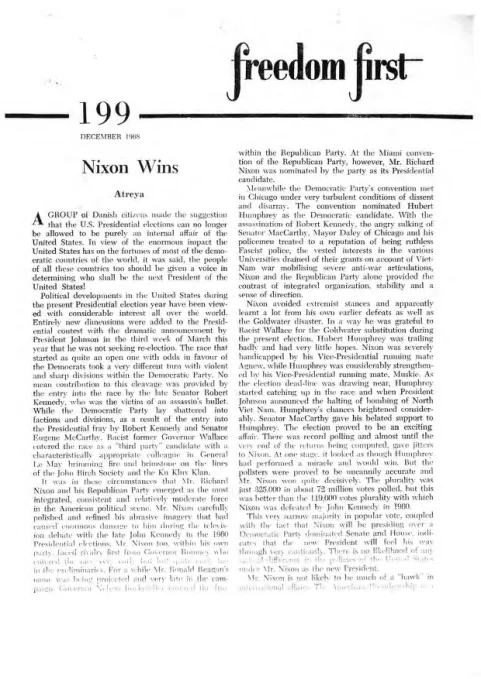
Nixon Wins
By Atreya
Writing under the byline “Atreya,” this piece surveys the 1968 U.S. presidential election, from Lyndon Johnson’s withdrawal from the race through the turbulent Democratic and Republican conventions to Nixon’s narrow popular-vote win over Hubert Humphrey. The author credits Nixon’s win to the Republican Party’s relative unity and organisation against a Democratic Party riven by the assassination of Robert Kennedy, Eugene McCarthy’s insurgency, and disorder at the Chicago convention, while George Wallace’s third-party run further split the field. The essay closes by assessing the challenges awaiting President-elect Nixon: pacifying an unhappy university-based intelligentsia agitated by the Vietnam War, and finding a face-saving way to end American involvement in Vietnam, alongside a swipe at commentators (naming John Freeman) who had disparaged Nixon before his election.
- President Johnson’s mid-March announcement not to seek re-election reshaped the race and exposed deep Democratic Party divisions.
- Robert Kennedy’s assassination and the disorderly Chicago convention (Mayor Daley, anti-war protests) badly damaged the Democrats.
- George Wallace ran a segregationist third-party campaign with General Curtis LeMay as running mate, drawing support characterized as aligned with the John Birch Society and Ku Klux Klan.
- Nixon won by a very narrow popular-vote margin (about 325,000 votes out of 72 million cast) against Humphrey, a closer margin than his 1960 loss to Kennedy.
- The author predicts Nixon will govern cautiously given a Democratic-controlled Congress and will not be a foreign-policy “hawk.”
- Domestically, Nixon is expected to face pressure from university campuses over Vietnam-related funding cuts and campus unrest.
- The piece criticizes commentators like John Freeman (former New Statesman editor, then British Ambassador-designate) for reversing earlier hostile assessments of Nixon.
s hill tribes, inherited from British-era
V. B. Karnik traces the decades-long problem of integrating Assam’s hill tribes, inherited from British-era “excluded” and “partially excluded” area administration, through post-Independence constitutional accommodations (the Sixth Schedule, autonomous District Councils) that failed to satisfy hill peoples’ aspirations for self-government. The article narrates the Naga separatist movement culminating in Nagaland’s creation in December 1963, and then the continuing agitation of the remaining hill districts (Khasi and Jaintia Hills, Garo Hills, Mikir and North Cachar Hills, Mizo Hills) under the All Party Hill Leaders Conference, which pushed the government toward a 1967 policy declaration and a proposed formula for a sub-State federation within Assam. Karnik explains the mechanics of the proposed reorganisation — a two-tier structure with a regional federation retaining subjects like public order and police, and a sub-State with its own legislature and Council of Ministers — while noting unresolved practical hurdles.
- Assam’s hill areas (over 22,000 of 47,000+ sq. miles) were governed under British-era “excluded”/“partially excluded” status with no integration into the rest of Assam.
- Post-Independence, the Sixth Schedule created autonomous District Councils for hill areas, but discontent persisted, led first by the Nagas.
- Naga separatism led to prolonged conflict with the Government of India and the eventual creation of the State of Nagaland in December 1963.
- The 1960 Assam Official Language Act (making Assamese the state language) intensified hill-area alienation and separatist agitation.
- The All Party Hill Leaders Conference (APHLC) won most hill-area seats in 1962 and 1967 elections, establishing itself as the hill peoples’ representative body.
- A January 1967 Government of India policy declaration proposed a ‘regional federation’ formula: a sub-State comprising Khasi-Jaintia and Garo Hills (Mikir/North Cachar optional; Mizo Hills undecided) with its own legislature and ministers, while the regional federation (State of Assam) retains subjects like public order and police.
- Unresolved issues remain, including division of assets/powers and the status of Shillong.
s account of the terror
By John Gross reviews Robert Conquest
John Gross reviews Robert Conquest’s The Great Terror, a comprehensive history of the Stalinist purges. Gross summarizes Conquest’s account of the terror’s escalation from forced collectivisation and the 1932-33 Ukrainian famine (est. 5 million dead) through the NKVD’s mass arrests, the 1934 Kirov assassination that Stalin secretly engineered as pretext, and the ‘Yezhovshchina’ of 1936-38, with Conquest estimating at least 20 million killed or died in camps from 1930 onward (3 million during the Yezhov period alone). Gross praises the book’s scholarly restraint and meticulous sourcing, noting Conquest avoids polemical excess despite ample material, and reflects on why the Purges remain comparatively obscure in Western consciousness relative to Nazi atrocities. He closes on Conquest’s point that the machinery of the Stalinist state was never dismantled and that former purge-era officials (Kosygin, Brezhnev) remain in power.
- Forced collectivisation from the late 1920s caused a man-made famine (1932-33) killing an estimated 5 million, mostly in Ukraine.
- Stalin secretly arranged the 1934 assassination of Leningrad party boss Sergei Kirov as a pretext for mass purges.
- Of 1,900-odd delegates who gave Stalin a standing ovation at the 1934 Party Congress, some 1,100 were later liquidated.
- Conquest estimates at least 20 million people were shot or died in camps under Stalin from 1930 onward, with about 3 million killed during the Yezhov period (1936-38).
- Gross argues Western public memory has downplayed Stalinist terror compared to Nazi atrocities, partly due to leftist reluctance and Soviet secrecy.
- The review recounts the case of theatre director Meyerhold, killed after refusing to endorse socialist realism, and grotesque episodes like the prosecution of chess players.
- The review notes that purge-era figures like Kosygin and Brezhnev remained in positions of Soviet leadership decades later, and draws a pointed parallel to the 1968 invasion of Czechoslovakia.
s obscenity complaint against a Blitz pin-up photograph, Karanjia
By G. A. Abba defends the Bombay High Court
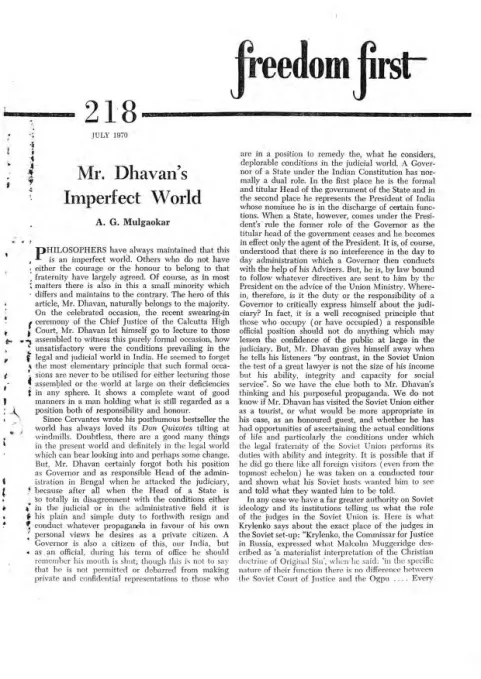
G. A. Abba defends the Bombay High Court’s contempt-of-court conviction of Blitz editor R. K. Karanjia, arguing against the popular narrative that Karanjia was a martyr for press freedom. The article recounts the underlying facts: a reader’s obscenity complaint against a Blitz pin-up photograph, Karanjia’s subsequent article “Whom Will You Fine For Konarak And Khajuharo?” ridiculing the lower judiciary’s handling of that case, and the High Court’s detailed judgment (quoted at length) finding the article a calculated attack on judicial confidence, alongside its rejection of Karanjia’s belated apologies as insincere. Abba concludes that Karanjia’s real strategy — and that of unnamed ‘communist’ interests he associates with such attacks — is to discredit Indian democratic institutions, especially the judiciary and the press, under cover of championing the poor.
- The case originated from a Blitz pin-up photograph (of dancer Pamela Tiffin) that a reader, Abdul Jabbar Taj of Nagpur, successfully had judged obscene by a magistrate; the Sessions Judge later quashed that conviction.
- Editor R. K. Karanjia then published an article attacking the lower judiciary over the case, leading the Nagpur Bench of the Bombay High Court to convict him of contempt of court (15 days’ imprisonment plus a Rs. 2,000 fine, or 15 more days in default).
- The High Court’s judgment (quoted extensively) found the article calculated to shatter public confidence in the impartiality and efficiency of the lower judiciary.
- The Court rejected Karanjia’s three separate apologies as insincere, belated, and motivated by fear of consequences rather than genuine contrition.
- Abba characterizes Karanjia’s pattern as: abuse press freedom, disclaim responsibility, invoke the poor and downtrodden, and play the martyr when consequences arrive.
- The piece links these attacks to a broader alleged communist strategy of discrediting India’s judiciary, press, and democratic institutions, citing the Kerala Chief Minister E.M.S. Namboodiripad’s own contempt conviction as a parallel.
Essay 5
A short unsigned tribute marks the sudden death in Bombay on 5 November of Murarji Vaidya, described as a prominent industrialist with wide-ranging interests in social and political developments, particularly the growth of freedom and democracy, which the tribute frames as his bond with Freedom First.
- Murarji Vaidya, a prominent industrialist, died suddenly in Bombay on 5 November 1968.
- He is remembered for interests spanning social and political developments and particularly the growth of freedom and democracy.
- The tribute frames his death as a loss to the journal and to the democratic movement in the country.
Reorganisation Of Assam
By V. B. Karnik
A boxed notice advertises V. B. Karnik’s book Strikes in India (Rs. 12), published by P. C. Manaktala & Sons Pvt. Ltd., Bombay.
- Announces publication of Strikes in India by V. B. Karnik, priced at Rs. 12.
- Published by P. C. Manaktala & Sons Pvt. Ltd., Fairfield, Churchgate, Bombay.
Terror Under Stalin
By John Gross
No summary was extracted for this article. Listed for completeness.
Freedom Of Press, Uses And Abuses
By G. A. Abba
No summary was extracted for this article. Listed for completeness.
Democracy And Development
By A. A. Deshpande
A. A. Deshpande reports on a six-day international seminar on “Problems of Democracy and Development” held at Coonoor in October 1968, organised jointly by the Indian Liberal Group, the Friedrich-Naumann Foundation of West Germany, and the Leslie Sawhny Programme of Training for Democracy. With 35 participants from 14 countries, including Jo Grimond, Dr. S. Chandrashekhar, and M. R. Masani, the seminar examined the relationship between democratic stability and economic development, concluding that neither is a guarantee of the other but that political instability undermines economic progress, and that developing countries should pursue their own indigenous forms of democracy rather than imported models.
- The seminar was held at Coonoor in October 1968 with 35 participants from 14 countries including India, Ceylon, Indonesia, South Korea, Malaysia, Nepal, Siam, South Vietnam, Belgium, France, Germany, Britain, and Sweden.
- It was jointly organised by the Indian Liberal Group, the Friedrich-Naumann Foundation, and the Leslie Sawhny Programme of Training for Democracy, co-directed by M. R. Masani and Gettfried Wust.
- Notable participants included Jo Grimond (leader of Britain’s Liberal Party), Dr. S. Chandrashekhar (Union Minister of State for Health & Family Planning), and M. R. Masani, M.P.
- The seminar found no short cuts to development and agreed the state’s primary economic function is twofold: a regulatory role and providing infrastructure.
- It concluded that exploitation of ethnic/linguistic/religious divisions and charismatic-leader appeal work against democracy in developing countries.
- Prosperity was found to support political stability, but was not judged a strict precondition (sine qua non) for either democracy or stability, and vice versa.
- The seminar recommended developing countries pursue their own indigenous forms of democracy rather than transplanted models, and cautioned against costly nuclear weapons programmes as a strain on economic stability.
Reviews: Tagore and Communism; Peaceful Coexistence and Intellectual Freedom; Brezhnev Doctrine
By V. K.
The “Reviews” section (initialled V.K.) covers two pamphlets and a news item. It first reviews A. Dasgupta’s Tagore and Communism, which argues communists have selectively misused Rabindranath Tagore’s writings for propaganda while ignoring his criticisms of Soviet censorship and dictatorship, and notes the Soviet government’s non-payment of royalties on Tagore’s books. It then reviews physicist Andrei Sakharov’s pamphlet Peaceful Coexistence and Intellectual Freedom (published in English by Siddharth Publications after underground circulation and a New York Times translation), which pleads for US-Soviet cooperation against the risk of nuclear destruction. A closing unsigned item explains Brezhnev’s newly proclaimed intervention doctrine (used to justify the invasion of Czechoslovakia) as a serious extension of Soviet claims over the internal affairs of socialist states.
- A. Dasgupta’s booklet Tagore and Communism argues communists selectively quote Tagore while ignoring his criticism of Bolshevism, comparing ‘Tsarism and Bolshevism’ as ‘the two sides of the same giant.’
- The review notes the Soviet government has not paid Tagore royalties owed to Vishwabharati.
- Andrei Sakharov’s essay Peaceful Coexistence and Intellectual Freedom, written June 1968 and smuggled out via typed copies before The New York Times published a translation, is reviewed as an appeal for US-Soviet cooperation to avert mutual destruction.
- Sakharov’s essay describes the risk of full-scale nuclear war as involving destruction of cities, poisoning of fields and water, radiation-induced genetic degeneracy, and civilizational collapse.
- The Brezhnev Doctrine item explains the Soviet claim that intervention in a socialist country is justified whenever internal forces threaten to restore capitalism there, framing this as the doctrinal basis for the Czechoslovakia invasion.
- The item speculates the doctrine could eventually be extended to threaten Western interests, citing Germany as an example.
With Many Voices
“With Many Voices” is the issue’s regular closing column of press and public quotations on current events, spanning remarks from Richard Nixon, Andre Malraux, Marshal Tito, and various Indian and international newspapers on themes including communist coalition politics, the Soviet role in Czechoslovakia, and the KGB, alongside a subscription notice for the magazine.
- The column compiles quotations from figures including Richard Nixon, Andre Malraux, and Marshal Josip Broz Tito on politics and civilisation.
- Several quotations from Indian and international press (The Indian Express, Swarajya, The Observer, Amrita Bazar Patrika) comment on Czechoslovakia’s occupation and Congress Party politics in India.
- A quotation from Swiss Press Review and News Report addresses Soviet claims to judge which countries qualify as ‘socialist.’
- A closing item from The Current reports a British airman’s confession of spying for a Russian diplomat, illustrating KGB activity abroad.
- The page includes a subscription coupon addressed to Freedom First, c/o Democratic Research Service, 127 Mahatma Gandhi Road, Bombay.
Generated by the v1.5 extraction pipeline. Awaiting editorial review.
Essay 8
No summary was extracted for this article. Listed for completeness.
Essay 9
No summary was extracted for this article. Listed for completeness.
Metadata and summary are AI-extracted from the source PDF and reviewed for editorial accuracy. The original work is available via the Read PDF tab above (where present); paragraph-level citation inside the PDF is deferred to a future engagement.