periodical issue
Freedom First
By "Atreya", (Contributed), R. Muthuswamy, G. L. M., (unsigned, reprinted from Indian Express), Jai Chinai, N. B. Desai, S. D. J., A. G. Noorani
Edited and published for the Democratic Research Service by V. B. Karnik at 127 Mahatma Gandhi Road, Bombay 1. Printed at Inland Printers, 55 Camdevi Road, Bombay 7. · Bombay · 1969
12 pages
Freedom First
Summary
Freedom First No. 200 (January 1969), the Bombay-based classical-liberal journal edited by V. B. Karnik for the Democratic Research Service, marks its own bicentennial issue with a brief editorial thanking readers, subscribers, and contributors for sixteen years of publication. The issue’s center of gravity is anti-Communist and anti-authoritarian commentary: pieces dissect the splintering of Indian Marxism in Kerala and West Bengal, dismantle the Brezhnev Doctrine of limited sovereignty advanced to justify the invasion of Czechoslovakia, and needle Krishna Menon’s non-alignment record via a review of Michael Brecher’s oral-history volume. Lighter or more miscellaneous items round out the number: a student’s essay on global student unrest, an editorial glossary satirising Communist jargon, readers’ letters on Acharya Rajneesh and the R. K. Karanjia contempt-of-court case, a report on Michael Stewart’s India visit, and the recurring ‘With Many Voices’ page of quoted press opinion.
Key points
-
Marking its 200th issue after sixteen years of publication, the magazine thanks readers and contributors in a brief editorial note.
-
Writing as “Atreya”, “Marxist Contortions in Kerala” traces the fracturing of Kerala’s Communist politics, describing a breakaway “Ultra” faction led by Kunnikal Narayanan, Imbichi Bava and Kosala Ramdas that rejects parliamentary participation and has mounted armed attacks on police stations at Tellicherry and Pulpally.
-
An unsigned piece dismantles the Brezhnev Doctrine of “limited sovereignty” advanced to justify the Czechoslovakia invasion, tracing it to S. Kovalev’s September 1968 Pravda article, and reproduces a protest letter signed by some seventy Marxist philosophers at the Korcula Summer School condemning the occupation.
-
R. Muthuswamy’s “Michael Stewart’s Mission” frames the British Foreign Secretary’s India visit as a fence-mending exercise still inhibited by “ruler-subject” resentments, criticising India’s own inconsistency in condemning Britain over Rhodesia while abstaining on Czechoslovakia.
-
A satirical glossary by “G.L.M.” redefines Communist political vocabulary, glossing “Election” as “Nomination by Party bosses for automatic approval by 99 percent members” and “Non-Alignment” as “Turning a blind eye to Communist aggressions.”
-
A. G. Noorani reviews Michael Brecher’s India and World Politics, built on interviews with V. K. Krishna Menon, which reveals Menon reflexively condemning “American Imperialism” while treating Soviet actions with near-total leniency.
-
Reader letters include N. B. Desai’s warning about the preacher Acharya Rajneesh’s blend of Marxism and religious rhetoric, and S. D. J.’s account of the R. K. Karanjia contempt-of-court case; the issue closes with “With Many Voices” quoting Rajagopalachari calling all factions of Indian Communism “subversionists.”
Essays
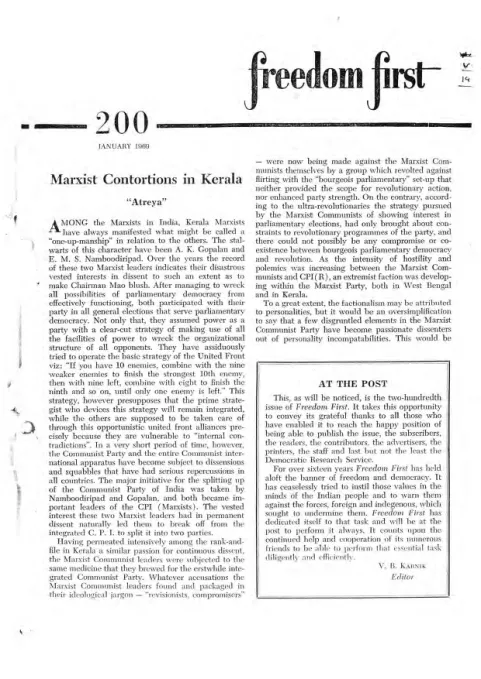
Marxist Contortions in Kerala
By “Atreya”
Writing under the pseudonym “Atreya,” the author traces the fracturing of Communist politics in Kerala, arguing that A. K. Gopalan and E. M. S. Namboodiripad built their careers on factional one-upmanship inherited from the original CPI split, and that this same logic has now turned against them. A breakaway “Ultra” faction led by Kunnikal Narayanan, Imbichi Bava, and Kosala Ramdas has rejected parliamentary participation, staged strikes at the Idikki power project, and mounted armed attacks on police stations at Tellicherry and Pulpally, forcing the ruling Marxist Communists into a difficult position between Right Communist pressure to develop the state and Ultra pressure to stay revolutionary.
- Kerala’s Marxist Communists (E.M.S. Namboodiripad and A.K. Gopalan) are accused of having built their power through opportunistic ‘united front’ tactics that are now being turned against them by their own dissidents.
- A breakaway ‘Ultra’ faction (Kunnikal Narayanan, Imbichi Bava, Kosala Ramdas) rejects parliamentary democracy as compatible with revolution and has resigned Assembly seats.
- The Ultras are linked to strikes at the Idikki Power Project and armed attacks/terrorism at Tellicherry and Pulpally.
- Industries Minister T.V. Thomas’s move to bring in G.D. Birla for a sick textile mill is cited as evidence of Right Communist pressure on the Marxist leadership.
- The article frames Kerala’s Marxist Communists as squeezed between Ultra-revolutionary terror on one side and Right Communist developmentalism on the other, with the ruling party’s survival in doubt.
Russian Doctrine Of Intervention
By (Contributed)
This contributed, unsigned piece analyses the doctrine of ‘limited sovereignty’ articulated by Brezhnev at the November 1968 Polish Communists’ Congress to retroactively justify the Warsaw Pact invasion of Czechoslovakia. It traces the thesis to S. Kovalev’s Pravda article of September 1968 and argues that Moscow has abandoned even the pretense that Czechoslovak leaders ‘invited’ intervention, instead asserting a class-based right to police any socialist state’s internal politics. The piece also reproduces, in full, a protest letter signed by roughly seventy Eastern and Western Marxist and left-wing philosophers (including Ernst Bloch, Herbert Marcuse, and Lucian Goldman) at the August 1968 Korcula Summer School symposium in Yugoslavia, condemning the occupation as an unjustifiable blow to world socialism and peaceful coexistence.
- Brezhnev’s speech at the Polish Communists’ Fifth Congress (November 1968) confirmed Russia’s claimed right to intervene in any socialist state facing an internal or external ‘threat to socialism.’
- The doctrine originated in S. Kovalev’s Pravda article of 26 September 1968, written primarily as retrospective justification for the Czechoslovak invasion.
- The piece argues Brezhnev’s formulation subordinates legal norms and national sovereignty to ‘the laws of class struggle,’ a marked departure from prior Soviet rhetoric of strict non-interference.
- It notes the contradiction between Brezhnev’s claims and Gromyko’s own statement in New York that the ‘Socialist commonwealth’ has no geographical limits.
- A separate protest letter signed by about 70 Eastern and Western Marxist philosophers at the Korcula Summer School (14-24 August 1968) calls the occupation of Czechoslovakia an illegal act with no justification, warning it will aid anti-socialist forces and complicate opposition to ‘American aggression in Vietnam.‘
Michael Stewart’s Mission
By R. Muthuswamy
R. Muthuswamy reports on British Foreign Secretary Michael Stewart’s visit to India for bilateral talks, framing it as a fence-mending mission twenty-one years after independence. The piece argues that Indo-British relations remain distorted by leftover ruler-subject resentment, cites lingering Indian grievances over Britain’s stance in the 1965 Indo-Pakistani war and its sanctions-only approach to Rhodesia, and criticises India’s own moral inconsistency in condemning Britain over Rhodesia while abstaining on a UN resolution condemning the Soviet invasion of Czechoslovakia.
- Michael Stewart’s visit is presented as part of a broader series of bilateral talks India has held with other countries, including Russia and the USA.
- The article argues Indo-British relations are still inhibited by ‘ruler-subject’ era resentments 21 years after independence.
- It recalls unresolved Indian grievances against Britain from the 1965 Indo-Pakistani war and contrasts this with Britain’s economic-sanctions-only approach to Rhodesia.
- The author criticises India’s moral inconsistency: vocal condemnation of Britain over Rhodesia, but a soft-pedalled, abstaining response to the Soviet invasion of Czechoslovakia.
- The visit produced little substantive progress beyond an agreement to refer the ‘India Library’ question to arbitration.
Marxist Terms Re-Explained
By G. L. M.
A satirical glossary by ‘G.L.M.’ redefines standard Communist political vocabulary — ‘Co-Existence,’ ‘Democracy,’ ‘Dictatorship of the Proletariat,’ ‘Election,’ ‘Non-Alignment,’ ‘Parliament,’ and similar terms — as euphemisms for one-party control, propaganda, and Soviet or Chinese domination, in the tradition of an Ambrose Bierce-style Devil’s Dictionary.
- The piece defines ‘Election’ as ‘Nomination by Party bosses for automatic approval by 99 percent members.’
- ‘Dictatorship of the Proletariat’ is glossed as ‘Benevolent rule by a coterie or a dictator not responsible to nor removable by the people.’
- ‘Non-Alignment’ is defined as ‘Turning a blind eye to Communist aggressions while castigating Western ones.’
- ‘Imperialist’ is defined relativistically as whichever power stands in the way of Soviet or Chinese domination ambitions.
Mao Society as Russians see it
By -Indian Express (reprint)
A short reprint from the Indian Express summarises a profile, published in the Soviet Communist Party’s theoretical organ Kommunist, of what a Maoist-modeled society would look like: an economy of enforced, army-organised labour battalions geared entirely to state military potential, an enforced levelling of social classes, and a total subordination of individual personality and national or world culture to state ideology and enforced self-denial.
- The source is Kommunist, the theoretical organ of the Soviet Communist Party, profiling a Maoist social model.
- The imagined society organises labour into army-style battalions and regiments, limiting consumption to ‘basic needs.’
- All resources are concentrated on building the state’s military potential.
- Individual personality is reduced to ‘a cog in the State machine,’ with national and world culture rejected in favour of enforced ideological self-denial.
Student Unrest—A Point Of View
By Jai Chinai
In a student-contributed op-ed (with an editorial note inviting reader responses), Jai Chinai argues that stereotyped explanations for global student unrest — generation gap, frustration, loss of religious authority — miss the real story: that for the first time in history youth constitutes a globally unified, better-informed, communicatively connected bloc with its own agenda. The author contrasts constructive Western student movements (aligned with socialist or liberalisation causes) with what he characterises as directionless Indian student vandalism, and argues responsibility for the unrest is diffuse across all of Indian society, not just students, with self-discipline as the only real remedy.
- The author rejects generation-gap and frustration explanations for student unrest as stereotypes that obscure a genuine new phenomenon.
- For the first time, ‘the Student’ has become synonymous with ‘the young generation’ as a globally unified, better-communicating bloc.
- Western student unrest (France’s socialist movement, US/UK counterculture, Czechoslovak liberalisation) is portrayed as having discernible, even noble, goals.
- Indian student unrest, by contrast, is characterised as vandalism, arson, and violence directed at teachers with no constructive goal.
- Responsibility for the broader unrest across Indian society (labourers, politicians, businessmen, etc.) is diffuse, and self-discipline plus better parenting/teaching are proposed as the only remedies.
Letters to the Editor: A New Preacher
By N. B. Desai
In the ‘Letters to the Editor’ column, N. B. Desai writes from Bombay to warn readers about Acharya Rajneesh, a charismatic new preacher drawing large Bombay crowds with a philosophy Desai summarises as ‘Marxism plus God’ — a call for revolution and, if necessary, a fifty-year dictatorship, delivered by a man who denounces India’s fatalism, its obsession with a lost past, and its acceptance of poverty, while quoting the Gita, the Bible, the Koran, Confucius, and Nietzsche. Desai suggests Rajneesh may be using religious rhetoric as a convenient front for a Marxist agenda and urges that he be watched.
- Acharya Rajneesh addressed large crowds at Bombay’s Cross Maidan on the theme ‘India and My Anxiety.’
- Desai summarises Rajneesh’s four core arguments: belief in destiny/rebirth has crippled Indian society; excessive reverence for the past prevents progress; fear of death produces a complacent ‘philosophy of poverty’; and India has surrendered joy and a sense of future.
- Rajneesh reportedly argues revolution is necessary, that democratic means cannot achieve it, and that a fifty-year dictatorship may be required.
- Desai frames Rajneesh’s blend of Marxism and God-talk as an ideological paradox and questions whether the religious framing is a convenient pretext for Marxist propagandising.
Letters to the Editor: A Brave Journalist!
By S. D. J.
A second letter, signed ‘S.D.J.,’ congratulates Freedom First for exposing facts in the R. K. Karanjia contempt-of-court case, focusing on the editor’s refusal (defended in the Supreme Court by counsel M. C. Chagla) to name a supposed ‘judicial friend’ who allegedly questioned a Magistrate’s judgment reproduced in Blitz. The writer notes the Court’s own scepticism about whether such a source existed at all, and draws a parallel to the separate Thackersey case, where the same editor is said to have attributed damaging remarks to named public figures who were either dead or unavailable to confirm them, accusing the editor of a pattern of unverifiable sourcing dressed up as principled journalism.
- The letter concerns R. K. Karanjia’s (unnamed but clearly identified via ‘Shri Karanjia’ and ‘Blitz’) refusal to disclose the identity of a ‘judicial friend’ cited in a contested article about a Magistrate’s judgment.
- Counsel M. C. Chagla argued in the Supreme Court that the editor’s non-disclosure upheld ‘the best traditions of journalism.’
- The Court itself expressed doubt whether such a letter-writer or ‘judicial friend’ existed at all.
- The writer alleges a similar pattern in the Thackersey case, where the editor attributed damaging quotes to public figures who were dead or unavailable for confirmation.
Menon And Menonism
By A. G. Noorani
A. G. Noorani reviews Michael Brecher’s India and World Politics (Oxford University Press), a transcript-based study built on seventeen hours of taped interviews with V. K. Krishna Menon. Noorani argues the book’s chief value lies not in Brecher’s ‘jargon-ridden’ analytical chapter but in the raw record of Menon’s own words, which reveal a man who reflexively distinguishes ‘American Imperialism’ as the world’s pre-eminent evil while treating Soviet actions with near-total leniency, defends his own dominance over Nehru-era foreign policy (including the 1962 Goa operation and the UN handling of Korea and Hungary), and admits, near the end of his account, one moment of self-reproach toward Nehru.
- The book is based on seventeen taped hours of interviews with Krishna Menon, edited down by Menon himself, plus a roughly forty-page analytical chapter by Brecher.
- Noorani highlights Menon’s admission that he insisted India water down its stance on Hungary at the UN and that he personally set India’s approach to the Korean resolution.
- Brecher’s own conclusion is quoted at length: Menon treats the US and USSR as equally powerful but morally unequal, reserving ‘unquestionable’ evil status for ‘American Imperialism’ while criticism of the Soviets is ‘rare and invariably mild.’
- Menon reveals he was never told about Nehru’s mediation feelers involving B. Shiva Rao regarding Chinese suzerainty over Tibet in exchange for border recognition, though Shiva Rao had disclosed this as early as 1963.
- Menon at one point recalls confessing to Nehru that he regretted not standing up to him more, and Nehru’s atypically warm reply.
- Noorani concludes that Menon’s ‘Image’ of world politics shaped Indian foreign policy significantly across the 1952-1962 decade.
With Many Voices
The issue’s recurring ‘With Many Voices’ page collects short quotations from the contemporary press and public figures on the Soviet invasion of Czechoslovakia, Indian politics, and Cold War alignment, framed by an epigraph from Tennyson. Quoted voices include Zbigniew Brzezinski, Morarji Desai, C. Rajagopalachari, K. Subba Rao, Dayanand Bandodkar, M. Ananthasayanam Ayyangar, and the Russian poet Evgeny Evtushenko (as reported by novelist Frank Hardy), alongside a subscription coupon and the issue’s printer/publisher colophon naming V. B. Karnik as editor.
- The page collects short press and public-figure quotations dated December 1968, mostly concerning the Soviet invasion of Czechoslovakia and its geopolitical fallout.
- C. Rajagopalachari is quoted from Swarajya calling all factions of Indian Communism ‘subversionists’ regardless of their internal splits.
- Evgeny Evtushenko is quoted (via Frank Hardy in Time) protesting that he wrote to his government opposing the Czechoslovakia action and was branded an enemy of the state.
- The page ends with a subscriber coupon (annual subscription Rs. 5.00) and the printer’s colophon: printed at Inland Printers, Bombay, and edited/published for the Democratic Research Service by V. B. Karnik.
Generated by the v1.5 extraction pipeline. Awaiting editorial review.
Metadata and summary are AI-extracted from the source PDF and reviewed for editorial accuracy. The original work is available via the Read PDF tab above (where present); paragraph-level citation inside the PDF is deferred to a future engagement.