periodical issue
Freedom First
By M. R. Pai
Edited and published for the Democratic Research Service by V. B. Karnik at 127 Mahatma Gandhi Road, Bombay 1, and printed by him at Inland Printers, 55 Gamdevi Road, Bombay 7. · Bombay · 1969
12 pages
Freedom First
Summary
Issue 211 of Freedom First (December 1969) is dominated by the crisis that split the Indian National Congress that year. Four separate commentaries — by Adam Adil, M. R. Pai, the pseudonymous “Atreya”, and the unsigned house line in “With Many Voices” — dissect the Congress split between the “Syndicate” (Nijalingappa, Morarji Desai, Kamaraj, S. K. Patil) and Indira Gandhi’s “Indicate” faction, triggered by the contested presidential nomination of V. V. Giri over Sanjiva Reddy and by Mrs. Gandhi’s dismissal of Morarji Desai and subsequent bank nationalisation. Alongside the domestic political crisis, the issue carries pieces on West German politics after Willy Brandt’s election (Arvind A. Deshpande), a parallel drawn between Indira Gandhi and Ceylon’s Sirima Bandaranaike, a first-person account of an Indian scholar’s imprisonment in Poland, V. B. Karnik’s review-essay of Victor Fic’s book on Indian communist tactics, three further book reviews, a reader’s letter on literacy and franchise, and a closing page of press-quote excerpts (“With Many Voices”).
Key points
-
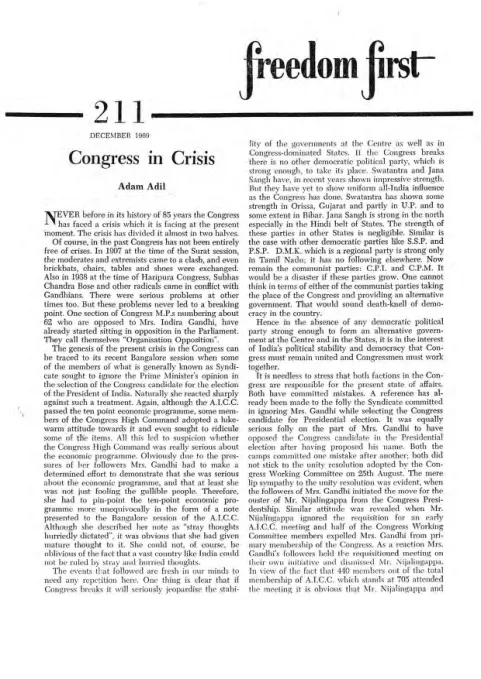
Adam Adil’s “Congress in Crisis” frames the 1969 Congress split as the worst crisis in the party’s 85-year history, tracing it from the Bangalore AICC session through Mrs Gandhi’s expulsion from primary membership and the retaliatory dismissal of Nijalingappa.
-
M. R. Pai’s “Prime Minister And The Party” argues the Syndicate-Indicate struggle pits two obsolescent political forces against each other and that India’s Constitution, not Congress’s dominance, is the real guarantor of democratic stability.
-
Writing under the pseudonym “Atreya,” an essay accuses Indira Gandhi of using power and patronage to smash the Congress party while borrowing Leninist/Stalinist tactics, including a fabricated “Zinoviev letter”-style scandal against C. Subramaniam, Chavan and Sukhadia.
-
Arvind A. Deshpande’s “The German Miracle” frames Willy Brandt’s Social Democrat-Free Democrat coalition victory as a hopeful shift comparable to Kennedy’s “New Frontier,” rooted in German self-confidence rather than anti-Americanism.
-
An unsigned feature recounts the ordeal of Sukumar Bose, a Bengali student imprisoned in Poland after the Warsaw Pact invasion of Czechoslovakia for writing a satire critical of Polish subservience to Moscow.
-
V. B. Karnik reviews Victor Fic’s Peaceful Transition to Communism in India, tracing CPI tactics from the 1948 Ranadive line of armed revolt to the 1958 Amritsar congress’s “peaceful transition” doctrine, and warning that secret directives reveal more revolutionary intent than public declarations.
-
Book reviews cover S. P. Sathe on the Golak Nath fundamental-rights debate and Kuldip Nayar’s Between the Lines, and a reader’s letter from E. P. Vargese proposes basing India’s franchise on a literacy qualification.
Essays
Congress in Crisis
By Adam Adil
Adam Adil’s lead editorial-style article surveys the unprecedented crisis facing the 85-year-old Congress party, tracing it from the Bangalore AICC session where the “Syndicate” tried to overrule Indira Gandhi on the presidential candidate, through her ten-point economic programme, the expulsion of Mrs. Gandhi from primary membership by Working Committee members, and the retaliatory dismissal of Nijalingappa by her own followers. The author argues both camps share blame for breaking the unity resolution of 25 August, warns that a Congress split would jeopardise governmental stability since no other party (Swatantra, Jana Sangh, DMK, communists) has uniform all-India strength, and concludes that Congressmen of both factions must cooperate with the Prime Minister to keep the party — and, implicitly, democratic stability — intact.
- Frames the 1969 split as the worst crisis in Congress’s 85-year history, worse than the 1907 Surat session or 1938 Haripura conflict.
- Traces the immediate trigger to the Bangalore AICC session and the Syndicate’s attempt to override Indira Gandhi on the presidential nomination.
- Notes 62 Congress MPs opposed to Mrs Gandhi formed an ‘Organisation Opposition’ bloc in Parliament.
- Argues no single opposition party (Swatantra, Jana Sangh, DMK, communists) has the all-India reach to replace a collapsed Congress.
- Assigns blame to both factions for abandoning the 25 August unity resolution.
- Calls for Syndicate Congressmen to cooperate with Mrs Gandhi’s economic reforms in the national interest, given the alternative is anarchy.
Reconstruction Of Indian Politics
By M. R. Pai
An unsigned short news feature recounts the ordeal of Sukumar Bose, a Bengali student who studied in Poland from 1955, married a Polish woman, and was arrested by the Polish Security Service in November 1968 after the Warsaw Pact invasion of Czechoslovakia. Bose was tried and convicted for writing a satire critical of the Polish government’s subservience to Moscow and its anti-Semitic policies, sentenced to three years, but was later pardoned after Indian Embassy intervention and deported alone, separated from his wife and son.
- Sukumar Bose went to Poland in 1955 on a Polish government scholarship to study Polish philology at the University of Lodz.
- He married Irena Bronska, a fellow student, in 1958 and took a job as a technical translator.
- Arrested by the Polish Security Service (Sluzba Bezpieczenstwa) in November 1968 following the Czechoslovakia invasion.
- Charged with writing a satire for a foreign radio station accusing the Polish government of being a Soviet puppet and of anti-Semitic policy.
- Convicted and sentenced to three years, but pardoned after Indian Embassy intervention and deported alone, without his wife and son.
Prime Minister And The Party
By M. R. Pai
M. R. Pai argues that Indian politics is undergoing a healthy “reconstruction” as the Congress party’s near-monopoly on power breaks down. He casts the Syndicate versus “Indicate” struggle as a contest between two obsolescent political forces — the Syndicate outdated politically, and the Indicate (an amalgam of communist-leaning figures around Indira Gandhi) hostile to national interests and drifting toward Soviet alignment in foreign policy. Pai rejects fears that a Congress collapse would produce instability or communist takeover, arguing India’s constitutional framework, not Congress’s dominance, is the real guarantor of democratic stability, and that a period of coalition politics — as in many Continental democracies — is a natural and ultimately healthy outcome for India’s pluralistic, continental-scale society.
- Frames the Syndicate/Indicate conflict via the analogy of the internecine destruction of the Yadavas after Krishna’s departure.
- Argues Congress had, since Independence, wrongly monopolised credit for the entire freedom movement, erasing figures like Subhas Chandra Bose from public memory.
- Identifies two harmful monopolies: government control of money supply (leading to inflation and corruption) and Congress’s political monopoly, now broken.
- Criticises Mrs Gandhi’s government and advisers (naming Dinesh Singh, All-India Radio under Inder Gujral) for pro-Soviet foreign policy tilt, including on the Indian Ocean, Andamans naval facilities, and an embassy at Hanoi.
- Rejects the two main fears about Congress’s disintegration — central instability and communist takeover — arguing the Constitution, not Congress, is the bastion of stability.
- Concludes India is moving toward coalition governance similar to Continental European democracies, which will teach Indian politicians humility.
The German Miracle
By Arvind A. Deshpande
Writing under the pseudonym “Atreya”, the author delivers a sharply polemical attack on Indira Gandhi, accusing her of deliberately using her power as Prime Minister to wreck and fragment the Indian National Congress while coining terms like “Bossism” and “Syndicate” to smear her opponents. The piece narrates the dismissal of Morarji Desai as Deputy Prime Minister, the sidelining of Sanjiva Reddy in the presidential contest in favour of V. V. Giri, the expulsion of Mrs Gandhi from primary Congress membership and the countering dismissal of Nijalingappa, and accuses her of borrowing Leninist/Stalinist tactics (invoking a fabricated “Zinoviev letter”-style scandal against C. Subramaniam, Chavan and Sukhadia). It ends by arguing that Mrs Gandhi’s own group of conformists and sycophants constitutes the “real syndicate,” ironically vindicating the very charge she levelled at her opponents.
- Accuses Mrs Gandhi of using power and patronage to smash the Congress party while deploying propaganda terms like ‘Bossism’ and ‘Syndicate’.
- Recounts the dismissal of Morarji Desai as Deputy PM and the installation of V. V. Giri over Sanjiva Reddy as the party’s presidential nominee.
- Describes the expulsion of Mrs Gandhi from primary Congress membership by the Working Committee and the retaliatory dismissal of Nijalingappa by her followers.
- Alleges the Prime Minister’s camp fabricated a ‘Zinoviev Letters’-style phantom scandal to trap C. Subramaniam, Chavan, and Sukhadia into her syndicate.
- Cites Mrs Gandhi’s interview to the Italian Communist Party journal L’Unita describing the struggle as between ‘socialism and conservative forces’.
- Concludes that Mrs Gandhi’s own following of ‘total conformists and sycophants’ is the real syndicate and real bossism.
Parallel From Ceylon
Arvind A. Deshpande writes on the political significance of Willy Brandt’s Social Democrats and the Free Democrats winning power in West Germany, ending the era of Konrad Adenauer-style Christian Democratic rule. He frames Brandt’s coalition as a hopeful, youthful shift comparable to the enthusiasm generated by John F. Kennedy’s ‘New Frontier’, discusses Brandt’s Ostpolitik outreach to Eastern Europe and the Soviet bloc as a genuine expression of German self-confidence rather than anti-Americanism, and expresses hope that eventual German reunification and detente will strengthen democracy and freedom across Europe.
- Describes the Social Democrat–Free Democrat coalition victory as a ‘political miracle’ ending the long Christian Democrat/Adenauer era.
- Compares the popular enthusiasm for Brandt’s ‘New Germany’ to that generated by John Kennedy’s ‘New Frontiersmen’.
- Frames Brandt’s detente overtures to Eastern Europe as rooted in new German self-confidence, not anti-Americanism or pro-Communism.
- Notes Poland’s cautiously positive response to Brandt’s overtures despite having suffered most under Nazi occupation.
- Predicts eventual German reunification, though the timeline and mechanism (e.g. West Berlin’s status) remain uncertain.
Peaceful Transition To Communism? (book review)
By V. B. Karnik
A short unsigned piece, reprinted from the Swiss Press Review and News Report, discusses Sirima Bandaranaike’s article drawing a parallel between her own fall from power in Ceylon and Indira Gandhi’s current political troubles in India. It recounts how Bandaranaike’s 1964 coalition with the Trotskyist Lanka Samajist Party (LSSP) and the appointment of N. M. Perera as Finance Minister initially generated euphoria, but Perera’s doctrinaire anti-private-enterprise budget alienated business and the public, contributing to her defeat in the 1965 general election.
- Bandaranaike wrote ‘Indira has to keep vigil on the Frontiers of Freedom’ in the Ceylon Daily News, timed ahead of Ceylon’s next general election.
- Draws a parallel between her own 1964 coalition experiment and Indira Gandhi’s alliance with the left in India.
- Recounts how N. M. Perera’s 1965 budget’s anti-private-enterprise provisions disillusioned business and public opinion.
- Cites the Ceylon Daily News’s 1965 verdict that the ‘greatest single factor’ in her defeat was fear that Marxist colleagues would swallow the SFLP and the country.
peaceful transition
By V. B. Karnik reviews Victor M. Fic
V. B. Karnik reviews Victor M. Fic’s book Peaceful Transition to Communism in India (Nachiketa Publications), which documents the Communist Party of India’s published tactical declarations from 1951 to the 1958 Amritsar congress, where the party formally adopted the doctrine of ‘peaceful transition’ to communism after abandoning the 1948 Ranadive line of armed revolt. Karnik praises the book’s value as a documentary reference but criticises its reliance solely on published declarations, arguing that secret directives — such as the ‘tactical line’ document behind the 1953 Madurai Congress resolution — reveal a different, more revolutionary intent than the public statements suggest. He highlights the book’s demonstration of the CPI’s continued subservience to Moscow and warns Indian ministers who receive lavish Soviet hospitality to heed Fic’s observation that Soviet and Chinese theorists view India’s rulers merely as temporary allies to be discarded once useful.
- Reviews Victor M. Fic’s ‘Peaceful Transition to Communism in India’ (Nachiketa Publications, Rs. 50).
- Traces CPI tactics from the 1948 Ranadive line of armed revolt, abandoned in 1951 on Rajani Palme Dutt’s advice, to the 1958 Amritsar congress’s adoption of ‘peaceful transition’.
- Criticises the book for relying only on published declarations, missing the ‘submerged part of the iceberg’ of secret directives, citing the 1953 Madurai Congress resolution as an example of publicly innocuous language masking a secret ‘tactical line’ from Moscow.
- Quotes the 1957 Declaration and 1960 Statement’s language urging Communists to transform Parliament into ‘an instrument serving the working people’ and to prepare for non-parliamentary mass struggle.
- Warns that what is happening in Bengal and Kerala faithfully implements this ‘peaceful transition’ doctrine’s real meaning.
- Cites Fic’s warning that Soviet and Chinese theorists view Indian rulers as temporary allies whose usefulness to Kremlin strategy will eventually be exhausted.
Reviews: Fundamental Rights and Amendment of the Indian Constitution (S. P. Sathe)
By M. B. Shah
The ‘Reviews’ section carries three book notices: M. B. Shah reviews S. P. Sathe’s monograph ‘Fundamental Rights and Amendment of the Indian Constitution’, which examines the Golak Nath v. State of Punjab ruling and the debate over Parliament’s power to abridge Fundamental Rights, concluding the Supreme Court’s assertive role is needed given Congress’s declining hold. K.V.B. reviews ‘The Strategy of Food and Agriculture in India’ (ed. V. R. Mutalik Desai), a multi-author essay collection on India’s food and agricultural problems that the reviewer finds informative but lacking in prescriptive strategy. N.D. reviews Kuldip Nayar’s ‘Between the Lines’, an insider account of Indian political decision-making from Nehru’s death through the language controversy, devaluation, and the Chinese invasion.
- M. B. Shah reviews S. P. Sathe’s constitutional law monograph, discussing Golak Nath v. State of Punjab (1967) and the Fundamental Rights amendment debate, noting Congress, PSP, and CPI support Nath Pai’s amending bill while Swatantra and Jana Sangh oppose it.
- Shah notes Sathe argues constitutional amendment limits on Fundamental Rights are a matter of political morality resting on public vigilance, not judicial sanction alone.
- K.V.B. reviews ‘The Strategy of Food and Agriculture in India’, edited by V. R. Mutalik Desai, an essay collection covering food problems, land reform, irrigation, marketing, and agricultural research.
- K.V.B. criticises the food/agriculture volume for not proposing a strategy or assessing ‘green revolution’ prospects, despite Dr Mutalik Desai’s conclusion on India’s lack of a national food policy.
- N.D. reviews Kuldip Nayar’s ‘Between the Lines’, praising its inside view of decisions from Nehru’s death to the Chinese invasion, including the language controversy and devaluation.
Reviews: The Strategy of Food and Agriculture in India (ed. V. R. Mutalik Desai)
By K.V.B.
A reader’s letter to the editor from E. P. Vargese, an advocate in Ernakulam, argues that India’s adoption of universal adult franchise in 1950 (when literacy stood at only 14 percent) was a hazardous experiment whose risks have since been proven. Noting literacy has since risen to only 35 percent, with roughly 350 million illiterate people vulnerable to propaganda, the writer proposes basing the franchise on a literacy qualification to stabilise political thought and safeguard parliamentary democracy.
- Argues that introducing adult franchise in India at 14 percent literacy was a hazardous experiment whose risks are now evident.
- States literacy has risen to only 35 percent since Independence, meaning nearly 350 million people remain illiterate and vulnerable to propaganda.
- Notes the annual literacy growth rate has been only about 1 percent, which the writer calls unsatisfactory.
- Proposes basing the franchise on a literacy qualification instead of age alone, to incentivise literacy and stabilise democracy.
Reviews: Between the Lines (Kuldip Nayar)
By N.D.
No summary was extracted for this article. Listed for completeness.
Letter to the Editor: Literacy and Franchise
By E. P. Vargese
The closing page, ‘With Many Voices’ (its title drawn from a Tennyson epigraph), compiles short excerpts from contemporary Indian and international press commentary on the political turmoil of November 1969 — covering unrest in West Bengal, the Congress split, Willy Brandt’s remarks, Solzhenitsyn’s expulsion from the Soviet Writers’ Union, and assessments of Indira Gandhi’s political standing — from sources including the Indian Express, Economic Times, Statesman, Times of India, and the Observer (London). The page also carries the magazine’s subscription form and its colophon, confirming the issue was edited and published for the Democratic Research Service by V. B. Karnik at 127 Mahatma Gandhi Road, Bombay 1, and printed at Inland Printers, Bombay.
- Compiles dated press quotations from mid-to-late November 1969 on the Congress crisis, West Bengal unrest, and international affairs.
- Includes commentary from Ajoy Mukherjee (West Bengal Chief Minister), Willy Brandt, Svetlana Allilueva, and multiple Indian newspapers (Indian Express, Economic Times, Statesman, Times of India).
- Notes the expulsion of Alexander Solzhenitsyn from the Soviet Union of Writers, described by the London Observer as ‘sinister and farcical’.
- Carries the magazine’s annual subscription form (Rs. 5.00) addressed to Freedom First, c/o Democratic Research Service, Bombay.
- Confirms the colophon: edited and published for the Democratic Research Service by V. B. Karnik at 127 Mahatma Gandhi Road, Bombay 1, printed at Inland Printers, 55 Gamdevi Road, Bombay 7.
Generated by the v1.5 extraction pipeline. Awaiting editorial review.
Metadata and summary are AI-extracted from the source PDF and reviewed for editorial accuracy. The original work is available via the Read PDF tab above (where present); paragraph-level citation inside the PDF is deferred to a future engagement.