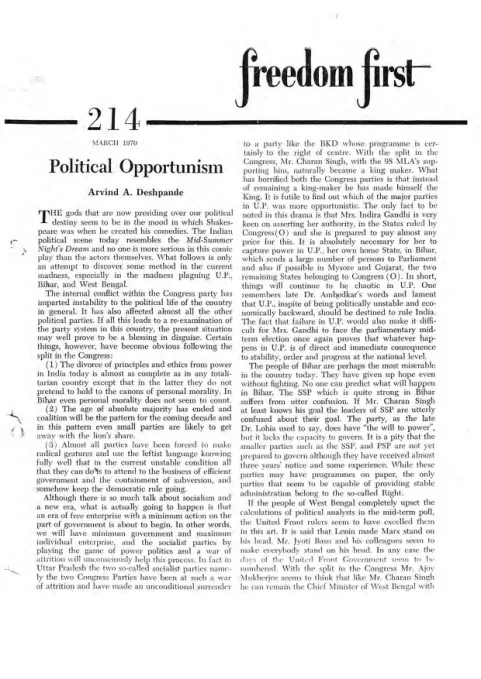
periodical issue
Freedom First
By M. R. Pai
Edited and published for the Democratic Research Service by V. B. Karnik at 127 Mahatma Gandhi Road, Bombay 1, and printed by him at Inland Printers, 55 Gamdevi Road, Bombay 7. · Bombay · 1970
12 pages
Freedom First
Summary
Issue 213 of Freedom First (February 1970) opens with V. B. Karnik’s editorial-style essay “Rational Politics”, which indicts both the ruling Congress and the opposition extremes (Jana Sangh and CPM) for irrational, power-seeking politics and calls for a climate of rational, goal-directed policy-making. The rest of the issue is dominated by the fallout of 1969: M. R. Pai’s four-point case against socialism, an unsigned report on the Home Ministry’s dramatised warning about organised rural violence (“The Anatomy Of Rural Violence”), R. Muthuswamy’s post-mortem of the 48-day Jamshedpur strike and its lessons for trade-union recognition law, an unsigned “Bengal Report” on Chief Minister Ajoy Mukherjee’s open confrontation with the CPM within West Bengal’s United Front government, and Brian Crozier’s survey essay on the intellectual roots of the Western “New Left” (Guevara, Debray, Fanon, Marcuse). Shorter items cover the Leslie Sawhny Programme’s 1969 training-and-seminar activities (“Training For Democracy”), a wry “Without Comment” note on the Sino-Soviet propaganda war, two book notices, and the recurring “With Many Voices” page of press-quote excerpts.
Key points
-
V. B. Karnik’s “Rational Politics” blames both the Congress leadership and the Jana Sangh and CPM as the two “irrational” destructive poles of Indian politics, calling for policy built on well-defined, attainable goals.
-
M. R. Pai’s “Why I Oppose Socialism” lays out a four-part case that socialism cannot cure poverty, destroys liberties, produces inequality between rulers and ruled, and introduces class warfare, citing the collapse of small banks after 1969 nationalisation.
-
Writing as “Atreya,” “The Anatomy Of Rural Violence” argues the Home Ministry’s dramatic warning about rural violence is “artificially inspired,” tracing engineered unrest to Naxalite and CPM strategy rooted in a 1949 Cominform directive.
-
R. Muthuswamy’s “Jamshedpur Strike-Lessons” analyses a 48-day strike across seven Tata-linked industrial units, arguing India’s low union-recognition threshold of 15% membership leaves no union commanding enough support to deliver on agreements, and calls for statutory majority-union recognition.
-
Writing as “Analyst,” a “Bengal Report” describes Chief Minister Ajoy Mukherjee’s December hunger-strike and subsequent assertion of administrative authority against the CPM’s control of the Home portfolio.
-
Brian Crozier’s “The New Left” surveys Che Guevara, Regis Debray, Frantz Fanon and Herbert Marcuse as the intellectual figures behind a fragmented but dangerous Western revolutionary movement.
-
The issue also reports on the Leslie Sawhny Programme’s 1969 training activities and closes with “With Many Voices,” quoting N. A. Palkhivala calling socialism “the opiate of the people.”
Essays
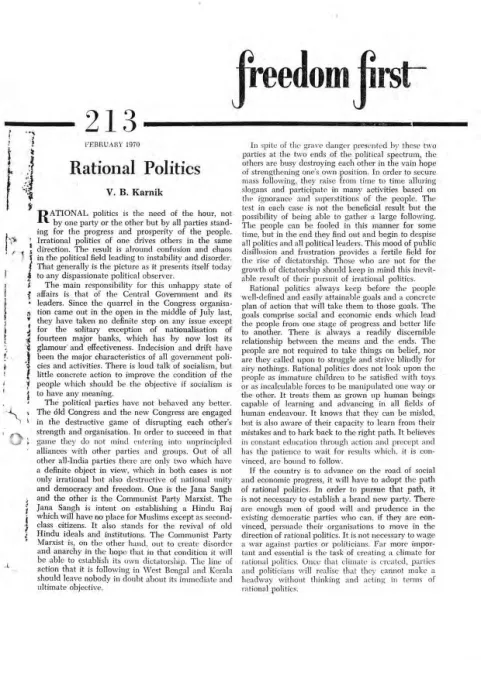
Rational Politics
By V. B. Karnik
V. B. Karnik’s lead essay argues that India’s political crisis stems from irrational politics practised by the ruling Congress and by opposition parties alike. He blames the Central Government and Congress leadership for drift and indecision since the party’s mid-1969 split, notes the sole concrete action taken was the nationalisation of fourteen major banks, and singles out the Jana Sangh and the Communist Party Marxist as the two ‘irrational’ and destructive poles of the spectrum — one pursuing a Hindu Raj hostile to Muslims, the other fomenting disorder in West Bengal and Kerala in pursuit of dictatorship. He contrasts this with a ‘rational politics’ that sets well-defined, attainable social and economic goals with a clear means-ends relationship, and argues this shift does not require a new party but a changed climate of opinion among existing democratic parties.
- Blames the Central Government and Congress leadership for indecision and drift since the July 1969 party split.
- Notes bank nationalisation (fourteen major banks) as the sole definite government action taken, and says it had already lost its ‘glamour and effectiveness’.
- Identifies the Jana Sangh (Hindu Raj, anti-Muslim) and the Communist Party Marxist (insurrectionary disorder in West Bengal and Kerala) as the two destructive extremes of Indian politics.
- Warns that public disillusion with irrational politics creates fertile ground for dictatorship.
- Defines ‘rational politics’ as policy built on well-defined, attainable goals with a clear, honest relationship between means and ends.
- Argues achieving this does not require a new party, only a changed climate that persuades existing parties and politicians to act rationally.
Training For Democracy (from a Correspondent)
An unsigned correspondent’s report on the Leslie Sawhny Programme of Training for Democracy’s activities during 1969: twenty-two training courses and high-level seminars involving over six hundred participants across several states, plus three high-level seminars organised jointly with the Friedrich-Naumann-Stiftung of West Germany on competitive enterprise, modernisation of the Indian social structure, and foreign investment and aid. The piece lists discussion leaders and participants at each seminar and notes broad agreement on the positive role of competitive enterprise, the limits of legislation as a tool of social change, and the value (used cautiously) of foreign aid and investment. It closes by describing a follow-up Bombay meeting on corporate ‘Social Responsibilities of Business’, including a model Statement of Objectives and proposals for a periodic ‘social audit’ of companies.
- The Leslie Sawhny Programme ran twenty-two training courses and seminars in 1969 for over 600 public men, industrialists, executives, political and social workers.
- Three high-level seminars were held jointly with the Friedrich-Naumann-Stiftung (West Germany): on competitive enterprise (Calcutta), modernisation of Indian social structure (Delhi), and foreign investment and aid (Madras).
- Discussion leaders/participants named include Mr. M. R. Masani, Dr. R. C. Cooper, Prof. B. R. Shenoy, Mr. M. R. Pai, Mr. Nirad C. Chaudhuri, Justice G. D. Khosla, and the Maharaja of Dhrangadhra, among others.
- The Delhi seminar noted excessive legislation over the prior twenty years, welcomed a minimum marriage age law and proposed abortion liberalisation, but flagged the impossibility of modernising social structure without population control.
- A follow-up meeting convened by J. R. D. Tata in Bombay in January 1970 discussed a model Statement of Objectives and a proposed ‘social audit’ mechanism for assessing companies’ social responsibilities.
Why I Oppose Socialism
By M. R. Pai
M. R. Pai lays out a four-part case against socialism in India: it cannot solve poverty and would instead slide the country from poverty into pauperism; it would destroy individual liberties as the constitution disintegrates under socialist policy pressure; it would produce glaring inequality between rulers and ruled; and it would undermine India’s ‘greatness’ and traditions. He distinguishes central planning and state ownership (socialism’s specific methodology) from the ordinary planning functions any modern state must perform, and argues nationalisation (illustrated by the collapse of small banks after 1960s consolidation and the 1969 bank nationalisation) enriches a ruling bureaucracy at the expense of ordinary citizens while destroying trade union rights and equality before law. He warns that socialism has introduced class warfare into Indian society and that the resulting popular disillusion, when it comes, will turn violently against the political class responsible for it.
- Opposes socialism on four grounds: it cannot cure poverty (and will produce pauperism instead), it destroys individual liberties, it produces inequality between rulers and ruled, and it erodes India’s traditions of greatness.
- Distinguishes the state’s legitimate planning obligations (defence, law and order, infrastructure, currency) from socialism’s specific methodology of central planning and state ownership of production, distribution and exchange.
- Cites the collapse of small banks (from ~740 at independence to ~70 by the time of 1969 nationalisation) as evidence that state-directed consolidation harms ordinary citizens.
- Argues that public-sector losses (Rs. 35 crores on Rs. 3,200 crores invested in central ‘running undertakings’) and misdirected capital-intensive investment worsen poverty and unemployment.
- Warns socialism introduces class warfare — business against public, urban workers against farmers, landless labour against peasants — which could turn violently against the political class when disillusion sets in.
The Anatomy Of Rural Violence
By “Atreya”
Writing under the pseudonym ‘Atreya’, the author examines the Union Home Ministry’s dramatic report warning that rural violence poses a critical situation, arguing the report exaggerates what is in fact remarkable rural stability given continued hardship. The piece traces the ideological engineering of rural violence to Naxalite, CPM, and earlier Marxist strategy dating to a 1949 Cominform directive, and describes the specific dynamics in West Bengal, Tamil Nadu (Tanjavur), Punjab, and Kerala. It concludes that the real rural crisis is organisational fragmentation — caused by policy-makers dismantling traditional structures without building replacements — rather than violence itself, and suggests the Home Ministry’s statement may be politically motivated, possibly linked to manoeuvring against the CPM within the West Bengal United Front and to Prime Minister Indira Gandhi’s own political positioning after bank nationalisation.
- Argues the Home Ministry’s report on rural violence is ‘artificially inspired’ possibly to justify further ‘spectacular and radical’ measures by the Prime Minister after bank nationalisation.
- Traces engineered rural violence to Naxalite and CPM strategy, and to a 1949 Cominform directive urging Communist parties toward united-front tactics in cities and insurrectionary tactics in the countryside.
- Notes the CPM accuses Indira Gandhi of colluding with West Bengal Chief Minister Ajoy Mukherji to justify removing the CPM from the United Front Ministry, following the pattern used in Kerala.
- Describes region-specific dynamics: CPM/Naxalite unrest in West Bengal, left-communist peasant unions timing agitation to harvest cycles in Tanjavur (Tamil Nadu), and a Kulak-versus-landless-labourer split among Communists in Punjab.
- Concludes the real rural crisis is organisational fragmentation from breaking up traditional structures without building replacements, and that organised sectors (e.g., plantations) show stability is achievable through integration, not suppression of violence per se.
Books Received
A short unsigned ‘Books Received’ notice lists two titles: ‘Industrial Workers in the U.S.S.R.’, edited by Robert Conquest (Frederick A. Praeger, New York), and ‘Jammu & Kashmir Guide 1969’ by Mulk Raj Saraf (Universal Publications, Jammu & Srinagar).
- Lists ‘Industrial Workers in the U.S.S.R.’, edited by Robert Conquest, published by Frederick A. Praeger, New York, priced at $6.25.
- Lists ‘Jammu & Kashmir Guide 1969’ by Mulk Raj Saraf, published by Universal Publications, Jammu & Srinagar, priced at Rs. 25.
Jamshedpur Strike-Lessons
By R. Muthuswamy
R. Muthuswamy analyses the lessons of the 48-day strike across seven Jamshedpur industrial units (including Tata Engineering and Locomotive Company, Indian Tube Company, and Tinplate Company of India), triggered by a faction-ridden INTUC union and led by a united front of Left and Right Communists, the Samyukta Socialist Party, and Praja Socialist Party under Kedar Das. Drawing on J. R. D. Tata’s public remarks urging government to ‘change the labour legislation or enforce the existing legislation’, the essay argues the strike exposed the failure of India’s voluntarist trade union recognition policy — multiple minority unions with as little as 15% membership can claim recognition, none commanding enough support to deliver on agreements, leaving both employers and government in an unworkable vacuum. It calls for statutory reform requiring recognition of only the majority union in a unit, determined by ascertaining the wishes of all workers.
- The 48-day Jamshedpur strike spanned seven units including Tata Engineering and Locomotive Company, Indian Tube Company, and Tinplate Company of India.
- The strike was led by the Jamshedpur Engineering Workers’ Coordinating Committee (JEWCC), a united front of Left and Right Communists, Samyukta Socialist Party and Praja Socialist Party factions, headed by Right Communist leader Kedar Das.
- J. R. D. Tata publicly urged government to ‘change the labour legislation or enforce the existing legislation’, criticising government inaction against the illegal strike.
- Identifies a structural problem: recognition requires only 15% membership, so multiple minority unions compete for recognition without any commanding majority support, undermining industrial relations.
- Recommends statutory recognition of only the majority union in a unit, determined by ascertaining the wishes of all workers, to resolve chronic multiplicity of unions.
Without Comment: Sino-Soviet Relations
By Swiss Press Review and News Report
A short unsigned ‘Without Comment’ item, sourced from the Swiss Press Review and News Report, notes that both the Soviet Union and Communist China appear to prefer publicly slanging each other over negotiating in private, citing a Chinese New Year editorial that insulted Brezhnev and ‘the clown’ Khrushchev without naming them, and Soviet papers Pravda and Izvestia responding in kind while focusing blame chiefly on Mao rather than Chou En-lai — read as a hint that Chou may be seen as heading a pro-Russian splinter faction.
- Both the USSR and China appear to prefer public mutual denunciation over private negotiation, per a Chinese New Year editorial and Soviet responses in Pravda and Izvestia.
- The Chinese editorial insults Khrushchev (‘the clown’) and Brezhnev without naming them directly, in keeping with a Communist habit of not naming targets.
- Soviet press responses single out Mao as villain while largely sparing Chou En-lai, suggesting Chou may be seen as leading a pro-Russian faction within the Chinese leadership.
- The item is explicitly sourced from the Swiss Press Review and News Report, and poses an open question of whether this reflects mere rhetoric or genuine deterioration in Sino-Soviet relations.
Bengal Report: Ajoy Mukherjee Challenges CPM
By Analyst
Writing under the byline ‘Analyst’, an unsigned ‘Bengal Report’ describes West Bengal Chief Minister Ajoy Mukherjee’s escalating public and administrative confrontation with the CPM within the state’s United Front government, including a mass hunger-strike campaign in December 1969 and a subsequent assertion of administrative authority over transfers and police matters despite a paralysed and CPM-sympathising bureaucracy. The piece details a widening rift in the trade union movement (AITUC split, industrial lockouts, over 500 units relocating out of West Bengal), a CPM claim of 100,000 volunteers and 21,000 members with 40,000 auxiliaries, and attempts by rival factions (including Bhupesh Gupta and E. M. S. Namboodiripad) to build alternative party fronts, concluding that the CPM appears to be extracting maximum benefit from the United Front before a possible withdrawal.
- Ajoy Mukherjee led a 24-hour hunger-strike on 28 December 1969 with PSP and SSP leaders, drawing nearly 2 lakh participants across 1,400+ centres, weakening CPM momentum temporarily.
- Mukherjee began asserting administrative authority — withholding a police transfer order and cancelling case withdrawals — despite a District Magistrate/police bureaucracy described as ‘severely tampered with’ and partly CPM-sympathising.
- The AITUC trade union federation is reported to be facing an open split, with over 500 industrial units relocating out of West Bengal amid depression and inter-union rivalry.
- CPM claims roughly 100,000 volunteers at its ‘beck and call’, 21,000 formal members, and a further 40,000 auxiliary membership.
- Rival factions attempt to build alternative political fronts: Bhupesh Gupta MP accuses Promode Dasgupta of wanting a ‘bogus United Front’ with CPM satellites, while E. M. S. Namboodiripad proposes a ‘front of all militant forces’ against the Chief Minister.
- Concludes the CPM may be extracting maximum value from the United Front Ministry before choosing the ‘ripe moment’ to withdraw.
The New Left
By Brian Crozier
Brian Crozier surveys the intellectual figures behind the Western ‘New Left’, arguing it is a fragmented, incoherent phenomenon united mainly by its appeal to a generation disillusioned with ‘old Left’ orthodoxies. He profiles Che Guevara (romanticised guerrilla martyrdom), Regis Debray (rejection of party discipline in favour of instant, unmediated revolution), Frantz Fanon (a racialised, nihilistic call to violence against the ‘white oppressor’ with no stated program for what follows), and Herbert Marcuse (an obscure, prolix critic of industrial society’s capacity to pacify dissent through rising living standards, whose teaching stops short of directly advocating violence but grants revolutionary elites a vanguard role). Crozier concludes, drawing on and citing an article in ‘The New Left’ published by the International Documentation and Information Centre, that despite its lack of unity the New Left has become a major threat to civilised life in advanced industrial societies.
- Argues the ‘New Left’ arose because the ‘old Left’ (Marx, Lenin, Mao orthodoxy) had lost relevance to Western society, leaving a gap filled by newer prophets of violence.
- Profiles Che Guevara as the most powerful current influence, citing his ‘revolutionary sex appeal’, early death, and role in the Cuban guerrilla war.
- Discusses Regis Debray’s ‘Revolution in the Revolution?’ as advocating a rejection of party discipline in favour of spontaneous action by any individual willing to ‘pick up a stone and throw it at a policeman’.
- Describes Frantz Fanon’s message as reducible to: colonised, oppressed men should kill the white oppressor, with no specification of what follows — called ‘the starkest’ and ‘most nihilistic’ of the New Left prophets.
- Characterises Herbert Marcuse as obscure and ‘turgid’ but analytically acute regarding industrial society’s capacity to pacify dissent by raising living standards, though his teaching stops short of directly advocating violence.
- Concludes, based on and citing an article in the pamphlet ‘The New Left’ (International Documentation and Information Centre), that the New Left — despite its lack of coherence or unity — has become ‘a major threat to civilised life in advanced industrial societies’.
With Many Voices (press quotations column)
The recurring ‘With Many Voices’ page collects short unsigned press-quote excerpts from January 1970 sources on themes including the risk of Sino-Soviet nuclear war, bureaucratic commission-appointing habits, wage-price spirals, socialism as ‘all power to politicians’ (P. Spratt), Indian poverty as ‘the poverty of politics and the politics of poverty’ (B. G. Verghese), Arnold Toynbee on humanity’s poor learning from history, and closing quotes from Morarji Desai, B. R. Bhagat, and V. B. Pandit on Gandhian socialism, foreign aid, and bureaucratic growth respectively. The page also carries the subscription form and colophon: edited and published for the Democratic Research Service by V. B. Karnik at 127 Mahatma Gandhi Road, Bombay 1, printed at Inland Printers, Gamdevi Road, Bombay 7.
- Compiles short press quotations dated January 1970 from sources including the Guardian Weekly, Observer (Arnold Toynbee), Time, Swarajya (P. Spratt), Hindustan Times (B. G. Verghese), Free Press Journal (Morarji Desai), and Financial Express (B. R. Bhagat).
- P. Spratt is quoted defining socialism as, in effect, ‘all power to politicians’.
- B. G. Verghese is quoted describing the Indian situation as ‘the poverty of politics and the politics of poverty’.
- Morarji Desai is quoted arguing democratic socialism can be achieved through Gandhian means without hurting or hitting anyone.
- The colophon confirms the issue is edited and published for the Democratic Research Service by V. B. Karnik at 127 Mahatma Gandhi Road, Bombay 1, printed at Inland Printers, 55 Gamdevi Road, Bombay 7, and lists the annual subscription as Rs. 5.00.
Generated by the v1.5 extraction pipeline. Awaiting editorial review.
Metadata and summary are AI-extracted from the source PDF and reviewed for editorial accuracy. The original work is available via the Read PDF tab above (where present); paragraph-level citation inside the PDF is deferred to a future engagement.