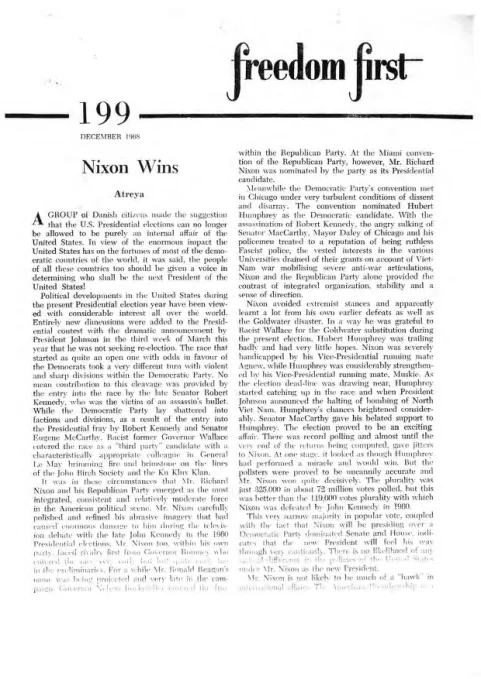
periodical issue
Freedom First
By A. G. Mulgaokar, Adam Adil, Brigadier J. P. Dalvi, V. B. Karnik, N. J. Tavaria
Edited and published for the Democratic Research Service by V. B. Karnik at 127 Mahatma Gandhi Road, Bombay 1, and printed by him at Inland Printers, 55 Gamdevi Road, Bombay 7. · Bombay · 1970
12 pages
Freedom First
Summary
Freedom First No. 218 (July 1970) is a twelve-page issue of the Bombay-based classical-liberal periodical, running from its masthead through the closing ‘With Many Voices’ press digest and colophon — the full issue as rendered. Editorially it takes aim at Congress-era statism and Left politics from several angles: a sharp editorial rebuke of the Governor of West Bengal for using a judicial swearing-in ceremony to praise Soviet-style justice; house ‘Notes’ welcoming the peaceful transfers of power in the 1970 Ceylon and British elections while condemning the rise of Naxalite political murders in India; a foreign-affairs survey of the winding-down of the Cambodia intervention and the fragile stabilization of South Vietnam and Laos; a admiring account of the creation of Meghalaya as a non-violent constitutional solution to hill-tribe demands in the North-East; a review-essay on the fragmentation of India’s opposition parties after the 1969 Congress split; a reader’s letter defending U.S. Cold War interventionism against Soviet subversion; and a closing digest of press quotations on Indian and world politics. The throughline across the issue is a defence of parliamentary democracy, constitutional process, and anti-communism against both authoritarian drift and revolutionary violence.
Key points
-
A. G. Mulgaokar’s “Mr. Dhavan’s Imperfect World” attacks the Governor of West Bengal for using a judicial swearing-in ceremony to praise Soviet-style justice, arguing the episode is itself the strongest case for abolishing the office of Governor.
-
The “Notes” section welcomes the 1970 Ceylon and British elections as proof of democracy’s capacity for peaceful change and condemns the murder of communist Maharashtra legislator Krishna Desai as part of rising political violence linked to the Naxalite movement.
-
Adam Adil’s “Situation In Indo-China” surveys the winding-down of the US intervention in Cambodia, phased troop withdrawal from South Vietnam, and a hopeful movement toward negotiation in Laos between Souvanna Phouma and the Pathet Lao’s Souphanouvong.
-
Brigadier J. P. Dalvi’s “Meghalaya: Blueprint Of Hope” celebrates the 2 April 1970 inauguration of Meghalaya as a triumph of non-violent constitutional negotiation, tracing the movement from the 1960 Assam Language Bill controversy through the 1966 Mizo rebellion he witnessed as army commander.
-
V. B. Karnik reviews Angela Burger’s Opposition in a Dominant-Party System, arguing the book’s framing was overtaken by the 1969 Congress split and speculating about a coming era of regional parties or “politics without parties.”
-
A reader’s letter from N. J. Tavaria defends American Cold War interventionism in Asia, crediting Kennedy’s 1962 support with preventing India becoming a Soviet satellite.
-
The closing “With Many Voices” page quotes Abraham Lincoln on the moral case for revolution against denial of constitutional rights.
Essays
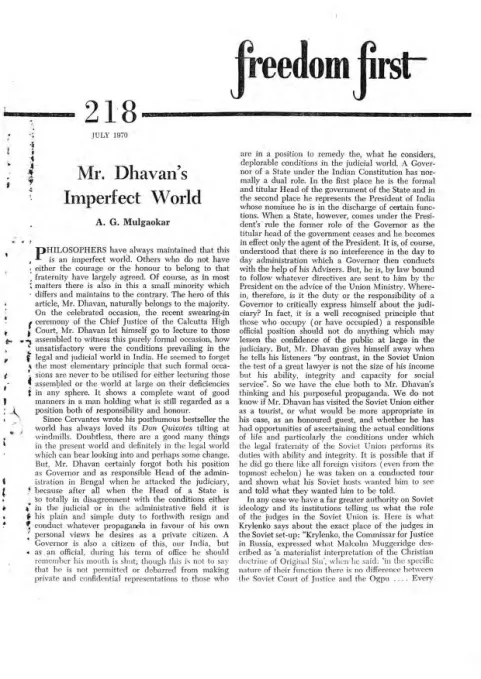
Mr. Dhavan’s Imperfect World
By A. G. Mulgaokar
A. G. Mulgaokar’s editorial attacks the Governor of West Bengal, Mr. Dhavan, for using the swearing-in of the Calcutta High Court’s Chief Justice to publicly criticize India’s judicial and legal conditions, comparing them unfavourably to a supposed Soviet ideal. Mulgaokar argues this breaches the constitutional convention that a Governor’s role at such functions is purely formal, and that if Dhavan holds strong personal views he should resign rather than use his office for propaganda. He turns Dhavan’s own comparison against him, quoting the Soviet Commissar for Justice Krylenko to show that in the USSR the judiciary is explicitly an instrument of the ruling party, and contrasts this with India’s constitutionally independent judiciary. The piece closes by citing a string of distinguished former Bengal Governors and arguing that Dhavan’s conduct is itself the best argument for abolishing the largely decorative office of Governor.
- Governor Dhavan used the Calcutta High Court Chief Justice’s swearing-in to criticize the state of India’s judiciary.
- Mulgaokar argues a Governor’s constitutional role at such functions is purely formal and titular.
- He quotes Soviet Commissar for Justice Krylenko (via Malcolm Muggeridge) to show Soviet courts are explicitly instruments of the ruling class, undercutting Dhavan’s praise of Soviet practice.
- The Times of India is cited approvingly for saying a Governor’s only duty at such events is to pronounce the induction formula.
- Mulgaokar contrasts Dhavan with a list of distinguished past Bengal Governors (Warren Hastings, Lord Casey, Mr. Burroughs).
- The article concludes that episodes like this are the strongest argument for abolishing the office of Governor altogether.
Notes (Two Elections; Political Murders)
The unsigned house ‘Notes’ section carries two items. ‘Two Elections’ welcomes the recent Ceylon and Great Britain elections as proof of democracy’s capacity for peaceful, orderly change of government, and draws a lesson for India: that the country’s appetite for social change should be pursued through democratic procedures rather than violent shortcuts that risk dictatorship. ‘Political Murders’ condemns the rise of politically motivated killings in India, linking it to the growth of the communist movement and singling out the Naxalites as a particularly vicious offshoot that shares communism’s end-justifies-the-means ethic with other communist factions. It cites the recent murder of Krishna Desai, a communist Maharashtra legislator and trade unionist in Bombay, as a shock to the city’s public life, and calls on police and the public to combine against such violence.
- The Ceylon and British elections of 1970 are praised as proof of democracy’s capacity for peaceful change of government.
- India is urged to pursue social change through democratic procedure rather than violent shortcuts.
- Rising political murders in India are linked to the growth of the communist movement generally and the Naxalite movement specifically.
- The murder of Krishna Desai, a communist Maharashtra Legislature member and trade unionist, in Bombay is cited as a shock to the city, with Shiv Sena involvement alleged but unconfirmed.
- The Notes call for public and police cooperation to suppress political violence and to build public opinion against organisations condoning it.
Situation In Indo-China
By Adam Adil
Adam Adil surveys the state of the Indo-China conflict in mid-1970: the winding down of the U.S. intervention in Cambodia, which is judged to have crippled but not eliminated North Vietnamese sanctuaries there; the resumption of a phased U.S. troop withdrawal from South Vietnam (150,000 troops over ten months); continuing gains in pacification and refugee resettlement in South Vietnam alongside a sharp rise in communist terrorism and growing (but so far non-threatening) unpopularity for President Thieu; and a more hopeful, if still uncertain, movement toward negotiation in Laos between Prince Souvanna Phouma and the Pathet Lao’s Prince Souphanouvong. The essay closes (continued on page 9) arguing that Asian nations themselves, not just the U.S. or USSR, must become guardians of peace and freedom in South East Asia, criticizing India and other Asian states for boycotting an Indonesia-led conference on Cambodia out of fear of communist displeasure, and noting uncertainty over whether Britain’s Conservative government will follow through on withdrawing troops east of Suez.
- U.S. intervention in Cambodia is judged to have crippled North Vietnamese communist sanctuaries without fully defeating them; American withdrawal from Cambodia was expected by June’s end.
- A phased U.S. troop withdrawal from South Vietnam was set to resume: 50,000 by October 15 and 100,000 more within six months after, totalling 150,000 within ten months.
- Pacification gains (refugee returns, reopened roads and schools) in South Vietnam are offset by a sharp rise in communist (Naxalite-style) terrorism, with about 1,000 South Vietnamese officials killed in May alone.
- President Nguyen Van Thieu faces growing unpopularity and protest but no imminent threat of a coup.
- In Laos, Prime Minister Souvanna Phouma proposed talks with Pathet Lao leader Souphanouvong, suggesting the Communists may be shifting from military takeover to negotiation.
- The author argues Asian nations, not Western or communist powers, must take responsibility for regional peace, criticizing India for boycotting an Indonesia-convened conference on Cambodia.
Meghalaya: Blueprint Of Hope
By Brigadier J. P. Dalvi
Brigadier J. P. Dalvi celebrates the 2 April 1970 inauguration of Meghalaya as an autonomous hill state within Assam, framing it as a triumph of reasoned, non-violent constitutional negotiation over a 15-year hill-people’s movement, and a possible template for resolving other regional disputes (Telangana, Vidharbha, Jharkhand, UP hill tracts). The essay traces the movement’s history from the 1950s District Councils through the 1960 Assam Language Bill controversy, the formation of the APHLC, Nehru’s personal sympathy and study of the ‘Scottish Pattern’ of devolution, the Mizo armed rebellion of 1966 (which Dalvi witnessed as a army commander), Indira Gandhi’s 1966 intervention and the 1967 ‘federal plan,’ and the eventual 1969 Assam Reorganisation Act. It closes with an assessment of the young Meghalaya government’s prospects, praising its ministers’ youth and modesty while warning of intra-APHLC factionalism and the risk that the new state’s shortcomings will fuel demands for full statehood.
- Meghalaya’s inauguration on 2 April 1970 followed a 15-year non-violent constitutional struggle by Assam’s hill peoples (Khasis, Jaintias, Garos, Nagas, Mizos, and others).
- Jawaharlal Nehru’s personal sympathy for the hill peoples and his study of Scotland’s devolved governance model shaped early proposals, though the APHLC rejected a ‘Scottish Pattern’ offer.
- The 1966 Mizo armed rebellion, which Dalvi witnessed as the army commander sent to quell it, is presented as a warning of what procrastination could produce elsewhere.
- Indira Gandhi’s December 1966 visit to Shillong and subsequent ‘federal plan’ broke a long political deadlock, leading to the Assam Reorganisation (Meghalaya) Act of 1969.
- Meghalaya and Assam share a Governor, capital (Shillong), High Court, Public Service Commission and Electricity Board, with Meghalaya holding 61 of 66 State List subjects but no jurisdiction over public law and order.
- Dalvi praises the young, modern, non-professional-politician character of Meghalaya’s ministers but warns of intra-APHLC fighting and the risk that government shortcomings will be blamed on the APHLC, strengthening demands for full statehood.
Parties In India
By V. B. Karnik
V. B. Karnik reviews Angela S. Burger’s Opposition in a Dominant-Party System, a scholarly study (based on 1963-64 fieldwork in six U.P. constituencies) of how the Jana Sangh, Praja Socialist Party, and Socialist Party built and maintained local organisations while the Congress was the dominant party. Karnik argues the book’s framing has been overtaken by events since the 1969 Congress split, which ended Congress’s dominant-party status, and critiques Burger’s two central hypotheses — that Congress leadership stays frozen among groups mobilized at Independence, and that newly mobilized leaders seek entry via opposition parties — as too general to be cleanly proved or disproved, and as failing to fit the Congress’s actual, continually changing leadership base. He closes by arguing Indian political parties largely lack a stable social base (with the possible exceptions of the ideologically organized Communist Party and Jana Sangh), and speculates about a coming era of regional parties, political instability, or even a future ‘politics without parties’ that the book does not anticipate.
- The essay reviews Angela S. Burger’s Opposition in a Dominant-Party System (Oxford University Press, Bombay, Rs. 52), a study of the Jana Sangh, PSP, and Socialist Party in six U.P. constituencies.
- Karnik argues the book’s ‘dominant party’ framing was overtaken by the 1969 Congress split and the fluidity of Indian party politics since 1967.
- He challenges Burger’s hypothesis that Congress leadership remains frozen among groups mobilized at Independence, arguing Congress leadership has changed continually, especially at state and district levels.
- He also challenges her hypothesis that newly mobilized leaders necessarily seek recognition via opposition parties, noting many eventually join Congress.
- Karnik argues most Indian parties lack the stable social base of a genuine political party, with the Communist Party and Jana Sangh as partial exceptions.
- He raises the possibility of a future dominated by regional parties, political/social disintegration, or a ‘politics without parties’ — questions the book does not address.
Letter to the Editor: America’s Responsibility
By N. J. Tavaria
A letter to the editor from N. J. Tavaria, dated 18 May 1970, defends American Cold War interventionism in Asia against the charge of aggression, arguing that Soviet totalitarian methods of subversion are more dangerous than overt American military action because they are hidden and insidious. The letter credits John F. Kennedy’s prompt support during the 1962 Sino-Indian war with preventing India from becoming a Soviet satellite, criticizes India’s government for criticizing U.S. actions in Vietnam and Cambodia while staying silent on Soviet actions in Hungary and Czechoslovakia, and argues that Indo-China is the springboard for communism’s spread into Asia and Africa, with only Japan economically equipped to contain China.
- The letter argues Soviet subversion is more dangerous than American overt intervention because it is hidden and insidious.
- It credits Kennedy’s 1962 support for India during the Sino-Indian war with preventing India becoming a communist satellite.
- It criticizes the Indian government for condemning U.S. actions in Vietnam/Cambodia while ignoring Soviet actions in Hungary, Czechoslovakia, and the Middle East.
- It frames Indo-China as the springboard for communism’s spread into Afro-Asia, with Japan as the only Asian country economically equipped to contain China.
With Many Voices
The closing ‘With Many Voices’ feature is a digest of press and public quotations from mid-June 1970, epigraphed with Tennyson, covering Indian and world affairs: China policy, the New Congress’s ‘middle class Socialism,’ property rights, fears that Mrs. Gandhi’s government is tilting toward the Soviet camp and Communists in Bengal, warnings about anarchy and inter-party violence in West Bengal, skepticism about ideological debate’s relevance to ordinary people, and quotations from Abraham Lincoln (via Swarajya) on the moral case for revolution against denial of constitutional rights, and from a British Democratic Party manifesto and a Hanoi slogan. The page closes with a subscription coupon and the issue’s colophon crediting V. B. Karnik as editor and publisher for the Democratic Research Service, printed at Inland Printers, Bombay.
- Digest of quotations from Statesman, March of the Nation, The White Star, Opinion, The Indian Monitor, Bhavan’s Journal, Thought, The Observer, Indian Express, Times of India, Janata, Economic Times, and The Economist, dated June 1970.
- Recurring themes: fear of India drifting into the Soviet camp, concern over West Bengal’s political violence, skepticism about the New Congress’s socialism, and debate over property rights.
- Abraham Lincoln is quoted (via Swarajya) on the moral justification for revolution when a majority denies a minority a clearly written constitutional right.
- The issue closes with a subscriber coupon and colophon: edited and published for the Democratic Research Service by V. B. Karnik, 127 Mahatma Gandhi Road, Bombay 1, printed at Inland Printers, Bombay 7.
Generated by the v1.5 extraction pipeline. Awaiting editorial review.
Metadata and summary are AI-extracted from the source PDF and reviewed for editorial accuracy. The original work is available via the Read PDF tab above (where present); paragraph-level citation inside the PDF is deferred to a future engagement.