periodical issue
Freedom First
By V. B. Karnik, Arvind A. Deshpande, A. G. Mulgaokar, Analyst, E. P. Varghese M.A. B.L., V. B. K.
Edited and published for the Democratic Research Service by V. B. Karnik at 127 Mahatma Gandhi Road, Bombay 1, and printed by him at Inland Printers, 55 Gamdevi Road, Bombay 7. · Bombay · 1970
12 pages
Freedom First
Summary
Freedom First issue 220 (September 1970) opens with V. B. Karnik’s lead essay ‘Land Hunger?’, which argues that the leftist demand for land redistribution is a political fiction: India’s landless population (over 103 million by a 1969 estimate) could not be materially helped by parcelling out the country’s limited surplus land, and the real solution lies in rural industry, tenancy security, and disciplined enforcement of existing ceiling and tenancy legislation rather than further fragmentation. The unsigned ‘Notes’ column comments on the second anniversary of the Soviet invasion of Czechoslovakia, the collapse of a CPM-led strike at Durgapur Steel Works, and pre-election alliance manoeuvring in Kerala. Arvind A. Deshpande’s ‘West Asia-Combat Of Illusions’ welcomes the 1970 Nasser-Israel ceasefire brokered through Gunnar Jarring and calls on both sides to abandon illusions about force and security. A. G. Mulgaokar reviews Briton Martin Jr.’s posthumous study ‘New India 1885’ on the founding of the Indian National Congress, tracing the Lytton-Ripon-Dufferin viceregal sequence and Allan Octavian Hume’s organising role. A Bengal Report by ‘Analyst’ credits Chief Minister B. B. Ghosh’s firm administration, backed by Indira Gandhi, for breaking a CPM-led strike at Durgapur. A reader’s letter from E. P. Varghese debates whether Kerala’s land reform is economically sound or merely a vote-catching Communist device. The Review section covers N. B. Bonarjee’s memoir ‘Under Two Masters’ on serving the ICS under British and independent Indian rule, and Robert Conquest’s edited volume ‘Industrial Workers in the U.S.S.R.’. A short note, ‘A Bad Precedent’, criticises Japan’s refusal to let Czechoslovak Expo-70 hostesses seek asylum, and the closing ‘With Many Voices’ column collects press quotations from Indian and international commentators on politics, ideology, and world affairs in August 1970.
Key points
-
V. B. Karnik’s “Land Hunger?” argues leftist demands for land redistribution are largely fictional given India’s already-fragmented holdings, drawing on economist Michael Lipton’s finding that there is little scope for “distributist land reform,” and calls instead for rural industry and disciplined enforcement of existing tenancy law.
-
The “Notes” column marks the second anniversary of the Czechoslovakia invasion, reports the collapse of a CPM-led strike at Durgapur Steel Works after eleven days including the arrest of Naxalite leader Kanu Sanyal, and previews Kerala’s mid-term election alliances.
-
Arvind A. Deshpande’s “West Asia-Combat Of Illusions” welcomes the 1970 Nasser-Israel ceasefire brokered through Gunnar Jarring, urging both sides to abandon illusions about force and security while flagging Palestinian refugees and Jerusalem’s status as the key unresolved issues.
-
A. G. Mulgaokar reviews Briton Martin Jr.’s New India 1885, crediting Allan Octavian Hume as the organiser who united regional bodies into the first Indian National Congress session.
-
Writing as “Analyst,” a “Bengal Report” credits Chief Minister B. B. Ghosh’s administration, backed by Indira Gandhi, with breaking the CPM-led Durgapur strike without conceding to demands for withdrawal of security forces.
-
A reader’s letter from E. P. Varghese argues Kerala’s Land Reforms Act has produced lawlessness rather than reform, criticising the “kudikidappukaran” hutment-dweller provision as enabling squatters to acquire land for nominal compensation.
-
Reviews cover N. B. Bonarjee’s ICS memoir Under Two Masters and Robert Conquest’s edited Industrial Workers in the U.S.S.R., alongside a note condemning Japan’s refusal to let Czechoslovak Expo-70 hostesses seek asylum.
Essays
Land Hunger?
By V. B. Karnik
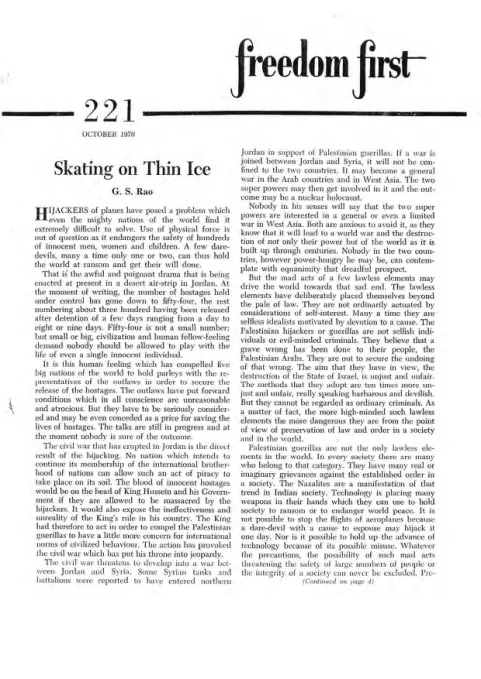
V. B. Karnik’s ‘Land Hunger?’ argues that the leftist clamour for land redistribution to the landless is unrealistic and largely propagandistic. He cites 1969 estimates of over 103 million landless people in India and falling per-capita land availability (0.47 hectares in 1955-56, down to 0.42 hectares in 1961-62), and draws on National Sample Survey data and economist Michael Lipton’s conclusion that there is little scope in India for ‘distributist land reform’ given how small most existing holdings already are. Karnik contends that further fragmentation would leave each landless recipient with less than an acre, below the threshold of economical cultivation, and that historically villagers were never uniformly land-owning but held independent trades (carpentry, weaving, pottery) that industrial and agricultural decline destroyed. He argues real land hunger is actually hunger for gainful employment, not land itself, and that the answer lies in developing rural industries and handicrafts, strict enforcement of the Zamindari Abolition Acts, Tenancy Acts and land ceiling legislation (rather than lowering the ceiling further), and support for family farms as the most efficient production unit. He closes by criticizing ‘leftist agitation of land-grab’ as likely to frustrate agriculture’s still-fragile rejuvenation.
- Cites 1969 estimate of over 103 million landless people in India and shrinking per-capita land availability (0.47 to 0.42 hectares, 1955-56 to 1961-62)
- Invokes National Sample Survey (16th Round, 1960-61) data showing roughly 75% of Indian farms are small to very small
- Draws on economist Michael Lipton’s finding that ‘distributist land reform’ has little scope in India given already-small holdings
- Argues further land redistribution would fragment holdings below the economical cultivation threshold
- Frames rural land hunger as really a hunger for gainful non-agricultural employment, not land
- Calls for strict enforcement of Zamindari Abolition, Tenancy, and Ceiling Acts rather than lowering ceilings further
- Advocates family farms and rural industry/handicrafts development as the real solution to rural poverty
- Criticizes ‘leftist agitation of land-grab’ as harmful to agriculture’s fragile recovery
Essay 2
The unsigned ‘Notes’ column covers three items: the second anniversary of the Soviet invasion of Czechoslovakia, noting the removal of Alexander Dubcek’s authority and continuing silent resistance among intellectuals and workers; the collapse after eleven days of a CPM-led strike at Durgapur Steel Works, which the column frames as a deliberate political struggle for control that the CPM lost after firm Centre and State intervention, including the arrest of Naxalite leader Kanu Sanyal; and a preview of shifting party alliances ahead of Kerala’s mid-term election, split between CPM-led and CPI-led fronts with the Congress itself divided into three factions.
- Marks the second anniversary of the Soviet invasion of Czechoslovakia and Alexander Dubcek’s removal from power within the ruling Communist Party
- Notes continuing quiet resistance in Czechoslovakia including a no-work protest on August 21
- Reports the CPM-led strike at Durgapur Steel Works collapsed unconditionally after eleven days due to firm Centre/State handling
- Notes the arrest of Naxalite leader Kanu Sanyal without resistance during the same period
- Previews Kerala’s mid-term election as a contest between a CPM-led alliance and a CPI-led alliance, with Congress split into three factions
West Asia-Combat Of Illusions
By Arvind A. Deshpande
Arvind A. Deshpande’s ‘West Asia-Combat Of Illusions’ welcomes the acceptance by President Nasser and Israel of a US-brokered 90-day ceasefire and negotiations through UN envoy Dr. Gunnar Jarring, while cautioning that lasting peace requires both sides to abandon cherished illusions. He argues Israel must give up the belief that force alone secures its position and must eventually grant full citizenship rights to non-Jewish residents, while the Arab states must abandon the fantasy of destroying Israel outright. He identifies the fate of roughly twelve lakh Palestinian refugees and the future of Jerusalem as the two most important unresolved issues, and closes by quoting Gibbon on the ‘triumph of barbarism and religion’, hoping history will not record the same verdict on the Jewish-Arab conflict.
- Welcomes the 1970 US-brokered 90-day ceasefire and Jarring-mediated negotiations between Nasser’s Egypt and Israel
- Argues Israel must abandon the illusion that military force alone can guarantee security
- Argues Arab states must abandon the illusion that Israel can be destroyed as a nation
- Identifies the roughly twelve lakh Palestinian refugees as the central unresolved humanitarian and political issue
- Flags the future status of Jerusalem as a second major sticking point
- Criticizes Indian political commentators for partisan pro-Arab framing of the conflict given India’s official non-aligned-but-pro-Arab policy
Birth Of The Indian National Congress
By A. G. Mulgaokar
No summary was extracted for this article. Listed for completeness.
Notes (Anniversary of Invasion; Strike in Durgapur; Alliances and Counter-Alliances)
A. G. Mulgaokar reviews Briton Martin Jr.’s posthumously published ‘New India 1885’ (Oxford University Press), calling it an authoritative and objective account of the circumstances that produced the Indian National Congress. The review traces the impact of Western education and the repressive Press Act under Viceroy Lytton, the reformist tenure of Ripon (local self-government, the Ilbert Bill, attempted reform of the Covenanted Civil Service), and the more cautious, initially disappointing Dufferin viceroyalty. It credits Allan Octavian Hume as the organising figure who brought together regional bodies like the Bombay Presidency Association, the Poona Sarvajanik Sabha, and the Indian Association of Calcutta into the first Congress session in 1885, with support from Ripon and Dufferin’s private encouragement despite the myth that Dufferin actively sponsored the Congress as a safety valve. The reviewer closes by contrasting the integrity of the founding generation (Dadabhai Naoroji, Pherozeshah Mehta, Telang) with the diminished standing of Congress leadership in 1970.
- Reviews Briton Martin Jr.’s ‘New India 1885’ (Oxford University Press, Rs. 55/-), published posthumously by his wife
- Praises the book’s objectivity, detailed case-study method, and narrative balance
- Traces Lytton’s repressive administration (Vernacular Press Act, Arms Act) and Ripon’s reformist response (local self-government, Ilbert Bill, Civil Service reform attempts)
- Describes Dufferin’s initially ambivalent, later more repressive stance toward Indian political aspirations
- Credits Allan Octavian Hume as the key organiser uniting regional associations into the first Indian National Congress session of 1885
- Notes the founding session’s front-piece photograph featuring Dadabhai Naoroji, Pherozeshah Mehta, and Telang
- Closes with a critical contrast between the founders’ integrity and the diminished stature of Congress leadership in 1970
Determined Will Of Ghosh Regime Pays Dividend (Bengal Report)
By Analyst
Writing under the byline ‘Analyst’ in the Bengal Report column, this piece credits West Bengal Chief Minister B. B. Ghosh’s administration, with the full backing of Prime Minister Indira Gandhi, for breaking a CPM-engineered eleven-day strike at Durgapur Steel Works without conceding to the union’s demand to withdraw Industrial Security and CRP forces. It also notes the successful handling of an Electricity Board employees’ strike and looming threats from state government employees and a planned peasant gherao of the Secretariat, alongside the arrest of Naxalite leader Kanu Sanyal. The piece cautions that these are only administrative successes and that the underlying ‘political vacuum’ in Bengal remains unfilled.
- Credits the B. B. Ghosh state government, backed by Indira Gandhi, with breaking the CPM-led Durgapur Steel Works strike after eleven days
- Frames the strike as a political power struggle for control of the plant, not a genuine industrial dispute
- Notes CPI, INTUC and SUC opposition to the CPM’s strike call, undermining its claimed trade-union character
- Reports the arrest of Naxalite leader Kanu Sanyal and stepped-up police action against Naxalite bomb-making centres
- Flags upcoming threats: a state government employees’ strike and a planned peasant gherao of the Secretariat on August 31
- Warns that administrative success against unrest does not resolve the state’s underlying political vacuum
Land Reforms-Political Or Economic? (Letter to the Editor)
By E. P. Varghese M.A. B.L.
A letter to the editor from E. P. Varghese of Ernakulam argues that Kerala’s Land Reforms Act (in force since January 1, 1970) has produced lawlessness rather than genuine reform, describing rampant crop-grabbing tolerated by police and Communist-led governments and criticizing the ‘kudikidappukaran’ (hutment-dweller) provision as enabling squatters to acquire land for a nominal 10 cents’ compensation. Varghese contends Kerala’s average holding (3.23 acres) is already too small and consolidated rather than fragmented, citing Dr. G. D. Patel’s book on Indian land law, and argues that Kerala’s land reform is a purely political vote-gathering exercise by Marxist and Socialist parties rather than an economically grounded policy.
- Argues Kerala’s Land Reforms Act (effective January 1, 1970) has produced disorder rather than reform, with unchecked crop-grabbing
- Criticizes the ‘kudikidappukaran’ hutment-dweller provision as allowing squatters to acquire land for a nominal 10-cent compensation
- Cites Dr. G. D. Patel’s ‘The Indian Land Problem and Legislation’ on Kerala’s already-low man-land ratio and small average holding (3.23 acres)
- Argues 94% of Kerala landholders already till their own soil, undercutting the ‘land to the tiller’ rationale
- Frames the reform as a purely political vote-capturing device by Communist and Socialist parties, disregarding economic viability
Review: Under Two Masters (N. B. Bonarjee)
By V. B. K.
The Review section (initialled V. B. K.) covers two books. The first, N. B. Bonarjee’s memoir ‘Under Two Masters’ (Oxford University Press), recounts the author’s twenty-two years serving in the ICS under the British and nine years under independent India; the reviewer summarises Bonarjee’s broadly favourable, though qualified, verdict on British rule as leaving India an industrial base, sound finance, and constitutional foundations, alongside his critique of the ‘cumbersome and rigid’ administrative apparatus retained after Independence. The second review covers Robert Conquest’s edited volume ‘Industrial Workers in the U.S.S.R.’ (Praeger), which the reviewer describes as an objective, well-documented account of Soviet industrial labour conditions that nonetheless omits political repression, forced labour camps, and Stalin-era terror from its scope.
- Reviews N. B. Bonarjee’s ‘Under Two Masters’ (Oxford University Press, Rs. 25/-), a memoir of ICS service under British and independent Indian rule
- Notes Bonarjee’s favourable verdict on British administration as leaving India sound finance, an industrial base, and constitutional foundations
- Highlights Bonarjee’s critique of the post-Independence system as retaining a ‘cumbersome and rigid’ administrative structure
- Reviews Robert Conquest’s edited ‘Industrial Workers in the U.S.S.R.’ (Praeger, $6.25) as objective and well-documented on labour conditions
- Notes the Conquest volume’s omission of political repression, forced labour camps, and Stalinist terror from its scope
- Cites Conquest’s observation that the Soviet proletariat is more ‘alienated’ in the Marxian sense than workers in most other countries
Review: Industrial Workers in the U.S.S.R. (ed. Robert Conquest)
By V. B. K.
A short unsigned note, ‘A Bad Precedent’, condemns the Japanese authorities at Expo ‘70 in Osaka for refusing to help six Czechoslovak girl-hostesses obtain political asylum in Canada, citing a Japan-Communist-bloc agreement not to let the World Fair facilitate defections, reportedly with US cooperation. The note argues this flouts the democratic and rule-of-law principles Japan claims to uphold, citing a Selig Harrison dispatch in The Guardian.
- Reports Japanese authorities at Expo ‘70 refused aid to six Czechoslovak hostesses seeking asylum in Canada
- Attributes the refusal to a Japan-Communist-bloc agreement barring the Fair from facilitating defections
- Notes reported US cooperation with Japanese authorities on this policy, per a Selig Harrison dispatch in The Guardian
- Criticizes the episode as inconsistent with Japan’s democratic and rule-of-law principles
Books Received
‘With Many Voices’ is the issue’s closing column of press quotations drawn from Indian and international commentary in August 1970, touching on the Indira Gandhi personality cult, socialism and democracy, Parliament censure-motion politics, Kerala alliance politics, the Nasser-Israel ceasefire and West Germany-Russia border agreement, Naxalite terror, and reflections from C. Rajagopalachari, M. R. Masani, J. B. Kripalani and others on the state of Indian politics.
- Collects short quotations from Commerce, Indian Express, The Economic Times, The Hindu, The Economist, Time, and other outlets, August 1970
- Includes M. R. Masani’s remark that ‘socialism and democracy cannot survive together for a very long time’
- Includes C. Rajagopalachari’s self-deprecating comment in Swarajya on being ‘an insignificant person in what is at present an insignificant country’
- Includes J. B. Kripalani’s observation in The White Star that ‘the Indian socialists have rarely shown any grasp of reality’
- Notes the Russia-West Germany border agreement and the Middle East ceasefire as hopeful developments per The Observer
- Includes a Time magazine warning that the bomb could replace Gandhi’s spinning wheel as a symbol if reforms fail the poor
Generated by the v1.5 extraction pipeline. Awaiting editorial review.
Metadata and summary are AI-extracted from the source PDF and reviewed for editorial accuracy. The original work is available via the Read PDF tab above (where present); paragraph-level citation inside the PDF is deferred to a future engagement.