periodical issue
Freedom First
By G. S. Rao, Analyst, Adam Adil, M. R. Masani, M.P., Ludmilla Thorne, N.D., V.B.K.
Edited and published for the Democratic Research Service by V. B. Karnik at 127 Mahatma Gandhi Road, Bombay 1, and printed by him at Inland Printers, 55 Gamdevi Road, Bombay 7. · Bombay · 1970
12 pages
Freedom First
Summary
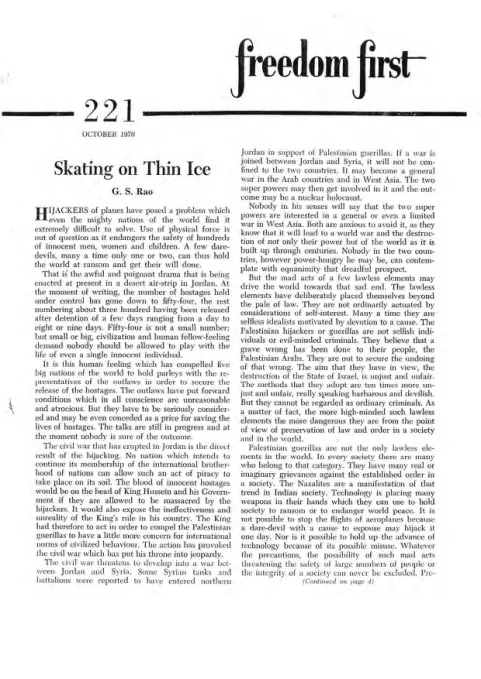
This issue of Freedom First (No. 221, October 1970) opens with G. S. Rao’s “Skating on Thin Ice,” a leader on the Jordan hijacking crisis and the risk of it escalating into an Indira Gandhi-era Cold War flashpoint, drawing an explicit parallel to India’s own Naxalite violence. A Bengal Report column by “Analyst” reads the Kerala mid-term election results as a portent for West Bengal’s fractured Left politics (CPI, CPM, Congress factions, Naxalites). Adam Adil covers the Lusaka non-aligned conference, criticizing the movement’s inconsistent record (citing Czechoslovakia 1968 and the 1962 Sino-Indian war) while cautiously welcoming its renewed emphasis on non-interference. M. R. Masani, M.P., contributes an edited Lok Sabha speech attacking the Government’s proposed Cotton Corporation of India as a politically motivated monopoly grab that will hurt farmers, traders and consumers alike. Ludmilla Thorne reviews Anatoli Marchenko’s smuggled camp memoir My Testimony, situating it against Solzhenitsyn’s One Day in the Life of Ivan Denisovich as unvarnished testimony that Soviet labour camps persist post-Stalin. A Reviews section covers two books on Indian industrial relations, and the issue closes with reader letters (on Israel/West Asia policy and land reform), a note on a citizens’ letter protesting the government’s expulsion of the BBC from Delhi, and the regular “With Many Voices” digest of press quotations from Rajagopalachari, Palkhivala, J.R.D. Tata, Vajpayee and others.
Key points
-
G. S. Rao’s “Skating on Thin Ice” uses the September 1970 Jordan hijacking crisis to warn that small groups of committed “lawless elements” can hold nations hostage, explicitly comparing the Palestinian guerrillas to India’s own Naxalites.
-
Writing as “Analyst,” a “Bengal Report” reads the Kerala mid-term election results as encouraging the CPI toward an open alliance with Congress(R), and notes the CPM recalibrating after over-estimating “revolutionary potentialities.”
-
Adam Adil’s “Lusaka Conference” surveys the non-aligned movement’s history from Belgrade through Cairo to Lusaka, criticising its “abject silence” over the 1968 Czechoslovakia invasion while crediting the conference’s call for genuine, internally-driven non-alignment.
-
M. R. Masani’s “Cotton Trade-Government Monopoly,” excerpted from a Lok Sabha speech, attacks the proposed Cotton Corporation of India as an unjustified monopoly grab that will hurt farmers, traders and consumers, citing the appointment of a “discredited Gujarat politician” as chairman.
-
Ludmilla Thorne reviews Anatoli Marchenko’s smuggled camp memoir My Testimony, situating it against Solzhenitsyn’s One Day in the Life of Ivan Denisovich as unvarnished proof that Soviet labour camps persisted after Stalin’s death.
-
Reviews cover Dimensions of Industrial Relations in India, marking the ILO’s fiftieth anniversary, and a survey finding 13-15% absenteeism across thirty Bombay industrial units.
-
The issue notes a letter from over 300 citizens protesting the government’s expulsion of the BBC from Delhi, and closes with “With Many Voices” quoting N. A. Palkhivala warning “Property has become a dirty word today; liberty may become a dirty word tomorrow.”
Essays
Skating on Thin Ice
By G. S. Rao
G. S. Rao’s leader uses the September 1970 Palestinian hijackings and the resulting Jordanian civil war as a case study in how a handful of committed “lawless elements” can hold entire nations, and potentially world peace, hostage. He argues the hijackers are not ordinary criminals but selfless idealists pursuing a grievance through indefensible means, and warns that unless such acts meet swift, universal condemnation, they will proliferate. The piece pointedly compares the Palestinian guerrillas to India’s own Naxalites as a domestic instance of the same phenomenon, and closes on the danger that a local, uncontrollable escalation could drag the two superpowers into a wider war.
- Frames the Jordan hostage crisis (September 1970) as an example of small groups of dedicated individuals holding whole nations to ransom via new technology (hijacking).
- Argues the Palestinian hijackers are ‘selfless idealists’ pursuing a grievance against Israel, not ordinary criminals, which makes them more dangerous, not less.
- Explicitly compares the Palestinian guerrillas to the Naxalites as an Indian manifestation of the same lawless-idealist pattern.
- Warns that the Jordan civil war could draw in Syria and escalate into a general Arab-Israeli war, risking superpower involvement and nuclear catastrophe.
- Calls for universal, immediate condemnation of hijacking-style tactics regardless of the cause behind them, arguing that public revulsion is the only real deterrent.
- Concludes that world peace is ‘skating on thin ice’ because such incidents could trigger war without either superpower intending it.
Bengal Report: Kerala Elections And West Bengal
By Analyst
Writing under the byline “Analyst” in the regular Bengal Report column, the author argues that the Kerala mid-term election results will reshape Left politics in West Bengal, emboldening the CPI to seek an open alliance with Congress(R) even as it navigates internal factions represented by Somnath Lahiri and Biswanath Mukherjee. The piece assesses the CPM as chastened after over-estimating revolutionary conditions and pulling back from confrontation (withdrawing the Durgapur strike call), noting a convergence between CPM and Naxalite tactics of low-level, patient “revolutionary” activity. It closes by describing floods and police handling of Naxalite attacks as giving the state administration a public-relations opening, and flags the unresolved question of preventive-detention powers for the state police.
- Kerala’s mid-term election results are read as encouraging the CPI toward an open alliance with Congress(R) in West Bengal.
- Identifies an internal CPI split, with Somnath Lahiri and Biswanath Mukherjee representing its two factions.
- Argues the CPM over-estimated ‘revolutionary potentialities’ in the past six months and is now recalibrating, having withdrawn the Durgapur strike and moderated Martyrs’ Day observance.
- Notes a practical convergence between CPM strategy and Naxalite activity, though the CPM views Naxalites as juvenile and prone to getting caught.
- Describes extensive floods giving the state administration, police, CRP and Army a chance to build a better public image through relief work.
- Flags that granting preventive-detention (PD) powers to West Bengal police depends on CPI agreement, per remarks from Sri K. C. Pant.
Lusaka Conference
By Adam Adil
Adam Adil reports on the September 1970 conference of over 60 non-aligned nations at Lusaka, arguing that non-alignment retains real substance despite many members leaning toward one superpower or the other. He traces the movement’s history from Belgrade (1961, with Nehru, Tito and Nasser) through Cairo (1964, with Lal Bahadur Shastri) to Lusaka, and criticizes the bloc’s inconsistent record: its weak response to Chinese aggression against India in 1962 and its ‘abject silence’ over the Soviet invasion of Czechoslovakia in 1968. He nonetheless credits the conference’s call for more active solidarity against threats to independence and its warning (echoing Indonesia’s General Suharto) about outside powers exploiting internal ethnic and cultural grievances, framing the conference’s chief achievement as encouraging genuine, internally-driven non-alignment.
- Over 60 non-aligned nations met at Lusaka in September 1970; the conference reaffirmed that non-alignment retains substance despite many members’ de facto superpower alignments.
- Traces the movement’s history: Belgrade 1961 (Nehru, Tito, Nasser), Cairo 1964 (Lal Bahadur Shastri after Nehru’s death), and now Lusaka.
- Criticizes non-aligned nations, including India, for failing to unequivocally condemn the Soviet invasion of Czechoslovakia in 1968.
- Notes that most non-aligned nations gave India only lukewarm support during the 1962 Chinese aggression, with Malaysia a notable exception.
- Cites Indonesian General Suharto’s warning that external powers can exploit ethnic/cultural minority grievances to foment civil war, calling it a colonial legacy.
- Credits Lusaka’s final declaration for stressing ‘full solidarity’ against threats to independence and for urging non-aligned nations to rely on internal strength rather than outside help.
Cotton Trade-Government Monopoly
By M. R. Masani, M.P.
Excerpted from a Lok Sabha speech of 27 August 1970, M. R. Masani, M.P., attacks the government’s plan to establish a Cotton Corporation of India as an unjustified move toward monopolising both import and domestic cotton trade. He argues the existing trade, run by roughly 300,000 small traders, is efficient, highly specialised, and already delivers about 90 per cent of the ultimate price to the farmer (per a Bombay University study), leaving razor-thin margins (0.5-1 per cent net) for merchants. Masani predicts the monopoly will victimise farmers, raise consumer prices, increase unemployment, and hand the trade to incompetent and corrupt bureaucratic machinery, citing the appointment of ‘discredited Gujarat politician’ Rasiklal Parikh as chairman as proof the move is a political and financial ‘grab’ rather than genuine economic policy.
- Speech excerpted from Masani’s remarks in the Lok Sabha on 27 August 1970 opposing the Cotton Corporation of India.
- Cites a Bombay University Department of Economics study finding traders’ net return on cotton sales is only 0.5-1 per cent, while farmers globally get 35-80 per cent of ultimate price but in India get about 90 per cent.
- Argues bulk government purchasing is unsuited to a trade that requires expertise in blending different cotton varieties and staples for different mills.
- Predicts three consequences: victimisation of farmers under monopoly procurement, higher consumer prices due to bureaucratic inefficiency, and increased unemployment among the roughly 300,000 small traders in the business.
- Attacks the appointment of Rasiklal Parikh, a ‘discredited Gujarat politician,’ as Corporation chairman as proof of political motive over competence.
- Frames the measure as ‘grab of trade’ analogous to ‘Land grab’, accusing the government of political lobbying and intrigue rather than economic justification.
Labour Camps In Russia
By Ludmilla Thorne
Ludmilla Thorne reviews Anatoli Marchenko’s My Testimony, a smuggled memoir of Soviet labour camps published in Paris in 1969 and then in English translation, arguing it proves that forced-labour camps persisted well past Stalin’s death. She recounts Marchenko’s biography (born 1938 to illiterate parents, arrested after a dormitory brawl, sentenced to six years for attempting to cross into Iran in 1960) and details the camp conditions he describes: engineered hunger, humiliation, and the deaths or persecution of fellow prisoners including Yuri Daniel. Thorne situates the book against Solzhenitsyn’s One Day in the Life of Ivan Denisovich, quoting Max Hayward’s introduction on its value as unvarnished testimony, and closes by noting Marchenko was rearrested in 1968 and remained imprisoned at time of writing, his health in doubt.
- My Testimony by Anatoli Marchenko, an eighth-grade-educated labourer, was first published in Paris in Russian (1969) before English editions in England, Canada and the U.S.
- Marchenko was sentenced to six years at hard labour in 1960 after a failed attempt to cross the Soviet border into Iran near Ashkhabad.
- The book describes camp conditions at Potma (about 3,500 political prisoners) including engineered starvation, humiliation, and abuse by camp administration.
- Recounts Marchenko’s friendship in the camps with writer Yuli Daniel, who was persecuted alongside Andrei Sinyavsky for the ‘crime’ of publishing abroad.
- Max Hayward’s introduction to the English edition calls it the first detailed, unvarnished report on Soviet camp conditions by a firsthand witness.
- Marchenko was rearrested on 29 July 1968 on a passport-violation charge and sentenced to two more years for ‘defamation of the Soviet political system’; friends feared for his survival in prison.
- The review notes the piece is condensed from an article in Problems of Communism.
Reviews: Dimensions of Industrial Relations in India / Absenteeism in Industries in Bombay - A Survey
By N.D. / V.B.K.
The Reviews section covers two books. N.D. reviews Dimensions of Industrial Relations in India, edited by Dr. B. S. Bhir, published to mark the ILO’s fiftieth anniversary, praising its contributions from figures such as V. V. Giri and N. H. Tata and its foreword by Dr. P. B. Gajendragadkar. V.B.K. reviews Absenteeism in Industries in Bombay — A Survey by the Employers’ Federation of India, summarizing its finding that absenteeism ran 13-15 per cent across thirty Bombay industrial units (1962-64), mostly ‘authorised,’ and noting that roughly 25 per cent of the workforce was non-permanent, which the review calls ‘unfair and unconscionable.’
- Dimensions of Industrial Relations in India (ed. Dr. B. S. Bhir, United Asia, Rs. 20) was published to mark the ILO’s fiftieth anniversary and includes contributions from V. V. Giri, N. M. Tidke, J. L. Hathi, N. H. Tata, V. B. Karnik and the editor.
- That book carries a foreword by Dr. P. B. Gajendragadkar, Vice-Chancellor of Bombay University and Chairman of the National Commission of Labour.
- Absenteeism in Industries in Bombay — A Survey (Employers’ Federation of India, Rs. 3) covered 30 industrial units and about 15 per cent of Bombay manufacturing workers over 1962-64.
- The survey found absenteeism of 13-15 per cent, with 70 per cent ‘authorised’ and only 30 per cent ‘unauthorised.’
- About 73-74 per cent of workers were employed on a permanent basis, leaving roughly 25 per cent temporary or casual — called a ‘grave evil’ requiring correction.
Britain 1970 - An Official Handbook (review)
By N.D.
The back section opens with N.D.’s brief review of Britain 1970 — An Official Handbook, followed by a Books Received list (including The Administrative History of India 1834-1947 by B. B. Misra, and Rethinking on Public Sector from the Forum of Free Enterprise). A note describes a letter signed by over 300 citizens sent to the Prime Minister protesting the government’s move to close the BBC’s New Delhi office, warning against censorship and intolerance. Two Letters to the Editor follow: David Zohar, Vice-Consul of the Consulate of Israel in Bombay, disputes claims in an earlier Freedom First article (No. 220) about Israeli treatment of minorities and about ‘secured and guaranteed frontiers’ being illusory; and R. Srinivasan of Madras responds to V. B. Karnik’s article ‘Land Hunger,’ arguing the ‘Land Grab’ movement is a political gesture that ignores the limited, immobile nature of land and the law of diminishing returns.
- Books Received list includes The Administrative History of India 1834-1947 by B. B. Misra (Oxford University Press) and Rethinking on Public Sector (Forum of Free Enterprise).
- Over 300 citizens signed a letter to the Prime Minister protesting the government’s decision to expel the BBC from its New Delhi office, warning it risks fostering an ‘intolerant insular and chauvinistic society.’
- David Zohar, Vice-Consul at the Consulate of Israel, Bombay, writes to correct claims in a prior issue’s article by A. A. Deshpande (‘West Asia — Combat of Illusions’, Freedom First No. 220) regarding Israel’s treatment of Moslems, Christians, Druses, Bahais and Jews, and regarding ‘secured and guaranteed frontiers.’
- R. Srinivasan of Madras responds to V. B. Karnik’s ‘Land Hunger’ article, arguing land redistribution cannot solve agricultural production problems given land’s fixed, immobile supply and the law of diminishing returns.
Letter to the Prime Minister (petition re: BBC office closure)
The closing ‘With Many Voices’ column, a regular digest of press quotations under a Tennyson epigraph, gathers commentary on the political events of September 1970: C. Rajagopalachari and N. A. Palkhivala on Indira Gandhi’s government’s autocratic drift and property/liberty rhetoric; J.R.D. Tata and A. B. Vajpayee on the abolition of privy purses; reactions to the BBC’s expulsion from India (Hindustan Times Weekly, Nirad C. Chaudhuri); international commentary from David Lawrence on hijacking as international crime and Pablo Casals; and press reaction to the Kerala election results. The masthead confirms the issue’s registration number (MH 272), its editing and publication by V. B. Karnik for the Democratic Research Service at 127 Mahatma Gandhi Road, Bombay 1, and printing by Inland Printers, Gamdevi Road, Bombay 7.
- Quotations column includes C. Rajagopalachari (Indian Express) on the ease of autocracy in India under Indira Gandhi’s government.
- N. A. Palkhivala (March of the Nation) warns ‘Property has become a dirty word today; liberty may become a dirty word tomorrow.’
- J.R.D. Tata (Swarajya) comments that ‘Only the power not to make decisions is left to the private sector’ following abolition of privy purses.
- A. B. Vajpayee, M.P. (Times of India), argues ‘Not the rulers but the supremacy of Parliament has been de-recognised.’
- Includes international commentary: David Lawrence on hijacking as an international crime requiring trials, and Pablo Casals on living in the moment.
- Masthead confirms Registered No. MH 272; edited and published by V. B. Karnik for the Democratic Research Service, 127 Mahatma Gandhi Road, Bombay 1; printed at Inland Printers, 35 Gamdevi Road, Bombay 7.
Generated by the v1.5 extraction pipeline. Awaiting editorial review.
Metadata and summary are AI-extracted from the source PDF and reviewed for editorial accuracy. The original work is available via the Read PDF tab above (where present); paragraph-level citation inside the PDF is deferred to a future engagement.