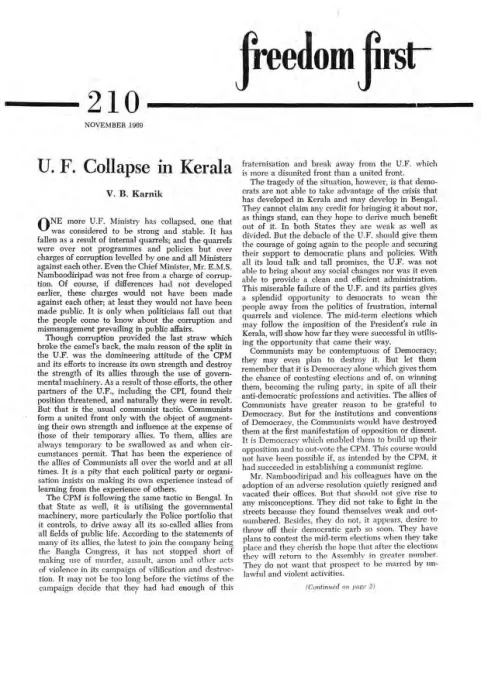
periodical issue
Freedom First
By A. G. Mulgaokar, C. L. Gheevala, Prabhat Das Gupta, M. R. Chandvadkar, V.B.K.
Edited and published for the Democratic Research Service by V. B. Karnik at 127 Mahatma Gandhi Road, Bombay 1, and printed by him at Inland Printers, 55 Gamdevi Road, Bombay 7. · Bombay · 1970
12 pages
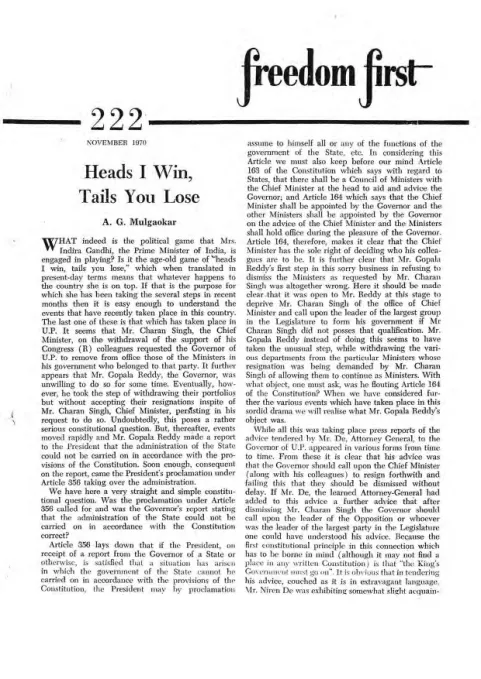
Freedom First
Summary
Freedom First issue 222 (November 1970) is a 12-page number of the Bombay-based liberal monthly, edited and published for the Democratic Research Service by V. B. Karnik. The issue opens with A. G. Mulgaokar’s constitutional analysis of the U.P. political crisis and President’s Rule, followed by C. L. Gheevala’s critique of nationalisation-centred democratic socialism, a reprint of Prabhat Das Gupta’s New Age article cataloguing CPM violence in West Bengal, M. R. Chandvadkar’s review of P. V. R. Rao’s book on Indian defence policy, a contributed report on the Liberal International’s 1970 Rome Congress (in which the Indian Liberal Group participated), a book review of a study of industrial strikes and morale, a short New Age-sourced item on CRP security for West Bengal political leaders, and the recurring ‘With Many Voices’ quotations column. The issue’s argumentative centre is a defence of constitutional propriety, anti-Communist and anti-nationalisation liberalism, and concern over political violence and inadequate national defence preparedness in the India of late 1970.
Key points
-
A. G. Mulgaokar’s “Heads I Win, Tails You Lose” dissects the 1970 UP constitutional crisis, in which President’s Rule was imposed under Article 356 and withdrawn four days later, arguing no genuine breakdown of constitutional government had occurred and that control of UP politics was decisive to Indira Gandhi’s own survival.
-
C. L. Gheevala’s “Democratic Socialism - Need For Rethinking” argues doctrinaire nationalisation and central planning have been discredited by experience, endorsing the Socialist Union’s view that a mixed economy needs a legitimately recognised private sector as a check on state activity.
-
A reprinted New Age article by Prabhat Das Gupta catalogues CPM violence against Naxalite and CPI rivals in West Bengal, citing Hare Krishna Konar’s own admission of 109 inter-party clashes and 23 deaths in three months, and naming 21 alleged CPM assault-squad leaders.
-
M. R. Chandvadkar reviews P. V. R. Rao’s Defence Without Drift, which argues India neglected defence until the 1962 Chinese invasion exposed “Himalayan Blunders” of complacency, and finds Indian defence spending at only 3.3% of GNP, the second-lowest in the world.
-
A contributed report on the Liberal International’s 1970 Rome Congress, attended by M. R. Masani for the Indian Liberal Group, covers resolutions on European security, Middle East peace, and legal measures against hijacking and kidnapping.
-
A review of Mrs. P. Chakraborty’s Strikes and Morale in Industry finds Indian trade unionism growing more conciliatory rather than militant, with strikes’ economic impact “markedly insignificant” compared to unemployment.
-
A short item reports armed CRP guards assigned around the clock to four West Bengal political leaders under President’s Rule, at a daily cost of over Rs. 127 per leader.
Essays
Heads I Win, Tails You Lose
By A. G. Mulgaokar
A. G. Mulgaokar dissects the 1970 U.P. constitutional crisis in which Chief Minister Charan Singh’s Congress (R) allies withdrew support, Governor Gopala Reddy declined to dismiss the ministers Charan Singh wanted removed, and President’s Rule was imposed under Article 356 — only to be withdrawn four days later. Mulgaokar argues the Governor acted improperly by stripping ministers of portfolios without accepting their resignations, that Attorney-General Niren De’s advice to dismiss the Chief Minister was constitutionally unsound and self-contradictory given his own government’s conduct, and that the U.P. Advocate-General K. L. Misra’s more cautious opinion was the better legal reading. He concludes that no genuine breakdown of constitutional government had occurred, that the President could not honestly have satisfied himself otherwise, and that the whole episode reflects Indira Gandhi’s calculation that control of U.P. politics is decisive for her own survival as Prime Minister.
- Charan Singh’s Congress (R) allies withdrew support and asked Governor Gopala Reddy to remove certain ministers from the U.P. cabinet.
- The Governor withdrew the ministers’ portfolios without accepting their resignations, which Mulgaokar calls a serious constitutional impropriety and a violation of Article 164.
- Attorney-General Niren De advised dismissing the Chief Minister and his colleagues; U.P. Advocate-General K. L. Misra’s opinion is presented as the more defensible constitutional reading.
- A proclamation of President’s Rule under Article 356 was issued and then withdrawn four days later, which Mulgaokar treats as proof the proclamation was never justified.
- The essay argues that whoever controls U.P. politics effectively controls the choice of India’s Prime Minister, explaining Indira Gandhi’s stake in the outcome.
- The piece questions whether the President genuinely satisfied himself, as Article 356 requires, that constitutional government had broken down in U.P.
Democratic Socialism - Need For Rethinking
By C. L. Gheevala
C. L. Gheevala argues that democratic socialists face a genuine dilemma over means, and that the doctrinaire equation of socialism with nationalisation, central planning, and bureaucratisation has been discredited by experience — Karl Marx’s prediction of capitalism’s collapse having proved false and welfare-state democracies having tempered the pattern he foresaw. Quoting the Socialist Union’s ‘Twentieth Century Socialism,’ the essay contends that a mixed economy requires a private sector that is not merely tolerated but recognised as performing a legitimate and necessary function, since competition between private and public enterprise is itself a check on state activity. Gheevala warns that unchecked nationalisation and bureaucratisation threaten individual freedom and initiative, eroding the independence of trade unions, cooperatives, and voluntary associations, and calls for eternal vigilance to keep those basic democratic values from being placed in jeopardy.
- Socialists face a dilemma between equality-of-opportunity goals and doctrinaire means such as nationalisation and central planning.
- Marx’s prophecy of capitalism’s collapse is described as having proved untrue given the rise of the welfare state and representative institutions.
- The essay endorses the Socialist Union’s ‘Twentieth Century Socialism’ view that a socialist economy should be mixed, with a legitimate, non-hamstrung private sector.
- An independent private sector is presented as a check on state activity, disciplining public-sector inefficiency through comparison and competition.
- The essay coins/borrows the phrase ‘Nationalisation is not Socialisation’ to describe the failure of ownership change alone to transform social relations.
- Excessive centralisation and bureaucratisation are warned to threaten individual freedom, voluntary associations, and the ability to criticise government without economic risk.
C.P.M. Activities in West Bengal
By Prabhat Das Gupta (extracts from an article in New Age, reprinted, contributed)
This piece reprints extracts from an article by Prabhat Das Gupta that originally appeared in the CPI journal New Age, cataloguing what it presents as a campaign of murder and terrorisation carried out by the CPM against naxalite supporters, CPI members, and other rivals in West Bengal during 1969-70. It cites Hare Krishna Konar’s own admission of dozens of inter-party clashes and deaths, gives figures attributing the large majority of a further hundred political murders to the CPM, and narrates a series of specific killings and mass raids in Jadavpur, Belghoria, Durgapur, and other localities, describing the CPM’s technique of armed ‘persuasion’ marches, bombings, and terror raids on non-compliant localities. It closes by estimating the CPM’s daily bomb budget in Calcutta and naming a list of 21 criminals said to spearhead CPM assault squads in the Baranagore-Panihalti-Belghoria area, several of them switched allegiance from Congress and now holding CPM office.
- The article is presented as extracts from a longer piece by Prabhat Das Gupta published in the CPI journal New Age.
- Hare Krishna Konar’s own admission is cited: 109 inter-party clashes and 23 deaths in the three months to December 31, 1969.
- In the three months to September 15, 1970, about 100 political murders occurred, 73 attributed to the CPM alone, mostly of naxalite and CPI supporters.
- Specific killings are narrated in Jadavpur, Belghoria, Durgapur, and Haltu, including kidnappings, beheadings, and torture.
- The CPM is described as running mass ‘terrorisation’ raids on entire localities to force undertakings of support.
- The daily Calcutta bomb budget is estimated at roughly Rs. 400 to Rs. 1000, and a list of 21 named criminals allegedly leads CPM assault squads in one area.
Defence Without Drift
By M. R. Chandvadkar
M. R. Chandvadkar reviews ‘Defence Without Drift’ by P. V. R. Rao, ICS (Retd.), a former Defence Secretary, praising it as a fine study of Indian defence and security policy since Independence. The review recounts the book’s argument that India showed apathy toward defence until the shock of the 1962 Chinese invasion, that ‘Himalayan Blunders’ of complacency about the Himalayan frontier, foreign policy, and army invincibility were exposed by that war, and that India’s conventional arms and equipment remain badly outdated (still using the .303 rifle) even as China and the USSR have raced ahead in missile and nuclear capability. Rao is said to call for self-sufficiency in indigenous defence production, a leaner ‘tail’ relative to fighting ‘teeth,’ and better use of retired service officers, whom Chandvadkar contrasts favourably with civil servants who can serve far longer. The review, continued on page 11, also stresses that India’s defence spending as a share of GNP is far below Pakistan’s and China’s and links defence policy inseparably to foreign policy.
- The review covers P. V. R. Rao’s ‘Defence Without Drift’ (Popular Prakashan, Bombay, Rs. 30), calling it a MUST for patriotic, democratic-minded readers.
- The book argues India neglected defence from Independence until the 1962 Chinese invasion exposed ‘Himalayan Blunders’ of complacency.
- India’s soldier and training are praised as first-class, but training on outdated arms is called wasteful; the book calls for indigenous, cent-per-cent self-sufficient defence production.
- India’s conventional arms, including the .303 rifle and outdated submarines, are described as far behind NATO, Soviet, and Chinese capability.
- India’s defence spending is cited as only 3.3% of GNP, the second-lowest in the world, versus double that for Pakistan and triple for China.
- The review calls for retired service officers to be better utilised given India’s early retirement age (48-50) for defence personnel versus civil servants (58-65).
Liberal International Congress
By (Contributed)
A contributed report on the Liberal International’s (World Liberal Union) 1970 Congress, held in Rome from 25-28 September, whose theme was ‘Mass Media’ and which was attended by representatives of liberal parties from 23 countries, including the Indian Liberal Group, represented by M. R. Masani, T. Tripathi, and A. A. Deshpande. It summarises resolutions passed on European security and disarmament, Middle East peace, aid to developing countries, use of violence in politics (hijacking, kidnapping, bombing), pollution, and the role of mass media in society, plus a note that Masani addressed the Congress on the eve of the meeting on ‘The Political Situation in India,’ chaired by Italian Liberal leader G. Malagodi.
- The Liberal International’s Congress met in Rome, 25-28 September 1970, on the theme ‘Mass Media,’ with delegates from 23 countries.
- The Indian Liberal Group was represented by M. R. Masani, T. Tripathi, and A. A. Deshpande; Masani addressed the Congress on ‘The Political Situation in India.’
- Resolutions covered European security, opposition to spheres-of-influence doctrine, Middle East peace terms, aid to developing countries per Pearson Commission recommendations, and condemnation of the Greek dictatorship.
- The Congress urged legal and administrative measures against hijacking, kidnapping, and bombing as instruments of political action.
- The Congress also addressed pollution and international cooperation on environmental protection, and expressed concern about concentration of mass media.
Review: Strikes and Morale in Industry (by Mrs. P. Chakraborty)
By V.B.K.
A book review, signed V.B.K., of ‘Strikes and Morale in Industry’ by Mrs. P. Chakraborty (Eastern Law House, Calcutta, Rs. 20), a study by a Bengal labour administration officer drawing on questionnaires and interviews to examine why workers unionise, the pattern of industrial conflict in India since Independence, and the causes of strikes and low morale. The reviewer highlights the author’s finding that trade unionism in India has grown more conciliatory rather than more militant, that strikes have markedly insignificant impact on the economy compared to unemployment and industrial accidents, and that a worker’s factory attitudes are inseparable from home and social life. The review closes with a ‘Books Received’ list of five other titles.
- The book by Mrs. P. Chakraborty examines strike behaviour and ‘job morale’ in West Bengal industries using statistical and interview-based methods.
- The author concludes trade unionism in India, a developing country, is not growing more militant and that union leaders tend to be conciliatory.
- The book finds the impact of strikes on the economy ‘markedly insignificant’ relative to unemployment, industrial accidents, and absenteeism.
- Workers are said to unionise mainly to secure economic gains, job security, and protection against unfairness and coercion.
- The book stresses that industrial peace requires improving the worker’s whole life environment, not just factory relations.
- A ‘Books Received’ list follows, naming five other titles including works on Russia, Solzhenitsyn, and the Green Revolution.
Books Received
A short item, sourced to New Age (September 27, 1970), reporting that under President’s Rule, armed CRP guards have been provided round the clock for four West Bengal political leaders — Jyoti Basu (CPM), Harekrishna Konar (CPM), Ajoy Mukherjee (Bangla Congress), and Pratap Chandra (Syndicate) — with the daily guarding cost for Jyoti Basu given as Rs. 127 and for Harekrishna Konar as Rs. 130, rising further when they travel outside Calcutta.
- Armed CRP guards have been assigned round the clock to four West Bengal political leaders under President’s Rule.
- The leaders named are Jyoti Basu (CPM), Harekrishna Konar (CPM), Ajoy Mukherjee (Bangla Congress), and Pratap Chandra (Syndicate).
- The daily security cost is given as Rs. 127 for Jyoti Basu and Rs. 130 for Harekrishna Konar, rising when they leave Calcutta.
- The item is credited to New Age, September 27, 1970.
CRP Guards for CPM Leaders
By (from New Age, September 27, 1970)
The recurring ‘With Many Voices’ column, prefaced by a Tennyson epigraph, gathers short quoted extracts from the press and public figures of September-October 1970 on subjects including naxalism, U.S. foreign policy, apartheid and South Africa, non-alignment, President Giri’s relationship to Indira Gandhi, communalism among religious parties, and the choice between Gandhi and Marx. The page also carries the issue’s registration number, a subscription coupon addressed to the Democratic Research Service, and the masthead crediting V. B. Karnik as editor and publisher, printed at Inland Printers, Bombay.
- The column compiles brief quotations from named commentators and publications dated September-October 1970.
- Quoted sources include Satindra Singh on naxalites as legitimate offspring of the Communist movement, Nirad C. Chaudhuri on India’s international image, and The Economist on President Giri’s independence from Indira Gandhi.
- C. Rajagopalachari is quoted from Swarajya on pessimism in America being a matter of world concern.
- M. R. Masani is quoted from March of the Nation framing India’s choice as between Gandhi and Marx.
- The page includes a subscription coupon for Freedom First addressed to the Democratic Research Service, 127 Mahatma Gandhi Road, Bombay 1.
- The masthead states the issue is edited and published for the Democratic Research Service by V. B. Karnik and printed at Inland Printers, Gamdevi Road, Bombay 7.
Generated by the v1.5 extraction pipeline. Awaiting editorial review.
Metadata and summary are AI-extracted from the source PDF and reviewed for editorial accuracy. The original work is available via the Read PDF tab above (where present); paragraph-level citation inside the PDF is deferred to a future engagement.