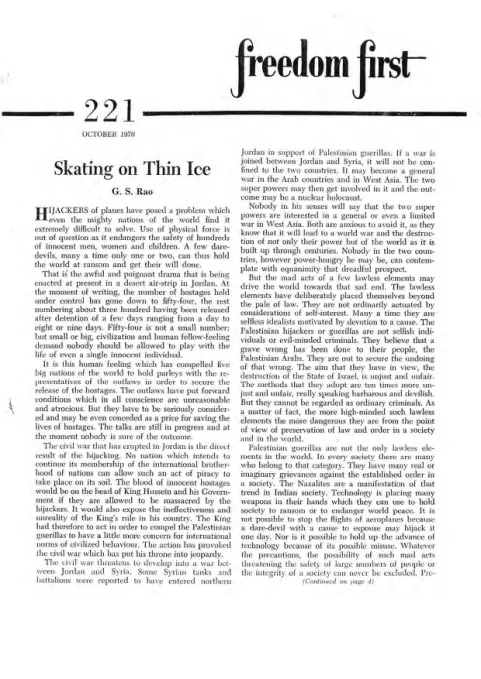
periodical issue
Freedom First
By S. V. Raju, C. S. Venkatachar
Edited and published for the Democratic Research Service by V. B. Karnik at 127 Mahatma Gandhi Road, Bombay 1, and printed by him at Inland Printers, 55 Camdevi Road, Bombay 7. · Bombay · 1970
12 pages
Freedom First
Summary
Freedom First No. 223 (December 1970), published by the Democratic Research Service, Bombay, opens with S. V. Raju’s analysis of the fractured opposition politics of late 1970, arguing that a genuine democratic alliance against the Congress(R) and Mrs. Gandhi’s drift toward Communist-backed rule is both necessary and, given rival factions among the Congress(O), Swatantra, Jana Sangh, and socialist parties, difficult to realise. C. S. Venkatachar contributes a constitutional-law analysis of Article 356’s history and abuse as a tool of central political control over the states. The issue also carries a eulogy-obituary of Gamal Abdul Nasser by Adam Adil and V. B. Karnik’s review-essay on Robert Payne’s biography of Stalin, alongside a Bengal political report on rising political violence, a letter to the editor on industrial absenteeism, two book reviews, a reprinted article on Lenin’s Comintern tactics, and a closing page of quoted press excerpts (“With Many Voices”).
Key points
-
S. V. Raju’s “The Need for an Alliance” surveys the fractured opposition, arguing the real danger to India’s institutions comes from Congress(R)‘s toleration of CPI support and attacks on the judiciary, and that a Grand Alliance is necessary to prevent a Communist-backed coalition from taking power.
-
C. S. Venkatachar’s “Article 356 - Use And Abuse” traces the provision to Section 93 of the 1935 Government of India Act, cataloguing nearly a dozen invocations since Independence used to manipulate state party factions rather than resolve genuine deadlock.
-
Adam Adil’s eulogy for Gamal Abdul Nasser credits him with giving the Arab world “a sense of dignity, unity and purpose,” weighing the Suez nationalisation and Aswan Dam against the costly, divisive war in Yemen.
-
V. B. Karnik reviews Robert Payne’s The Rise and Fall of Stalin, quoting its verdict that Stalin “killed without compunction and without enjoyment,” and tracing collectivisation’s roughly ten million peasant deaths and the purges of Old Bolsheviks.
-
Writing as “Analyst,” “Vicious Circle?” warns of a self-reinforcing cycle of political violence in West Bengal in which police repression breeds youth alienation and further recruitment into Naxalite movements, calling for a “positive psychological, healing approach” instead.
-
A reprinted article by Marcel Body recounts how Lenin’s Comintern deliberately split Western European socialist parties in the 1920s, judging Mussolini’s fascism “preferable” to Italian socialism and thereby helping clear the path for Mussolini and, later, Hitler.
-
Reviews cover P. Spratt’s D.M.K. in Power, tracing the party’s roots to the Justice Party and Periyar’s Self-Respect movement, and a study of the Green Revolution’s benefits confined to about 20% of irrigated wheat- and gram-growing areas.
Essays
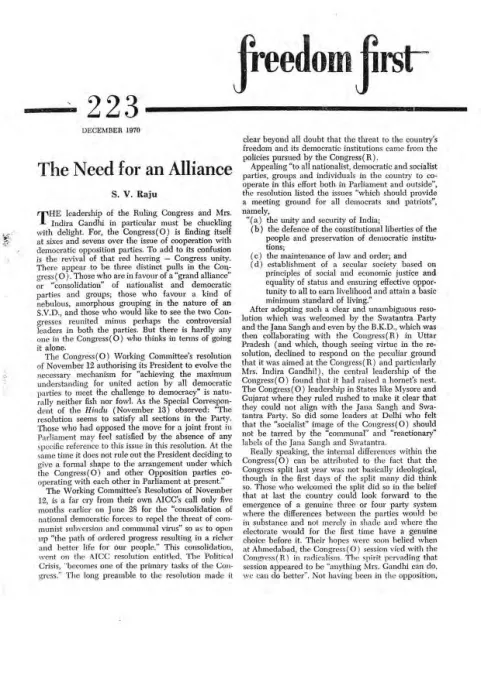
The Need for an Alliance
By S. V. Raju
S. V. Raju surveys the confused state of opposition politics in India in late 1970, arguing that the Congress(O) is paralysed by three competing visions of realignment: a full ‘grand alliance’ with Swatantra and the Jana Sangh, a vague new grouping, or reunification with the ruling Congress(R). He traces the Congress(O) Working Committee’s November 12 resolution back to the AICC’s earlier call for ‘consolidation of national democratic forces’ and argues the split within the Congress(O) was never ideological but factional. Raju contends that the real danger to India’s democratic institutions comes from the policies of Congress(R) under Mrs. Gandhi, whose government tolerates and even benefits from Communist Party of India support, undermines law and order, attacks the judiciary, and rides roughshod over Parliament (citing the Privy Purses Bill). He surveys which parties would or would not join a broad alliance (SSP, Praja Socialist Party, PSP, BKD) and closes by citing Rajaji’s warning in Swarajya against DMK cooperation with the ‘topsy turvy Indira Gandhi Congress and the CPI’, and K. Kamaraj’s defence of Swatantra’s patriotism, concluding that a Grand Alliance is necessary to prevent a Communist-backed coalition from taking power at the Centre.
- The Congress(O) is split three ways over whether to pursue a ‘grand alliance’, a looser grouping, or reunification with Congress(R).
- The Congress(O) Working Committee resolution of 12 November 1970 authorised its President to seek ‘united action by all democratic parties’ but was deliberately vague.
- Swatantra and the Jana Sangh welcomed the proposed alliance resolution; the BKD saw merit in it but declined to respond, believing it aimed at Congress(R) and Mrs. Gandhi.
- Raju argues the 1969 Congress split was factional rather than ideological, evidenced by the Congress(O)‘s own radicalism at its Ahmedabad session.
- Mrs. Gandhi’s government is charged with tolerating and benefiting from CPI support, undermining law and order, and threatening judicial and constitutional norms.
- Kamaraj and Rajaji’s public statements are cited as evidence that Swatantra and allied leaders share patriotic motives despite ideological differences with the DMK and Congress(R).
- Raju warns that failure to form the alliance risks a Congress(R)-Communist coalition at the Centre after the next general election, drawing a parallel to postwar Communist takeovers in Eastern Europe.
Article 356 - Use And Abuse
By C. S. Venkatachar
C. S. Venkatachar traces Article 356 of the Constitution to its colonial-era ancestor, Section 93 of the Government of India Act 1935, arguing that Congress inherited and then exploited this emergency power once it had ‘flattened out the opposition parties’ after 1937. He explains that while the Constitution provides for four types of national emergency, Article 356 was developed as a fifth, distinct tool aimed specifically at securing the dominant Congress party’s hold on the states, exploited through devices like Governor’s reports, floor-crossing, and factional manipulation rather than through the legislature itself. Venkatachar catalogues nearly a dozen invocations of Article 356 since the Constitution’s commencement, from Punjab (1951) and Pepsu (1952) through Kerala, Andhra, Orissa, Rajasthan, and Haryana, describing them as instances where central authority was used to manipulate state party factions rather than resolve genuine constitutional deadlock. He concludes that only eternal public vigilance, and ultimately appeal to the electorate, can check such misuse, and that resort to Article 356 should be a last resort under exceptionally compelling circumstances only.
- Article 356 descends directly from Section 93 of the Government of India Act, 1935, which the British used only once in six years but which Congress has invoked repeatedly.
- The Constitution provides four national emergency powers (war, insurrection, subversion, financial collapse); the failure of state constitutional machinery is a distinct fifth category exploited by the ruling party.
- Congress developed the practice of confusing unwritten British constitutional conventions with the rigid provisions of India’s written constitution, exporting a two-party assumption to a multi-party reality.
- The state legislature — the body that should confirm claims to a majority — has been bypassed in practice through devices like ‘counting of heads at Raj Bhavan’ and parading of legislators.
- Article 356 has been invoked nearly a dozen times since the Constitution’s commencement, starting in Punjab in 1951, and repeatedly in Kerala, Andhra, Orissa, Rajasthan, Haryana, and Pepsu.
- Venkatachar argues eternal vigilance by informed public opinion, and ultimately electoral appeal, are the only real safeguards against misuse of Article 356.
- He recommends Article 356 be treated strictly as a last resort under exceptionally compelling circumstances.
Gamal Abdul Al-Nasser
By Adam Adil
Adam Adil’s eulogy assesses Gamal Abdul Nasser roughly a month after his death, describing him as a dynamic but polarising leader who gave the Arab world ‘a sense of dignity, unity and a sense of purpose’ after centuries of stagnation traced back to Ottoman rule. Adil recounts Nasser’s rise from a resentful army colonel under the corrupt monarchy of King Farook to leader of the bloodless 1952 revolution, and his subsequent land reforms breaking up the Pasha landholding class. The piece weighs mixed economic achievements — the Suez Canal nationalisation and the Aswan High Dam — against costly failures, including the war in Yemen against the Imam and the broader division of the Arab world into ‘progressive’ and ‘reactionary’ camps that Adil argues only strengthened Israel. Nasser is credited with resisting Soviet political domination despite military dependence on Russia, and with brokering a settlement between Palestinian fedayeen and King Hussein of Jordan shortly before his death. Adil closes by quoting Professor Elie Salem’s assessment that Nasser’s significance lay ‘not so much what he did, but what he meant to the Arab people.’
- Nasser is credited with giving the Arab world a renewed sense of dignity, unity, and purpose after centuries of post-Ottoman stagnation.
- He rose to power via the bloodless 1952 overthrow of the corrupt monarchy of King Farook, alongside trusted fellow army officers.
- His land reforms abolished the Pasha landholding class and capped land ownership at 200 acres, redistributing land to landless peasants.
- Major achievements credited to Nasser: nationalisation of the Suez Canal and construction of the Aswan High Dam with Soviet help.
- His division of the Arab world into ‘progressive’ and ‘reactionary’ camps (including a costly, failed war in Yemen against the Imam) is presented as a major strategic failure that weakened Arab unity and strengthened Israel.
- Despite heavy military dependence on Soviet arms and personnel, Nasser resisted Soviet political ideology and banned the Communist Party in Egypt.
- His last major achievement was brokering peace between Palestinian commandos and King Hussein’s Jordanian army.
Portrait Of A Tyrant
By V. B. Karnik
V. B. Karnik reviews Robert Payne’s biography ‘The Rise and Fall of Stalin,’ calling it a meticulously documented, full-scale portrait corroborating the by-then widely accepted verdict — voiced first in Khrushchev’s 1956 secret speech — that Stalin was history’s most malignant tyrant. Karnik traces Stalin’s path from a cobbler’s son and minor Georgian communist functionary through the 1921 invasion of Georgia, his manoeuvring for bureaucratic control after the 1917 Revolution despite an insignificant role in it, and his accumulation of power through control of the party machinery, ultimately outlasting Lenin’s late-life effort (via his suppressed Testament) to remove him. The review details the terror of forced collectivisation (ten million peasant deaths), the purges of Old Bolsheviks including Trotsky, Zinoviev, Kamenev, and Bukharin, the show-trial confessions extracted under torture, the execution of Red Army generals on the eve of World War II, and the invented ‘Doctors’ Plot’ targeting Jewish physicians near the end of Stalin’s life. Karnik notes Payne’s argument that this terror system was rooted in, not invented by, Leninist ideology, but that Stalin’s mechanical, murderous habit exceeded any political necessity, concluding the review (continued from page 8 onto page 11) with an assessment of Stalin’s mixed legacy: real industrial and wartime achievements set against the annihilation of rights, liberties, and millions of lives.
- The review covers Robert Payne’s ‘The Rise and Fall of Stalin’ (Simon and Schuster, New York, $10), a seven-hundred-page biography spanning Stalin’s full 73-year life.
- Payne’s verdict, quoted at length, is that Stalin was a unique species of mass-murderer who ‘killed without compunction and without enjoyment,’ often out of habit or laziness rather than political need.
- Stalin’s 1921 revenge invasion of Georgia and the destruction of its ‘moderate socialist’ government are presented as an early template for his later terror.
- Stalin rose to dominance not through revolutionary prominence (his role in 1917 was ‘insignificant’) but through control of the party’s bureaucratic apparatus, becoming Commissar of Nationalities and later General Secretary.
- Lenin’s suppressed Testament reveals he lost confidence in Stalin late in life and wished to remove him from power, a wish frustrated by Lenin’s death.
- Collectivisation killed roughly ten million peasants; subsequent purges destroyed the Old Bolshevik leadership and Red Army generals through forced, torture-extracted confessions.
- Payne argues the terror system’s ideological roots lie in Leninism itself, with Stalin as its most extreme executor.
- The review continues onto page 11 with a discussion of Stalin’s 1953 death, the temporary post-Stalin de-Stalinisation movement, and its failure or suppression in Hungary and Czechoslovakia.
Vicious Circle? (Bengal Report)
By Analyst
Writing under the byline ‘Analyst’ in the ‘Bengal Report’ column, this piece (dated 21 November 1970) warns of a self-reinforcing cycle of political violence in West Bengal: daily murders, police reprisal round-ups, and the resulting alienation of youth and their families, which in turn feeds recruitment into ‘revolutionary’ Naxalite and Marxist movements. The author argues that neither strong administrative measures nor police powers alone can break this vicious circle, and that the fragmentation of the state’s opposition parties (Congress(R), Bangla Congress, Forward Bloc, RSP, CPI, CPM) will further isolate the government from popular sentiment. The piece calls instead for a ‘positive psychological, healing approach’ to disaffected youth, criticizing establishment figures (including Chief Minister Ajoy Mukherjee) for offering only ‘paper talk’ and rhetoric of matching violence with violence, and argues that only committed personal leadership capable of emotionally engaging youth can address what the author calls a widespread ‘mental illness,’ rather than physical beating or repression alone.
- Daily political murders in West Bengal go unwitnessed due to public terror and a ‘see no evil’ silence.
- Police crackdowns are predicted to sweep up many innocents alongside the guilty, embittering families and communities.
- The cycle described: police repression breeds youth alienation, which breeds recruitment into Naxalite/Marxist movements, which breeds further repression.
- Opposition fragmentation (Congress(R), Bangla Congress, Forward Bloc, RSP, CPI moving closer to CPM) will further isolate the administration from the people.
- The author is not opposed to strong measures per se, but rejects relying on them ‘practically entirely’ to solve the crisis.
- Calls for personal, emotionally engaging leadership (contrasted with ‘paper Gandhism’) to break through what is described as a form of collective ‘mental illness’ among radicalized youth.
Letter to the Editor (re: Monograph on Absenteeism)
By N. M. Vakil
A letter to the editor from N. M. Vakil, Secretary of the Employers’ Federation of India, responds to the magazine’s October 1970 review of a monograph on industrial absenteeism. Vakil clarifies the monograph’s statistics on Badli (substitute), temporary, and casual employment, arguing that the ~26% non-permanent workforce reflects high absenteeism among permanent staff rather than deliberate avoidance of permanent hiring, and that if absenteeism fell, permanent employment share would rise correspondingly. An editorial rejoinder signed V.B.K. follows, questioning whether the 70% absenteeism figure cited is fully ‘authorised’ absenteeism.
- Vakil defends the Employers’ Federation of India monograph’s finding that ~74% of surveyed industrial employees are permanent, with the remainder Badli, temporary, or casual workers.
- He argues non-permanent employment exists to cover absenteeism among permanent staff, not to avoid permanent hiring obligations.
- Vakil calculates that if absenteeism were eliminated, permanent worker share would rise to about 89%.
- An editorial reply (V.B.K.) questions the premise, noting that if leave reserves already cover 70% of absenteeism ‘authorised’, the required Badli workforce should be smaller than currently maintained.
Reviews: D.M.K. in Power (P. Spratt)
By N.D.
Two short book reviews appear under the ‘Reviews’ heading. N.D. reviews P. Spratt’s ‘D.M.K. in Power’ (Nachiketa Publications, Rs. 25), praising its account of the DMK’s first year in office in Tamil Nadu after the fourth General Election and its historical tracing of the party’s roots to the Justice Party and Periyar Ramaswami Naicker’s Self-Respect movement, while noting the book covers only the DMK’s first year and does not address the period after the death of C. N. Annadurai. S.D. reviews ‘Studies in Green Revolution,’ edited by G. S. Pohekar (United Asia Publications, Rs. 5), a slim volume of six scholarly essays describing the Green Revolution’s real but geographically and crop-limited impact, confined largely to the 20 per cent of irrigated wheat- and gram-growing areas.
- N.D. reviews P. Spratt’s ‘D.M.K. in Power,’ noting the DMK provided stable, efficient government in Tamil Nadu despite losing leader C. N. Annadurai before completing its second year in office.
- Spratt’s book traces DMK’s roots to the Justice Party of the 1920s-30s and the Self-Respect movement led by Periyar Ramaswami Naicker.
- N.D. suggests the book’s model could be useful for studying other regional parties given the growing significance of regionalism in Indian politics.
- S.D. reviews ‘Studies in Green Revolution’ (ed. G. S. Pohekar), noting the Green Revolution’s benefits are largely confined to about 20% of irrigated wheat and gram-growing area.
- S.D. concludes the volume is useful for stimulating thought and action toward spreading agricultural gains to wider areas and other crops.
Reviews: Studies in Green Revolution (ed. G. S. Pohekar)
By S.D.
A reprinted article by Marcel Body, originally published in the weekly journal Thought and introduced as coming from someone ‘intimately connected with the Comintern in its early years,’ recounts how Lenin’s Russian Communist Party used specially trained agents and ample funds to intervene in the workers’ movements of Western Europe in the early 1920s, deliberately engineering splits in parties like the Italian Socialist Party (‘Turati’s party’). Body recounts Lenin’s blunt 1919 reply to Angelica Balabanova’s objections about sending adventurers to split Italian socialism, and describes how the Comintern, in judging Mussolini’s fascism ‘preferable’ to Turati’s socialism in the early 1920s, helped clear the way first for Mussolini and later — through the same ruthless anti-Social-Democrat strategy pursued in Germany — for the rise of an outsider named Adolf Hitler.
- The Russian Communist Party sent specially trained agents with ample funds abroad to intervene in the workers’ movements of the Second International, defeating Western Social Democracy ‘at any price’.
- Lenin held the ‘whip hand’ in the split between Second and Third International-affiliated parties.
- In 1919, Lenin dismissed Angelica Balabanova’s concerns about sending unreliable men to Italy to split the Italian Socialist Party (‘Turati’s party’), saying ‘they will always be good enough to split Turati’s party.’
- The Italian Socialist Party split, but Body notes it was Mussolini, not Togliatti, who benefited from putting the pieces back together.
- In Moscow in 1921 and after, the Comintern judged Mussolini’s fascism preferable to Turati’s socialism, believing fascism would ‘prepare the way for Communism.’
- The same ruthless anti-Social-Democrat strategy in Germany is presented as having cleared the political arena for the rise of Adolf Hitler.
Lenin’s Whip Hand
By Marcel Body
The closing page, ‘With Many Voices,’ is a compilation of short quoted excerpts from contemporary press and public figures on themes of Cold War politics, Communism, land reform, and Indian governance, drawn from sources including Time, The Economist, The Statesman, and statements by figures such as British PM Edward Heath, J. R. Jayawardena, and Norman Borlaug. The page closes with a subscription form for Freedom First and the issue’s colophon, naming V. B. Karnik as editor and publisher for the Democratic Research Service.
- Compiles brief quotations on Cold War and domestic political themes from sources like Time, The Economist, The Statesman, and March of the Nation.
- Includes Edward Heath’s warning that civil war, not war between nations, will be the main danger of the coming decade.
- Includes a Jan Sangh Central Working Committee resolution accusing the Indian government of aligning with ‘every other blackmailing country’ between Mao and Kosygin.
- Includes Norman Borlaug’s (1970 Nobel Peace laureate) comment that the Green Revolution buys time against the larger problem of overpopulation but cannot solve world nutrition alone.
- Closes with a subscription form addressed to Freedom First, C/o Democratic Research Service, 127 Mahatma Gandhi Road, Bombay 1, and the issue’s publication colophon naming V. B. Karnik as editor/publisher.
Generated by the v1.5 extraction pipeline. Awaiting editorial review.
Metadata and summary are AI-extracted from the source PDF and reviewed for editorial accuracy. The original work is available via the Read PDF tab above (where present); paragraph-level citation inside the PDF is deferred to a future engagement.