periodical issue
Freedom First
By Adam Adil, A. G. Mulgaokar, S. R. Mohan Das, V. B. Karnik, Anatole Shub, K. K. Sinha, A. G. Noorani, V. B. Patankar
Edited and published for the Democratic Research Service by V. B. Karnik at 127 Mahatma Gandhi Road, Bombay 1, and printed by him at Inland Printers, 55 Camdevi Road, Bombay 7. · Bombay · 1971
12 pages
Freedom First
Summary
Freedom First No. 224 (January 1971), edited and published by V. B. Karnik for the Democratic Research Service, Bombay, opens with commentary on the December 1970 Pakistani general elections and their implications for the country’s unity, then turns to the Indian Supreme Court’s privy purses judgement as a landmark statement of the rule of law against executive claims of paramountcy. A tribute marks C. Rajagopalachari’s ninety-second birthday, followed by pieces on the December 1970 Baltic-coast workers’ revolt in Poland and on Andrei Amalrik’s dissident essay on the Soviet Union’s prospects. K. K. Sinha’s essay argues for a coherent policy platform to unite India’s non-Left opposition parties (Congress(O), Swatantra, Jana Sangh) against the ruling Congress and the Left. The issue closes with book reviews (Archibald Cox’s study of the Warren Court; a study of Ceylon’s parliamentary democracy) and the recurring ‘With Many Voices’ column of press quotations, alongside a subscription form.
Key points
-
Adam Adil surveys Pakistan’s first general elections on adult franchise, concluding they entrenched two irreconcilable nationalisms, Bengali autonomy under Sheikh Mujibur Rehman and Zulfikar Ali Bhutto’s centralising West Pakistan politics, leaving the question no longer whether Pakistan will survive as a democracy but whether it will survive as one entity.
-
A. G. Mulgaokar’s “Ultra Vires” analyses the Supreme Court’s judgment striking down the abolition of privy purses, reading it as reaffirming that no authority, including the Government, stands above the Rule of Law and rejecting the Attorney-General’s claim of unreviewable presidential “paramountcy.”
-
S. R. Mohan Das pays tribute to C. Rajagopalachari on his ninety-second birthday, recalling how as Chief Minister of Madras he reformed a lax Secretariat through personal example rather than formal edicts.
-
V. B. Karnik’s “Revolt In Poland” analyses the December 1970 Baltic-coast workers’ revolt over food prices, which forced the resignation of Party leader Gomulka despite brutal suppression, situating it within a recurring pattern of communist-bloc unrest from Poznan 1956 to Czechoslovakia 1968.
-
Anatole Shub reviews Andrei Amalrik’s banned essay “Will the Soviet Union Survive Until 1984?,” discussing Amalrik’s forecasts of anti-Russian nationalist unrest and possible imperial disintegration in the event of a Sino-Soviet war.
-
K. K. Sinha’s “Strategy For Democracy” argues the Indian Right needs a clear ideological platform combining a growth-oriented economy, honest land reform, rule of law and non-aligned foreign policy to unite Congress(O), Swatantra and Jana Sangh against the Left.
-
A. G. Noorani reviews Archibald Cox’s The Warren Court, highlighting its relevance to Indian debates about banning organisations via the Court’s protection of dissenting associations’ membership lists.
Essays
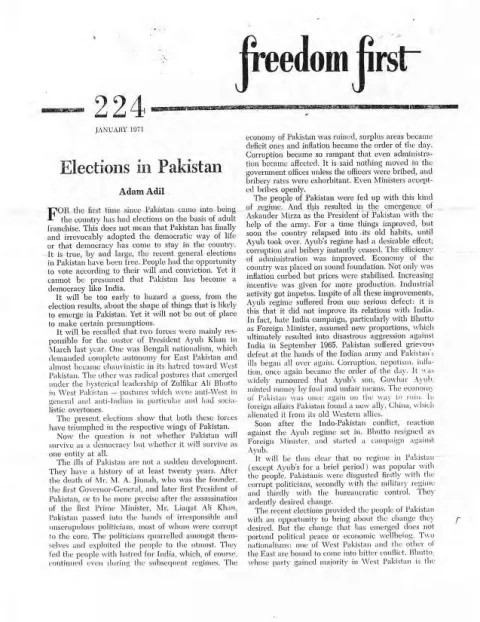
Elections in Pakistan
By Adam Adil
Adam Adil surveys Pakistan’s first general elections held on adult franchise, arguing that while the polls were largely free, they do not mean Pakistan has become a stable democracy like India. He traces Pakistan’s troubles to two decades of corrupt and unscrupulous political leadership after Jinnah’s death and Liaquat Ali Khan’s assassination, the anti-India campaigns that culminated in the 1965 war, and Ayub Khan’s mixed legacy of administrative efficiency undone by his failure to improve relations with India. The election results show two triumphant but irreconcilable nationalisms - Bengali autonomy under Sheikh Mujibur Rehman in the East, and Zulfikar Ali Bhutto’s anti-West, anti-India, semi-socialist politics in the West - leading the author to conclude that the real question is no longer whether Pakistan will survive as a democracy but whether it will survive as one entity at all.
- Pakistan’s December 1970 elections were the first held on adult franchise and were largely free, but this does not signal a durable democratic transition.
- Two decades of corrupt, quarrelling politicians after Jinnah’s death and Liaquat Ali Khan’s assassination discredited civilian rule.
- Ayub Khan’s regime curbed corruption and stabilised the economy but worsened relations with India, culminating in the 1965 war.
- Post-1965, Bhutto resigned as Foreign Minister and built a campaign against Ayub combining anti-West and anti-India postures with socialist overtones.
- The elections entrenched two irreconcilable nationalisms: Bengali autonomy in the East under Mujibur Rehman, and Bhutto’s centralising West Pakistan politics.
- The author predicts bitter conflict between the two wings and doubts a constitution can be agreed within the mandated 120 days.
Ultra Vires
By A. G. Mulgaokar
A. G. Mulgaokar analyses the Supreme Court’s judgement striking down the government’s derecognition of the former princes and abolition of their privy purses. He reads the ruling as reaffirming that no person or authority in India, including the Government, is above the Rule of Law, and as rejecting the Attorney-General’s claim that the President could exercise unreviewable ‘paramountcy’ or act-of-State powers against citizens. The article walks through the Court’s reasoning on Articles 291, 362, 363 and 366(22): that Britain’s paramountcy lapsed at independence and was never inherited by the Indian government, that the right to a privy purse is a fundamental property right rather than a matter arising from covenant (and so not barred from judicial review by Article 363), and that presidential ‘recognition’ of a ruler cannot be withdrawn as an executive fiat without basis in law. It closes by noting Mr. Justice Hegde’s concurring view that the Constituent Assembly’s guarantees to the princes were meant as genuine, binding commitments rather than an illusion.
- The Supreme Court’s privy purses judgement re-emphasised established principles rather than announcing wholly new law.
- The Court held that no person or authority, including the Government, stands above the Rule of Law.
- The Attorney-General’s claim of unreviewable presidential ‘paramountcy’ or act-of-State power against citizens was rejected as fantastic given that British paramountcy lapsed at independence.
- The right to a privy purse was held to be a fundamental property right under Articles 19(1)(f) and 31, not a claim arising out of covenant, so Article 363 did not bar judicial review.
- The majority held presidential recognition of a ruler cannot be withdrawn without legal basis, and that the President’s actions are always subject to judicial testing unless expressly excluded.
- Justice Hegde’s judgement is described as particularly forthright, holding that the constitutional guarantees to princes were meant as real, binding assurances, not illusions.
Rajaji - Ninety Two Years Young
By S. R. Mohan Das
S. R. Mohan Das pays tribute to C. Rajagopalachari on his ninety-second birthday, marvelling at his continuing intellectual vitality, discipline, and engagement with contemporary politics, religion, and philosophy despite serious physical handicaps including very poor eyesight. The author, recalling his own experience as a journalist granted an 8 a.m. appointment with Rajaji when he was Chief Minister of Madras during a severe drought, describes how Rajaji imposed self-discipline on a lax Secretariat simply by his own early arrival and personal example rather than by formal orders, transforming administrative performance through leadership without oppression.
- Rajaji is praised for extraordinary intellectual and physical vitality at 92 despite poor eyesight and other handicaps.
- Critics have called him opportunistic or ‘foxy’, but the author sees a constant thread of value norms across his long public life.
- As Chief Minister of Madras during a severe seven-year drought, Rajaji reformed a lax Secretariat by personal example rather than formal edicts, starting work at 8 a.m. himself.
- This produced a chain reaction of improved discipline and productivity throughout the administration within about a week.
- The author holds this up as a rare example in Indian politics of leadership achieved without oppression.
Revolt In Poland
By V. B. Karnik
V. B. Karnik analyses the December 1970 workers’ revolt in the Polish port cities of Gdansk, Gdynia and Szczecin, sparked by a steep rise in foodstuff prices and wage freezes intended to curb an underlying economic crisis. He recounts how the revolt, though suppressed with brutal police and army violence, forced the resignation of Party leader Wladyslaw Gomulka (himself a beneficiary of the 1956 Poznan uprising) along with the Head of State and Prime Minister, with power passing to the reputedly efficient but hard administrator Gierek. Karnik situates the revolt within a recurring pattern of communist-bloc unrest - Poznan 1956, Hungary 1956, Czechoslovakia 1968 - arising from an inherent contradiction between the people’s aspirations and the demands of one-party dictatorship, arguing that such revolts, even when suppressed, cannot permanently extinguish popular discontent under communist rule.
- The revolt began among workers in Gdansk, Gdynia and Szczecin over a steep rise in food prices, spreading to Wroclaw, Poznan and Cracow with student and youth support.
- It was suppressed with brutal violence by police and army but nonetheless forced the resignation of Gomulka and the Head of State and Prime Minister.
- Poland’s economic crisis stemmed from a shortfall in foodstuff exports (its main source of foreign exchange) compounded by falling agricultural production and rising internal consumption.
- Karnik frames the unrest as part of a recurring pattern across the communist bloc: Poznan 1956, the Hungarian revolt of 1956, and the Czechoslovak reforms crushed in 1968.
- He argues communist political-power priorities structurally conflict with economic modernisation, since regimes fear losing control if they grant industrial managers and skilled workers real autonomy.
- The piece closes arguing that popular discontent under communist dictatorships can be suppressed but never permanently removed.
Andrei Amalrik And Future Of Russia
By Anatole Shub
Anatole Shub, a journalist and personal friend of Andrei Amalrik, offers a personal appraisal of Amalrik’s banned essay ‘Will the Soviet Union Survive Until 1984?’. Shub praises the essay for its freedom from both official pro-regime illusions and Western populist sentimentality about Soviet workers and peasants, and reflects on Amalrik’s unusual position as a Moscow intellectual with deep, independently-developed knowledge of Western thought despite the KGB’s isolation of Soviet citizens (Amalrik’s apartment was searched in May 1969 amid a broader crackdown on Russian dissidents). Shub is somewhat less pessimistic than Amalrik about the evolution of the tolerated Soviet intelligentsia, expects discontent to spread from literary circles to the scientific and technical intelligentsia and eventually the Party itself, and discusses Amalrik’s forecasts of anti-Russian nationalist unrest and possible disintegration of the Soviet empire in the event of a Sino-Soviet war, which Shub finds more plausible regarding Eastern Europe than regarding the internal Soviet nationalities.
- Amalrik’s essay is praised for being free of both official Soviet illusions and Western sentimentality about Soviet workers and peasants.
- Amalrik’s apartment was searched by the KGB on 7 May 1969 amid a broader crackdown on Russian democrats, interrupting his plan to write a full-length book.
- Shub is less pessimistic than Amalrik about the pace of change but expects Soviet discontent to spread from literary circles to the scientific/technical intelligentsia and eventually into the Party.
- Amalrik forecasts anti-Russian nationalist movements growing among Soviet peoples, driven by resentment of Tsarist and Soviet-era Russian dominance.
- Shub finds Amalrik’s prediction of the loss of Eastern European protectorates more credible than his prediction of the internal Soviet Union being torn apart by its nationalities.
- Both writers consider a Sino-Soviet war a plausible trigger for imperial disintegration, though Shub questions whether China will remain as internally dogmatic and internationally isolated as under Mao within a decade.
Strategy For Democracy
By K. K. Sinha
K. K. Sinha argues that with Indira Gandhi’s Congress split and the opposition Congress(O), Swatantra and Jana Sangh trying to build an anti-Congress(N) alliance, the Indian Right urgently needs a clear, positive ideological platform rather than merely opposing the ruling party or courting confusion by calling itself ‘progressive’. He contrasts the Left’s programme - expanding state ownership and control over industry, trade, transport, credit and agriculture, detailed planning, populist and anti-religious politics, and growing dependence on the Soviet Union - with a proposed Right platform: a growth-oriented economy favouring savings, investment and enterprise while preventing monopoly; support for infrastructure and employment-generating projects; honest land reform that promotes rather than hampers agricultural production; firm commitment to the Rule of Law, judicial independence, and the Constitution; state impartiality between religions; a creative federal system balancing a strong Centre with capable states; and a foreign policy of non-alignment rather than dependence on either superpower. He urges the three rightist parties to agree on this substantive programme rather than focus solely on organisational and electoral tactics.
- The article argues the Indian Right needs a clear, agreed ideological platform, not just anti-Congress(N) electoral tactics.
- The Left’s programme is characterised as expanding state ownership and control across industry, trade, transport, credit and agriculture, detailed planning, and growing dependence on the Soviet Union.
- The proposed Right platform calls for a growth-oriented economy favouring savings, investment, and enterprise, while preventing monopoly and minimising unnecessary controls.
- It calls for honest land reforms that promote rather than hamper agricultural production, and credit/finance availability for agriculture and small industry.
- Politically, it calls for firm commitment to Rule of Law, judicial independence, constitutional government, and state impartiality between religions.
- In foreign policy it calls for a non-satellite, non-aligned, independent Indian role rather than dependence on either superpower.
- The author argues a clear, popularised manifesto could draw non-aligned Congress(N) supporters uncomfortable with reliance on communists toward the Right.
Reviews: The Warren Court - Constitutional Decision as an Instrument of Reform (Archibald Cox)
By A. G. Noorani
A. G. Noorani reviews Archibald Cox’s ‘The Warren Court: Constitutional Decision as an Instrument of Reform’ (Harvard University Press), a set of lectures by the former U.S. Solicitor-General surveying the Warren Court’s transformative rulings from 1953-1968 on race relations (extending Brown v. Board of Education’s logic against private discriminatory action, later mooted by the Civil Rights Act 1964), criminal justice (right to counsel and transcripts at state expense, exclusion of unlawfully obtained evidence and wiretap evidence), and freedom of association (protecting membership lists of dissenting organisations from compelled disclosure). Noorani highlights the review’s relevance to India given contemporary talk of banning organisations, quoting the Court’s warning against suppressing ‘heretics’ whose value is rarely apparent except in rare cases, and Cox’s own reflections on the insoluble tension in constitutional adjudication between what the law requires and what result is best for the country. He also notes Justice Frankfurter’s dissent that the Warren Court risked overreaching into politics via the reapportionment cases, and closes hoping U.S. constitutional experience, where court appointments are still made on political considerations without impugning judicial integrity, might serve India as a lesson rather than precedent for degradation.
- Cox’s book, based on lectures, surveys the Warren Court’s constitutional-reform rulings 1953-1968 on race, criminal justice, and political democracy.
- The Court extended Brown v. Board of Education to cover private discriminatory action with a public aspect, a move later made less necessary by the Civil Rights Act of 1964.
- In criminal law, the Court established a right to state-funded counsel for the poor, restricted unlawfully obtained and wiretap evidence, and rewrote the law of confessions in favour of the accused.
- The Court protected the right of dissenting associations to withhold membership lists from official scrutiny absent a demonstrated state need, which Noorani flags as relevant to Indian debates about banning organisations.
- The Re-Apportionment cases, ruling that equality before law requires equal representation in state legislatures, were among the Court’s most controversial decisions and drew a dissent from Justice Frankfurter.
- Noorani closes hoping India can learn from, without simply importing, the U.S. experience of political considerations in judicial appointments alongside preserved judicial integrity.
Reviews: The Working of Parliamentary Democracy in Ceylon (A. R. Tyagi and K. K. Bhardwaj)
By V. B. Patankar
V. B. Patankar reviews ‘The Working of Parliamentary Democracy in Ceylon’ by A. R. Tyagi and K. K. Bhardwaj (Sultan Chand and Sons, Delhi), which describes Ceylon’s British-legacy parliamentary system: a Governor-General representing the Crown with largely symbolic ceremonial powers, a Prime Minister who is the real locus of executive power, a bicameral legislature with a partly-elected Senate, loose and undisciplined Ceylonese political parties prone to defections, and a tradition (except for Mrs Bhandaranaike’s 1960 government) of coalition rule. Patankar notes the book credits the late S. W. R. D. Bandaranaike as architect of Ceylon’s modern local government system and praises Ceylon’s record of half a dozen free and orderly elections and its strong, independent judiciary and civil service, while criticising the book itself for repetitiveness and some contradictory statements.
- The reviewed book covers Ceylon’s British-legacy parliamentary system, including the largely ceremonial Governor-General and the Prime Minister as the true locus of executive power.
- Ceylonese parties are described as loose, undisciplined organisations prone to defections, with personalities counting for more than principles.
- Except for Mrs Bhandaranaike’s 1960 government, all Ceylonese governments have been coalitions.
- The book credits the late S. W. R. D. Bandaranaike as the architect of Ceylon’s modern local government system.
- Patankar praises Ceylon’s record of half a dozen free, orderly elections under adult suffrage and its independent judiciary and civil service.
- The review criticises the book for repetition and apparently contradictory statements in places.
Generated by the v1.5 extraction pipeline. Awaiting editorial review.
Metadata and summary are AI-extracted from the source PDF and reviewed for editorial accuracy. The original work is available via the Read PDF tab above (where present); paragraph-level citation inside the PDF is deferred to a future engagement.