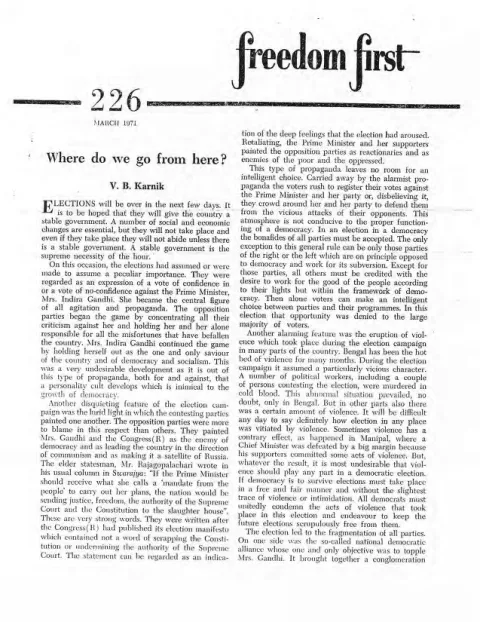
periodical issue
Freedom First
Edited and published for the Democratic Research Service by V. B. Karnik at 127 Mahatma Gandhi Road, Bombay 1, and printed by him at Inland Printers, 55 Gamdevi Road, Bombay 7. · Bombay · 1971
12 pages
Freedom First
Summary
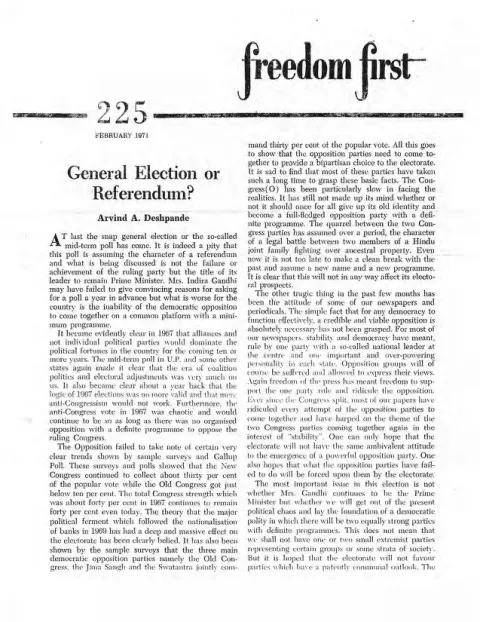
Freedom First No. 225 (February 1971) appears amid the run-up to India’s 1971 snap general election, and the issue’s editorial voice frames that election as effectively a referendum on Indira Gandhi’s leadership rather than a genuine contest of programmes. Arvind A. Deshpande’s lead article argues the fragmented opposition (Old Congress, Jana Sangh, Swatantra) must unite around a common minimum programme if it hopes to check the ruling Congress, and lays out an eight-point liberal-opposition platform. The Notes section comments on the Commonwealth’s survival past the Singapore crisis, on the prospects for a democratic constitution emerging in Pakistan after its first post-Independence elections, and sharply criticises the government’s mass arrests and externment of Plebiscite Front workers ahead of the Jammu and Kashmir Lok Sabha election as an assault on free and fair polling. M. D. Kini surveys threats to press freedom in India (government control of newsprint and advertising, the Tribune case) as building blocks of a functioning democracy, while N. A. Palkhivala, in excerpts from a Bombay lecture, defends the fundamental right to property against moves to empower Parliament to abridge it, drawing on the Supreme Court’s Privy Purses judgment. The issue also runs an extended extract from Khrushchev Remembers on Stalin’s court and the terror of collectivisation, a short review of a book on the ILO, a Without Comment item on the Patrice Lumumba University’s role in Soviet propaganda training, a reader’s letter calling for a positive political alternative for disaffected youth, and the regular ‘With Many Voices’ page of quotations from the press on the coming election.
Key points
-
Arvind A. Deshpande’s “General Election or Referendum?” argues the 1971 snap poll has become a referendum on Indira Gandhi’s leadership because the opposition failed to unite, and sets out an eight-point common minimum programme for a liberal alliance.
-
The “Notes” section welcomes the Commonwealth’s survival past the Singapore arms-sales crisis and sharply condemns the Jammu and Kashmir government’s mass arrests and externment of Plebiscite Front workers ahead of the Lok Sabha election.
-
M. D. Kini’s “Freedom Of The Press In India” surveys threats to press freedom through government control of newsprint and advertising, recounting the Press Council’s finding against the Haryana government in the Tribune case.
-
N. A. Palkhivala’s “Constitution And The Common Man,” excerpted from a Bombay lecture, defends the fundamental right to property as a safeguard against dictatorship, quoting extensively from the Supreme Court’s Privy Purses judgment.
-
Extracts from Khrushchev Remembers recount Stalin’s paranoid dacha routine, testing food for poison and forcing Khrushchev to dance the Gopak, and the terror and starvation Khrushchev witnessed during forced collectivisation near the Urals in 1930.
-
A “Without Comment” item reports 21 political killings in West Bengal in 48 hours, attributed by police to the CPM’s campaign of “reconquest” of lost territories.
-
The issue also covers Pakistan’s prospects for a democratic constitution after its first post-Independence elections and carries a review of a book on the ILO.
Essays
General Election or Referendum?
By Arvind A. Deshpande
Arvind A. Deshpande’s ‘General Election or Referendum?’ argues that the 1971 snap poll has become a referendum on whether Indira Gandhi remains Prime Minister rather than a real choice between rival programmes, because the opposition parties have failed to unite on a common platform. He traces the logic of coalition politics since 1967, criticises Mrs. Gandhi’s ‘radical’ posture (bank nationalisation, de-recognition of rulers) as image-management rather than substantive relief for the poor, and contrasts her lack of personal loyalty from colleagues with Nehru’s. He sets out an eight-point minimum programme (fundamental rights and judicial/press independence; a welfare state for the poorest 200 million; employment schemes; industrial peace and consumer protection; running public-sector units at a profit; foreign aid discrimination; a foreign policy tilted away from the superpowers) that he believes a united liberal opposition, potentially in alliance with the SSP, should adopt. He closes by urging a ‘rational’ anti-communism fused with liberalism, Gandhism and humanism.
- Frames the 1971 election as a referendum on Mrs. Gandhi’s leadership rather than a genuine policy contest
- Blames opposition disunity and the failure to grasp coalition-era electoral arithmetic since 1967
- Criticises Mrs. Gandhi’s radicalism as image-preservation with little real effect on the poor
- Sets out an eight-point common minimum programme for a united liberal opposition
- Calls for a liberal opposition that fuses liberalism, Gandhism, and rational (not obsessive) anti-communism
s survival of the Singapore crisis over Britain
The unsigned ‘Notes’ section opens with ‘The Commonwealth,’ welcoming the body’s survival of the Singapore crisis over Britain’s proposed arms sales to South Africa, quoting at length the Commonwealth Conference’s declaration of principles on racial equality and human dignity, while warning that the danger of a split could resurface if Britain proceeds with the arms sale. ‘Developments in Pakistan’ discusses the country’s first post-Independence elections and the prospect of a democratic constitution, noting the divergence between the two major parties (one in East Pakistan, one in West) as the chief obstacle, and argues a strong, stable, democratic Pakistan is in India’s own interest. ‘Stupid and Inexcusable’ condemns the Jammu and Kashmir government’s mass arrests, externments, and rejection of nomination papers targeting the Plebiscite Front ahead of the Lok Sabha election, calling the resulting election certain to be unfree and unfair. ‘Without Comment’ reproduces a New Age report on 21 political killings in West Bengal in 48 hours, attributed by police to the CPM’s campaign of ‘reconquest’ of lost territories.
- The Commonwealth survived the Singapore crisis over Britain’s proposed arms sales to South Africa; the danger of a split could still recur
- Quotes the Commonwealth Conference’s declaration on racial equality and human dignity at length
- Sees Pakistan’s post-Independence elections as an opportunity for democratic government, with East-West party divergence as the main hurdle
- Condemns the Jammu & Kashmir government’s arrests and externment of Plebiscite Front workers as making free elections there impossible
- Reports 21 political killings in West Bengal in 48 hours attributed to CPM violence, per a New Age report
Freedom Of The Press In India
By M. D. Kini
M. D. Kini’s ‘Freedom Of The Press In India’ argues that a free press is indispensable to democracy and surveys the many pressures that threaten it in India: mob violence, proprietorial interference, and above all government controls exercised through newsprint quotas and advertising allocation. He recounts the Tribune case, in which the Press Council found the Haryana government had improperly withdrawn advertisements and pressured the paper’s editorial policy, and quotes the Council’s and the Tribune’s own conclusions on the absence of any government right to use ad revenue as leverage. He notes the small number of large-circulation dailies in a country of nearly 60 crore people, catalogues import-licence and rotary-machine bottlenecks tied to Cold War trade politics, and closes arguing that a free press must serve facts, not any party’s interest, and that government should recognise this as being in its own long-term benefit.
- Argues a free press is sine qua non for functioning democracy and is guaranteed, if imperfectly protected, by India’s Constitution
- Identifies newsprint quotas and advertising allocation as the government’s chief levers of control over the press
- Recounts the Press Council’s finding against the Haryana government in the Tribune advertising-withdrawal case
- Notes only 16 of India’s roughly 600 dailies exceed a lakh in circulation, against a population of nearly 60 crore
- Criticises import-licence politics (rotary machines importable only from the USSR and East Europe) as another chokepoint on the press
Constitution And The Common Man
By N. A. Palkhivala
N. A. Palkhivala’s ‘Constitution And The Common Man’ (excerpted from a Bombay lecture) argues that India’s 23 years of freedom are historically anomalous and fragile, and that the Constitution’s fundamental rights, especially the right to property, are essential safeguards against dictatorship rather than obstacles to progress. He rejects the claim that the Constitution blocks social and economic uplift, attributing the persistence of poverty instead to ‘wooden-headed’ government economic policy. Drawing on the Supreme Court’s Privy Purses judgment, he quotes at length from the opinions of Chief Justice Hidayatullah, and Justices Shah and Hegde on the rule of law binding even the President and the Union, arguing the case’s stakes were the Constitution’s sanctity and the nation’s financial integrity, not merely the interests of former rulers. He closes urging citizens out of a complacent ‘silent majority’ stance to actively defend fundamental rights before it is too late.
- Argues India’s 23 years of democratic freedom are a historical exception and vulnerable to dictatorship if not zealously guarded
- Defends the fundamental right to property as integral to a sound body politic, not an obstacle to social progress
- Blames poverty and unemployment on ‘wooden-headed’ government economic policy, not constitutional constraints
- Extensively quotes the Supreme Court’s Privy Purses judgment (Hidayatullah C.J., Shah J., Hegde J.) on the rule of law binding the executive
- Calls on citizens to move beyond passive belief in truth’s eventual triumph and take active steps to defend fundamental rights
Khrushchev Remembers
‘Khrushchev Remembers’ presents extracts from the first couple of chapters of the book of that name, with an editorial framing note (citing translator Crankshaw’s preface and noting a scholarly dispute over the memoirs’ authenticity between Victor Zorza of the Guardian and thirty American Soviet-affairs experts convened by the U.S. State Department). The extracts themselves are Khrushchev’s own account: living as a virtual recluse near Moscow; his comparison of Stalin’s and Mao’s personality cults; the terror and starvation he witnessed during collectivisation on a visit to a collective farm near the Urals in 1930; Stalin’s practice of keeping shifting inner circles to prevent any single ally becoming too secure; and long, dread-filled evenings at Stalin’s dacha where guests could not leave until dismissed, where Stalin tested his own food and drink for poison, and where he once forced Khrushchev to dance the Gopak before other officials.
- Frames the memoirs’ contested authenticity: Victor Zorza called them a ‘publishing hoax,’ but thirty U.S. State Department-convened experts judged them authentic
- Khrushchev compares Stalin’s personality cult to Mao Zedong’s, calling both ‘sick’
- Recounts eyewitness horror at starvation and repression during forced collectivisation near the Urals in 1930
- Describes Stalin’s practice of rotating his inner circle to keep allies insecure and prevent any challenge to his position
- Details Stalin’s paranoid dacha routine: testing food and drink for poison, and forcing subordinates like Khrushchev to entertain him, including a forced Gopak dance
Generated by the v1.5 extraction pipeline. Awaiting editorial review.
India and the ILO (book review)
By N.D. (reviewer initials); book by N. K. Kakkar
No summary was extracted for this article. Listed for completeness.
Metadata and summary are AI-extracted from the source PDF and reviewed for editorial accuracy. The original work is available via the Read PDF tab above (where present); paragraph-level citation inside the PDF is deferred to a future engagement.