periodical issue
Freedom First
By M. R. Pai
Edited and published for the Democratic Research Service by V. B. Karnik at 127 Mahatma Gandhi Road, Bombay 1, and printed by him at Inland Printers, 55 Gamdevi Road, Bombay 7. · Bombay · 1971
12 pages
Freedom First
Summary
Freedom First No. 227 (April 1971) is a special election-focused issue of the Bombay classical-liberal monthly, published in the immediate aftermath of the 1971 Lok Sabha and West Bengal/Tamil Nadu assembly elections. M. R. Pai opens with an analysis of Indira Gandhi’s landslide and the collapse of the anti-Congress Democratic Front, warning that her statist economic instincts risk further concentrating power. K. K. Sinha assesses the CPM’s rise to dominance of the Bengal left and the fracturing of the non-Left opposition, while a writer under the pseudonym “Atreya” charts the DMK’s sweep of Tamil Nadu. A data page tabulates seats and vote shares for both the Parliament and the two state assemblies. The issue also carries A. B. Shah’s tribute to the British-born Marxist-turned-liberal India scholar Philip Spratt, an extract from a US Presidential report to Congress on American policy toward South Asia, V. K. Sinha’s review of Abraham Brumberg’s documentary collection on Soviet dissent (“In Quest of Justice”), a review of A. G. Noorani’s “India’s Constitution and Politics,” a page of short press-quote excerpts (“With Many Voices”), and a brief Books Received notice.
Key points
-
M. R. Pai’s “1971 Elections and India’s Future” reads the Lok Sabha result as a personal mandate for Indira Gandhi and the collapse of the anti-Congress Democratic Front, then warns that her promised nationalisation and price-control programme risks a “Stalinist” economic dependency on the Soviet Union.
-
K. K. Sinha’s “Election In West Bengal” traces the CPM’s emergence as the dominant force of the Bengal left and Congress(J)‘s consolidation as the anti-CPM rallying point, forecasting continued class warfare with the Army newly deployed to police thanas.
-
Writing as “Atreya”, the author’s “Election Trends In Tamil Nadu” attributes the DMK’s landslide sweep of the assembly and Lok Sabha seats to calculated political opportunism rather than popularity, while cataloguing electoral-roll irregularities and warning the DMK against triumphalist retaliation.
-
An extract from the US President’s Report to Congress lays out American policy toward South Asia, citing economic and family-planning aid to India and disclosing a one-time exception permitting arms sales to Pakistan.
-
A. B. Shah’s tribute to Philip Spratt recounts the former Communist agent’s journey through the Meerut Conspiracy trial to liberal humanism under M. N. Roy’s influence, and the difficulty his book “Hindu Culture and Personality” faced finding an Indian publisher.
-
V. K. Sinha reviews Abraham Brumberg’s “In Quest of Justice”, tracing the post-Stalin literary “thaw” and the 1966 Siniavsky-Daniel trial as the turning point that shifted Soviet dissent from literary freedom to demands for constitutional rights.
-
A further review of A. G. Noorani’s “India’s Constitution and Politics” praises its treatment of the presidency, Cabinet system and parliamentary privileges, singling out its dispassionate debunking of communal-riot myths.
-
The issue also carries a tabulated results page for the 1971 Parliament and West Bengal/Tamil Nadu assembly elections, alongside the regular “With Many Voices” digest of press quotations.
Essays
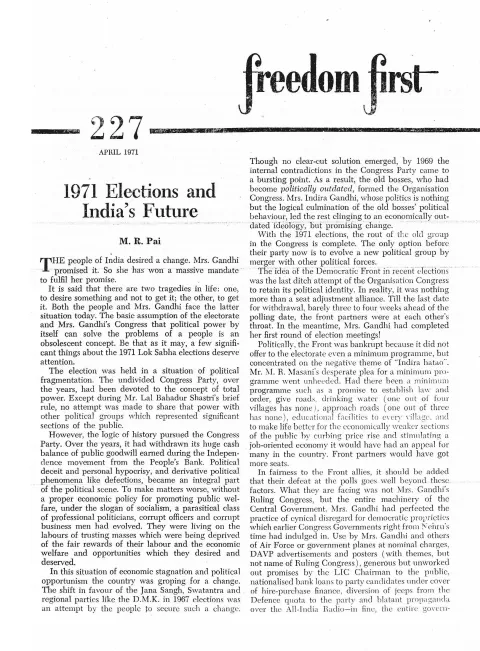
1971 Elections and India’s Future
By M. R. Pai
M. R. Pai reads the 1971 Lok Sabha result as the collapse of the old Congress establishment and the arrival of Indira Gandhi’s personal mandate, achieved despite an opposition Democratic Front that never cohered into more than a seat-adjustment pact. In the continuation on page 11, Pai turns from the electoral post-mortem to a sharply critical economic argument, warning that Mrs. Gandhi’s promised expansion of the public sector, nationalisation, and price controls is a “carbon copy of the Stalinist programme” that will worsen shortages, burden the middle class and the poor alike, and risks trading British colonialism for a form of Soviet economic dependency, given Russia’s growing military and commercial encirclement of India.
- The 1971 election produced a massive personal mandate for Indira Gandhi and routed the old Congress establishment.
- The Democratic Front’s defeat is attributed to its lack of a positive minimum programme, offering only the negative slogan against Mrs. Gandhi.
- Pai lists structural lessons: big names alone no longer win votes, caste-based parties face decline, and national opposition parties must consolidate or risk irrelevance.
- Pai warns that political stability depends on constitutional restraint, which he doubts Mrs. Gandhi will honour given her record and her huge majority.
- In the continuation, Pai attacks the promised statist economic programme as certain to fail the poor and the middle class through price controls, nationalisation, and expanded public-sector inefficiency.
- He warns of a ‘modern colonialism’ risk from USSR economic and military dealings, including a cited deal to sell outdated surgical instrument manufacturing equipment to Madras at inflated prices.
- He frames 1971 as marking the end of the Gandhian era of politics based on purity of means, replaced by a pragmatic, ends-justify-means politics under Mrs. Gandhi.
Election In West Bengal
By K. K. Sinha
K. K. Sinha surveys the West Bengal assembly election results, describing the CPM’s emergence as the dominant force of the organised left and the Congress(J)‘s consolidation as the rallying point of anti-CPM sentiment, aided by the nationwide ‘Indira Wave.’ He details the failed negotiations to unite the three Congress factions, the CPI’s dilemma between allying with the CPM or the Congress, and speculates on Moscow’s likely preference for cultivating both Mrs. Gandhi and the CPM given the CPM’s strategic position facing East Bengal and China. He closes by predicting continued ‘class’ warfare in Bengal, with the Army’s deployment to police thanas as a key new factor, and a blurring line between Naxalite guerrillas and CPM activists.
- The CPM emerged as the dominant leftist force in West Bengal, while Congress(J) became the rallying point against it, boosted by the nationwide pro-Indira wave.
- Negotiations to merge the three rival Congress factions (Congress(O), Congress(J)/Bangla Congress) broke down before the election.
- The CPI faces a strategic dilemma: allying with Congress risks isolation from the left; allying with the CPM risks losing its distinct organisational identity.
- Sinha speculates that Moscow will pursue a double-edged policy, cultivating both Mrs. Gandhi at the Centre and the CPM regionally given the CPM’s position on the China and East Bengal borders.
- The Army’s deployment into roughly 300 police thanas during the Presidential Rule period is described as a significant new development shaping post-election law and order.
- Sinha forecasts continued and possibly intensifying ‘class barricade’ warfare in Bengal, with Naxalite and CPM activist identities becoming interchangeable.
Election Trends In Tamil Nadu
By “Atreya”
Writing under the byline “Atreya,” the author analyses the DMK’s landslide in the Tamil Nadu assembly and Lok Sabha elections, questioning why Chief Minister Karunanidhi called mid-term polls despite the DMK’s comfortable majority, and reviewing several explanations (personal popularity, fear of eroding support, cost) before concluding the real driver was calculated political opportunism. The continuation on page 10 catalogues specific irregularities in electoral rolls and voter registration favouring the DMK, and closes with a caution to the DMK against triumphalism, urging it to use its overwhelming mandate for clean, efficient administration rather than vindictive retaliation against opponents.
- The DMK won 183 of 201 assembly seats it contested and swept 23 of 24 parliamentary seats in Tamil Nadu, a scale described as ‘flood-tide’ victory.
- The author rejects popularity, anticipated decline, and cost as sufficient explanations for Karunanidhi calling early elections, pointing instead to calculated political advantage.
- Large-scale irregularities are cited: removal of nearly 50,000 names from the Chief Minister’s constituency rolls and inclusion of thousands of names of people in temporary huts.
- The Old Congress (Kamaraj’s faction) won only a single seat despite polling substantial vote share; the DMK and allies took 38 of 39 parliamentary seats contested.
- The author closes with a warning against DMK triumphalism, urging restraint from retaliating against opposition-linked cooperatives, unions and businesses.
America And South Asia
By [An extract from the Report to the Congress by the President of the United States of America]
This piece reproduces an extract from a report to the US Congress by the President of the United States, laying out American policy toward South Asia. It frames US goals as fostering regional stability, encouraging India-Pakistan normalisation, continuing bilateral economic and family-planning assistance to India, and maintaining a balance among the interests of the USSR, China, and the US in the subcontinent, while noting a controversial one-time exception permitting arms sales to Pakistan.
- US policy toward South Asia is framed as parallel to its East Asia and Pacific policy, aiming at regional peace and stability.
- Two fundamental problems are identified: the challenge of economic/political development, and turning India-Pakistan relations from hostility to cooperation.
- The US describes itself as the largest provider of economic aid to South Asia, including support for India’s family planning efforts.
- The report discloses a ‘one-time sale of a limited amount of military equipment’ to Pakistan as an exception to the general arms embargo.
- The US states it will not try to dictate normalisation between India and Pakistan but will encourage it, while balancing its regional activities against Soviet and Chinese interests.
Philip Spratt - A Tribute
By A. B. Shah
A. B. Shah’s tribute to Philip Spratt, the British-born former Communist International agent (tried in the Meerut Conspiracy Case) who became a India-based scholar of Hindu psychology and a committed liberal humanist under the influence of M. N. Roy. Shah recounts the difficulty Spratt faced getting his major work, “Hindu Culture and Personality,” published in India, credits P. C. Manaktala for taking it on despite unfavourable early advice, and portrays Spratt as an austere, unworldly figure whose scholarship he regards as indispensable, if incomplete, for understanding the Hindu mind.
- Spratt came to India in 1926 for the Communist Party of Great Britain and was tried in the Meerut Communist Conspiracy case; prison led him to rethink Marxism.
- He moved from Marxism through M. N. Roy’s non-conformist Marxism and ‘scientific humanism’ to non-doctrinaire liberal humanism.
- His magnum opus, Hindu Culture and Personality (Manaktalas, Bombay, 1966/1968), combined Christian and Freudian frameworks to analyse the Hindu psyche.
- An Indian publisher initially rejected the manuscript on fears it would hurt Hindu religious sensibilities; P. C. Manaktala ultimately published it, and it sold out despite largely unfavourable reviews.
- Shah describes Spratt as personally austere — riding a bicycle in his sixties, mending his own spectacles — and recommends the book as essential, if not exhaustive, reading for understanding India.
Election Results at a Glance
No summary was extracted for this article. Listed for completeness.
In Quest Of Justice
By V. K. Sinha
V. K. Sinha reviews Abraham Brumberg’s edited collection “In Quest of Justice” (Praeger, 1970), which documents the growth of protest and dissent in the Soviet Union from Stalin’s death through the 1966 Siniavsky-Daniel trial and beyond. Sinha traces the post-Stalin literary thaw, the persistence of underground (‘non-official’) literature under continued censorship, and situates the Siniavsky-Daniel trial as a turning point that shifted dissent from literary to explicitly political demands for civil liberties and legal protections already nominally guaranteed by the Soviet constitution and the Universal Declaration of Human Rights.
- Sinha frames Stalin’s 1953 death and Khrushchev’s 1956 secret speech as the start of a slow, incomplete thaw in Soviet cultural and political repression.
- Writers such as Ilya Ehrenburg and Dudintsev signalled a literary ‘thaw’ that never fully arrived at ‘spring’; repression continued with occasional laxity.
- The February 1966 Siniavsky-Daniel trial is presented as the pivotal event that shifted dissent from literary freedom to demands for constitutional and human-rights protections.
- Brumberg’s volume is described as comprising three parts: analytical commentaries, an extensive documents section (letters, petitions, trial transcripts), and samples of underground (‘samizdat’-type) literature.
- The review closes by naming several prominent dissidents — Bukovsky, Litvinov, Grigorenko, Ginzburg, Galanskov, Larisa Daniel — as exemplars of the ongoing struggle for civil liberties in the USSR.
Essay 7
A brief review, signed ‘V.B.K.,’ of A. G. Noorani’s “India’s Constitution and Politics” (Jaico Publishing House), a companion volume to an earlier Noorani book collecting articles on constitutional and political topics over roughly nine years. The reviewer highlights chapters on the President and Governor, the Cabinet system, parliamentary privileges, and Attorney General relations as authoritative constitutional analysis, and singles out Noorani’s dispassionate treatment of the Muslim question and communal riots — including pieces titled ‘How a Riot Begins and Spreads’ and ‘The Famous 23 Riots’ — as especially valuable for debunking myths propagated by Hindu communalists.
- The book is a roughly 600-page, Rs. 10 companion volume collecting Noorani’s articles on constitutional and political affairs over about nine years.
- Early chapters cover the President and Governor’s roles, the Cabinet system, parliamentary privileges, and Attorney General relations, praised as authoritative.
- The reviewer highlights Noorani’s treatment of the Muslim question, Urdu, and communal riots as dispassionate and rational.
- Specific articles ‘How a Riot Begins and Spreads’ and ‘The Famous 23 Riots’ are noted for debunking a communal-riot myth propagated by Hindu communalists.
Generated by the v1.5 extraction pipeline. Awaiting editorial review.
Metadata and summary are AI-extracted from the source PDF and reviewed for editorial accuracy. The original work is available via the Read PDF tab above (where present); paragraph-level citation inside the PDF is deferred to a future engagement.