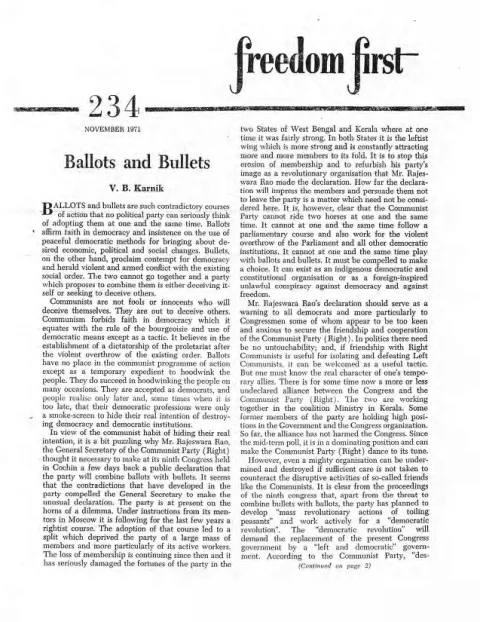
periodical issue
Freedom First
By S. V. Raju
Edited and published for the Democratic Research Service by V. B. Karnik at 127 Mahatma Gandhi Road, Bombay 1, and printed by him at Inland Printers, 55 Gamdevi Road, Bombay 7. · Bombay · 1971
12 pages
Freedom First
Summary
This May 1971 issue of Freedom First is dominated by the unfolding crisis in East Pakistan. Adam Adil’s opening piece narrates the declaration of independence of Bangla Desh and the Pakistani army’s crackdown, while K. K. Sinha’s follow-up essay, written as the conflict entered a guerrilla phase, analyses the roots of Bengali alienation from Islamabad and urges India and other governments to recognise the new state without delay. Alongside the Bangla Desh coverage, S. V. Raju offers a post-mortem of the failed opposition Grand Alliance (Congress-O, Swatantra, Jan Sangh, and the Samyukta Socialist Party) against Mrs Gandhi’s Congress in the 1971 general election, and Horst Hartmann contributes an explainer on West Germany’s mixed-member electoral system, implicitly informing the magazine’s recurring interest in electoral reform for India. Shorter unsigned items cover the JVP-led insurrection in Ceylon, the Soviet propaganda agency Novosti’s tenth anniversary, book reviews of Solzhenitsyn’s For the Good of the Cause and a monograph on the Prague Spring, a reader’s letter, and a closing digest of press quotations on the Bangla Desh crisis and Indian politics.
Key points
-
Adam Adil’s “Bangla Desh” surveys the outbreak of civil war after the declaration of independence under acting President Nazrul Islam, tracing West Pakistani economic and military dominance, the failed Mujib-Bhutto talks, and the army’s destruction of Dacca and Chittagong.
-
K. K. Sinha’s follow-up “Bangla Desh - Second Phase” argues Yahya Khan and Bhutto used negotiations as cover to bring in reinforcements, sets out five urgent tasks for the fledgling Bangla Desh government, and urges India to recognise it promptly.
-
An unsigned piece marks Novosti’s tenth anniversary, describing the Soviet news agency’s propaganda network and correspondents’ alleged intelligence activity leading to expulsions abroad.
-
The “Notes” column’s “Revolt in Ceylon” reads the JVP insurgency as a warning about India’s own pool of unemployed educated youth, while “Electoral System” cites the 1971 results to argue India’s first-past-the-post system badly distorts representation.
-
S. V. Raju’s “Alliance That Never Was” dissects the collapse of the anti-Congress Grand Alliance of Swatantra, Congress(O), Jan Sangh and the SSP, arguing Congress dominated seats despite winning under 44% of votes because of opposition disunity.
-
Horst Hartmann explains West Germany’s mixed-member electoral system and its five-per-cent threshold, designed as a lesson from the Weimar Republic’s collapse into Nazism.
-
Review notices cover Solzhenitsyn’s “For the Good of the Cause” as bureaucratic satire and Victor M. Fic’s “The Prague Spring: 1968” as an indictment of Soviet intervention in Czechoslovakia.
-
A reader’s letter responding to M. R. Pai’s election article debates whether India’s welfare state should rest on private or public enterprise, and the closing “With Many Voices” page compiles press quotations on the Bangla Desh crisis.
Essays
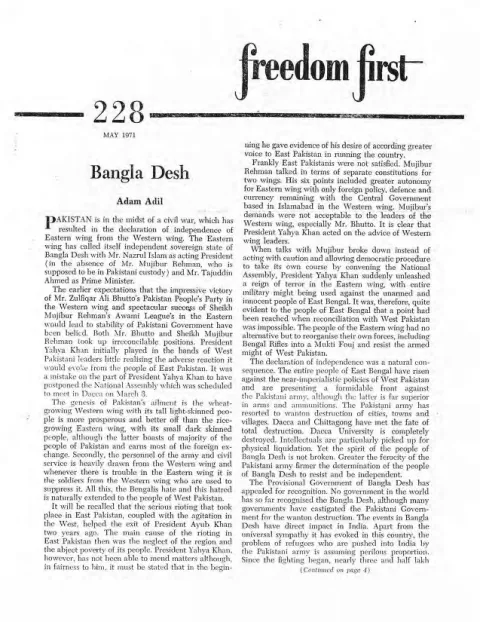
Bangla Desh
By Adam Adil
Adam Adil surveys the outbreak of civil war in Pakistan following the declaration of independence of Bangla Desh, with Nazrul Islam as acting President and Tajuddin Ahmed as Prime Minister in the reported absence of Sheikh Mujibur Rehman. The essay traces the structural grievances behind the split — the economic and administrative domination of the Eastern wing by West Pakistan, the failed talks between Mujibur Rehman and Bhutto, and President Yahya Khan’s decision to postpone the National Assembly and then unleash military force on East Bengal. It describes the destruction of Dacca and Chittagong, the targeting of intellectuals, and the formation of the Mukti Fouj resistance force, and closes on the refugee crisis spilling into West Bengal and India’s cautious diplomatic position.
- Bangla Desh declared independence under acting President Nazrul Islam and PM Tajuddin Ahmed, with Mujibur Rehman reported in Pakistani custody
- Root causes include economic disparity between the wings and West Pakistani dominance of the army and civil service
- Talks between Mujibur Rehman’s six-point autonomy demand and Bhutto/Yahya Khan broke down, leading to postponement of the National Assembly
- The Pakistani army launched a campaign of destruction against Dacca, Chittagong, and Dacca University, targeting intellectuals
- Nearly three and a half lakh refugees, both Hindu and Muslim, had crossed into West Bengal by the time of writing
- No government had yet recognised Bangla Desh, but the author argues India will eventually have no alternative
Novosti After Ten Years
An unsigned piece marking Novosti’s tenth anniversary (February 1971) surveys the Soviet news agency’s growth into a major propaganda channel, describing its network of roughly 600 staff journalists, its 49 foreign magazines and five newspapers distributed to 110 countries, and its flagship Indian publication Soviet Land, which circulates 550,000 copies fortnightly in twelve Indian languages plus English. The piece is sharply critical, quoting Novosti’s own head Boris Burkov on the agency’s ideological mission and cataloguing its activities in Africa, the Middle East, and its 1969 syndication agreement with India’s Press Information Bureau, alongside reports of Novosti correspondents engaging in intelligence and subversive activity leading to expulsions from several countries.
- Novosti marked its tenth anniversary in February 1971 amid a leadership shake-up reflecting Moscow’s dissatisfaction with its performance
- The agency runs about 600 staff journalists and publishes 49 magazines and five newspapers in 110 countries
- Its principal Indian output, Soviet Land, has a circulation of 550,000 across 12 Indian languages plus English
- Novosti reached a 1969 syndication agreement with India’s Press Information Bureau
- The piece alleges Novosti correspondents have engaged in intelligence and subversive activities, leading to expulsions from several African countries and friction with Cuba
Notes: Revolt in Ceylon / Electoral System
The unsigned “Notes” column carries two short editorials. “Revolt in Ceylon” reflects on the three-week insurgency of young, educated but unemployed Ceylonese youths (dubbed “Che Gueverites”) that required tanks, armoured cars, and foreign help to suppress, and warns that India’s own large pool of unemployed educated youth poses a similar risk unless curative and preventive measures are taken. “Electoral System” argues that India has given too little thought to alternatives to its inherited British first-past-the-post system, pointing to the 1971 election results where the Congress won a large majority of seats on a modest vote share while opposition parties were badly under-represented, and calls for study of proportional and other systems such as the French and German models.
- The Ceylon insurgency, though initially appearing minor, required a three-week military operation with tanks, armour, and foreign help to suppress
- The rebels were largely young, educated, unemployed persons who fell prey to professional revolutionaries; the piece downplays foreign (North Korean) involvement as a major factor
- The column warns India has a similarly large and growing mass of educated unemployed youth and needs both curative and preventive measures
- On electoral reform, the column cites the Congress winning 350 Lok Sabha seats on 63 million votes versus the Organisation Congress’s 16 seats on 15 million votes as an illustration of distortion under first-past-the-post
- It calls for study of proportional representation and other systems like the French and German models
Bangla Desh - Second Phase
By K. K. Sinha
K. K. Sinha’s essay picks up the Bangla Desh story as the Pakistani army captures most major towns, marking the end of the first chapter of the independence struggle and the start of a longer guerrilla phase. Sinha reviews the economic and political exploitation of East Bengal, the failure of talks between the Awami League and Islamabad, and argues Yahya Khan and Bhutto deliberately strung out negotiations to buy time to bring in military reinforcements before launching a “lesson-teaching” campaign of terror. He lays out five urgent tasks for the Bangla Desh government going forward — consolidating the Mukti Fouz’s guerrilla command, managing refugees, administering controlled villages, building diplomatic contacts abroad, and establishing study cells for economic and political recovery planning — and urges India and other governments to recognise Bangla Desh promptly to help end the crisis.
- Sinha frames the fall of major towns to the Pakistani army as ending the first phase and opening a longer, harder guerrilla phase of the independence struggle
- He attributes the conflict to structural exploitation of East Bengal (jute exports benefiting West Pakistan, non-Bengali control of industry, skewed army recruitment) and the failed parity/one-man-one-vote disputes
- He argues Yahya Khan and Bhutto used talks with Mujibur Rehman as cover to bring in military reinforcements before launching a repression campaign
- Sinha sets out five priority tasks for the Bangla Desh government: guerrilla reorganisation, refugee management, village administration, international diplomacy, and study cells for economic/political recovery
- He urges prompt recognition of Bangla Desh by India and other governments to avoid prolonging “human agony”
Alliance That Never Was
By S. V. Raju
S. V. Raju dissects the collapse of the anti-Congress “Grand Alliance” of Swatantra, Congress(O), Jan Sangh, and the Samyukta Socialist Party in the 1971 general election, arguing the coalition was an “alliance that never was.” He shows Mrs Gandhi’s Congress won only 43.64% of votes cast (23.91% of the total electorate) yet dominated the result, crediting this to the disunity of her opponents rather than her own claimed mandate. Raju details the Alliance’s disputes over seat allocation (citing South Bombay and Rajkot as flashpoints), its failure to agree on a common programme, its inability to counter the “Garibi Hatao” slogan, and local politicians’ unwillingness to risk their own standing for the coalition’s sake, concluding that the electorate rejected “the politics of opportunism.”
- Mrs Gandhi’s Congress secured only 43.64% of votes cast (23.91% of the total electorate), far short of her claimed 95% support, but the fractured opposition let her dominate seats
- The Grand Alliance (Swatantra, Congress-O, Jan Sangh, SSP) suffered severe internal disputes over seat-sharing, notably in South Bombay and Rajkot
- The Swatantra Party briefly walked out of the Alliance on January 3 over the SSP’s entry before rejoining on January 8
- The Alliance failed to counter Congress’s “Garibi Hatao” (eliminate poverty) messaging against its own “Indira Hatao” slogan
- In Tamil Nadu the Alliance secured 59 lakh votes against the DMK-Congress(R) combine’s 76 lakh, but electoral vagaries limited seat gains
- Raju concludes voters rejected “opportunistic pacts” and that the electorate desires stability over such alliances
Electoral System In Germany
By Horst Hartmann
Horst Hartmann, in a piece based on a talk given at the Democratic Research Service, explains West Germany’s mixed-member electoral system, in which voters cast two votes — one for a directly elected constituency candidate among 248 constituencies, and one for a party’s Federal State list — with the second vote determining each party’s overall proportional strength in the 496-seat Bundestag via the D’Hondt counting method. He traces the system’s origins to the Weimar Republic’s fragmented multi-party collapse into Nazism, describes the five-per-cent threshold designed to prevent splinter parties, and recounts how the party system consolidated from ten parties in 1949 to four by the third Bundestag, while noting ongoing debate — with the CDU favouring a shift toward British/Indian-style plurality voting and the SPD divided and the FDP opposed.
- German voters cast two votes: one for a directly elected constituency MP (248 constituencies) and one for a party’s Federal State list, which determines proportional seat totals via the D’Hondt method
- The Bundestag totals 496 elected deputies (248 direct plus 248 from state lists), with Berlin’s 22 deputies holding only advisory status
- A five per cent threshold (or three constituency wins) is designed to prevent splinter parties, a lesson drawn directly from the Weimar Republic’s collapse into Nazism
- The party system consolidated from about ten parties in the first Bundestag (1949) to four (CDU/CSU, SPD, FDP) by the third Bundestag
- The CDU has pushed for a shift toward British/Indian-style plurality voting, partly in response to far-right NPD gains during a 1960s economic downturn, while the SPD is divided and the FDP opposes any change
Reviews: For the Good of the Cause
By V. B. K.
The Reviews section carries two book notices. V. B. K. reviews Alexander Solzhenitsyn’s For the Good of the Cause (National Academy, Delhi), describing it as a minor but effective satire of Soviet bureaucratic soullessness centred on a technical school whose new building is arbitrarily reassigned to a research institute, praising the book’s spare, unexaggerated style. V. B. Patankar reviews Victor M. Fic’s The Prague Spring: 1968 (Nachiketa Publications), a case study of the reforms attempted under Alexander Dubcek and their crushing by Soviet intervention, framing it as an indictment of Marxist theory’s “cruel fallibilities” and the Soviet bloc’s use of force against Czechoslovakia.
- For the Good of the Cause is described as a satire on Soviet bureaucratic apparatus, centred on a technical school whose promised new building is reassigned to a research institute by ministry decree
- The reviewer calls it ‘one of the minor works of Solzhenitsyn’ but praises its economical, unexaggerated prose
- The Prague Spring: 1968 is presented as a case study of the reforms planned under communist leader Alexander Dubcek and their suppression
- Patankar’s review frames the Soviet intervention as exposing the ‘cruel fallibilities’ of Marxist theory and undermining the prospects of the communist bloc
Reviews: The Prague Spring: 1968
By V. B. Patankar
A published letter to the editor from R. Srinivasan of Madras responds to M. R. Pai’s article “1971 Elections and India’s Future,” praising its boldness and reflecting on Mrs Gandhi’s electoral success as owed to weaker and poorer sections of the electorate (per Jagjivan Ram’s own admission). The writer argues India’s government now faces a choice between a welfare state achieved through private enterprise or one achieved through public enterprise, criticises nationalised banks for lending to the poor without regard to repayment capacity, and suggests New Deal-style measures could have addressed unemployment more effectively.
- The letter responds to M. R. Pai’s article “1971 Elections and India’s Future,” praising its bold statements on the reasons for Indira Gandhi’s success
- Cites Jagjivan Ram’s admission that the elections were won on the strength of weaker and poorer sections of society
- Frames the post-election choice as between a welfare state built on private enterprise versus one built on public enterprise
- Criticises nationalised banks for extending credit to the poor without assessing repayment capacity
- Suggests New Deal-style measures, as used in 1930s America, could have better addressed India’s unemployment problem
Letter to the Editor
By R. Srinivasan
“With Many Voices” is the issue’s closing feature, a curated digest of press quotations from Indian and international outlets (Swiss Press Review, Times of India, Sunday Standard, Indian Express, The Observer, The Economist, Time, and others) on the Bangla Desh crisis, Cold War dynamics, and Indian politics following the 1971 election, framed by an epigraph from Tennyson. The quotes range from warnings about the difficulty of secession gaining outside support, to commentary on the Pakistani army’s violence in East Bengal, to wry observations about Mrs Gandhi’s political positioning and the international community’s muted response to the crisis.
- The feature compiles short press quotations from a wide range of Indian and international publications dated between March 27 and April 26, 1971
- Multiple quotes address the Bangla Desh crisis, including warnings about weak international mediation efforts and allegations of Pakistani army violence against civilians
- Other quotes reflect on Mrs Gandhi’s post-election political position and comparisons to Mao
- The section closes with a subscription notice for Freedom First
Generated by the v1.5 extraction pipeline. Awaiting editorial review.
Metadata and summary are AI-extracted from the source PDF and reviewed for editorial accuracy. The original work is available via the Read PDF tab above (where present); paragraph-level citation inside the PDF is deferred to a future engagement.