periodical issue
Freedom First
India's International Relations
By Arvind A. Deshpande, M. D. Kini, Hippopotamus, Charles Foley, G. L. Mehta
Edited and published for the Democratic Research Service by V. B. Karnik at 127 Mahatma Gandhi Road, Bombay 1, and printed by him at Inland Printers, 55 Gamdevi Road, Bombay 7. · Bombay · 1971
12 pages
Freedom First
Summary
This is the September 1971 issue (No. 232) of Freedom First, the classical-liberal Bombay periodical edited by V. B. Karnik for the Democratic Research Service. The issue is dominated by the geopolitics of the Bangladesh crisis: Arvind A. Deshpande’s lead essay ‘India’s International Relations’ reassesses India’s non-alignment policy in light of the newly signed Indo-Soviet treaty of August 1971, weighing the divergent motivations of the U.S., U.S.S.R., and China and urging India to explore bilateral ties with Japan and Western Europe rather than binding itself to one bloc. M. D. Kini’s ‘Amendments And Welfare’ opposes the 24th and 25th Constitution Amendment Bills, defending property as a fundamental right against the abridgement of Fundamental Rights in favour of the Directive Principles. ‘Hippopotamus’ explains the 1971 Bretton Woods/dollar crisis following Nixon’s suspension of gold convertibility. Charles Foley’s ‘Conspiracy In Mexico’ reports on a Soviet- and North Korean-linked guerrilla plot uncovered in Mexico. A ‘Without Comment’ section reprints P. Kodanda Rao’s Swarajya commentary on the Golaknath judgment and a U.S. News & World Report survey of conflict across Asia. G. L. Mehta’s open letter criticizes U.S. support for Pakistan during the East Pakistan crisis. The issue closes with book reviews (Silesian Inferno, The Marxian Mirage, Britain 1971) and the ‘With Many Voices’ page of press extracts on the Indo-Soviet treaty and world affairs.
Key points
-
Arvind A. Deshpande’s “India’s International Relations” reassesses non-alignment after the Indo-Soviet Treaty, arguing India should not over-invest in Moscow but pursue bilateral ties with Japan and Western Europe as a counterweight.
-
M. D. Kini’s “Amendments And Welfare” opposes the 24th Constitution Amendment Bill and the forthcoming 25th, defending property as a fundamental right against subordination to the Directive Principles.
-
Writing as “Hippopotamus”, “Dollar-Crisis” explains Nixon’s suspension of gold convertibility as the effective end of Bretton Woods and favours floating exchange rates over new protectionism.
-
Charles Foley’s “Conspiracy In Mexico” reports a Soviet- and North Korean-linked guerrilla plot uncovered in Mexico City, modelled on Castro’s insurgency strategy and financed by bank robbery.
-
“Without Comment” items reprint P. Kodanda Rao’s critique of the Golaknath judgment’s internal contradictions and a U.S. News survey finding 16 of 23 Asian nations embroiled in Peking-instigated conflict.
-
G. L. Mehta’s open letter, as former Indian Ambassador to the US, condemns American arms support for Pakistan’s crackdown in East Pakistan as tantamount to complicity in genocide.
-
Reviews cover Karl Friedrich Grau’s “Silesian Inferno” on Soviet atrocities against German civilians in Silesia and Satyavrata Patel’s polemical “The Marxian Mirage”.
-
The closing “With Many Voices” page quotes M. R. Masani on statism “spilling over” into the cultural sphere and multiple sources warning the Indo-Soviet Treaty could become “a millstone round the neck” of India.
Essays
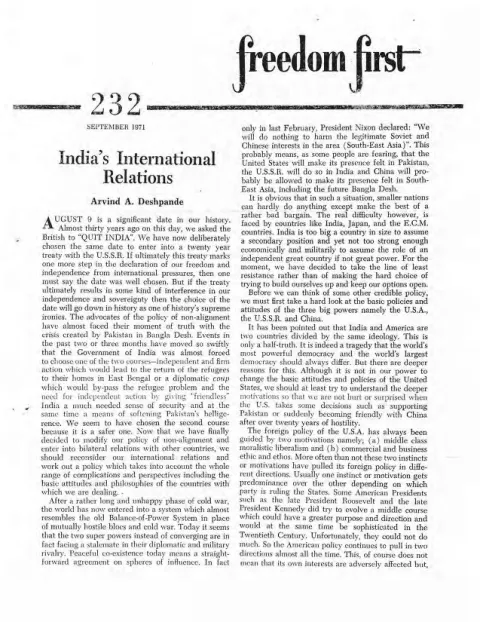
India’s International Relations
By Arvind A. Deshpande
Arvind A. Deshpande’s essay examines India’s foreign policy in the wake of the twenty-year Indo-Soviet treaty signed on 9 August 1971, the anniversary of the Quit India movement. He argues the world has moved from Cold War bipolarity toward a Balance-of-Power system with informal spheres of influence, and that India, too large to be a client state yet not strong enough to be an independent power, has taken ‘the line of least resistance’ by tilting toward Moscow rather than building independent strength. The essay analyses the distinct motivations of the U.S. (moralistic liberalism pulling against commercial/trader interests, producing a preference for ‘stable’ over merely democratic governments), the U.S.S.R. (geopolitical realism treating India as a counterweight to China), and China (suspicion of Soviet ‘revisionism’ and of Japan’s rising strength). Deshpande concludes that India should not over-invest in the Indo-Soviet alignment but should explore bilateral relations with Japan and Western European countries, arguing a triangular India-Japan-E.C.M. relationship could be a significant counterweight that ‘can neither be pressurised nor ignored.’
- The 20-year Indo-Soviet treaty was signed on 9 August 1971, deliberately chosen to echo the Quit India anniversary.
- The world has shifted from Cold War bipolarity to a Balance-of-Power system with de facto spheres of influence.
- India is ‘too big… to assume a secondary position’ but ‘not too strong enough economically and militarily’ to be an independent power.
- U.S. foreign policy oscillates between moralistic anti-communism and a commercial/trader preference for stable (even undemocratic) governments.
- The U.S.S.R. treats India pragmatically as a geopolitical counterweight to China rather than out of ideological solidarity.
- China fears Soviet ‘revisionism’ as much as American ‘imperialism’ and distrusts Japan’s growing strength.
- Deshpande recommends India pursue bilateral relations with Japan and West European (E.C.M.) countries rather than relying solely on the Soviet alignment.
Amendments And Welfare
By M. D. Kini
M. D. Kini’s essay opposes the 24th Constitution Amendment Bill (passed 384-23), which asserts Parliament’s power to abridge Fundamental Rights to give effect to the Directive Principles of State Policy, and previews the proposed 25th Amendment, which would replace ‘compensation’ with ‘amount’ for compulsorily acquired property and bar judicial review of the adequacy of compensation. Kini argues property is as fundamental a right as life and liberty, invokes former Bombay High Court judge V. M. Tarkunde’s view that the last seventeen years of abridgements (through Golaknath) sufficed, and contends that subordinating Fundamental Rights to Directive Principles revives ‘the false dichotomy of formal freedoms… and the real freedoms like the right to work.’ He also defends the privy purses of former rulers as a small, morally-owed cost against the backdrop of the Indo-Soviet treaty and looming press-ownership legislation, warning that ‘freedom and democracy… have always been whittled away bit by bit.’
- The 24th Amendment passed 384-23 and asserts Parliament’s right to abridge Fundamental Rights to serve the Directive Principles.
- The (then-forthcoming) 25th Amendment would substitute ‘amount’ for ‘compensation’ and bar courts from reviewing compensation adequacy for acquired property.
- Kini argues the right to property is as fundamental as the rights to life and liberty and should not be left to political whim.
- He cites V. M. Tarkunde’s view that abridgements up to the Golaknath case were adequate and that most further curbs on property are unnecessary.
- He frames the debate as ‘freedom versus bread,’ arguing both are necessary and that state capitalism/collectivism increases state control rather than genuine welfare.
- He also discusses the (separate) 26th Amendment abolishing princely privy purses, defending the privy purse as a small moral obligation from Sardar Patel’s integration settlement.
- Kini connects all three bills to the Indo-Soviet Treaty and proposed press-ownership legislation as signs of ‘an era of greater state control.‘
Dollar-Crisis
By Hippopotamus
Writing under the pseudonym ‘Hippopotamus,’ this piece explains the 1971 international monetary crisis triggered by President Nixon’s suspension of dollar-gold convertibility. It traces the 1944 Bretton Woods assumptions (fixed gold price, dollar-as-good-as-gold, fixed exchange rates) and how post-war dollar outflows through aid, investment, and the Vietnam War created a persistent overhang of dollars abroad that the fixed-exchange-rate system could not absorb, forcing other countries to ‘co-finance’ U.S. spending. The author lays out two possible solutions — new protectionist barriers, which The Economist warned would be damaging, or floating/flexible exchange rates, which the author favours as ending the ‘senseless sovereign right of every country… to fix its own exchange rate’ — and closes by dismissing Marxist predictions of capitalism’s collapse as ‘wishful thinking.’
- Nixon’s suspension of dollar-gold convertibility marked, at least in theory, the end of the 1944 Bretton Woods system.
- Bretton Woods rested on four assumptions: fixed gold price, dollar-as-good-as-gold, U.S. gold redemption at $35/ounce, and fixed exchange rates.
- Post-war aid, capital transfers, and above all Vietnam War spending flooded the world with dollars, which fixed exchange rates could not adjust for.
- This forced other countries to effectively co-finance U.S. balance-of-payments deficits by absorbing surplus dollars.
- Two remedies are weighed: protectionist barriers (criticized via The Economist as damaging to the world economy) versus flexible/floating exchange rates (the author’s preferred solution).
- The essay closes by rejecting Soviet/Marxist claims (reported via Literaturnaya Gazeta and covered in the same issue) that the dollar crisis signals capitalism’s collapse.
Without Comment: The Soviet Citizen
A short unsigned item, ‘Marxist Explanation,’ reports (via Time, 26 July 1971) a Soviet magazine’s (Literaturnaya Gazeta) theory that the Pentagon Papers were leaked because rival factions of American ‘monopolists’ — consumer-goods makers, non-Vietnam military suppliers, and war-profiting military-industrial firms — were fighting each other, with the civilian and non-war factions arranging the leak to embarrass the war-profiteers. The item closes by expressing alarm at how ‘fantastic’ this Soviet reading of U.S. affairs is, despite years of efforts to improve Soviet-American relations.
- Literaturnaya Gazeta’s account claims the Pentagon Papers leak resulted from infighting among three factions of U.S. ‘monopolists.’
- The Soviet magazine frames all U.S. newspapers that printed the Pentagon Papers as tools of the ‘dissident monopolies.’
- The item (via Time) treats this as evidence of a persistently distorted Soviet view of American institutions.
Conspiracy In Mexico
By Charles Foley
Charles Foley’s ‘Conspiracy In Mexico’ (continued on page 8) reports on a Soviet-backed guerrilla plot uncovered in Mexico City, in which young Mexican leftists were taken to the Patrice Lumumba Friendship University in Moscow on a ‘cultural exchange,’ then some were routed via East Berlin to North Korea for six months of guerrilla training, before returning to organize bank robberies to fund an insurgency. Leader Fabricio Souza’s plan, modeled on Castro’s, aimed to start in the countryside and spread to workers and students; the plot collapsed after a botched hold-up (netting $84,000, in a deliberate echo of Stalin’s 1907 Tiflis raid) led to the arrest of 21 of the fifty ‘Muscovite excursionists.’ The piece situates the episode against the expulsion of Soviet diplomats from Mexico and Mexico’s historically wary but formally correct relationship with Moscow since granting Trotsky asylum in 1936.
- A Soviet embassy in Mexico City ran an intelligence operation described as the busiest in the hemisphere.
- Young Mexican leftists were recruited via a ‘cultural exchange’ to Patrice Lumumba Friendship University in Moscow.
- A subset were routed through East Berlin to North Korea for six months of guerrilla, sabotage, and unarmed-combat training.
- Leader Fabricio Souza modeled his plan on Castro’s rural-to-urban insurgency strategy.
- The group financed itself via bank robbery, explicitly imitating young Stalin’s 1907 Tiflis raid; one robbery netted $84,000.
- The plot unraveled when a captured member led police to arms caches; 21 of fifty participants were rounded up.
- Five Soviet diplomats were expelled from Mexico as a result; the piece situates this against Mexico’s wary history with Moscow since sheltering Trotsky in 1936.
Without Comment: Fundamental Right
By P. Kodanda Rao (quoted from Swarajya)
A ‘Without Comment’ item reprints P. Kodanda Rao’s Swarajya commentary on the Golaknath case (1967), which held by a 6-5 majority that Parliament could not abridge Fundamental Rights, framing them as pre-existing ‘natural rights.’ Kodanda Rao criticizes the judgment’s internal contradiction — declaring past abridgements ‘invalid ab initio’ yet letting them stand — and notes it left open the possibility of a future ‘constituent’ body superseding both Parliament and the Supreme Court to abridge rights, a possibility not fully explored in the ruling.
- Until Golaknath (1967), the Supreme Court had for nearly two decades accepted Parliament’s power to abridge Fundamental Rights.
- The Golaknath majority (6-5) held Fundamental Rights were ‘natural,’ ‘immutable,’ and not created by but only ‘expressed in’ the Constitution.
- Kodanda Rao highlights the contradiction that the judgment called prior abridgements invalid ab initio but let them stand as valid.
- The judgment implied a hypothetical ‘constituent’ body could be convoked to override both Parliament and the Supreme Court’s own Golaknath ruling.
- Kodanda Rao notes the ruling was a bare one-judge majority and could be reversed in a future case.
Reviews (Silesian Inferno; The Marxian Mirage; Britain 1971)
By S.D. / V.K.
An unsigned ‘Without Comment’ digest, credited to U.S. News & World Report, surveys conflict across Asia beyond Vietnam: of 23 Asian nations, 16 are described as embroiled in war, rebellion, or civil strife, much of it instigated by Red China, while only seven (Mongolia, Japan, Singapore, Bhutan, Nepal, Afghanistan, and the Maldives) are free of conflict. It runs through flashpoints country by country — Ceylon, India’s north-east and West Bengal, Thailand, Burma, Indonesia, the two Koreas, the two Chinas, North and South Vietnam, the Philippines, Malaysia, Laos, Cambodia, and Pakistan — framing Peking, not Moscow, as the leading sponsor of Asian insurgencies under the new slogan ‘Marxism-Leninism-Mao Tsetung Thought.’
- 16 of 23 Asian nations are described as embroiled in war, rebellion, or civil strife, home to over 1.8 billion people.
- Only seven nations (Mongolia, Japan, Singapore, Bhutan, Nepal, Afghanistan, Maldives) are judged free of conflict.
- Most Asian Red leaders reportedly now look to Peking rather than Moscow as the capital of world Communism, viewing the Soviets as too ‘conservative.’
- Country-by-country flashpoints are listed: Ceylon, India’s north-east and West Bengal (Naxalites), Thailand, Burma, Indonesia, the two Koreas, the two Chinas, Vietnam, the Philippines, Malaysia, Laos, and Cambodia.
- The new ideological slogan cited is ‘Marxism-Leninism-Mao Tsetung Thought.‘
Without Comment: Asia Beyond Vietnam
Extracts from a letter by G. L. Mehta, former Indian Ambassador to the U.S., published in several American newspapers, criticize U.S. support for Pakistan during the East Pakistan crisis. Mehta, describing decades of goodwill toward the U.S. and gratitude for its past aid to India, argues he cannot understand the ‘rationale of American policy in supporting directly and indirectly what is tantamount to genocide in East Pakistan,’ noting that U.S. arms meant for defense against India or China had instead been ‘turned with a vicious ferocity upon their own people.’ He reports that American public and Senate opinion condemned Pakistani atrocities more strongly than the administration, which he calls ‘unresponsive as well as callous,’ and warns that this policy risks pushing India toward the Soviets while strengthening anti-American and anti-Muslim sentiment in India.
- G. L. Mehta, former Indian Ambassador to the U.S., wrote an open letter published in several American newspapers.
- He expresses long-standing personal goodwill toward the U.S. and gratitude for its aid to India during food crises and the 1962 Chinese invasion.
- He argues U.S. military aid to Pakistan, originally justified against India or China, has instead been used with ‘vicious ferocity’ against Pakistan’s own people.
- He reports American public opinion and several U.S. senators condemned Pakistani atrocities more strongly than the Nixon administration did.
- He warns that continued U.S. support for Pakistan strengthens anti-American, anti-West, and anti-Muslim sentiment within India and risks pushing India further toward the Soviet Union.
- He explicitly compares the East Pakistan atrocities to those of Hitler, Stalin, and Vietnam.
U.S. Policy On Pakistan
By G. L. Mehta
The ‘Reviews’ page carries three short unsigned (initialed) notices. ‘Silesian Inferno,’ reviewed by S.D., covers Karl Friedrich Grau’s documentary account (published by the Centre of Information and Documentary Evidence, West, Seewald Verlag) of atrocities committed by Soviet troops against German civilians in Silesia in early 1945, describing indiscriminate looting, killing, torture, and rape, and noting Silesia was treated worse than other conquered German regions because it was slated for transfer to Poland. ‘The Marxian Mirage’ by Satyavrata Patel is reviewed (initials cut off at the page break) as a polemical but ‘remarkable’ examination of Marxism as philosophy, economic theory, and political practice, though the reviewer finds it argued from a fixed point of view rather than searching or comprehensive. ‘Britain 1971,’ an official Central Office of Information handbook, is reviewed briefly by V.K. as a useful, well-illustrated informational volume.
- Silesian Inferno (Karl Friedrich Grau) documents Soviet army atrocities against German civilians in Silesia in the first half of 1945, based on eyewitness statements.
- The reviewer (S.D.) notes Soviet troops behaved markedly worse in Silesia than in other conquered German territory, attributing this to Silesia’s planned post-war transfer to Poland.
- The Marxian Mirage by Satyavrata Patel argues Marxism is an ‘ignorant and barbarous superstition’ and Marx a ‘spurious economist’; the reviewer finds the author’s Marxism scholarship ‘remarkable’ but the treatment one-sided rather than objective.
- Britain 1971, a Central Office of Information handbook, is reviewed favorably by V.K. as informative and well-illustrated.
With Many Voices
‘With Many Voices’ is the issue’s closing page of curated press extracts (headed by a Tennyson epigraph) reacting to the Indo-Soviet treaty and contemporary world events, drawn from sources including Swarajya, the Times of India, Swiss Press Review, Time, The Economist, Free China Weekly, and others, alongside the subscription coupon and imprint line naming V. B. Karnik as editor/publisher for the Democratic Research Service.
- The page compiles brief quoted reactions from multiple newspapers and commentators to the Indo-Soviet treaty and current world affairs.
- M. R. Masani is quoted (Times of India, 15 August) describing a ‘spilling over of Statism from the economic to the cultural sphere.’
- C. R. (writing in Swarajya) is quoted as saying ‘America has proved to be a broken reed.’
- Multiple sources (Opinion, Thought, Swiss Press Review) warn the Indo-Soviet treaty could become ‘a millstone round the neck of the Indian nation.’
- International items include commentary on Nixon’s China visit, the Yugoslav bureaucracy debate (quoting Milovan Djilas), and William Buckley on Greek-colonel diplomacy.
- The page carries the Freedom First subscription coupon (Rs. 5.00 annual) and the publication’s imprint: edited and published for the Democratic Research Service by V. B. Karnik, printed at Inland Printers, Bombay.
Generated by the v1.5 extraction pipeline. Awaiting editorial review.
Metadata and summary are AI-extracted from the source PDF and reviewed for editorial accuracy. The original work is available via the Read PDF tab above (where present); paragraph-level citation inside the PDF is deferred to a future engagement.