periodical issue
Freedom First
By "Atreya", Hippopotamus, (From a Correspondent), F. Hajenko, V. B. K., S.D., S. R. Narayana Ayyar
Edited and published for the Democratic Research Service by V. B. Karnik at 127 Mahatma Gandhi Road, Bombay 1, and printed by him at Inland Printers, 55 Gamdevi Road, Bombay 7. · Bombay · 1971
12 pages
Freedom First
Summary
This October 1971 issue of Freedom First (No. 233), published by the Democratic Research Service under editor V. B. Karnik, gathers commentary on press freedom, constitutional rights, Cold War geopolitics, and Soviet economic reform, alongside book reviews, a letter to the editor, and a page of quoted opinion. In the rendered pages, contributors include a columnist writing as “Atreya” on the threatened nationalization of the Indian press; “Hippopotamus” on the 1971 Berlin agreement among the Four Powers; an unsigned correspondent’s report on a Bombay seminar convened by the Fundamental Rights Front against the 24th and 25th Constitutional Amendments; F. Hajenko on the halting progress of Soviet economic reform; an unsigned “Without Comment” digest of military and Communist-front-organisation data; two book reviewers (initialed V.B.K. and S.D.); a reader’s letter from S. R. Narayana Ayyar on Centre-State relations; and a closing page of aphoristic press quotations titled “With Many Voices.” The issue’s argumentative center, in the rendered pages, is a defence of constitutional and press liberties against what several contributors frame as creeping authoritarian and Soviet-aligned encroachment under Indira Gandhi’s government, paired with a skeptical, comparative eye on Soviet-bloc economic and foreign policy.
Key points
-
Writing as “Atreya”, “Take-over of Press” argues a proposed press take-over law, ostensibly targeting a “monopoly press”, is designed to hand trustee control of major newspapers to Communist-aligned unions.
-
An editorial notice, “A Victory Of Reason”, mourns the death of former Freedom First editor Raman Desai; a companion piece under “Hippopotamus” narrates the 1971 Four-Power Berlin agreement as the effective end of a quarter-century of confrontation.
-
A correspondent’s report on a Bombay seminar of the Fundamental Rights Front, presided over by K. Subba Rao, records warnings from M. R. Masani and A. D. Gorwala that the 24th and 25th Amendments risk turning “constitutional democracy” into “constitutional despotism”.
-
F. Hajenko’s “Economic Reform In Russia” traces the Soviet reform programme’s origin in declining growth and its incomplete implementation amid bureaucratic conservatism.
-
A “Without Comment” digest compares Chinese and Soviet military strength and catalogues Soviet-controlled Communist front organisations shaken by the invasion of Czechoslovakia.
-
Reviews fault Sudhir Hendre’s “Hindus and Family Planning” as an unsupported anti-Muslim polemic and summarise K. R. Bhandarkar and Raja Kulkarni’s book on slow computerisation in India.
-
A letter from S. R. Narayana Ayyar argues Centre-State disputes are manufactured by self-centred politicians rather than reflecting genuine popular division.
-
The closing “With Many Voices” page quotes N. A. Palkhivala on dogma as the enemy of economic wisdom and C. Rajagopalachari praising the international standing the Indo-Soviet Treaty gave India.
Essays
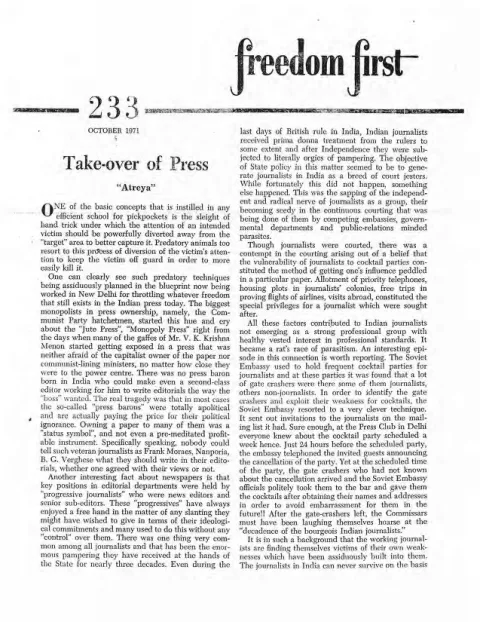
Take-over of Press
By “Atreya”
Writing under the pseudonym “Atreya,” the author argues that a proposed press take-over law being drafted in New Delhi is being smuggled in behind a manufactured furore over a “monopoly press,” a charge first raised by Communist Party figures resentful of press criticism of V. K. Krishna Menon. The piece traces how decades of state pampering of journalists (privileges, junkets, priority telephones) hollowed out the profession’s independence, illustrates Soviet Embassy manipulation of Delhi journalists via a staged cocktail-party cancellation, and warns that the pending legislation would hand control of newspapers with circulation over 15,000 to trustees drawn from Communist-controlled unions and journalist federations, achieving a “parasitical take-over of control points of newspapers by the Soviet-lining Communists” rather than genuine diffusion of ownership.
- Compares the press take-over campaign to a pickpocket’s sleight-of-hand diversion tactic aimed at distracting from the real target.
- Attributes the original ‘Jute Press’/‘Monopoly Press’ agitation to the Communist Party’s press caucus, dating it to criticism of V. K. Krishna Menon.
- Argues India’s so-called press barons were largely apolitical and did not dictate editorial lines to veteran editors like Frank Moraes, Nanporia, and B. G. Verghese.
- Describes decades of state-conferred privileges (telephones, housing plots, foreign trips) that left journalists professionally dependent and vulnerable to manipulation.
- Recounts an anecdote of the Soviet Embassy in Delhi identifying and ‘capturing’ gate-crashing journalists at a staged cocktail party.
- Names a PTI employee, recently returned from a Moscow assignment, as a key operative advancing the take-over inside the Indian Federation of Working Journalists.
- Concludes the proposed legislation would let trustee control of dailies (circulation over 15,000) fall to Communist-controlled unions and pensioned politicians, not genuine diffusion of ownership.
A Victory Of Reason
By Hippopotamus
A brief unsigned editorial notice records the death of Raman Desai, who edited Freedom First for three years. Though a banker by profession, Desai is remembered for his deep engagement with the arts (painting, music, dance), his association with the Indian Committee for Cultural Freedom, and his tenure as Honorary Secretary of the Asiatic Society of Bombay.
- Announces the death of Raman Desai, former editor of Freedom First for three years.
- Notes his profession as a banker alongside a deep interest in cultural affairs.
- Cites his association with the Indian Committee for Cultural Freedom and his role as Honorary Secretary of the Asiatic Society of Bombay.
Raman Desai
Writing as “Hippopotamus,” the author narrates the twenty-seven-year history of divided Berlin from the 1944 Allied agreement through the 1948 blockade, the 1953 East Berlin rising, the 1958 Khrushchev ultimatum, and the 1961 Wall, before detailing the September 1971 Four-Power agreement reached after seventeen months and thirty-three sessions of negotiation. The piece credits Willy Brandt’s and Walter Scheel’s Ostpolitik, and Brandt’s firmness with Brezhnev, for securing Soviet guarantees of unimpeded transit to West Berlin and recognition of ties between West Berlin and the Federal Republic, concluding that the agreement marks the effective end of a quarter-century of confrontation even though Germany’s division itself remains unresolved.
- Recaps Berlin’s post-war history: the 1944 Allied occupation agreement, 1948-49 blockade, 1953 East Berlin rising, 1958 Khrushchev ultimatum, and the 1961 Wall.
- Credits the 1969 Social Democrat-Free Democrat coalition and its Ostpolitik under Willy Brandt and Walter Scheel with opening talks with Moscow, Warsaw, and East Berlin.
- Details seventeen months of Four-Power negotiations culminating in the September 1971 Berlin agreement.
- Notes the Soviet Union’s guarantee of unimpeded transit traffic to West Berlin and recognition of ties between West Berlin and the Federal Republic as major concessions.
- Rejects the West German right-wing paper Bild’s framing that the agreement confirms Germany’s division, arguing division was already a fact.
- Concludes the agreement represents a ‘giant and welcome step’ toward East-West accord, quoting the Times of India.
Fundamental Rights In Danger
By (From a Correspondent)
An unsigned correspondent’s report covers a one-day seminar held in Bombay on August 28, 1971, convened by the Fundamental Rights Front and presided over by former Chief Justice K. Subba Rao, to oppose the 24th and 25th Constitutional Amendments. The seminar’s adopted statement argues the amendments hand Parliament unlimited power to abridge fundamental rights and let the state confiscate property without real compensation, warning this opens the door to “an authoritarian regime” and the end of India’s democratic way of life. The report excerpts papers by S. P. Aiyar, J. M. Lobo Prabhu, K. Santhanam, R. C. Cooper, M. R. Masani, Zafar Futehally, and A. D. Gorwala, and continues onto page 10 with V. Shankar’s legal analysis of the Golak Nath case, arguing Article 13(2) overrides Parliament’s amending power under Article 368.
- Reports a Fundamental Rights Front seminar in Bombay on August 28, 1971, presided over by K. Subba Rao, opposing the 24th and 25th Constitutional Amendments.
- The adopted statement calls the amendments a threat that could reduce ‘constitutional democracy’ into ‘constitutional despotism.’
- Summarizes the 25th Amendment’s replacement of ‘compensation’ with ‘amount’ for property acquisition as removing meaningful judicial review of takings.
- Cites M. R. Masani’s warning that free speech, association, movement, and religious and educational rights of minorities would all become vulnerable to a bare parliamentary majority.
- Quotes A. D. Gorwala calling the bill ‘a monument to the inherent arbitrary, autocratic tendencies of our elected Prime Minister.’
- Continues on page 10 with V. Shankar’s legal argument, following Justice Hidayatullah, that Article 13(2) overrides Article 368 and that Parliament’s amending power cannot abridge Part III rights.
Economic Reform In Russia
By F. Hajenko
F. Hajenko surveys the Soviet Union’s economic reform program, tracing its origins to declining growth rates and returns on capital in the late 1950s (particularly in agriculture, where annual production growth slumped from 5.9 to 2.1 percent between 1956-60 and 1961-65). The reform, beginning in the USSR in late 1965 following East Germany’s 1963 start, sought to replace purely administrative planning with profitability as the criterion of enterprise success, market relations, material incentives, and profit-linked bonuses, aiming to make individual workers’ earnings depend on enterprise success. The piece, continuing on page 11, reports the reform’s implementation has lagged behind schedule, hampered by insufficient market relations between enterprises, bureaucratic conservatism, and the difficulty of reconciling greater worker participation in management with the Soviet factory director’s still near-dictatorial legal powers.
- Traces the reform’s origin to declining Soviet growth rates and returns on capital (fondootdacha) beginning in the late 1950s, especially in agriculture.
- Notes East Germany began Soviet-bloc economic reform first, in January 1963, with the USSR following in late 1965 after Party Central Committee plenary resolutions.
- Describes the reform’s mechanics: profitability replacing gross production as the success criterion, expanded market relations, and profit-linked bonuses including a ‘thirteenth salary.’
- Quotes Soviet economist L. Leontev’s Kommunist article framing ‘economic initiative’ as a coming powerful force in production.
- Reports official Soviet claims of success, including a 1969 Central Committee speech calling the policy ‘completely justifying itself in practice.’
- Continuing on page 11, attributes the reform’s incomplete implementation to insufficient market relations, bureaucratic conservatism, and unresolved conflict between promised worker participation in management and the Soviet factory director’s still near-dictatorial powers.
Without Comment (Russian and Chinese Forces; Front Organisations)
An unsigned digest titled “Without Comment” presents two items without editorial framing. The first summarizes an International Institute for Strategic Studies survey comparing Chinese and Soviet military strength, noting China’s reliance on Mao Tse-tung’s ‘people’s war’ doctrine, expanding Chinese arms production, and the Soviet Union’s continuing missile and submarine build-up amid the Sino-Soviet border standoff. The second describes the network of Soviet-controlled Communist front organisations (the World Peace Council, World Federation of Trade Unions, World Federation of Democratic Youth, International Union of Students, and others) and their role in disseminating propaganda, noting these fronts were shaken and partly stalled by member disagreement over the Soviet invasion of Czechoslovakia.
- Cites an International Institute for Strategic Studies survey: China has 2.9 million men under arms and relies on Mao Tse-tung’s ‘people’s war’ doctrine for mobility-limited defence.
- Notes 33 of China’s 140 divisions and virtually all its nuclear force are deployed against Russia along the northern border.
- Reports the USSR now leads the US in ICBM strength (1,510 to 1,054) while the US-Soviet submarine-missile gap is narrowing.
- Lists major Soviet-controlled front organisations: World Peace Council, World Federation of Trade Unions, World Federation of Democratic Youth, International Union of Students, and others (WIDF, FISE, IADL, WFSW, IOJ, OIRT, FIR).
- Notes these fronts produce 19 publications and innumerable bulletins and organise world youth festivals as major propaganda events.
- States the fronts were shaken by the Soviet invasion of Czechoslovakia, with officials who criticised the invasion losing their posts between 1969 and 1970.
Reviews: Hindus and Family Planning
By V. B. K.
Two brief unsigned book reviews (initialed V.B.K. and S.D.) appear under the “Reviews” heading. The first, of Sudhir Hendre’s Hindus and Family Planning, faults the book’s central thesis (that family planning will reduce Hindus to a minority within a century, purportedly due to Muslim polygamy) as unsupported by its own tables, and criticizes the author’s broader anti-Muslim, anti-secularist, anti-Marxist polemic as an intemperate advocacy of Hindu interests rather than a serious case for its stated demographic argument. The second, of K. R. Bhandarkar and Raja Kulkarni’s Computer and Labour Problems in India, summarizes the book’s account of slow computerisation in India (only 116 electronic computers in 1970), its discussion of automation’s employment effects, and faults it for not addressing the deeper question of labour-intensive versus capital-intensive technology choice for a developing economy.
- Review of Hindus and Family Planning: notes the book’s core thesis is that family planning will reduce Hindus to a minority within roughly a century.
- The reviewer finds the argument’s basis (permission for Muslim men to marry up to four wives) empirically unsupported and unproven by the book’s own tables.
- Describes the book’s larger project as a ‘strident plea’ for Hindu interests against secular government, Muslims, minorities, and foreign powers like Russia and China.
- Review of Computer and Labour Problems in India: reports only 116 electronic computers were in use in India as of 1970, mostly for accounting and inventory control rather than production.
- Notes the book acknowledges automation’s employment risks but concludes automation ‘cannot be avoided’ and should only have its pace regulated.
- Faults the book for not addressing the central policy question for a developing economy: whether to pursue capital-intensive or labour-intensive industrialization.
Reviews: Computer and Labour Problems in India
By S.D.
In a letter to the editor responding to an earlier article on the Rajamannar Report, S. R. Narayana Ayyar argues that disputes between States and the Centre in India are manufactured by self-centred politicians rather than reflecting genuine popular division, pointing to the harmony ordinary Indians display across regional and linguistic lines at religious gatherings and in daily life. He contends that Gandhiji’s methods of winning freedom are being cynically misapplied by politicians to create disruption, and concludes the fault lies not with the constitutional structure of Centre versus States but with the roughly five thousand elected representatives themselves.
- Responds to an August article summarizing the Rajamannar Report on Centre-State autonomy.
- Argues ordinary Indians across regions and languages show cooperative unity at religious gatherings, undercutting claims of deep popular Centre-State division.
- Contends politicians misuse and ‘cynically’ misapply Gandhiji’s methods of winning freedom to create disruption rather than unity.
- Argues the Centre is elected by the same voters as the States, so blaming ‘the Centre’ as an external force is misleading.
- Concludes the root problem is the roughly five thousand elected representatives themselves, not the States-versus-Centre structure.
Books Received
The closing page, “With Many Voices,” collects short quotations on Indian and international politics excerpted from other publications between August and September 1971, framed by an epigraph from Tennyson. Quoted voices include N. A. Palkhiwala on economic wisdom and dogma, Nayantara Sahgal on the fate of dissenters, C. Rajagopalachari praising the Indo-Soviet Treaty’s international standing, and others on shortages under socialism, comparisons of India and Czechoslovakia, and Communist front organisations, alongside the journal’s subscription form and imprint naming V. B. Karnik as editor and publisher.
- Opens with a Tennyson epigraph (‘The deep / Moans round with many voices…’) framing the page’s miscellany of quotations.
- Quotes N. A. Palkhiwala (Indian Express) that ‘the greatest enemies of economic wisdom are dogma and ideology.’
- Quotes C. Rajagopalachari (Swarajya) stating the Indo-Soviet Treaty ‘has evoked respect for India in the international world.’
- Quotes Nayantara Sahgal on the vulnerability of dissenters and independent thinkers who do not fall in line.
- Quotes Janata (September 5) asserting ‘India is not Czechoslovakia and Indira is no Dubcek.’
- Includes the journal’s subscription form and imprint: edited and published by V. B. Karnik for the Democratic Research Service, 127 Mahatma Gandhi Road, Bombay 1.
Generated by the v1.5 extraction pipeline. Awaiting editorial review.
Metadata and summary are AI-extracted from the source PDF and reviewed for editorial accuracy. The original work is available via the Read PDF tab above (where present); paragraph-level citation inside the PDF is deferred to a future engagement.