periodical issue
Freedom First
By V. B. Karnik, A. G. Mulgaokar, "Atreya", Adam Adil, Hippopotamus, K. K. Sinha, S.D., "Saadi"
Edited and published for the Democratic Research Service by V. B. Karnik at 127 Mahatma Gandhi Road, Bombay 1, and printed by him at Inland Printers, 55 Gamdevi Road, Bombay 7. · Bombay · 1971
12 pages
Freedom First
Summary
This is the 234th issue of Freedom First (Bombay), dated November 1971, edited and published for the Democratic Research Service by V. B. Karnik. The issue is dominated by the Bangladesh crisis and its ripple effects: the refugee burden on India, President Yahya Khan’s war rhetoric, American arms sales to Pakistan despite the crackdown, and a Liberal International resolution on East Bengal and press freedom. Domestic politics features prominently too, with pieces on the Communist Party (Right)‘s declared shift toward combining electoral and revolutionary tactics, the Congress government’s growing reliance on Ordinances in place of parliamentary process, and the post-split transformation of the Congress(R) organisation in West Bengal under Indira Gandhi’s new youth-led leadership. Rounding out the issue are a review of a biography of Finance Minister Y. B. Chavan, a satirical eyewitness account of a bungled civil-defence mock air raid in Bombay, a short piece on Soviet treatment of the Crimean Tatar and Volga German minorities, a historical essay on the movement toward European union, and the regular “With Many Voices” digest of quotations from the Indian and world press.
Key points
-
V. B. Karnik’s “Ballots and Bullets” attacks the Communist Party (Right)‘s declared combination of electoral and revolutionary tactics as self-contradictory and warns Congress against cultivating ties with it.
-
A. G. Mulgaokar’s “Nixon - Denying His Country’s History” accuses Nixon of betraying America’s revolutionary heritage by continuing to arm Yahya Khan’s regime during the Bangladesh crisis.
-
Writing as “Atreya”, “Is Parliament Redundant for Socialism?” criticises the government’s growing reliance on Ordinances rather than parliamentary legislation, faulting trade unions for compounding the trend.
-
Adam Adil’s “Bangla Desh” reports India’s mounting refugee burden and continued US arms sales to Pakistan, arguing the Indo-Soviet Treaty has already deterred Pakistani war rhetoric.
-
A report on the Liberal International’s Zurich Congress records resolutions on the East Bengal refugee crisis and on threats to Indian press freedom from proposed Companies Act amendments.
-
K. K. Sinha’s “Transformation Of Congress In W. Bengal” credits the Chhatra Parishad and Yuva Congress youth organisations for Congress(R)‘s doubled seat count in the March 1971 state election.
-
Reviews cover T. V. Kunhi Krishnan’s biography of Y. B. Chavan and U. R. Rao’s reminiscences of Gandhi, while “Saadi“‘s satirical “Mock Air Raid” recounts a farcically bungled Bombay civil-defence exercise.
-
A Minority Rights Group report on Soviet treatment of the Crimean Tatars and Volga Germans, and N. J. Tavaria’s bitter letter on the decline of Indo-US relations, round out an issue closing with the usual “With Many Voices” digest.
Essays
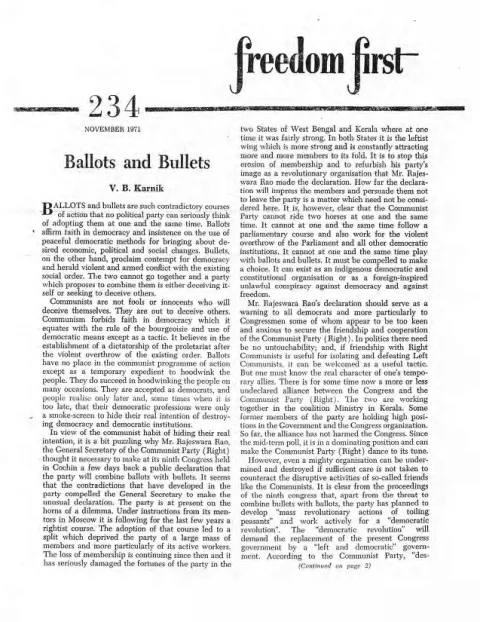
Ballots and Bullets
By V. B. Karnik
V. B. Karnik argues that the Communist Party (Right)‘s General Secretary, Mr. Rajeswara Rao, has declared at the party’s ninth Congress in Cochin that it will combine ballots with bullets — a position Karnik calls self-contradictory, since democratic methods and violent overthrow of the existing order cannot be pursued simultaneously without one being a smokescreen for the other. He reads the declaration as a response to the party’s shrinking membership (concentrated now in West Bengal and Kerala) and warns Congressmen against cultivating friendly relations with the Communist Party (Right), noting an undeclared alliance already operating in the Kerala coalition ministry. He concludes that the party’s proposed “mass revolutionary actions of toiling peasants” and push for a “democratic revolution” are unlikely to succeed but will create serious law-and-order problems for the Congress and the government.
- Communist Party (Right) General Secretary Rajeswara Rao declared at the ninth Congress in Cochin that the party would combine ballots with bullets.
- Karnik argues ballots (faith in democracy) and bullets (violent overthrow) are contradictory means that no party can honestly pursue together.
- The party’s membership has eroded under a Moscow-directed ‘rightist course’, especially in West Bengal and Kerala.
- An undeclared alliance already exists between Congress and the Communist Party (Right), notably in the Kerala coalition ministry.
- Karnik warns that friendly relations with the party are a liability, even if useful as a tactic against Left Communists.
- He predicts the party’s push for ‘mass revolutionary actions of toiling peasants’ and a ‘democratic revolution’ will likely fail but still cause disorder.
Nixon - Denying His Country’s History
By A. G. Mulgaokar
A. G. Mulgaokar accuses President Nixon of betraying America’s own revolutionary and anti-slavery heritage by continuing to arm and support General Yahya Khan’s regime during the Bangladesh crisis, drawing parallels to the American colonies’ revolt against taxation without representation and the Union’s fight against the slaveholding South. He surveys American press and political reaction (Chester Bowles, Galbraith, Ambassador Keating) as increasingly sympathetic to India, discusses the Indo-Soviet Treaty in light of the 1939 Anglo-Polish Treaty of Mutual Assistance, and argues that Sheikh Mujibur Rahman’s trial under martial law is a legal nullity since martial law cannot function where ordinary courts are operating.
- Mulgaokar argues Nixon’s support for Yahya Khan contradicts America’s own history of revolt against tyranny and slavery.
- American public and press opinion (Bowles, Galbraith) is described as increasingly sympathetic to India’s difficulties.
- The Indo-Soviet Treaty is compared to the 1939 Anglo-Polish Treaty of Mutual Assistance as a deterrent pact.
- Mujib’s trial is called a legal nullity because martial law cannot coexist with functioning ordinary courts.
- The essay questions why India has not formally granted Bangla Desh belligerency rights, as was done for Franco’s side in the Spanish Civil War.
Is Parliament Redundant for Socialism?
By “Atreya”
Writing under the pseudonym “Atreya”, the author criticizes the Congress government’s growing habit of governing by Ordinance rather than through Parliament, citing examples such as the Family Pension Scheme, amendments to the Payment of Bonus Act, and new levies to fund Bangla Desh refugee relief. The piece argues that trade unions across the ideological spectrum have compounded the problem by themselves demanding Ordinances on wages and bonus rather than defending parliamentary and collective-bargaining processes, which the author says undermines unionism itself. It concludes that quick development does not require short-circuiting democratic accountability, contrasting the current trend unfavourably with Nehru’s era.
- The essay criticizes the government’s increasing recourse to Ordinances instead of parliamentary legislation.
- Cited examples include the Family Pension Scheme, the Payment of Bonus Act amendment, and new levies for Bangla Desh refugee relief.
- Trade unions of all ideological stripes are blamed for themselves demanding Ordinances rather than defending union bargaining processes.
- The author argues this makes trade unions functionally redundant if the State can simply prescribe wages by decree.
- The piece contrasts Nehru’s restraint in avoiding Ordinances even under tougher political opposition with the current trend.
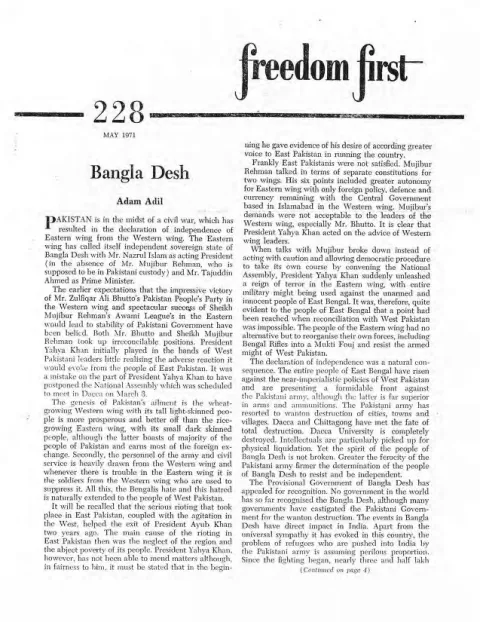
Bangla Desh
By Adam Adil
Adam Adil surveys the deepening India-Pakistan tension in late 1971, describing the escalating refugee burden on India (nearly nine million refugees, growing by 30,000 a day) and its fiscal cost, criticizing continued US arms sales to Pakistan despite the crackdown in East Bengal, and situating the Indo-Soviet Treaty as a deterrent against Pakistani aggression. The piece argues Pakistan cannot win a war against India given India’s preparedness, Pakistan’s economic collapse, and China’s evident disinterest in backing Yahya Khan, and concludes that Bangla Desh’s people now demand nothing less than full independence.
- India faces nearly nine million refugees, growing by 30,000 daily, at enormous fiscal cost (Rs. 200 crores budgeted, potentially Rs. 600 crores total).
- The US continues military aid and arms sales to Pakistan despite the crackdown, according to Senator Edward Kennedy’s disclosures.
- The Indo-Soviet Friendship Treaty is presented as a deterrent that has already restrained Pakistani war rhetoric.
- The author argues Pakistan cannot win a war against India given India’s preparedness, Pakistan’s economic dependence on East Bengal, and China’s lack of support.
- East Bengal’s demand has hardened from autonomy to full independence and sovereignty for Bangla Desh.
World Liberals on Bangla Desh and Threats to Press Freedom
This unsigned report covers two resolutions adopted at the Congress of the Liberal International in Zurich, chaired by Mr. Gaston Thorn, Foreign Minister of Luxemburg. The first resolution expresses concern over the tragic events in East Bengal and the refugee crisis, calls for international assistance, condemns states supplying weapons to Pakistan, and appeals for Sheikh Mujibur Rahman’s release or fair civilian trial. The second resolution addresses threats to press freedom in India and Asia, criticizing proposed amendments to the Indian Companies Act that could force newspaper owners to divest control, with the Swiss journalist W. Bretscher calling the scheme the ‘most vicious and underhand’ he has encountered in fifty years of journalism.
- The Liberal International Congress in Zurich adopted resolutions on East Bengal and on threats to press freedom in India and Asia.
- Attendees included Walter Scheel, Geertsema, Jeremy Thorpe, G. Malagodi, and M. R. Masani, who successfully amended the East Bengal resolution to add clauses on refugee relief and Mujib’s trial.
- The resolution appeals to Pakistan to convene the National Assembly as elected in December 1970.
- The press freedom resolution criticizes proposed Indian Companies Act amendments that could force divestment of newspaper ownership.
- Swiss journalist W. Bretscher is quoted condemning the scheme as the worst attack on press freedom he has seen in fifty years.
United Europe
By Hippopotamus
Writing under the pseudonym “Hippopotamus,” the author traces the history of the movement toward European unity from Count Coudenhove-Kalergi’s 1923 proposal through Churchill’s 1946 Zurich Appeal, the OEEC, the Council of Europe, the Coal and Steel Community, and the 1957 Treaty of Rome establishing the EEC. The piece (continuing past the rendered pages) discusses the EEC’s generalized tariff preference scheme for developing countries and the implications of Britain’s prospective entry into the Common Market for Commonwealth trade preferences.
- Traces the idea of European union from Coudenhove-Kalergi’s 1923 plan through Churchill’s 1946 Zurich Appeal to the 1957 Treaty of Rome.
- Describes the OEEC (1948), the Council of Europe (1949), and the European Coal and Steel Community (1951) as successive steps toward integration.
- Notes Europe was historically divided into three blocs: the Common Market countries, EFTA, and the Comecon countries.
- Discusses the EEC’s Generalized Scheme of Preferences (GSP) for developing countries as non-reciprocal, non-discriminatory tariff treatment.
- Raises concerns about the loss of Commonwealth tariff preferences once Britain joins the Common Market.
Transformation Of Congress In W. Bengal
By K. K. Sinha
K. K. Sinha describes the post-split transformation of the Congress(R) in West Bengal, crediting Indira Gandhi’s new leadership style and the rise of youth organisations — the Chhatra Parishad and Yuva Congress — for the party’s jump from 55 to 105 seats in the March 1971 election. The piece (continuing past the rendered pages) discusses the marginalisation of the older generation of Congressmen, the growth of the Chhatra Parishad from 17,000 to over a lakh members, and new pressures on the youth leadership from unemployed and urban-poor supporters demanding patronage.
- Congress(R) grew from 55 to 105 seats in West Bengal’s March 1971 election, a shift attributed to Indira Gandhi’s new leadership and party image.
- The Chhatra Parishad and Yuva Congress are described as the main driving force of the new Congress, displacing the older generation.
- The Chhatra Parishad grew from about 17,000 members in 1969 to over 100,000.
- Some veteran trade unionists and Congress workers are described as gradually aligning with the new leadership.
- The new leadership faces pressure from unemployed and urban-poor supporters seeking jobs and demanding donations be collected on their behalf.
Review: Chavan and the Troubled Decade (T. V. Kunhi Krishnan, Somaiya Publications, Bombay 14, Rs. 32)
By S.D.
A review, signed “S.D.”, of T. V. Kunhi Krishnan’s biography-cum-political-history “Chavan and the Troubled Decade” (Somaiya Publications, Bombay, Rs. 32). The reviewer praises Y. B. Chavan’s rise from a poor peasant family to Finance Minister and his statesmanlike refusal of the Prime Ministership offer during the Congress split, while criticizing the book’s structure for failing to convincingly bind Chavan’s personal story to the broader account of the ‘troubled decade,’ concluding the book is well-written but tells more about the decade than about Chavan himself.
- The book under review is T. V. Kunhi Krishnan’s ‘Chavan and the Troubled Decade’ (Somaiya Publications, Bombay, Rs. 32).
- Chavan is praised for rejecting the Prime Ministership offer during the Congress split rather than go along with policies he disagreed with.
- C. Subramaniam is quoted praising Chavan for subordinating personal interest and prestige to national interest.
- The book argues Indira Gandhi’s failure to consult colleagues, including Chavan, before nominating a presidential candidate contributed to the Congress split.
- The reviewer criticizes the book’s organizing conceit — using Chavan’s life as a ‘binding thread’ for the decade’s story — as unconvincing.
Mock Air Raid
By “Saadi”
Writing under the pseudonym “Saadi”, the author gives a satirical first-person account of a widely-publicised mock air-raid civil defence exercise held on 3rd October near Apollo Bunder in Bombay, describing how the elaborately announced drill — sirens, blackout, mock bombings, and rescue operations — collapsed into farce when fire brigades and ambulances failed to respond for over half an hour, leaving the crowd disillusioned about the state of India’s civil defence preparedness amid real fears of Pakistani aggression.
- The Directorate of Civil Defence and Home Guards heavily publicised a mock air raid exercise for 3rd October at Apollo Bunder and other Bombay locations.
- The public turned out in large numbers, taking the exercise seriously given real fears of Pakistani aggression.
- The mock bombs, sirens, and blackout proceeded as announced, but the promised rescue response was farcically delayed.
- Fire brigades and ambulances failed to arrive for over 30 minutes, and when they did, showed no urgency in retrieving mock casualties.
- The author concludes it is unclear whether what was witnessed was a serious exercise or ‘just a farce’, and notes similar reports came from other locations.
Minorities in Russia
This unsigned item summarizes a Minority Rights Group report on Soviet treatment of the Crimean Tatar and Volga German minorities, describing their World War II deportation en masse to Central Asia under Stalin (part of seven nationalities totalling 1.5 million people), Khrushchev’s 1956 denunciation of the deportations as among Stalin’s crimes, the partial 1957 restoration of autonomous territories for five of the seven nationalities, and the continued denial of repatriation and autonomy to the Crimean Tatars and Volga Germans specifically, despite their ongoing campaign for equal rights.
- A Minority Rights Group report documents Soviet treatment of Crimean Tatar and Volga German minorities.
- Both groups were part of seven nationalities (1.5 million people) deported en masse to Central Asia during WWII as alleged German collaborators.
- Khrushchev’s 1956 20th Party Congress speech included these deportations among Stalin’s catalogued crimes.
- 1957 Soviet decrees restored autonomous territories for five of the seven deported nationalities, but not for the Crimean Tatars or Volga Germans.
- Crimean Tatars (numbering about 300,000) continue to campaign for equality of rights and repatriation, which has been denied.
With Many Voices
The regular “With Many Voices” column, a digest of quotations from the Indian and international press on current affairs — including remarks on the Soviet Union’s changed international status, debates over the meaning of ‘socialist economy’ (quoting Jayaprakash Narayan), commentary on the Congress(R)‘s political discipline, the Bangla Desh refugee crisis as a world responsibility, and criticism of the Communist Party’s role in engineering further Congress splits — followed by the issue’s subscription form and publication colophon.
- The column collects short press quotations from sources including Indian Express, The Statesman, Hindusthan Standard, Janata, The Hindu, and Swiss Press Review.
- Jayaprakash Narayan is quoted distinguishing a genuine ‘socialist economy’ from a merely state-owned ‘bureaucratic economy’.
- A quotation from E.M.S. Namboodiripad on the Soviet Union’s wish to stay friendly with both India and Pakistan is included.
- Multiple quotations address the Bangla Desh refugee crisis as an international, not merely Indian, responsibility.
- The page includes the subscription form for Freedom First and the publication’s colophon, naming V. B. Karnik as editor/publisher for the Democratic Research Service.
Generated by the v1.5 extraction pipeline. Awaiting editorial review.
Metadata and summary are AI-extracted from the source PDF and reviewed for editorial accuracy. The original work is available via the Read PDF tab above (where present); paragraph-level citation inside the PDF is deferred to a future engagement.