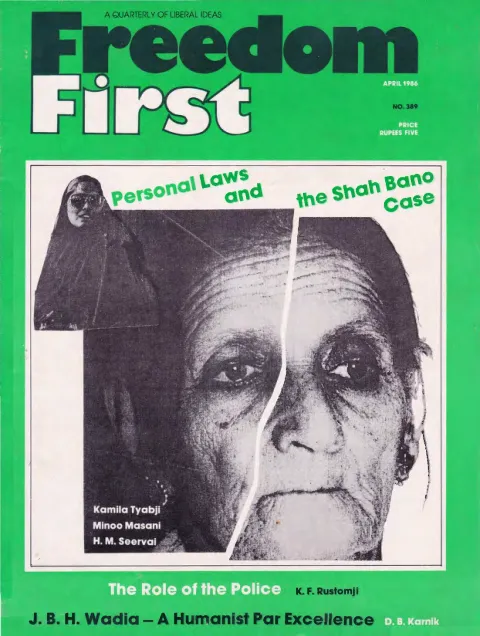
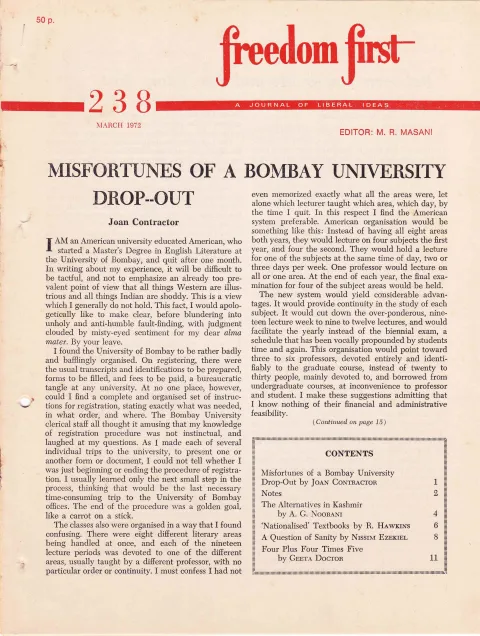
periodical issue
Freedom First
A Journal of Liberal Ideas
By Joan Contractor, A. G. Noorani, R. Hawkins, Nissim Ezekiel, Geeta Doctor, Cynthia Young, Colonel Joseph Lagu
Published for the Democratic Research Service by J. R. Patel, Associate Editor, Freedom First at 127, M. Gandhi Road, Bombay 1 and printed by him at Inland Printers, 55 Gamdevi Road, Bombay 7. · Bombay · 1972
16 pages
Freedom First
Summary
Freedom First No. 238 (March 1972), edited by M. R. Masani, is a monthly issue of this Bombay-based journal of liberal ideas covering roughly sixteen printed pages. Its editorial notes column, ‘Between You & Me and The Lamp Post,’ takes up student unrest and Vice-Chancellor security, the Prime Minister’s push to make State governments ‘fall in line’ with the Centre (framed as an attack on federalism), Sophia Wadia’s seventieth birthday and the PEN, the newly formed National Union of Journalists, and revelations that Defence Minister Jagjivan Ram let slip disagreements within government over Kashmir strategy after the Bangladesh war. A. G. Noorani contributes a long piece on electoral malpractice, preventive detention, and the banning of the Plebiscite Front in Jammu & Kashmir. R. Hawkins argues against centralising school-textbook production, Nissim Ezekiel reviews the Medvedev brothers’ account of Soviet psychiatric persecution, an unsigned review (by Cynthia Young) assesses Robert Conquest’s critique of Marxism, Geeta Doctor surveys Bombay art exhibitions, and an American graduate-school drop-out, Joan Contractor, recounts her disillusioning month at Bombay University. The issue also carries an open letter from a Southern Sudanese Anya Nya commander on the Bantu massacres, a letter to the editor on M. N. Roy’s pamphleteering legacy, and a closing page of quotations (‘With Many Voices’).
Key points
-
Joan Contractor’s “Misfortunes of a Bombay University Drop-Out” recounts an American graduate student’s disillusioning month at Bombay University, contrasting its fragmented lecture system with American continuity.
-
The “Notes” column praises Governor Dharma Vira for resisting Central pressure, reports the founding of the National Union of Journalists under Frank Moraes, and criticises the Prime Minister’s demand that states “fall in line” with the Centre.
-
A. G. Noorani’s “The Alternatives in Kashmir” surveys decades of rigged Kashmir elections and the externment of Plebiscite Front leaders, criticising the Front for failing to develop a democratic alternative once the plebiscite became moot.
-
R. Hawkins’s “‘Nationalised’ Textbooks” argues against centralised textbook production, proposing competing series and standard-setting committees instead.
-
Nissim Ezekiel reviews the Medvedev brothers’ “A Question of Madness” on Zhores Medvedev’s psychiatric detention for dissent, framing Soviet psychiatric persecution as “ideological madness”.
-
A review of Robert Conquest’s “Where Marx Went Wrong” questions Conquest’s thesis that Marx’s system was merely corrupted by successors, while Geeta Doctor surveys Bombay’s gallery scene.
-
An open letter from Anya Nya commander Colonel Joseph Lagu appeals to the OAU over alleged mass killing of Bantus in Southern Sudan, and a letter from J. B. H. Wadia credits M. N. Roy’s pioneering pamphleteering legacy.
Essays
Misfortunes of a Bombay University Drop-Out
By Joan Contractor
Joan Contractor, an American graduate student who enrolled for a Master’s in English Literature at the University of Bombay and quit after a month, describes the university’s confusing, poorly documented registration process and criticises its lecture organisation, which spread eight literary areas across nineteen periods a week with no continuity, taught by twenty to thirty different professors. She contrasts this with the American system’s more focused four-subjects-per-year structure and argues it would provide continuity, cut down lecture overload, and allow a yearly rather than biennial examination. The essay continues on page 15, where she elaborates that the syllabus itself felt too general even though it led her to a valuable rereading of Melville’s Moby Dick and Joseph Addison. Her central complaint, however, is attitudinal: she found Bombay University students hostile toward lecturers and administration indifferent to students, and contrasts this with the mutual respect and individual responsibility she associates with American universities, closing with a call for administrative reorganisation and a change in attitude on both sides.
- An American graduate student recounts quitting a Bombay University Master’s programme in English Literature after one month.
- She found registration bureaucratic and poorly documented, with no single complete set of instructions available.
- Classes spanned eight literary areas taught by 20-30 different lecturers across 19 weekly periods with little continuity.
- She proposes an American-style system: 3-6 dedicated professors, four subjects per year, and annual rather than biennial exams.
- Despite her complaints, she credits the syllabus with introducing her to Moby Dick, George Eliot, and Joseph Addison.
- Her deepest criticism is cultural: she perceives student hostility toward faculty and a lack of mutual respect, contrasted with American norms of student responsibility and cooperation.
Notes
The editorial notes column, ‘Between You & Me and The Lamp Post,’ opens by praising the Warden of Wadham College, Oxford for his sharp reply to student demands for ‘direct action,’ contrasting it with murderous attacks on Indian academics such as Professor V. V. John. It then commends outgoing Mysore Governor Dharma Vira for publicly protesting a breach of the Prime Minister’s assurance to the State, framing this as a defence of gubernatorial independence under the Constitution against the ‘rapacious politicos’ of the ruling party, and names other retired ICS officers (A. D. Shroff, N. Dandekar, H. M. Patel) it hopes will similarly serve the public. Further items cover an ‘In This Issue’ preview, a tribute to Sophia Wadia on the occasion of her 70th birthday and the PEN’s literary fund, the founding of the National Union of Journalists under Frank Moraes as a step away from Communist-aligned journalist bodies, and a report that Defence Minister Jagjivan Ram had inadvertently confirmed President Nixon’s claim of internal government division over pressing the military advantage in Kashmir after the Bangladesh war. It closes with States Rights Under Fire, condemning the Prime Minister’s demand that State governments ‘fall in line’ with the Centre as contrary to the federal Constitution, and citing the toppling of opposition-run State governments as evidence of a broader assault on federalism, plus a correction notice about a misattributed name in the February issue.
- Praises a Wadham College, Oxford letter refusing student ‘direct action’ demands, contrasted with violence against Indian academics like Professor V. V. John.
- Commends Governor Dharma Vira of Mysore for resisting Central pressure and defending gubernatorial independence under the Constitution.
- Names A. D. Shroff, N. Dandekar, and H. M. Patel as other retired civil servants it hopes will continue public service.
- Reports the founding of the National Union of Journalists under Frank Moraes as a break from Communist-dominated journalist bodies.
- Notes President Nixon’s claim, apparently corroborated by Defence Minister Jagjivan Ram, of internal Indian government disagreement over pressing military advantage in Kashmir.
- Criticises the Prime Minister’s demand that State governments ‘be in tune with the Central Government’ as contrary to the Constitution’s federal design.
The Alternatives in Kashmir
By A. G. Noorani
A. G. Noorani surveys the state of democracy in Jammu & Kashmir on the eve of Assembly elections, arguing that the arrests of Maulana Masoodi and Ghulam Mohiuddin Karra represent an admission of the ruling Congress Party’s fear of a fair contest. He details a history of rigged elections stretching back to 1957 and 1962, when dozens of National Conference candidates won uncontested, and the 1967 election’s mass rejection of nomination papers, alongside the 1954 Constitutional order that stripped Kashmiris of the full protection of fundamental rights guaranteed elsewhere in India, particularly around preventive detention. He then describes the externment of Plebiscite Front leaders Sheikh Abdullah, Mirza Afzal Beg, and G. M. Shah and the Front’s 1967 ban under the Unlawful Activities (Prevention) Act, contrasted with a Srinagar by-election won against the Congress candidate by editor Shameem Ahmed Shameem with Sheikh Abdullah’s backing. Noorani situates Kashmir’s plight within international abandonment following Pakistan’s 1965 aggression, and closes by criticising the Plebiscite Front for having failed, despite repression, to develop a sensible democratic alternative to its now-moot demand for a plebiscite, noting Front president M. A. Beg’s February 1972 proposal for bilateral talks on the State’s autonomy under Article 370.
- The arrest of Maulana Masoodi and Ghulam Mohiuddin Karra before Assembly elections is read as evidence the ruling Congress fears a fair contest in Kashmir.
- Traces rigged elections back to 1957 and 1962 (mass uncontested seats) and 1967 (118 nomination papers rejected in 39 of 75 constituencies).
- The 1954 Constitution (Application to Jammu & Kashmir) Order weakened fundamental-rights protections, especially against preventive detention, compared to the rest of India.
- Plebiscite Front leaders Sheikh Abdullah, Mirza Afzal Beg, and G. M. Shah were externed and the Front banned under the Unlawful Activities (Prevention) Act, 1967.
- Editor Shameem Ahmed Shameem won a Srinagar parliamentary seat against the Congress candidate with Sheikh Abdullah’s support, having broken with the Front over the plebiscite issue.
- Notes international abandonment of Kashmir’s cause after Pakistan’s 1965 aggression closed off the plebiscite option via the U.N.
- Criticises the Plebiscite Front for failing to offer a democratic alternative once the plebiscite demand became impractical.
- Records Front president M. A. Beg’s February 1972 proposal for bilateral talks on the State’s autonomy under Article 370.
‘Nationalised’ Textbooks
By R. Hawkins
R. Hawkins argues that ‘nationalised’ textbooks, meaning centrally produced and mandated texts for the whole country, are both impractical and undesirable given India’s linguistic and cultural diversity, and that education policy is in any case moving toward decentralisation rather than centralisation. He contends that the real problem is not too little central control but too much monopoly power already held by individual States, universities, and examining bodies over textbook provision. Hawkins lays out what a good textbook should do (provide a framework rather than lesson notes) and argues good textbook-writing requires experienced teacher-authors working alone or in small teams, not committees assembling composite manuscripts from submissions, since single-author coherence produces a better book than ‘scissors and paste’ compilation. He proposes a market-like alternative: multiple competing textbook series per subject, standard-setting committees that recommend five to ten best series without regard to public or private origin, five-year syllabus stability, and modest, structured royalty payments (capped between 1 and 5 percent depending on print run) to keep authors incentivised.
- Rejects the idea of a single centrally produced ‘nationalised’ textbook system as impractical given India’s linguistic and cultural diversity.
- Notes that education policy in 1969-70 was already moving power from the Centre to the States, the opposite of centralisation.
- Identifies existing State, university, and examining-body monopolies over textbook provision as the real problem, not insufficient central control.
- Argues a good textbook provides a framework for teaching, not a substitute for the teacher or a set of lesson notes.
- Insists good textbooks require single authors or small complementary teams, not committees compiling ‘best bits’ from many manuscripts.
- Proposes multiple competing textbook series per subject, periodic (five-yearly) syllabus review, and capped royalty rates (1-5%) to keep authors motivated.
A Question of Sanity
By Nissim Ezekiel
Nissim Ezekiel reviews A Question of Madness by brothers Zhores and Roy Medvedev, which recounts Zhores Medvedev’s 1970 arrest and confinement at the Kaluga Psychiatric Hospital after Soviet authorities used the pretext of ‘voluntary’ psychiatric examination to suppress a dissenting scientist. Ezekiel narrates how Zhores, a biologist known for a critical study of Lysenko, was targeted after losing his job and refusing to recant his findings, then detained under vague emergency-hospitalisation rules and diagnosed with ‘heightened nervousness’ by KGB-linked psychiatric officials despite showing no clear symptoms of mental illness. He recounts Roy Medvedev’s parallel campaign to free his brother, the international protest this provoked, Zhores’s release after nineteen days, and the subsequent surveillance and warning of those who had written in his defence. Ezekiel frames the episode as revealing an ‘ideological madness’ in the Soviet system, in which dissent itself is pathologised as a symptom of mental illness, and closes by noting the book memorialises other, less famous victims of similar persecution who remain confined.
- Reviews A Question of Madness by Zhores and Roy Medvedev (trans. Ellen de Kadt, Macmillan, 1971).
- Zhores Medvedev, a biologist and Lysenko critic, was arrested in May 1970 and confined to Kaluga Psychiatric Hospital.
- Soviet psychiatric officials diagnosed ‘heightened nervousness’ despite finding no clear symptoms of mental illness.
- His brother Roy Medvedev led an international letter-writing campaign that secured his release after 19 days.
- People who protested Zhores’s detention were later questioned and warned by Party organisations.
- The review frames Soviet psychiatric detention of dissidents as a bureaucratic substitute for Stalin-era terror.
- The book also documents other, lesser-known victims of similar psychiatric persecution still confined at the time of writing.
Four Plus Four Times Five
By Geeta Doctor
In an unsigned review credited at the close to Cynthia Young, Robert Conquest’s book Where Marx Went Wrong is assessed as a subtle, thought-provoking, if slim critique of communist theory and practice. The review characterises Conquest’s core thesis as holding that Marx’s original system was sound but corrupted by his successors, a position the reviewer finds questionable given how central concepts like the ‘dictatorship of the proletariat’ and the ‘law of increasing misery’ were to Marx himself and how readily historical experience falsified them (rising wages under rising capital investment, and the fact that Western liberties which curbed the state trace to Britain’s pioneering capitalist role, not to workers’ revolts, which historically have not come chiefly from workers). The review credits the book with tracing the logical descent from dictatorship of the proletariat to dictatorship of the party to dictatorship of one man, and with showing that communism substitutes an anxiety to change distribution for genuine understanding of production, but faults its later chapters as loosely strung together and its proofreading as poor.
- Reviews Robert Conquest’s Where Marx Went Wrong (Pee Kay Publications, New Delhi), reprinted in India.
- Faults Conquest’s premise that Marx’s original system was sound but corrupted by successors as questionable, since flawed concepts (dictatorship of the proletariat, law of increasing misery) originate with Marx himself.
- Notes historical experience falsified Marx’s ‘law of increasing misery’ as wages rose alongside capital investment.
- Observes that the ‘great rebellions against communism’ in recent years have been revolts of workers, not of the bourgeoisie or military, undercutting Marxist class assumptions.
- Credits the book’s account of the descent from ‘dictatorship of the proletariat’ to dictatorship of the party to dictatorship of one man.
- Summarises the book’s core claim: communism tries to fix distribution by seizing production, a category error since Marxist political economy was a critique of capitalism, not a plan for running an economy.
- Criticises the book’s later chapters as loosely organised and its proofreading as substandard.
Essay 7
Geeta Doctor surveys Bombay’s art gallery scene for the month, opening with an observation that each gallery’s ambience conditions how viewers respond to the art it shows, from the reverent isolation of the Taj Art Gallery to the maze-like Pundole. She reviews N. S. Bendre’s show at the Taj as visually delightful but emotionally frigid, finds Jeram Patel’s works at the Chemould overpriced and inaccessible, and describes Vinod Parul’s obsessively repeated snake-and-colour imagery at the Jehangir as claustrophobic rather than revelatory. The most interesting show, she writes, was an exhibition of nearly a hundred Australian prints at the Coomaraswamy Hall, showcasing a wide range of printmaking techniques (linocuts to precision screen prints) and highlighting the negative-positive image effects artists like Bea Maddock and George Baldessin achieved; the piece (continuing to page 13) closes by suggesting India lacks sufficient facilities for printmaking to become a more popular medium despite having craftsmen with relevant skills in textiles and metalwork.
- Surveys several Bombay galleries (Taj, Chemould, Jehangir, Coomaraswamy Hall) and argues each gallery’s atmosphere conditions viewer response to the art shown.
- Reviews N. S. Bendre’s show at the Taj as visually accomplished but emotionally frigid.
- Finds Jeram Patel’s Chemould show overpriced relative to its content.
- Describes Vinod Parul’s repeated snake imagery at the Jehangir as claustrophobic rather than revelatory of its intended religious symbolism.
- Highlights an Australian graphics exhibition at Coomaraswamy Hall as the month’s most interesting show, praising its range of printmaking techniques.
- Notes India lacks sufficient facilities for printmaking to flourish as a popular artistic medium despite relevant craft skills existing in textiles and metalwork.
Essay 8
This is an Open Letter to President Kaunda of Zambia, in his capacity as chairman of the Organization of African Unity, from Colonel Joseph Lagu, a commander of the Anya Nya (the Southern Sudanese Bantu military organisation), reprinted from the Zambia Daily Mail. Lagu appeals for international attention to what he describes as the extermination of Bantus in Southern Sudan, alleging half a million deaths from murder, repression, and disease at the hands of Sudanese forces aided by Soviet tanks, helicopters, and personnel. He recounts the killing of William Deng, a southern leader who had chosen political co-operation, as emblematic of the fate of southerners who sought accommodation rather than resistance, and closes with a direct plea for the OAU and the world to recognise Southern Sudanese as human beings and to intervene before, in his words, every African man, woman and child in Southern Sudan is dead.
- An Open Letter from Anya Nya commander Colonel Joseph Lagu to OAU chairman President Kaunda, reprinted from the Zambia Daily Mail.
- Alleges roughly half a million Bantu deaths in Southern Sudan from Sudanese government repression, aided by Soviet tanks, helicopters, and personnel.
- Describes the killing of southern leader William Deng after he pursued a path of political co-operation with the Sudanese government.
- Cites a cited example from the book ‘Sudan, An African Tragedy’ by a Norwegian journalist describing a massacre of 50 civilians, including children, in a church.
- Frames the letter as a direct plea to the Organization of African Unity for recognition and intervention.
- Presents the conflict as a story of racial and cultural persecution largely ignored by the world press.
Essay 9
A Letter to the Editor from J. B. H. Wadia responds to A. G. Noorani’s January article ‘On Pamphleteering,’ agreeing with its observations on the decline of pamphleteering but arguing that Noorani, in naming Congress Socialist Party leaders like Jayaprakash Narayan, Minoo Masani, Ashok Mehta, and Dr. Lohia as having ‘moulded a certain intellectual climate,’ overlooked M. N. Roy’s pioneering contribution to the same climate from a Marxist standpoint. Wadia traces Roy’s influence from the 1922 publication of India In Transition through decades of writings in Vanguard, Independent India, and later Radical Humanist, and cites a University of California, Berkeley bibliography crediting Roy with 133 publications, 70 of them pamphlets under 100 pages, urging renewed attention to Roy’s status as, in Wadia’s words, ‘the humanist par excellence.’
- J. B. H. Wadia’s letter responds to A. G. Noorani’s January 1972 article ‘On Pamphleteering.’
- Argues Noorani, while praising Congress Socialist Party figures for shaping India’s intellectual climate, omitted M. N. Roy’s Marxist-derived pioneering contribution to the same climate.
- Traces Roy’s influence from India In Transition (1922) through Vanguard, Independent India, and Radical Humanist until his death in 1954.
- Cites a University of California, Berkeley bibliography crediting Roy with 133 publications, including 70 pamphlets under 100 pages.
- Calls M. N. Roy ‘the humanist par excellence’ and laments political writers’ reluctance to acknowledge his legacy.
Essay 10
A closing page of quotations titled ‘With Many Voices,’ epigraphed with a line from Tennyson, gathers short quoted remarks from contemporary newspapers and magazines on politics, poetry, and current affairs, including comments attributed to Chou En-lai, President Nixon, Yevtushenko, Danny Kaye, Al Capone, Raymond Aron, Elia Kazan, and N. A. Palkhivala, alongside a subscription form for Freedom First and the journal’s statutory publication statement.
- A page of short quotations from contemporary press sources on politics, culture, and current affairs, framed by an epigraph from Tennyson.
- Includes remarks attributed to Chou En-lai, President Nixon, Soviet poet Yevtushenko, Danny Kaye, Al Capone, Raymond Aron, Elia Kazan, and N. A. Palkhivala.
- Accompanied by a Freedom First subscription form and the journal’s printing/publication details.
Generated by the v1.5 extraction pipeline. Awaiting editorial review.
Metadata and summary are AI-extracted from the source PDF and reviewed for editorial accuracy. The original work is available via the Read PDF tab above (where present); paragraph-level citation inside the PDF is deferred to a future engagement.