periodical issue
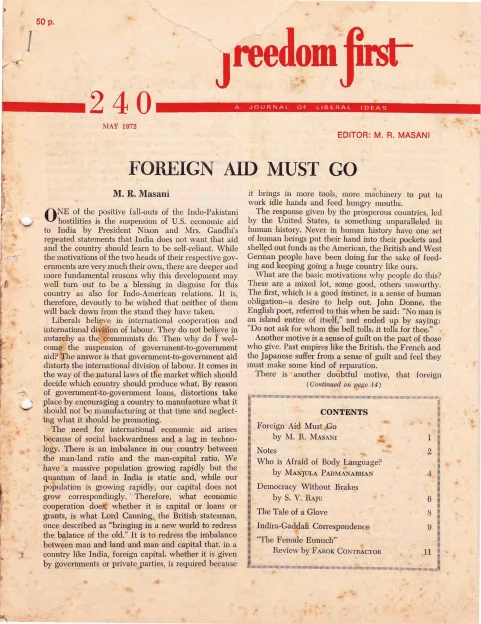
Freedom First
A Journal of Liberal Ideas
By S. V. Raju
Published for the Democratic Research Service by J. R. Patel, Associate Editor, Freedom First at 127, M. Gandhi Road, Bombay 1 and printed by him at Inland Printers, 55 Gamdevi Road, Bombay 7. · Bombay · 1972
16 pages
Freedom First
Summary
Freedom First No. 240 (May 1972), edited by M. R. Masani for the Democratic Research Service, Bombay, is a monthly journal of liberal ideas published in the immediate aftermath of the 1971 Indo-Pakistani war and the March 1972 Indian state assembly elections. The issue’s editorial center is a defence of economic and political liberalism against both the socialist tilt of Indira Gandhi’s Congress government and Soviet-style central planning: Masani’s lead essay argues that the suspension of U.S. aid to India is a disguised blessing because government-to-government aid distorts markets and entrenches statism, while S. V. Raju’s analysis of the state elections indicts Congress’s use of state machinery, money power, and a fragmented opposition to secure a manufactured landslide. Other contributors and features include Manjula Padmanabhan on the pseudo-science of body language, a Soviet Analyst-sourced satire on Soviet consumer shortages (the search for a pair of gloves), a translated Indira Gandhi-Gaddafi diplomatic exchange over the Bangladesh war, Farok J. Contractor’s review of Germaine Greer’s The Female Eunuch, readers’ letters on university education and constitutional federalism, and a closing page of aphoristic quotations from the world press under the standing feature ‘With Many Voices’.
Key points
-
M. R. Masani’s “Foreign Aid Must Go” welcomes the suspension of US aid to India as a blessing in disguise, arguing government-to-government aid entrenches statism and bureaucratic power.
-
The “Notes” column details allegations of vote-rigging in the March 1972 state elections and criticises India’s turn to Soviet computer collaboration over more advanced American technology.
-
Manjula Padmanabhan introduces kinesics, or body language, surveying gestures said to reveal unconscious defensiveness and cross-cultural differences in touch norms.
-
S. V. Raju’s “Democracy Without Brakes” argues Congress’s state-election landslide reflected superior financing and a divided opposition rather than genuine mandate, since it won only 44.64% of the vote but 71% of seats.
-
An unsigned “Tale of a Glove” satirises Soviet bureaucratic shortages through the story of a war-wounded pensioner’s months-long failed search for gloves.
-
A translated Indira Gandhi-Gaddafi correspondence over the 1971 war shows Gaddafi rejecting Indian appeals and accusing India of Soviet collusion.
-
Farok Contractor reviews Germaine Greer’s “The Female Eunuch” as a brilliant if occasionally dubious critique of sociologically conditioned femininity, and readers’ letters debate Bombay University and constitutional federalism.
Essays
Foreign Aid Must Go
By M. R. Masani
M. R. Masani’s lead editorial essay welcomes the suspension of U.S. economic aid to India following the Indo-Pakistani war, arguing that government-to-government aid, however well-intentioned, distorts the international division of labour and the natural workings of the market. He surveys the motives of donor nations (human obligation, imperial guilt, and anti-communist strategy) and argues, continuing on page 14, that aid strengthens statism, socialism, and bureaucratic power in recipient countries, discourages private equity investment, and breeds a corrosive combination of dependency and ingratitude. He concludes that private foreign equity capital serves India’s interests where government loans do not, and expresses hope India will be spared further government-to-government aid.
- Welcomes Nixon’s suspension of U.S. aid and Indira Gandhi’s rhetoric of self-reliance as a possible blessing in disguise.
- Argues liberals favour international cooperation and division of labour but oppose aid because it distorts market-driven allocation of production.
- Surveys donor motives: genuine humanitarian obligation, post-imperial guilt, and anti-communist Cold War strategy.
- Presents a data table showing the U.S. supplied 57.8% of foreign aid utilised by India, followed by the World Bank/IDA and West Germany.
- Argues aid strengthens the pro-communist trend by fueling neo-colonialism propaganda and helping regimes like Sukarno’s Indonesia and Nkrumah’s Ghana drift toward communism.
- Contends government-to-government aid transfers economic power from people, industrialists and businessmen to bureaucrats and politicians, citing Djilas’s The New Class (‘Everybody’s property is nobody’s property’) and a Gujarati proverb ‘Konna baapni divali?’
- Concludes foreign private equity capital benefits India (profits only on success) whereas government loans burden India with repayment regardless of how the funds were used.
Notes
The editor’s standing column ‘Between You & Me and the Lamp Post’ covers three items in this issue. Under ‘Fascism in Calcutta’, it details alleged large-scale rigging of the March 1972 Kashmir and Bengal state elections, quoting Congress leader P. C. Sen, Hind Mazdoor Sabha’s Bimal Banerjee, and the Economic Times’ description of ‘Politics of Terror in Bengal’, and criticizes CPM and other communist leaders for newly discovering the value of constitutional safeguards after having earlier backed the 24th and 25th Constitutional Amendments curbing Fundamental Rights. Under ‘What is Moderate?’ it questions the Indian government’s description of Arab states’ post-war stance as ‘moderate’ given the hostile tone of Libya’s Gaddafi (referencing the correspondence reprinted later in the issue). A further item, ‘A Brave Man’s Ordeal’, reports on Alexander Solzhenitsyn’s abandonment of hope of receiving his Nobel Prize in person after the Kremlin refused a visa to the Swedish Academy’s representative, describing his persecution in the USSR. ‘Perpetuating Our Backwardness’ criticizes India’s decision to seek Soviet collaboration on computers rather than more advanced American technology. ‘A Myth Exploded’ argues the North Vietnamese invasion of South Vietnam disproves the claim that the conflict was a purely indigenous civil war, and ‘Moscow’s Hand’ argues the invasion was master-minded and provisioned by the Kremlin.
- Reports detailed allegations of vote-rigging, ballot-box tampering, and violence in the March 1972 Kashmir and Bengal state elections, citing P. C. Sen and Bimal Banerjee.
- Notes with irony that CPM leader E. M. S. Namboodiripad and V. K. Krishna Menon now invoke constitutional safeguards for civil liberties after backing amendments that curbed Fundamental Rights.
- Questions the Indian government’s characterization of post-war Arab states, including Libya, as adopting a ‘moderate’ stance toward India.
- Covers Solzhenitsyn’s decision to give up hope of collecting his 1970 Nobel Prize after the Kremlin denied a visa to the Swedish Academy secretary.
- Criticizes India’s decision to seek Soviet collaboration on computer technology instead of more advanced American (IBM) technology.
- Argues the North Vietnamese invasion of South Vietnam, involving twelve of Hanoi’s fourteen regular divisions, disproves the ‘civil war’ framing of the conflict and implicates Soviet backing.
Who is Afraid of Body Language?
By Manjula Padmanabhan
Manjula Padmanabhan’s article introduces readers to kinesics, or body language, as a popular pseudo-science that claims to reveal unconscious thoughts and feelings through gestures, posture, and use of personal space. She surveys examples: crossed arms signalling defensiveness, rhythmic ‘ticking’ movements signalling anxiety, hand movements toward the head as a suppressed defensive gesture, and territorial behaviour around ‘air space’ on shared seating. The piece closes with a cross-cultural comparison of touch norms between Americans, Arabs, and Indians, concluding that kinesics, while sometimes far-fetched, has genuine potential as both an amusing pastime and a developing branch of psychology.
- Introduces kinesics (body language) as a popular grab-bag American science claiming to reveal unconscious thought through gesture.
- Crossed arms over the chest signal defensiveness and stubbornness; loosely crossed arms in women signal a desire to draw attention to femininity.
- Rhythmic or ‘ticking’ movements, and hands raised toward the head, are described as suppressed defensive/aggressive gestures rooted in nervous strain.
- People are highly sensitive to unconsciously guarded ‘air space’ and touch norms, which vary by culture and closeness of relationship.
- Contrasts American, Arab, and Indian norms around touching among friends versus strangers, concluding Western friendliness can mask more guarded true selves.
- Concludes kinesics, like any pseudo-science, has real potential as both entertainment and an emerging branch of psychology.
Democracy Without Brakes
By S. V. Raju
S. V. Raju analyses the March 1972 Indian state assembly elections, arguing that Congress secured a landslide in seats but not in genuine voter preference, thanks to superior financing, control of state machinery, use of the Bangladesh victory as a national referendum, a divided and discredited opposition, and India’s first-past-the-post electoral system. He documents alleged coercion of business ‘quotas’ for campaign funds, misuse of official machinery including Air Force planes, and Congress electoral pacts with the CPI even while officially opposing communism. Raju shows the Congress won 44.64% of votes but 71% of seats, and that proportional representation would have denied it a majority in at least six states; he closes by warning that the ‘car of Indian democracy is running without brakes’ given the collapse of internal checks within the Congress party and urging the opposition to undertake political re-education rather than mere electioneering.
- Congress used the post-Bangladesh war ‘referendum’ effect and lavish, forced financing (industry quotas, ‘dossiers’ on non-compliant business houses) to dominate the state elections.
- Documents violence, intimidation, ballot-box tampering, and vanished electoral rolls, particularly affecting the urban middle class.
- Congress secured only 44.64% of the vote but 71% of seats; proportional representation would have denied it a majority in at least six states and the Delhi Metropolitan Council.
- The CPI won 112 seats on just 3.57% of votes due to electoral pacts with Congress, while Congress(O) with 4.56% got only 88 seats and Jana Sangh with 8.23% got 105.
- The opposition’s disarray, lack of alliance, and history of engineered defections in earlier state governments undercut its credibility.
- Concludes internal checks within the Congress Party have vanished, and the opposition must undertake serious political re-education rather than continue conventional electioneering.
The Tale of a Glove
An unsigned piece, credited to Soviet Analyst, recounts a Pravda story about A. D. Nikontov of Voronezh, a war-wounded man who spent months in a bureaucratic odyssey trying to obtain a pair of gloves, being shuttled between the Ministry of Trade, regional trade departments, and a Woolworths-style shop that had no gloves in stock despite official instructions. The piece uses the episode, alongside Pravda’s own admission of chronic shortages of goods like fish, footwear, and kitchenware, as a satire of Soviet economic planning and bureaucratic indifference, noting only that officials responsible were eventually reprimanded, with no indication that Nikontov ever got his gloves.
- Soviet planning reports routinely admit shortfalls in commodities such as fish, herring, vegetables, woollen fabrics, clothes, footwear and kitchen utensils despite claimed production growth.
- War-wounded pensioner A. D. Nikontov of Voronezh searched every shop in a city of 660,000 for months without finding a pair of gloves.
- His letter to the Ministry of Trade was forwarded through several bureaucratic layers (Pronichkin, Sotnikov, Yevteev) with instructions to assist him, yet the shop had no gloves to sell.
- Pravda itself expressed indignation, and reported five weeks later that officials responsible received reprimands.
- The Ministry of Trade admitted the demand for gloves nationally could not be satisfied and that measures were being taken to increase production.
- The piece notes wryly that readers are never told whether Nikontov managed to buy a pair of gloves.
Indira-Gaddafi Correspondence
This item reprints, in translation from the Lebanese Arabic daily Al-Hayat, a diplomatic exchange between Indira Gandhi and General Gaddafi of Libya concerning the 1971 Indo-Pakistani war and the creation of Bangladesh. Gandhi’s letter asks Libya to use its influence to convince Pakistan to abandon its ‘policy of aggression’. Gaddafi’s reply rejects Indian and Libyan consultations as fruitless, accuses India of colluding with the Soviet Union to obstruct UN resolutions, denies any right existed to intervene by force in what he calls an internal Pakistani matter, and states that India’s negotiated reliance on Soviet MiGs and napalm was ‘more persuasive’ with India than Libya’s arguments for peace.
- Indira Gandhi’s letter to Gaddafi requests Libyan diplomatic pressure on Pakistan to end its ‘policy of aggression’ in East Bengal.
- Gaddafi’s reply calls prior consultations with India, including with other Third World leaders, ‘useless and of no value’.
- Gaddafi accuses India of collusion with Russia to obstruct UN resolutions while dealing ‘blows of death’ in East Pakistan.
- Gaddafi argues no law permits forcible intervention to change what he calls an essentially internal Pakistani problem, regardless of the tragedy involved.
- Gaddafi states India’s negotiations with Russia over MiG jets and napalm proved ‘far more persuasive’ than his side’s arguments for peace, implying India had already decided on war.
- The correspondence is noted elsewhere in the issue as forming part of a booklet released by the Libyan Embassy in Beirut, ‘The Dangerous Indian Attempt Against East Pakistan’.
”The Female Eunuch” Review
By Farok Contractor
Farok J. Contractor reviews Germaine Greer’s The Female Eunuch (Paladin, 1970), calling it a brilliant expose of women’s historical subservience to masculine conceptions of femininity. He summarizes Greer’s central hypothesis that biological sex differences are minor and that most differences between men and women are products of sociological conditioning, and praises her critique of institutions like marriage and motherhood, including her comparison of girls’ upbringing to the psychological bind depicted in Portnoy’s Complaint. The reviewer finds some of Greer’s arguments (such as her claim about chromosome variance) dubious but judges the book intellectually taut and calls it a healthy, engaging read that exceeded his expectations given how over-exposed the topic of women’s liberation had become.
- Greer’s fundamental hypothesis: biological sex differences are minimal, and apparent differences between the sexes are largely the product of sociological conditioning.
- The reviewer finds the chromosome-based argument for this hypothesis dubious but calls the book’s overall thesis sound.
- Praises Greer’s critique of motherhood and marriage, including her comparison of female upbringing to the psychological bind in Portnoy’s Complaint.
- Notes Greer positions herself as an intellectual analyst of feminism rather than an activist, leaving activism to figures like Friedan, Millett, and Stiennes (sic).
- Cites Greer’s contention that women, like men, remain in bondage to constructed ‘stereotypes’ of femininity even while claiming liberation.
- Concludes the book is intellectually tight, occasionally irascibly extreme, but overall a healthy and engaging read.
Essay 8
This letters page prints two reader responses. C. S. Nair, an M.A. English Literature student at Bombay University, corroborates an earlier article by ‘Joan Contractor’ on the disillusioning experience of postgraduate study, criticizing the university’s outdated syllabus, its bias toward students with money and leisure, and an examination system he says rewards writing speed and memory over intelligence. P. Kodanda Rao writes to dispute an earlier editorial note describing the Indian Constitution as a loose federation, quoting K. M. Munshi’s view that India is a national union with no constituent sovereignty, to which the editor replies that the real issue is not looseness but the Prime Minister’s attempt to shift States List subjects into the Concurrent List by demanding conformity with central socialist policy.
- C. S. Nair corroborates an earlier account of disillusionment with Bombay University’s M.A. English Literature program, criticizing its outdated syllabus and rote-memory examination system.
- P. Kodanda Rao disputes an earlier note describing India’s Constitution as a ‘Federation’, citing K. M. Munshi’s characterization of India as a national Union without constituent sovereignty.
- Rao notes ‘Union Of India’ was chosen over ‘Federation Of India’ in constitutional drafting to reflect this design.
- The editor’s reply concedes the federation is ‘too tight’ but argues the real controversy is the Prime Minister’s de facto transfer of States List subjects to the Concurrent List by demanding conformity with central socialist policy.
Essay 9
The closing feature ‘With Many Voices’ is an unsigned compilation of aphoristic quotations drawn from the world press (Quest, the Economist, U.S. News & World Report, National Review, and others), commenting wryly on Indian politics (Congress’s alliance of the new rich and old communists, the cult of personality around Indira Gandhi) and international affairs (Nixon’s invasion of Cambodia, Soviet consumer shortages, Rhodesia, British Labour politics). The page closes with the journal’s subscription form and imprint, noting it is published for the Democratic Research Service by J. R. Patel at 127 Mahatma Gandhi Road, Bombay.
- Quotes from Quest describe Mrs. Gandhi’s socialism as a combination of the new rich and old communists, and note Bombay’s wealthy Marxists have become ‘New Congressmen’.
- Cites William A. Rusher in National Review attributing Nixon’s Cambodia decision partly to his repeated viewings of the film Patton.
- Notes a Bombay advertisement’s slogan ‘One Leader, One Nation, One Indira’ as evidence of a personality cult.
- Includes press commentary comparing treaties to roses and young girls (General de Gaulle) and on the Economist’s view that West Bengal’s definition of peace is ‘two or three political murders a day instead of six or seven’.
- The page closes with Freedom First’s subscription form and its publication imprint via the Democratic Research Service, Bombay.
Generated by the v1.5 extraction pipeline. Awaiting editorial review.
Metadata and summary are AI-extracted from the source PDF and reviewed for editorial accuracy. The original work is available via the Read PDF tab above (where present); paragraph-level citation inside the PDF is deferred to a future engagement.