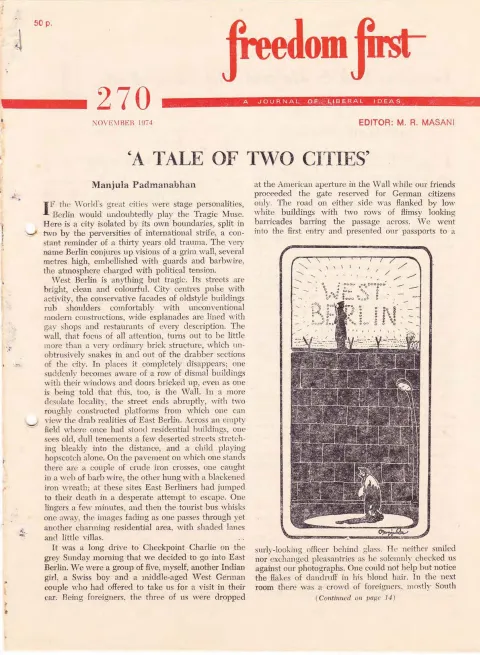
periodical issue
Freedom First
A Journal of Liberal Ideas
By Vrunda Moghe, Sharu S. Rangnekar, R. K. Narayan, A. G. Noorani, Anil Dharkar
Published for the Democratic Research Service by J. R. Patel, Associate Editor, Freedom First at 127, M. Gandhi Road, Bombay 1 and printed by him at Inland Printers, 55 Gamdevi Road, Bombay 7. · Bombay · 1972
16 pages
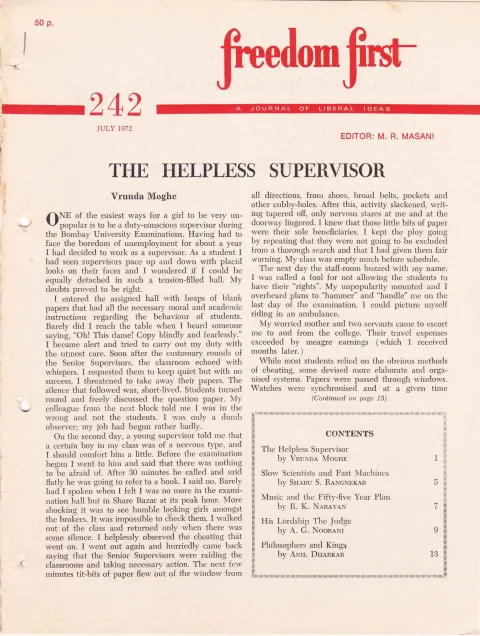
Freedom First
Summary
This is the complete July 1972 issue (No. 242) of Freedom First, the Bombay-based journal of liberal ideas edited by M. R. Masani and published for the Democratic Research Service. The issue mixes reportage, satire, editorial commentary, and a book review. Its editorial spine, the unsigned column ‘Between You & Me and The Lamp Post,’ surveys the Vietnam war’s turning tide, the Nixon-Moscow summit, Soviet double-dealing (with a companion box, ‘Broken Pledges,’ tabulating 24 of 25 US-Soviet summit agreements the Soviets are said to have violated), Communist inroads in Orissa’s state government, the death of the Duke of Windsor, and the erosion of minority-institution protections under the Aligarh Muslim University (Amendment) Bill. Vrunda Moghe opens the issue with a first-person account of the chaos and cheating she witnessed as an exam supervisor at Bombay University. Sharu S. Rangnekar criticizes the slow, committee-bound Electronics Commission for holding back India’s computer industry. R. K. Narayan contributes a satirical sketch imagining Indian classical and light music nationalized under a ‘Fifty-five Year Plan.’ A. G. Noorani reviews Henry Cecil’s Hamlyn Lectures on the English judiciary and argues India lacks any comparable public scrutiny of its judges. Anil Dharkar reviews a Popular Prakashan reprint of a Daedalus special issue on political leadership, dwelling on Erik Erikson’s psychoanalytic essay on Gandhi. The issue closes with ‘With Many Voices,’ a page of aphoristic press quotations on Cold War and development themes from Churchill, Nixon, Rajagopalachari, and others.
Key points
-
Vrunda Moghe’s “The Helpless Supervisor” recounts rampant, organised cheating she witnessed as a Bombay University exam supervisor, and the hostility her attempts at discipline provoked.
-
The editorial column assesses the Nixon-Moscow summit as producing little beyond a tactical truce, citing a Senate study claiming the Soviets violated 24 of 25 past agreements, and warns of a Communist “take-over” step in Orissa.
-
Sharu S. Rangnekar’s “Slow Scientists and Fast Machines” criticises the glacial, committee-bound Electronics Commission for holding back India’s fledgling computer industry.
-
R. K. Narayan’s satirical “Music and the Fifty-five Year Plan” imagines Indian classical and light music nationalised under bureaucratic quotas and inspectors.
-
A. G. Noorani’s review of Henry Cecil’s Hamlyn Lectures contrasts British public scrutiny of judges with the stagnant salary and declining governmental respect facing Indian judges.
-
Anil Dharkar reviews the Daedalus collection “Philosophers and Kings”, dwelling on Erik Erikson’s psychoanalytic essay on the origins of Gandhi’s non-violence.
-
A “Broken Pledges” tabulation catalogues alleged Soviet violations of US-Soviet summit agreements since 1943, and the closing “With Many Voices” page quotes Djilas on socialist leaders’ abuse of nationalised property.
Essays
Helpers Clubs
Vrunda Moghe, newly on the Freedom First staff, recounts her experience as an examination supervisor during the Bombay University exams. Assigned to an unruly hall, she found students copying openly, passing notes and papers through windows, and organizing elaborate cheating rings involving ‘Helpers Clubs’ in nearby vacant houses that smuggled in pre-written answers. Her attempts to enforce discipline made her deeply unpopular with students and drew no support from colleagues or the administration; she was threatened, subjected to staff-room gossip, and had to be escorted to and from college by her worried mother and two servants after rumors that students planned to ‘handle’ her. The essay closes on a bitterly ironic note: a student who cheated flagrantly and scored a first division later told her to her face that ‘dishonesty pays.’
- The author took up work as an exam supervisor at Bombay University after a period of unemployment.
- Cheating was rampant and organized, including note-passing, coordinated watch-synchronized paper exchanges through windows, and an off-site ‘Helpers Club’ supplying pre-written answers.
- Her attempts to enforce exam discipline made her the target of hostility from students and indifference or blame from colleagues and senior supervisors.
- She faced a veiled threat from a student who invoked his father’s position as a Police Inspector, and had to be escorted to and from the exam hall for safety.
- The essay closes with a cheating student who scored 61% in the First Year Arts Examination cheerfully informing her afterward that ‘dishonesty pays.‘
Essay 2
The unsigned editorial column surveys several current events. On Vietnam, it argues the ‘Cassandras’ predicting South Vietnamese collapse were wrong, credits the American blockade and bombing with halting the North Vietnamese offensive, and cautions against equating military superiority with justice. It assesses the Nixon-Moscow summit as producing little of substance beyond a superpower ‘alliance of convenience,’ quoting the French Communist paper Humanite and citing a US Senate Judiciary Committee staff study claiming the Soviets violated 24 of 25 past agreements with the US (elaborated in the accompanying ‘Broken Pledges’ box). Domestically, it welcomes the collapse of the ‘opportunist’ Swatantra-Utkal Congress coalition in Orissa but condemns the installation of a Communist as the state’s General Secretary as a step in India’s ‘Communist take-over.’ It criticizes Indira Gandhi’s and President V.V. Giri’s soft rhetoric toward Eastern Bloc agrarian collectivization, expresses guarded British public sympathy for the Duke of Windsor after his death, and closes by warning that the Aligarh Muslim University (Amendment) Bill and attacks on Christian and Muslim institutions in Kerala threaten India’s minority communities despite their electoral support for the Congress Party.
- The column argues that the tide has turned in Vietnam, with North Vietnam having lost over 50,000 men and the US blockade and bombing campaign proving decisive.
- It characterizes the Nixon-Moscow summit as producing little concrete beyond a tactical superpower truce, doubting the durability of any new agreements given the Soviets’ record of violating prior ones.
- It criticizes the nomination of a Communist as General Secretary in Orissa as evidence of a step-by-step ‘Communist take-over’ of India, and criticizes Indira Gandhi and President V. V. Giri for downplaying Soviet-style collectivization rhetoric among ‘agrarian reformers.’
- It reflects on British public and even Labour Party sympathy for the Duke of Windsor following his death, framed as a ‘bad conscience’ over his earlier forced abdication.
- It warns that the Aligarh Muslim University (Amendment) Bill and moves against Christian and Muslim institutions in Kerala will alienate minority communities that had supported the Congress Party at the polls.
The Helpless Supervisor
By Vrunda Moghe
Sharu S. Rangnekar surveys India’s decade-old computer industry (dating from ESSO’s introduction of the first commercial computer in 1961) and criticizes the government’s Electronics Commission, formed in February 1971, for its glacial pace and disconnect from industry needs. He describes a controversy between commercial data-processing applications (criticized for displacing clerical labour) and scientific/computational uses, and a parallel dispute over hardware providers (IBM, ICL, and the public-sector ECIL). He accuses scientists on the Commission of having inherited the ‘Brahamic Arrogance’ of the civil servants they replaced, dismisses the idea of an indigenous ‘Ambassador’-brand computer as impractical, and criticizes a reported proposal to collaborate with the USSR on a MIR-2 computer given Russia’s weak computing reputation. He closes by warning that unrealistic, slow-moving deliberation by overcommitted scientist-committee-members threatens to ‘ruin the electronics industry in India.’
- India’s computer industry began in 1961 with ESSO’s first commercial machine; by 1972 there were about 150 units in operation and 50 more planned, roughly 60% for commercial use.
- The government’s Electronics Commission, formed in February 1971 to formulate computer policy, is criticized for extreme slowness, having drafted a policy only for ‘electronic desk calculators’ after a full year.
- Rangnekar accuses scientist-commissioners of adopting the same ‘Brahamic Arrogance’ that afflicted the civil service, while excluding commercial computer users from representation on the Commission.
- He criticizes the idea of a fully indigenous ‘Ambassador’-brand computer as unrealistic given the software support burden, and casts doubt on a reported proposal to collaborate with the USSR on the MIR-2 computer.
- He warns that overcommitted scientists serving on multiple committees are delaying decisions on individual computer projects, with serious consequences for corporate planning and the industry as a whole.
Slow Scientists and Fast Machines
By Sharu S. Rangnekar
A short unsigned item on the American student radical Kathy Boudin, who was in hiding and sought by police over an explosion that destroyed a house in Greenwich Village. The piece notes that Boudin had spent 15 months in the Soviet Union and had published an article in Leviathan on the disillusionment of young Soviet intellectuals with socialism, who saw central economic planning as inherently tied to restrictions on personal freedom, including the requirement to secure police approval to live in cities like Moscow, Kiev, or Leningrad.
- Kathy Boudin, an American student radical wanted by police over a Greenwich Village explosion, had earlier spent 15 months in the Soviet Union.
- Her article in Leviathan described young Soviet intellectuals as viewing ‘planning’ as tied to a ‘disappointed dream’ and resenting restrictions on where they could live.
- The item frames Soviet citizens’ pessimism as evidence that centralized economic planning is inherently linked to the erosion of personal freedoms.
Music and the Fifty-five Year Plan
By R. K. Narayan
R. K. Narayan’s satirical sketch (reprinted with courtesy from a T. Chowdiah Smaraka Ramaseva Samithi souvenir) imagines Indian music nationalized under a ‘Fifty-five Year Plan.’ A Director-General of Music would file bureaucratic administration reports; a Minister would mandate cross-regional listening quotas between North and South Indian audiences, with fines for yawning; Government-appointed ‘Watch-and-Ward Inspectors’ would police audience attentiveness at every Music Sabha; and a Music Tribunal would adjudicate disputes and could halt performances. Musicians would be recognized as ‘torchbearers of culture,’ with a triennial ‘Grand Musician of the Indian Republic’ title and official precedence at banquets, plus a bureaucratic mechanism for artistes to preemptively report bad moods to the Director of Meteorology. The piece closes by insisting the Government has no doubt this is ‘moving on the right lines’ and urging composers to write songs promoting rural civic improvement.
- The satire imagines a ‘Fifty-five Year Plan’ for musical revival, with a Director-General of Music filing bureaucratic reports on hours of vocal and instrumental music delivered.
- A Minister would mandate that North and South Indian audiences sit through twelve-hour cross-regional listening sessions each quarter, with yawning or restlessness punishable by fine and reprimand.
- Every Music Sabha would have a Government-appointed ‘Watch-and-Ward Inspector’ empowered to switch off a performer’s microphone if audience members appear inattentive.
- A Music Tribunal, meeting quarterly across major cities, would have jurisdiction to stop any performance without giving reasons.
- Musicians would receive formal state recognition, including a triennial ‘Grand Musician of the Indian Republic’ title, official banquet precedence, and a bureaucratic system for pre-registering bad moods with the Director of Meteorology.
His Lordship The Judge
By A. G. Noorani
A. G. Noorani reviews Henry Cecil’s 1970 Hamlyn Lectures, The English Judge, and uses it to reflect on the relative absence of serious, informed public scrutiny of the judiciary in India compared to Britain. He surveys Cecil’s account of British public and legal opinion on judges — their reputation for fairness balanced against real disabilities such as being barred from publicly replying to press criticism — and Cecil’s proposal (which Noorani finds impractical) that barristers under consideration for judgeship undergo a probationary period as deputy-judges. Noorani closes by drawing a contrast between the well-compensated, publicly esteemed English judge and the Indian judge, whose salary has stagnated for decades and who faces increasing governmental disregard, with the 1958 Law Commission Report on judicial service still awaiting implementation.
- Noorani frames the essay around jurist Ehrlich’s dictum that there is no guarantee of justice except the personality of the judge, and argues India lacks the kind of serious, informed public criticism of its judiciary that Britain has, per Henry Cecil’s Hamlyn Lectures.
- Cecil’s survey of British opinion, including quoted schoolboy and lay impressions, finds judges esteemed as embodying fairness despite occasional criticism that they have become tools of the Establishment — a claim Cecil finds unsubstantiated.
- Cecil identifies real disabilities judges face, such as being barred from replying publicly to press criticism, while noting a judge’s words carry unique, unanswerable authority in court.
- Noorani criticizes Cecil’s proposal that prospective judges undergo a probationary period as deputy-judges as impractical, arguing judgeship should go to those who must be persuaded rather than those who seek it.
- The essay closes by contrasting the English judge’s rising real income and public respect with the Indian judge’s stagnant salary and declining governmental respect, noting the unimplemented 1958 Law Commission Report.
Philosophers and Kings
By Anil Dharkar
Anil Dharkar reviews Philosophers and Kings: Studies in Leadership, a Popular Prakashan reprint of a 1968 Daedalus special issue on political leadership. He traces the historical shift in how leadership has been studied, from mythologized founder-figures through Enlightenment social-contract theory and Marx’s structural account of history, to the 20th century’s renewed interest in individual leaders (Lenin, Hitler, Stalin, Gandhi) as psychoanalytic and multi-disciplinary methods became available. He focuses at length on Erik Erikson’s essay ‘In Search of Gandhi,’ a preview of Erikson’s larger psychoanalytic study of Gandhi’s early life and the origins of non-violence, weighing the promise and danger of psycho-historical analysis, including Victor Wolfenstein’s controversial Freudian reading of Gandhi’s Salt March via Ernest Jones’ theory linking salt to human semen, which Dharkar treats with skepticism. He notes the volume also covers Nkrumah, de Gaulle, and Newton, and commends Popular Prakashan for making the collection available cheaply.
- The reviewed volume, Philosophers and Kings, is a Popular Prakashan reprint (407 pp., Rs. 10) of a 1968 special issue of Daedalus, the journal of the American Academy of Arts and Sciences, on political leadership.
- Dharkar traces a historical shift from mythologized founder-narratives, through Enlightenment social-contract theorists (Hobbes, Locke, Adam Smith) and Marx’s structural view of history, to renewed 20th-century interest in individual leaders following the rise of figures like Lenin, Hitler, Stalin, and Gandhi.
- He gives extended attention to Erik Erikson’s essay ‘In Search of Gandhi,’ describing it as a preview of Erikson’s larger study of the origins of Gandhi’s non-violence, informed by Gandhi’s own autobiography Experiments with Truth.
- Dharkar discusses the risks of psycho-historical analysis via Victor Wolfenstein’s Freudian reading (drawing on Ernest Jones) of Gandhi’s Salt March as symbolically tied to sexual abstinence, an interpretation Dharkar treats skeptically, especially given the material conditions of Indian poverty.
- The review notes the volume also treats Nkrumah, de Gaulle, and Newton, and praises Popular Prakashan’s low-priced edition, suggesting a sequel applying multiple analytic approaches to a single leader.
Essay 6
No summary was extracted for this article. Listed for completeness.
Essay 7
No summary was extracted for this article. Listed for completeness.
Essay 8
An unsigned tabulation, ‘Broken Pledges,’ presents a US Senate Judiciary Committee staff study’s claim that of 25 agreements reached at seven US-Soviet summit meetings since 1943, the Soviets violated 24. It lists specific instances at Teheran (1943), Yalta and Potsdam (1945), and Geneva (1955), plus broken Soviet promises on free elections in Eastern Europe, POW repatriation, Korea, German reunification, free travel between Berlin and the West (citing the 1948-49 Berlin blockade and 1961 Berlin Wall), the 1962 Cuban missile crisis, and the 1970 Middle East cease-fire, which Russia allegedly helped Egypt violate by moving SA-2 and SA-3 missiles to the Suez Canal.
- A US Senate Judiciary Committee staff study found that of 25 agreements reached across seven US-Soviet summits, the Soviets violated 24.
- At Teheran (1943) all four major Stalin agreements were broken; at Yalta (1945) five of six; at Potsdam (1945) all 14.
- Russia is said to have broken promises of free elections in Hungary, Bulgaria, Poland, Czechoslovakia and Rumania, all of which became Communist dictatorships.
- Cited violations include the Berlin blockade (1948-49), the Berlin Wall (1961), the secret placement of offensive missiles in Cuba (1962) despite assurances they were defensive, and the movement of SA-2/SA-3 missiles to the Suez Canal in violation of a 1970 Middle East cease-fire.
Essay 9
The closing page, ‘With Many Voices,’ is a compilation of press quotations on current affairs, framed by an epigraph from Tennyson. Quotes touch on courage (Churchill), the unreliability of defectors (The Economist), the abuse of nationalized property under socialism (Milovan Djilas), the incompatibility of rapid economic equality and development (W. Arthur Lewis), Nixon’s justification for continuing the Vietnam War (quoted from The Economist), UNCTAD’s demands on the US (Time), Sham Lal’s warning that India risked becoming ‘a larger edition of Burma,’ Rajagopalachari’s remark that India and Pakistan’s joint Silver Jubilee of independence is ‘without jubilation,’ and commentary on the Soviet response to the Haiphong harbour mining.
- The page compiles brief press quotations on Cold War, development, and domestic Indian political themes, framed with an epigraph from Tennyson.
- Milovan Djilas (in The New Class) is quoted on socialist leaders treating nationalized property as their own while wasting it as if it belonged to someone else.
- W. Arthur Lewis is quoted arguing that developing countries cannot simultaneously pursue rapid economic equality and economic development, and that the USSR has abandoned the former.
- Sham Lal, writing in The Times of India, warns that elements of India’s ruling party want the country to become ‘a larger edition of Burma.’
- C. Rajagopalachari, quoted from Swarajya, observes that the Silver Jubilee of independence in India and Pakistan is ‘a jubilee without jubilation.’
Generated by the v1.5 extraction pipeline. Awaiting editorial review.
Metadata and summary are AI-extracted from the source PDF and reviewed for editorial accuracy. The original work is available via the Read PDF tab above (where present); paragraph-level citation inside the PDF is deferred to a future engagement.