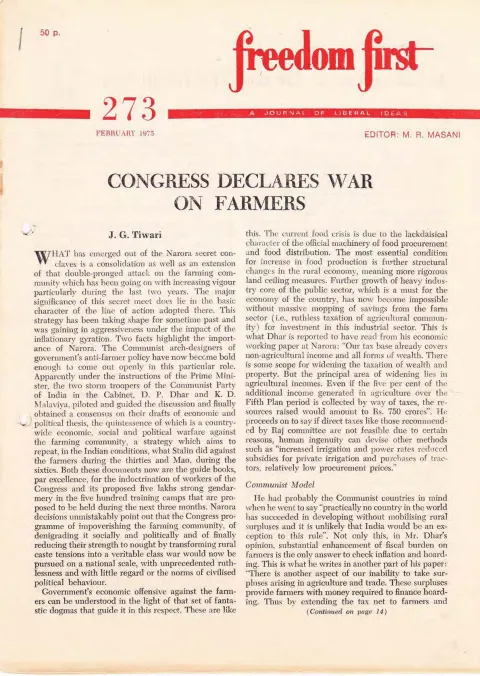
periodical issue
Freedom First
A Journal of Liberal Ideas
Published for the Democratic Research Service by J. R. Patel, Associate Editor, Freedom First at 127, M. Gandhi Road, Bombay 1 (Phone: 254341) and printed by him at Island Printers, 53 Gamdevi Road, Bombay 7. · Bombay · 1973
16 pages
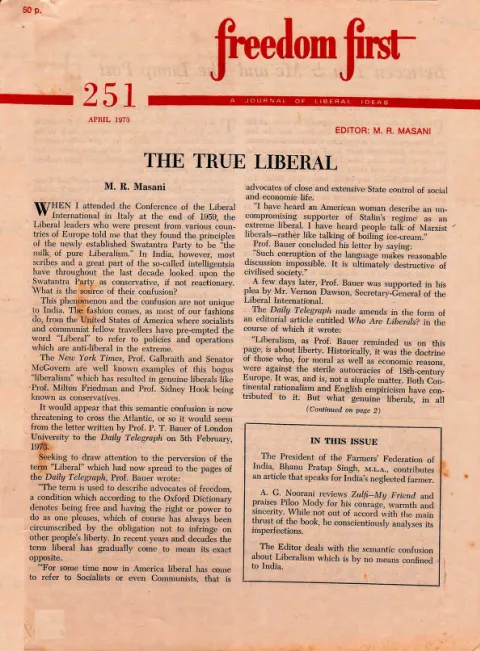
Freedom First
Summary
This is the complete April 1973 issue (No. 251) of Freedom First, the Bombay-based journal of liberal ideas edited by M. R. Masani. The issue opens with Masani’s own editorial, ‘The True Liberal,’ defending classical liberalism against what he sees as its corruption by Western ‘progressive’ usage, and closes the argument in the ‘Between You & Me and The Lamp Post’ column with notes on book-import censorship fears and Soviet repression under the guise of ‘humanism.’ The bulk of the issue’s substantive content is Bhanu Pratap Singh’s essay ‘For Farm and Freedom,’ a sustained attack on Indira Gandhi’s land-ceiling policy as economically incoherent and covertly aimed at collectivized agriculture, and an unsigned editorial, ‘The Budget of an Ignoramus,’ attacking Finance Minister Y. B. Chavan’s 1973-74 budget as fiscally reckless. A. G. Noorani reviews Piloo Mody’s biography of Zulfikar Ali Bhutto, finding it warm but uncritical; Manjula Padmanabhan reviews Sasti Brata’s novel Confessions of an Indian Woman Eater. The issue rounds out with a wire-service filler on Soviet bureaucratic bungling (‘Coffee or Fertiliser?’), a reader’s letter on Vietnam bombing statistics, and the recurring ‘With Many Voices’ page of quotations.
Key points
-
M. R. Masani’s “The True Liberal” defends classical liberalism against its inversion in American usage, arguing the Swatantra Party represents authentic liberalism despite being called “conservative” in India.
-
The “Notes” column warns a proposed State Trading Corporation monopoly on book imports threatens literary censorship, and cites a study finding roughly a million people in Soviet forced-labour camps.
-
Bhanu Pratap Singh’s “For Farm and Freedom” attacks Indira Gandhi’s land-ceiling policy as economically incoherent and a covert step toward Soviet-style agricultural collectivisation.
-
An unsigned editorial, “The Budget of an Ignoramus”, excoriates Finance Minister Y. B. Chavan’s 1973-74 budget for escalating deficits despite three years of heavy fresh taxation.
-
A. G. Noorani reviews Piloo Mody’s biography of Bhutto, “Zulfi — My Friend”, finding it warm but factually uncritical on the Pakistan break-up.
-
Manjula Padmanabhan reviews Sasti Brata’s novel “Confessions of an Indian Woman Eater” as derivative and lacking genuine candour.
-
A wire filler recounts a Soviet bureaucratic mix-up distributing coffee as fertiliser, and a reader’s letter disputes claims of indiscriminate American bombing of North Vietnam.
Essays
The True Liberal
By M. R. Masani
In this lead editorial, M. R. Masani takes up the semantic confusion surrounding the word ‘liberal,’ prompted by a February 1973 letter from Prof. P. T. Bauer to the Daily Telegraph. Masani argues that the Swatantra Party, though widely dismissed by Indian commentators as ‘conservative,’ actually represents ‘the milk of pure Liberalism’ as recognized by European Liberal International delegates. He traces the corruption of the term to the United States, where socialists and communist sympathizers such as the New York Times, J. K. Galbraith, and Senator McGovern have appropriated ‘liberal’ to mean its opposite, causing genuine liberals like Milton Friedman and Sidney Hook to be mislabelled ‘conservative.’ He quotes at length from Bauer’s letter and from a Daily Telegraph editorial (‘Who Are Liberals?’) that sides with Bauer’s view that liberalism is historically about liberty and limited government, distinct from both conservatism (concerned with social order) and socialism (concerned with social equality). Masani closes by affirming that groups like the Indian Liberal Group, affiliated with Liberal International, represent the authentic liberal tradition in India.
- Masani argues the word ‘liberal’ has been semantically inverted in American usage to mean support for extensive state control.
- European Liberal International delegates in 1959 called the Swatantra Party ‘the milk of pure Liberalism,’ contradicting the Indian press’s habit of calling it conservative.
- Prof. P. T. Bauer’s February 1973 letter to the Daily Telegraph is quoted extensively as the trigger for the piece.
- The Daily Telegraph’s own editorial response, ‘Who Are Liberals?’, is quoted to reinforce the distinction between liberalism, conservatism, and socialism.
- Genuine liberals (Milton Friedman, Sidney Hook) are mislabelled ‘conservative’ because of this confusion, while socialists are called ‘liberal.’
- The essay ends by crediting the Indian Liberal Group and Liberal International with upholding authentic liberalism in India.
Between You & Me and The Lamp Post
This unsigned editorial column, a recurring Freedom First feature, runs two items in this issue. ‘And Now Books’ warns that a proposed government move to give the State Trading Corporation a monopoly on book imports (reported from New Delhi in early March) threatens to extend film-style censorship to literature, and criticizes Indian intellectuals and institutions for their muted response compared to the outcry over the American-films ban. ‘Back to Stalin’ reports on a study by British sociologist Prof. Peter Reddaway for the International Committee for the Defence of Human Rights, describing roughly a million people held in Soviet forced-labour camps and 200,000 more in psychiatric detention, with sophisticated modern methods of prisoner degradation replacing Stalin-era ‘primitive’ torture.
- A New Delhi news item reports a proposal to give the State Trading Corporation monopoly control over book imports, restricting foreign exchange to ‘essential’ books and barring ‘politically offensive’ ones.
- The column criticizes the Indian Committee for Cultural Freedom and Quest for insufficient protest, and calls on PEN, universities, publishers, and librarians to raise their voices.
- ‘Back to Stalin’ cites a Prof. Peter Reddaway study finding roughly one million people in Soviet forced-labour camps and 200,000 in psychiatric clinics.
- The piece frames Soviet ‘refinement’ of repression (starvation-level treatment, psychiatric detention) as continuity with, not progress from, the Stalin era.
- A sardonic comment from an unnamed ‘European expert on Communism’ closes the item: dissenters are now institutionalized rather than shot, framed ironically as ‘progress in Soviet Humanism.‘
For Farm and Freedom
By Bhanu Pratap Singh
Bhanu Pratap Singh, identified in the issue’s front-page teaser as President of the Farmers’ Federation of India, argues that India’s land-ceiling policy is both economically incoherent and a Trojan horse for eventual collectivization of agriculture. He contests Indira Gandhi’s claim (made in a July 1972 Hyderabad speech) that small holdings, as in Japan, produce higher yields, arguing instead that yield is a function of capital, technical skill, and government support rather than farm size, and that Japan’s small-farm productivity rests on subsidies India’s government is unwilling to match. He cites falling procurement prices for wheat, rice, and sugarcane against rising input costs (fertilizer, tractors, electricity) between 1967-68 and 1971-72 as evidence government policy is squeezing farmers. He then presents a roster of statements by Indian political figures (President Giri, Indira Gandhi, chief ministers of Haryana, Assam, Madhya Pradesh, Kerala, U.P.) that he reads as circumstantial evidence of a covert drive toward Soviet- or Chinese-style collectivization, and closes with statistics on rural malnutrition, mortality, and healthcare access, arguing the ceiling policy will neither help the landless (a mere 6 million hectares would become available against a need for 60 million) nor the existing farming community, and will instead deepen the country’s food crisis.
- Argues yield is determined by capital, skill, and government support, not by farm size, contra Indira Gandhi’s citation of Japan.
- Cites falling real procurement prices for wheat/rice/sugarcane against sharply rising input costs (fertilizer +38.7%, tractors +74.1%, electricity +90%) 1967-68 to 1971-72.
- Compiles ten statements/actions by Indian leaders (President Giri, Mrs. Gandhi, state chief ministers, Planning Commission officials) as evidence of a covert push toward Soviet/Chinese-style collectivization.
- Notes that the maximum land expected to be declared surplus (6 million hectares) falls far short of the 60 million hectares needed to give all 30 million landless families two hectares each.
- Cites Institute of Public Opinion data: two-thirds of India’s rural population suffers chronic malnutrition; 86 million children aged 1-6 affected; 40% child mortality under age 5.
- Warns that the government’s decision to impose low land ceilings will idle thousands of tractors and tens of thousands of tubewells built for larger farms.
- Concludes that pursuing agricultural socialization risks both economic collapse (as in the USSR, which still imports grain) and loss of democratic rights.
The Budget of an Ignoramus
An unsigned editorial excoriates Finance Minister Y. B. Chavan’s 1973-74 budget as fiscally reckless, framing him as an ‘ignoramus’ in matters of high finance. It documents a pattern of escalating deficits (from an estimated Rs. 232 crores in 1971-72 to an actual Rs. 971 crores once state overdrafts are included) despite three successive years of heavy fresh taxation totalling roughly Rs. 1,000 crores. The piece argues the new Rs. 292.6 crore tax package, concentrated in indirect taxes (excise and customs) that will raise industrial costs, undermines the government’s own stated growth targets (5% GDP growth, 7-8% industrial growth, 7% export growth) and calls the promised ‘accelerated economic growth’ a ‘midsummer dream.’ It credits tax expert Nani Palkhivala with having first drawn attention to India’s uniquely high tax burden, ironically now corroborated by the Finance Minister’s own proposal to widen provident-fund and life-insurance tax exemptions to encourage savings.
- Traces deficit growth: Rs. 232 crores estimated for 1971-72 ballooned to Rs. 519 crores actual, and the 1972-73 deficit reached Rs. 550 crores (Rs. 971 crores including state overdraft provisions).
- New 1973-74 taxes total Rs. 292.6 crores, exceeding even the post-1962-war 1963-64 budget’s Rs. 265 crores in additional taxes.
- Indirect tax increases (Rs. 118 crores excise, Rs. 156 crores customs) are said to fall ‘entirely’ on industry, raising both manufacturing and capital costs.
- Argues Chavan had the option to defer part of his tax proposals pending the monsoon outlook but chose not to.
- Credits Nani Palkhivala with having first publicized India as the world’s most heavily taxed nation.
- Closes by calling Chavan ‘an ignoramus’ in financial matters, referencing his own admission of inexperience when moved from the Home Ministry to Finance.
One Man’s Bhutto
By A. G. Noorani
A. G. Noorani reviews Piloo Mody’s Zulfi — My Friend (Thomson Press, Rs. 24), a memoir-biography of Pakistani President Zulfikar Ali Bhutto by his boyhood friend, Swatantra Party chairman and MP Piloo Mody. Noorani argues Mody, despite unique access, has failed in his duty as an informed Indian journalist to give readers a critical account of Bhutto, instead reproducing Bhutto’s own version of events uncritically. He finds the book’s account of the 1962-1965 period (China tilt, 1965 war, Tashkent, break with Ayub Khan) thin, and is especially critical of its treatment of the Pakistan break-up (1970-71): Noorani marshals the historical record — including Bhutto’s own statements, Rehman Sobhan’s Guardian account, and Tajuddin Ahmed’s version — to show Mody’s narrative that Bhutto sought compromise with Mujibur Rehman is contradicted by the facts, including Bhutto’s explicit threat of a ‘popular movement’ if the Assembly convened without PPP participation. Noorani does credit Mody for a forceful, well-documented appeal for repatriation of Pakistani POWs, and recommends the book to Indian students of public affairs despite its analytical failures, praising its warmth and sincerity as a personal portrait.
- Mody’s book is criticized for lacking ‘intensive research,’ with Noorani noting Mody admits he does not claim objectivity or scholarly rigor.
- Noorani finds the account of 1962-65 (China, the 1965 war, Tashkent, Ayub break) ‘sketchy’ and lacking new information.
- The central critique concerns the Pakistan break-up: Noorani uses the historical record (Bhutto’s own words, Rehman Sobhan, Tajuddin Ahmed) to show Mody’s pro-Bhutto narrative on the Mujib negotiations is factually wrong.
- Bhutto’s February 28, 1971 speech is shown to have contained a threat (of a ‘popular movement’ and general strike) rather than the mere ‘appeal’ Mody describes.
- Noorani nonetheless praises the book’s ‘powerful and ably documented appeal’ for the repatriation of the 400,000 Bengalis and Pakistani POWs.
- Despite its flaws, Noorani recommends the book to Indian students of public affairs as a portrait of friendship.
Review: Any Indian Can!! (Confessions of an Indian Woman Eater by Sasti Brata)
By Manjula Padmanabhan
Manjula Padmanabhan reviews Sasti Brata’s novel Confessions of an Indian Woman Eater (Arrow paperback, 255 pp., Rs. London), a first-person account narrated by a young Brahmin protagonist, Amit Ray, chronicling his sexual and career exploits from Calcutta to Delhi to Europe and back. Padmanabhan finds the novel derivative — ‘a redux of the Great American Rags-to-Riches Saga’ recast with an Indian hero — and its supposedly frank treatment of sex neither shocking nor genuinely honest, comparing the prose to a ‘True Confessions’ article. She is particularly harsh on the protagonist’s character, describing him as possessing ‘not the slightest vestige of personal integrity,’ torn between self-pitying inferiority and an overcompensating ‘Super Indian’ pose. She concludes that as pure fiction the book is unoriginal to the point of embarrassment, and as ostensibly unvarnished truth, offers little worth knowing.
- The novel is framed as a thinly fictionalized memoir of Sasti Brata’s own alter-ego, Amit Ray, a Brahmin who leaves Calcutta for Delhi, then Europe.
- Padmanabhan compares its treatment of sex unfavorably to ‘True Confessions’ magazine, finding it neither shocking nor genuinely candid.
- She judges the protagonist to lack any ‘personal integrity,’ oscillating between self-pity about his Indian identity and an overcompensating Westernized ‘pukka sahib’ persona.
- The novel is read as a critique-by-example of a certain expatriate Indian type: ‘mama’s boys who come back from abroad with lisping drawls.’
- Padmanabhan’s final verdict is double-edged: as fiction it is unoriginal to the point of embarrassment; as truth, better left unknown.
Coffee or Fertiliser?
A short wire-service filler (credited to the N.Y. Times News Service) recounts, via Izvestia’s own reporting, a bureaucratic mix-up in which a shipment of 728 jute bags of top-grade coffee beans destined for Yelets and a shipment of bagged fertilizer destined for Terbuny had their shipping documents swapped at a Moscow-area railroad station. Despite obvious physical evidence that the ‘fertilizer’ delivered to Terbuny was actually coffee, station masters and agricultural officials repeatedly deferred to the paperwork rather than trust their own observations, dumping and distributing valuable coffee as fertilizer across state and collective farms. Three months later, Izvestia reported nine bags of the coffee still unaccounted for. The piece is presented as an illustration of Soviet bureaucratic rigidity and blind deference to documentation over evidence.
- 728 jute bags of coffee beans bound for Yelets and a fertilizer shipment bound for Terbuny had their paperwork swapped at a Moscow rail station.
- Station master Mr. N. Birkin insisted the shipment be processed as ‘fertilizer’ according to the documents despite workers’ doubts.
- An agronomist and a chemist each failed to formally verify the material, deferring instead to the paperwork.
- Coffee beans were distributed to state and collective farms and used or stored as fertilizer before the error was caught.
- Izvestia reported that nine bags of the coffee remained missing three months later, worth ‘a sizable sum.‘
Letter: Ballyhoo About Bombing
By A. K. Jayaram
A. K. Jayaram writes a letter praising Freedom First’s March issue commentary on the proportions of damage from American bombing of North Vietnam, and reinforces it by quoting a passage from The Economist that disputes the ‘widespread belief’ that the B-52 raids constituted indiscriminate terror bombing. The quoted Economist passage compares Hanoi’s reported casualty figures (roughly 1,300-2,000, per varying sources) unfavorably in scale to Allied bombing of Germany in World War II and to North Vietnamese artillery bombardment of An Loc and refugee attacks near Quang Tri, arguing Hanoi’s death toll was in fact relatively modest by comparison.
- Jayaram’s letter responds approvingly to Freedom First’s March issue treatment of North Vietnam bombing statistics.
- The quoted Economist passage estimates 1,300 to 2,000 Hanoi deaths across the bombing campaign’s fortnight, based on statements from a Hanoi doctor and other reports.
- The Economist comparison notes German bombing of Britain and Allied firestorm raids on Hamburg/Dresden killed far larger numbers in single nights.
- The letter notes Hanoi’s death toll was smaller than civilians killed by North Vietnamese artillery at An Loc or against refugees near Quang Tri.
With Many Voices
The recurring ‘With Many Voices’ page collects short quotations from public figures and periodicals on current affairs, under a Tennyson epigraph. Items include Ambassador Daniel Moynihan on civility, William F. Buckley on the disjunction between lovable and loveable nations, F. C. Nano and The Economist on Vietnam and superpower politics, Justice Beg on whether God is subject to parliamentary amendment, Home Minister Umashankar Dikshit’s remark on the CIA, Bhupesh Gupta on the ‘floating’ and ‘auctionable’ MLAs of Orissa, Romesh Thapar on the Planning Commission’s paper consumption, and two quotations from President Nixon on self-reliance versus government dependency. The page closes with a subscription form for Freedom First.
- Includes a Daniel Moynihan quotation on civility as fundamental to national character.
- Quotes Bhupesh Gupta comparing Orissa MLAs to floating, auctionable currency amid political horse-trading.
- Quotes Romesh Thapar noting the Planning Commission consumes a ton of paper daily.
- Two Nixon quotations from The Economist emphasize self-reliance over government dependency.
- The page also carries the journal’s subscription form (Rs. 5 annual, Rs. 3 for students), addressed to Democratic Research Service, Mahatma Gandhi Road, Bombay.
Generated by the v1.5 extraction pipeline. Awaiting editorial review.
Metadata and summary are AI-extracted from the source PDF and reviewed for editorial accuracy. The original work is available via the Read PDF tab above (where present); paragraph-level citation inside the PDF is deferred to a future engagement.