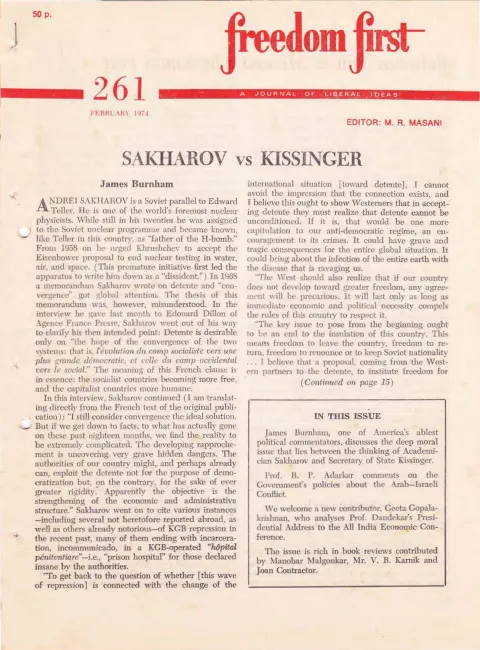
periodical issue
Freedom First
A Journal of Liberal Ideas
Published for the Democratic Research Service by J. R. Patel, Associate Editor, Freedom First at 127, M. Gandhi Road, Bombay 1 (Phone: 254341) and printed by him at Inland Printers, 55 Gamdevi Road, Bombay 7. · Bombay · 1973
16 pages
Freedom First
Summary
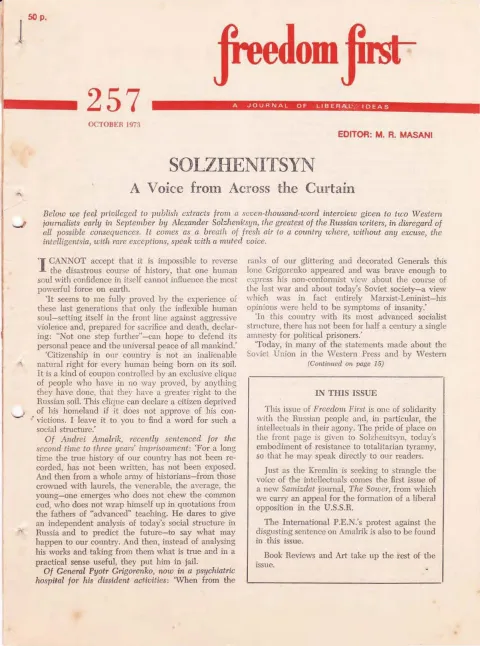
This is the complete October 1973 issue (No. 257) of Freedom First, the Bombay-based liberal journal edited by M. R. Masani, rendered in full across all 16 pages. The issue is organized around solidarity with Soviet dissidents: the cover and its continuation give extended extracts from a September 1973 interview with Alexander Solzhenitsyn on the impossibility of reversing Soviet totalitarianism, the persecution of Andrei Amalrik, General Grigorenko, and other dissidents, and the psychology of state jamming and censorship. The unsigned editorial column ‘Between You & Me and The Lamp Post’ surveys the Soviet crackdown, South Vietnam’s Senate elections, the declining non-aligned movement, a slump in Indira Gandhi’s popularity, and the Indian government’s restriction of American scholars. A samizdat programme document from the underground Soviet journal The Sower calls for a liberal opposition party built on scientific-democratic management of society. International PEN’s protest (signed by Heinrich Böll and David Carver) against Amalrik’s second sentence is reproduced along with the roster of the PEN All-India Centre’s office-bearers. An Economist reprint defends the Vietnam War as a defence of pluralism against a one-party communist alternative. The issue closes with a profile of the collage/envelope artist Raobail, three book/magazine reviews (on judicial-independence protests following the Chief Justice supersession, on E. N. Mangat Rai’s memoir Commitment My Style, and on the relaunched Parsiana magazine), and the ‘With Many Voices’ page of press quotations, alongside period advertisements (Raymond’s Woollens, Amar Dye-Chem, Milton’s Shirts, Bombay Dyeing, Glycodin, ACC White Cement) and the subscription form.
Key points
-
Extracts from a September 1973 Solzhenitsyn interview insist one determined conscience can resist an oppressive state, citing the persecution of Andrei Amalrik and General Grigorenko.
-
The “Notes” column surveys renewed Stalinist-style repression, celebrates South Vietnam’s Senate election under President Thieu, and criticises India’s cap on visiting American scholars.
-
A translated samizdat programme document from the underground journal “The Sower” calls for a Soviet liberal opposition party built on scientific-democratic management and market-oriented reform.
-
International PEN’s protest, signed by Heinrich Böll and David Carver, condemns Andrei Amalrik’s renewed sentence as a contradiction of detente.
-
A reprinted Economist item, “A War Worth Fighting”, defends continued American involvement in Vietnam as a defence of South Vietnamese pluralism against one-party rule.
-
Manjula Padmanabhan profiles envelope-collage artist Raobail, and Sujata Manohar reviews “A Judiciary Made to Measure” on the Supreme Court supersession protests.
-
Mehra Masani reviews E. N. Mangat Rai’s memoir “Commitment My Style”, focusing on its portrait of Punjab Chief Minister Pratap Singh Kairon’s centralising, fear-inducing administration.
Essays
Solzhenitsyn: A Voice from Across the Curtain
The front-page feature reproduces extracts from a seven-thousand-word interview Alexander Solzhenitsyn gave to two Western journalists in early September 1973, continued on page 15. Solzhenitsyn insists that a single human soul with an inflexible conscience can alter the course of history, and attacks the Soviet state’s treatment of citizenship as a revocable privilege rather than an inalienable right. He cites the cases of Andrei Amalrik (sentenced a second time to three years for ‘Will the Soviet Union Survive Until 1984?’) and General Pyotr Grigorenko (confined to a psychiatric hospital for dissent). The continuation on page 15 develops his critique of Western moral relativism (‘the same thing happens in Greece, Spain, Turkey’), his account of radio jamming as an instrument of infantilizing the population, and his reflection on why mankind survives despite reservoirs of and capacity for self-sacrifice, ending with his warning that Brezhnev-era dissidents like Grigorenko and Vladimir Bukovski refused to buy freedom at the price of their convictions.
- Solzhenitsyn argues one determined individual conscience can resist and eventually reverse an oppressive state.
- He frames Soviet citizenship as a revocable ‘coupon’ controlled by a ruling clique rather than a natural right.
- He cites Andrei Amalrik’s second three-year sentence and General Grigorenko’s psychiatric confinement as emblematic of dissident persecution.
- He criticizes Western commentators’ reflexive ‘whataboutism’ (citing Greece, Spain, Turkey) as diminishing the distinct horror of Soviet psychiatric imprisonment.
- He describes radio jamming as reducing Soviet citizens to a ‘robot’s level’ by controlling information uniformly.
- He closes by praising dissidents such as Grigorenko and Bukovski for refusing to trade their convictions for personal freedom.
Between You & Me and The Lamp Post
The unsigned ‘Between You & Me and The Lamp Post’ editorial column runs across several sub-sections. ‘Back to Stalin’ surveys renewed Stalinist repression: the scientist Roy Medvedev stripped of his passport, Andrei Sinyavsky’s smuggled diary, General Grigorenko’s confinement, Solzhenitsyn’s public defiance including his claim that any harm to him would carry the KGB’s approval, and the show ‘confessions’ of Pyotr Yakir and Victor Krasin. ‘Senate Elections in Viet Nam’ celebrates South Vietnamese President Thieu’s electoral victory as vindication of the war effort. ‘Non-Aligned?’ mocks the Algiers non-aligned conference for including dictators like Castro while Indira Gandhi’s domestic popularity was reportedly slumping to an all-time low per an Indian Institute of Public Opinion poll. ‘Harassing Scholars’ criticizes the Indian government’s cap on American scholars entering the country, quoting U.S. Ambassador Daniel Moynihan on the resulting atrophy of South Asian studies in American universities.
- Chronicles renewed ‘Stalinist’ repression: Roy Medvedev’s passport confiscation, Sinyavsky’s smuggled camp diary, Grigorenko’s continued psychiatric confinement, and Solzhenitsyn’s public defiance via Le Monde.
- Notes the coerced ‘confessions’ of dissidents Pyotr Yakir and Victor Krasin as a Brezhnev-regime counterattack.
- Celebrates South Vietnam’s August Senate elections (92% turnout) under President Thieu as vindicating the war effort against North Vietnamese pressure.
- Derides the Algiers non-aligned conference as dominated by dictators (Castro, Sihanouk) despite some ‘sensible’ member governments.
- Reports a steep decline in Indira Gandhi’s popularity per an Indian Institute of Public Opinion poll, contrasted with resilient Congress party support.
- Criticizes New Delhi’s cap on American scholars, citing Ambassador Moynihan’s warning that it will atrophy South Asian studies in the U.S.
For a Liberal Opposition Party in U.S.S.R.
This is a translated samizdat programme document from the first issue of the underground Soviet journal The Sower, calling for the creation of a social-democratic opposition party in Russia. The document analyzes Soviet ‘state capitalism’ through three historical phases (Bolshevik, Stalinist, and the current post-Stalin phase of stagnation and moral demoralization), argues that the scientific intelligentsia’s need for intellectual freedom puts it in structural conflict with the ossified administrative class, criticizes open protest and petition-signing as tactically self-defeating, engages critically with Andrei Sakharov’s reform proposals as insufficiently concrete, and lays out an eight-point reform programme calling for scientific-democratic management, market-oriented economic reforms (including elements of the NEP), workplace democracy, narrowed income differentials, relaxation of ideological censorship, and an end to Soviet support for ‘semifascist’ Arab regimes and interventions in Eastern Europe.
- States the goal of creating a social-democratic opposition party in Russia despite the group’s small size and inexperience.
- Analyzes Soviet ‘state capitalism’ in three phases: the progressive Bolshevik phase, the brutal Stalinist phase, and the current phase of stagnation since Stalin’s death.
- Argues the scientific intelligentsia is structurally in conflict with the administrative class because intellectual freedom is a precondition of its productive work.
- Criticizes open protests and petition-signing as having weakened the movement by inviting repression of its most active members.
- Engages critically with Andrei Sakharov’s reform letter, judging it insufficiently concrete to serve as a programme.
- Proposes an eight-point programme: scientific-democratic management, NEP-style economic reforms, workplace democracy, capped income inequality, relaxed censorship, humanized politics, an end to Soviet support for ‘semifascist’ Arab regimes and Eastern European interventions, and urgent environmental/social measures.
Sentence on Amalrik: International PEN Protest
By Heinrich Boll (President); David Carver (Secretary)
International PEN’s formal protest against Andrei Amalrik’s renewed sentence, signed by Heinrich Böll (President) and David Carver (Secretary), argues that Amalrik’s punishment contradicts the spirit of detente and that any writer who is ‘guilty’ of Amalrik’s crime shares it with honest authors everywhere; it compares the Soviet Union’s actions to Khrushchev’s 1956 treatment of dissenters and pledges International PEN’s efforts on Amalrik’s behalf. The page also lists the signed roster of the PEN All-India Centre’s office-bearers (led by President Dr. S. Radhakrishnan and Vice President Masti Venkatesa Iyengar) and a long list of PEN members and distinguished writers who co-signed, including M. R. Masani, M. C. Chagla, Nissim Ezekiel, and Khushwant Singh.
- International PEN, led by Heinrich Böll and David Carver, formally protests Amalrik’s renewed sentence as a contradiction of detente.
- The protest compares the Soviet action to Khrushchev’s 1956 treatment of dissident writers.
- PEN pledges to use all means to alleviate Amalrik’s and his wife’s personal situation.
- Lists the PEN All-India Centre’s office-bearers, headed by Dr. S. Radhakrishnan as President and Masti Venkatesa Iyengar as Vice President.
- Records a long roster of co-signing Indian writers and public figures, including M. R. Masani, M. C. Chagla, and Khushwant Singh.
A War Worth Fighting
By The Economist
A reprint from The Economist defends continued American involvement in the Vietnam War as a defence of a pluralist alternative to communism. It argues South Vietnam under President Thieu remains a more open society than the North, with a parliament capable of defying the president, a freer press, and the prospect (however limited) of political choice, and contends this pluralist structure of power offers a foundation for eventual democratization that a centralized communist regime forecloses.
- Argues South Vietnam’s relative openness (parliament, press, Amnesty International access) justified the American intervention.
- Contends Thieu’s government, unlike a communist one, cannot command total authority and must deal with semi-independent political actors.
- Concludes South Vietnam’s pluralist structure of power is a ‘decisive advantage’ for post-war economic and political development.
A Man of Letters (and Envelopes)
By Manjula Padmanabhan
An Art-section profile by Manjula Padmanabhan of the Bombay-based artist Raobail, who transforms plain postal envelopes into collage artworks using ink, magazine fragments, and postage stamps. The piece traces his path from agricultural science graduate to L.I.C. clerk to J.J. School of Art dropout, describes his three exhibitions (two at Jehangir Art Gallery), and recounts how Swiss graphic artist Hans Erni became fascinated with his work after visiting his 1972 exhibition, becoming a recipient of his decorated envelopes and an advocate seeking foreign recognition for him.
- Raobail transforms plain envelopes into collage art using ink, magazine fragments, and postage stamps.
- He trained in agricultural science before working as an L.I.C. clerk and later attending (and leaving) the J.J. School of Art.
- His third exhibition (late 1972) attracted Swiss artist Hans Erni, who now receives Raobail’s decorated envelopes and promotes his work abroad.
- Raobail reports his mail reaches recipients everywhere except the United States and Canada, where he says letters are ‘pilfered’.
- He describes his working method as improvisational: ‘I don’t have any plan when I paint. I just paint.‘
Protests from the Bar (review of A Judiciary Made to Measure, ed. N. A. Palkhivala)
By Sujata Manohar
A book review by Sujata Manohar of A Judiciary Made to Measure, edited by N. A. Palkhivala, covering the nationwide protests over the government’s supersession of three Supreme Court judges in appointing A. N. Ray as Chief Justice. The review recounts Mohan Kumaramangalam’s stated rationale that judicial appointments should reflect a ‘suitable’ philosophy from the government’s point of view, argues this abandonment of the seniority convention threatens judicial independence given the government’s role as the country’s largest litigant, and notes subsequent erosion of judicial independence at lower levels, including a controversial state Chief Justice appointment and the appointment of a judge with a ‘pronounced political record as a communist.’
- The review covers protests over Justice A. N. Ray’s appointment as Chief Justice in supersession of three senior judges.
- Cites Mohan Kumaramangalam’s parliamentary rationale that the appointment reflected a philosophy ‘most suitable’ to the government.
- Argues abandoning the seniority convention is dangerous because government is the country’s largest litigant, creating a conflict of interest.
- Cites Articles 124 and 217 on required judicial consultation for Supreme Court and High Court appointments.
- Notes the book contains Jayaprakash Narayan’s appeal to the Prime Minister and a joint lawyers’ statement of 26 April 1973.
- Warns of further erosion of judicial independence, including politically motivated appointments at lower court levels.
An Outline of Administration (review of Commitment My Style by E. N. Mangat Rai)
By Mehra Masani
A review by Mehra Masani of Commitment My Style by E. N. Mangat Rai, a memoir spanning 1938 to 1972 covering the author’s Punjabi Christian upbringing, ICS training and administrative career (including famine duty, price control, and terms as Finance and Chief Secretary of Punjab and Jammu & Kashmir), and his 1972 resignation over policy differences. The review focuses particularly on Mangat Rai’s chapter on Sardar Pratap Singh Kairon, Chief Minister of Punjab from 1956, portraying Kairon as a dynamic but flawed leader whose over-centralization, cronyism (including toward his own sons), and use of police for personal intelligence-gathering produced a climate of fear that ultimately undermined the administration he sought to energize, foreshadowing broader administrative deterioration in Indian governance.
- The reviewed memoir spans 1938-1972, covering the author’s Punjabi Christian upbringing, ICS career, and 1972 resignation.
- Mangat Rai’s career included famine duty in Hissar, price control work, and service as Finance and Chief Secretary of Punjab and J&K.
- The review centers on Kairon’s chapter, describing him as centralizing administration while decentralizing policy under an ‘action first, philosophy later’ approach.
- Kairon is portrayed as secular, energetic, and personally accessible, but prone to suspicion and cronyism, including toward his own sons.
- Kairon’s use of police to gather intelligence on politicians and officials produced administrative ‘terror’ that stifled fearless action.
- The review connects Kairon’s blind spots to a broader multiplication of similarly flawed political leadership in later Indian governance.
Parsiana (magazine review)
By Feroza Paymaster
A short review by Feroza Paymaster of the relaunched Parsiana magazine, edited by Jehangir R. Patel, praising its attractive, dynamic new format introduced with the Parsi New Year. The first issue is noted for covering the disposal of the dead and Parsi divorce customs, alongside art and drama reviews and an interview with D. F. Karaka.
- Parsiana relaunched with the Parsi New Year under editor Jehangir R. Patel, priced at Rs. 2.
- The reviewer calls the new format ‘attractive, dynamic and in keeping with the times’ compared to the older version.
- The first issue covers topics including disposing of the dead, Parsi divorce, art and drama reviews, and an interview with D. F. Karaka.
With Many Voices
The closing ‘With Many Voices’ page is a compilation of short quotations from the contemporary press (Indian Express, The Hindu, Time, The Economist, Hindustan Times, Times of India) commenting on Indian politics, the Vietnam War, and world affairs in mid-1973, including remarks by Kamaraj on political cheating, Ambassador Moynihan on American reliability, Piloo Mody on ‘Maruti Socialism,’ and Time magazine’s assessment of India’s ‘worst crisis in 26 years.’ The page also carries the Freedom First subscription form and publication masthead (Democratic Research Service, Bombay; printed at Inland Printers).
- Compiles press quotations on Indian and world politics from Indian Express, The Hindu, Time, The Economist, Hindustan Times, and Times of India.
- Kamaraj is quoted repeatedly criticizing political rhetoric (‘puratchi’ and ‘munnetram’) as a cover for cheating the people.
- Piloo Mody is quoted describing the prior eight years as the era of ‘Maruti Socialism.’
- Time magazine is quoted describing India as in the ‘midst of its worst crisis in 26 years’ with the Prime Minister allegedly unaware of it.
- The page carries the Freedom First subscription form and masthead identifying publication by the Democratic Research Service, Bombay.
Generated by the v1.5 extraction pipeline. Awaiting editorial review.
Metadata and summary are AI-extracted from the source PDF and reviewed for editorial accuracy. The original work is available via the Read PDF tab above (where present); paragraph-level citation inside the PDF is deferred to a future engagement.