periodical issue
Freedom First
A Journal of Liberal Ideas
By S. V. Raju
Published for the Democratic Research Service by J. R. Patel, Associate Editor, Freedom First at 127, M. Gandhi Road, Bombay 1 (Phone: 254341) and printed by him at Inland Printers, 55 Camdevi Road, Bombay 7. · Bombay · 1973
16 pages
Freedom First
Summary
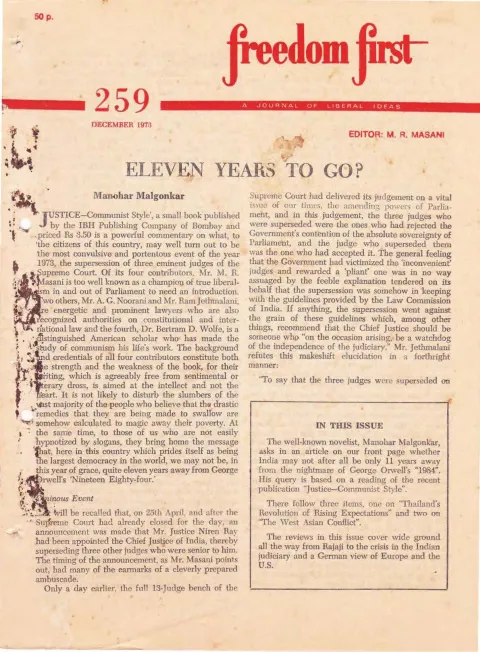
Freedom First No. 259 (December 1973), edited by M. R. Masani, is a sixteen-page issue of the Bombay-based journal of liberal ideas. Its lead article, Manohar Malgonkar’s “Eleven Years to Go?”, reviews the four-contributor book Justice—Communist Style on the April 1973 supersession of three Supreme Court judges, using contributions from Masani, A. G. Noorani, Ram Jethmalani and Dr. Bertram D. Wolfe to argue that the episode signals a drift toward committed, party-loyal courts and a broader erosion of institutional freedoms in India. The issue otherwise ranges widely: Geeta Doctor reports on the student-led 1973 upheaval in Thailand; a pained open letter from Israeli minister Moshe Kol to the President of the Liberal International rebukes European liberals for their silence during the Yom Kippur War, paired with a legal analysis of U.N. Security Council Resolution 242 by Sheila Sumant; short notices cover Soviet-style corruption and an Amnesty International anti-torture campaign; and the back pages carry three book reviews (on Rajaji, on the Indian judiciary crisis, and on Karl Kaiser’s Europe and United States) plus a page of quoted commentary on the West Asian conflict under the heading “With Many Voices.”
Key points
-
Manohar Malgonkar’s “Eleven Years to Go?” reviews “Justice—Communist Style”, using essays by Masani, Noorani, Jethmalani and Wolfe to argue the April 1973 judicial supersession signals a drift toward party-loyal courts.
-
Geeta Doctor’s “Thailand’s Revolution” traces the country’s history of strongman rule since 1932 and the distinctively student-led 1973 uprising that toppled Field Marshal Thanom’s regime.
-
Israeli minister Moshe Kol’s open letter rebukes European Liberal International leaders for their silence during the Yom Kippur War, except for Willy Brandt.
-
Sheila Sumant’s “The Controversial U.N. Resolution 242” analyses the legal ambiguity between the resolution’s English and French versions on Israeli withdrawal, favouring the English working-draft interpretation.
-
Short items cover Amnesty International’s global anti-torture campaign, finding 63 of 139 countries surveyed reportedly practise it, and Soviet-style low-level corruption toward foreign businesspeople.
-
S. V. Raju reviews Bimanesh Chatterjee’s anecdotal memoir “Thousand Days with Rajaji”, and S. P. Aiyar reviews two books on the judicial supersession crisis, including K. S. Hegde’s own account.
-
A further review of Karl Kaiser’s “Europe and United States” summarises strained transatlantic relations following Vietnam and the declining dollar, and the closing “With Many Voices” page compiles quotations on the October 1973 West Asian war.
Essays
Eleven Years to Go?
By Manohar Malgonkar
Manohar Malgonkar reviews Justice—Communist Style, a book by M. R. Masani, A. G. Noorani, Ram Jethmalani and Dr. Bertram D. Wolfe on the April 1973 supersession of three Supreme Court judges. He recounts how Justice Niren Ray was named Chief Justice over three seniors after the Court had ruled on Parliament’s amending powers, and how Mohan Kumaramangalam later admitted openly that a judge’s “political philosophy” should match the ruling party’s. The piece (continued on page 15) surveys each contributor’s argument: Noorani traces communist infiltration of the Congress through Kumaramangalam; Masani’s “Freedom Is Indivisible” links the judiciary takeover to a wider pattern of state control (banks, insurance, mines, foodgrain trade); Jethmalani’s “Soviet Justice” compares the episode to the hollow constitutional guarantees of the USSR, where rights are undercut by the qualifier “subject only to the law”; and Wolfe closes with a scholarly reflection on the origins of totalitarianism, arguing true democracy requires a tradition of self-limitation beyond mere constitutional text.
- The book under review has four contributors: M. R. Masani, A. G. Noorani, Ram Jethmalani, and Dr. Bertram D. Wolfe, an American scholar of communism.
- On 25 April 1973 Justice Niren Ray was appointed Chief Justice of India, superseding three senior judges who had ruled against unlimited parliamentary amending power.
- Mohan Kumaramangalam told Parliament that judges must share the ruling party’s ‘basic outlook’ and ‘political philosophy’.
- Kumaramangalam is described as a former CPI leader who had joined Congress and allegedly worked to build a ‘Communist Command Post’ within it.
- Jethmalani’s essay argues Soviet constitutional rights are meaningless because they are ‘subject only to the law’, which the Party can reshape at will.
- Masani’s essay frames the judicial supersession as one part of a broader state takeover encompassing banks, insurance, mines and the foodgrain trade.
- Wolfe’s closing essay locates the roots of totalitarianism in the absence of a political culture of self-limitation, not merely in weak constitutional guarantees.
Thailand’s Revolution
By Geeta Doctor
Geeta Doctor’s report on Thailand’s 1973 student-led revolution traces the country’s political history since the 1932 end of absolute monarchy, arguing that constitutional government there has repeatedly given way to strongman rule under figures such as Pridi Phanomyong, Pibul Songram, Sarit Thanarat and Field Marshal Thanom Kittikachorn. She describes the October crisis that toppled Thanom’s regime—sparked by a student movement independent of any single charismatic leader—and the ambiguous roles played by the King and the army in the transition to a civilian government under Dr. Sanya Thamasak. The essay closes by framing the unrest as a ‘revolution of rising expectations’ driven by economic strain from the American withdrawal from the region and population growth outpacing rice production, and expresses cautious optimism that a durable new constitution may finally emerge.
- Thailand’s October 1973 crisis erupted in Bangkok, killing about three hundred people and ending Field Marshal Thanom Kittikachorn’s military regime.
- The article traces the flawed 1932 Constitution drafted by Pridi Phanomyong, which entrenched his People’s Party and was widely misunderstood by ordinary Thais.
- Successive strongmen (Pibul Songram, Sarit Thanarat, Thanom Kittikachorn) ruled despotically despite nominal constitutional government.
- The 1973 uprising was distinctively led by students rather than a single ‘demagogic’ leader, marking a new pattern in Thai political change.
- The King and army’s ambiguous, behind-the-scenes roles helped ease the transition to a civilian premier, Dr. Sanya Thamasak.
- Economic pressures—American withdrawal from the region and rice production failing to keep pace with population growth—are cited as underlying causes of unrest.
- The author frames the moment as Thailand’s ‘revolution of rising expectations,’ expressing hope that a durable constitution will finally result.
Europe’s Guilty Silence: Israel Liberals’ Reproach
By MOSHE KOL
This item reproduces, in full, a letter dated 14 October 1973 from Moshe Kol, a minister in the Israeli Cabinet, to the President of the Liberal International (also the Foreign Minister of Luxembourg). Kol recounts the Yom Kippur War’s outbreak, the Soviet Union’s massive arms supply to Egypt and Syria, and the political isolation Israel felt from European governments and the Liberal International itself. He singles out British and French policy as effectively favoring the Arab side, expresses disappointment at the silence of Liberal International leaders (with the exception of Willy Brandt), and asks pointedly what liberalism and the struggle for peace mean if fellow liberals stay silent while Israel fights for survival.
- The letter is from Moshe Kol, a minister in the Israeli Cabinet, addressed to the President of the Liberal International (also Luxembourg’s Foreign Minister), dated 14 October 1973.
- Kol describes the 6 October surprise attack by Egypt and Syria on the Day of Atonement, backed by large-scale Soviet arms shipments.
- He criticizes the British arms embargo (seen as effectively hurting only Israel) and the French Government’s statement of sympathy with the attackers.
- He expresses disappointment that, apart from West German Chancellor Willy Brandt, no European Liberal leader spoke up in support of Israel.
- Kol frames the silence as a betrayal of liberal principles and repeatedly asks what ‘Liberalism and struggle for peace and negotiations’ actually mean under these circumstances.
The Controversial U.N. Resolution 242
By Sheila Sumant
Sheila Sumant analyzes the legal ambiguity of U.N. Security Council Resolution 242 (22 November 1967), noting that discrepancies between its English and French versions have fueled a longstanding dispute over whether Israel is required to withdraw from ‘all’ occupied territories or merely ‘territories occupied in the recent conflict.’ She argues, based on international-law convention that multilingual texts should be interpreted per their working-draft language (English, in this case), that the Resolution is a non-binding ‘recommendation’ under Chapter VI of the U.N. Charter rather than a binding Chapter VII order, and that its withdrawal and non-belligerency clauses are interdependent, requiring a negotiated peace rather than unilateral Israeli withdrawal. She concludes it is high time Arab states recognize Israel and negotiate directly, following the ‘Simla spirit’ of the India-Pakistan settlement.
- Resolution 242, dated 22 November 1967, is analyzed as deliberately vague to secure Security Council consensus.
- A key controversy concerns discrepancies between the French version (implying withdrawal from ‘all’ occupied territories) and the English version (‘territories occupied in the recent conflict’).
- International law convention holds that interpretation should follow the resolution’s working-language draft, which was English (the British draft).
- The Resolution is characterized as a Chapter VI ‘recommendation’, not a binding Chapter VII Security Council order.
- Withdrawal and Arab recognition/non-belligerency are presented as interdependent conditions of a single, indivisible resolution.
- The author invokes the ‘Simla spirit’ of the India-Pakistan agreement as a model, arguing Arab states should recognize Israel and negotiate directly.
Corruption—Soviet Style
A short unsigned filler item, credited to Insight (Hong Kong), wryly describes the culture of low-level corruption facing foreign businesspeople in the Soviet Union, where officials expect gifts, lavish entertainment and ‘educational’ foreign trips in lieu of outright bribes, since open solicitation of money is avoided.
- The piece argues Russians are not above being bribed, despite officially disdaining the practice as a ‘capitalist custom.’
- Business in Russia reportedly requires extending gifts, generous expense-account entertaining, and foreign trips to local contacts.
- The item is credited to the publication Insight, Hong Kong.
Campaign Against Torture
This short news item describes Amnesty International’s global campaign for the abolition of torture, including a signature appeal to the U.N. General Assembly and an international conference planned in Paris on 10-11 December. It cites Amnesty’s survey finding that of 139 countries examined, 63 reportedly use torture (34 of these as regular administrative practice) and only 26 were free of it, and references a 1972 Amnesty report on torture in Brazil describing how it grows from sporadic use into invariable interrogation practice.
- Amnesty International is running a global signature campaign urging the U.N. to outlaw torture of prisoners.
- Indian Amnesty groups are chaired by Mr. G. L. Mehta (Bombay) and Mr. M. C. Setalvad (New Delhi).
- An international conference on abolishing torture was scheduled for 10-11 December in Paris.
- Amnesty’s survey of 139 countries found 63 reportedly use torture, 34 of these as regular practice, with only 26 countries found free of it.
- A 1972 Amnesty report on Brazil is cited describing how torture escalates from sporadic use to routine interrogation practice.
- Countries named as having prevalent torture of prisoners include Brazil, Greece, Turkey, South Africa, Uruguay, and North/South Vietnam, alongside historical reference to Stalin-era Russia.
Reviews — Rajaji the Man (Thousand Days with Rajaji by Bimanesh Chatterjee)
By S. V. Raju
S. V. Raju reviews Thousand Days with Rajaji by Bimanesh Chatterjee, an anecdotal memoir by C. Rajagopalachari’s former Military Secretary rather than a formal biography. The review praises the book’s faithful capture of Rajaji’s dry wit, pragmatism, and disdain for hypocrisy through numerous anecdotes—covering his tenure as Governor of Bengal and Governor-General, his views on corruption and English education, his relinquishing of high office, and his eventual disillusionment with Congress that led to founding the Swatantra Party. Raju concludes that the volume, while modest, refutes uncharitable criticisms of Rajaji as cold or elitist and is valuable reading for admirers and critics alike.
- The book under review, by Bimanesh Chatterjee (Rajaji’s former Military Secretary), is anecdotal rather than a formal biography, covering a thousand days of Rajaji’s service.
- Rajaji is shown as pragmatic and averse to ‘isms’, writing with equal facility on subjects from Family Planning to Fundamental Rights in his Swarajya ‘Dear Reader’ column.
- Anecdotes depict Rajaji’s sharp wit, his insistence on straightforwardness, and his refusal to write an autobiography or encourage biographers.
- The review recounts his disillusionment with Congress, framing his eventual founding of the Swatantra Party as the product of gradual disenchantment rather than sudden decision.
- Rajaji reportedly declined efforts to erect a statue of himself, insisting Gandhiji’s name and legacy should not lapse from public memory.
- The reviewer, S. V. Raju, judges the book essential reading both for admirers of Rajaji and for his critics.
Reviews — Crisis in Indian Judiciary (Supersession of Judges, ed. Kuldip Nayar; Crisis in Indian Judiciary by K. S. Hegde)
By S. P. Aiyar
S. P. Aiyar reviews two books on the 1973 judicial supersession crisis: Supersession of Judges, edited by Kuldip Nayar, and Crisis in Indian Judiciary by K. S. Hegde, one of the three superseded judges. Aiyar describes the appointment of Justice A. N. Ray as Chief Justice as the most unfortunate episode in the evolution of India’s constitutional government, contrasting it with the restraint shown by the British Raj in analogous appointment disputes. He details how Mohan Kumaramangalam allegedly masterminded the supersession, and summarizes contributions from Kuldip Nayar’s edited volume (M. C. Chagla, N. A. Palkhivala, Jayaprakash Narayan, and a disappointing piece by H. P. Ranina on the Kesavananda Bharati judgment), before turning to Hegde’s own book, which Aiyar judges a ‘hurried’ but valuable and frank rejoinder that situates the judicial crisis within a larger crisis of Indian democracy.
- The review covers Supersession of Judges (ed. Kuldip Nayar) and Crisis in Indian Judiciary by K. S. Hegde, one of the three superseded judges.
- Aiyar frames Justice A. N. Ray’s appointment as Chief Justice on 25 April 1973 as violating a well-established convention of seniority in judicial appointments.
- The review contrasts this with the British-era Sir Maurice Gwyer precedent, where seniority disputes were handled with more constitutional propriety despite the absence of formal restraints.
- Mohan Kumaramangalam is depicted as the mastermind of the supersession, with Aiyar noting Kumaramangalam’s contradictory invocation of American New Deal-era court-packing precedents despite otherwise denouncing the U.S.
- N. A. Palkhivala and M. C. Chagla’s contributions to the Nayar volume are highlighted, including criticism of an ‘ultra-socialistic’ or ‘committed’ judiciary trend.
- Jayaprakash Narayan’s essay in the volume is quoted arguing that unrestrained appeals to ‘the people’s will’ can mask infiltration by anti-democratic forces.
- H. P. Ranina’s summary of the Kesavananda Bharati judgment is singled out as the volume’s weak point, criticized as ungrammatical and clumsy.
- Aiyar judges Hegde’s book a ‘hurried rejoinder’ but a valuable, frank contribution situating the judicial crisis within a broader crisis of Indian democracy.
Reviews — Europe & the US: A German View (Europe and United States by Karl Kaiser)
By S. P. Aiyar
An unsigned review (immediately following S. P. Aiyar’s byline in the same review section) of Karl Kaiser’s Europe and United States summarizes the book’s account of strained U.S.-European relations following the Vietnam War, the declining dollar, and 1971 Nixon-era trade measures. It surveys the mutual grievances—American complaints about European and Japanese trade surpluses and inadequate contributions to defense costs, versus European (especially French) resistance to paying for the upkeep of U.S. troops framed as serving American strategic interests—and reports Kaiser’s proposed solution: Europe conceding ground on monetary and trade issues in exchange for the U.S. maintaining its troop presence, alongside Kaiser’s argument for a West European defense structure that could also advance political union. The review praises the essay’s clarity and brevity.
- Karl Kaiser’s essay examines strained U.S.-European relations following the Vietnam War, the declining dollar, and the Nixon administration’s August 1971 trade measures.
- It attributes American trade deficits to weak U.S. export performance and the cost of maintaining roughly 300,000 U.S. troops stationed in Western Europe.
- Some Europeans, notably the French, argue U.S. troops serve American strategic interests and troops would become ‘mercenaries’ if Europe conceded to U.S. trade demands.
- Kaiser proposes a mutually acceptable trade-off: Europe conceding ground on monetary and trade policy in exchange for continued U.S. troop commitments.
- Kaiser argues for creation of a West European defense structure, which could also advance European political union and neutralize Soviet hostility to the Community.
- The reviewer praises the essay for its clear thinking and brevity.
With Many Voices
“With Many Voices” is a compiled column of short quotations from world leaders and commentators on the October 1973 West Asian conflict and the broader Cold War, drawn from sources including Time, Economic and Political Weekly, The Times of India, and U.S. News & World Report. The selections range from Romesh Thapar’s criticism of both Arab disunity and India’s uncritical pro-Arab statements, to remarks by the Shah of Iran, Golda Meir, Chou En-Lai, and Anthony Lewis’s comparison of Nixon’s Watergate predicament to Neville Chamberlain’s 1940 fall from power.
- The column compiles brief quotations on the 1973 West Asian war and international affairs from sources such as Time, Economic and Political Weekly, The Times of India and U.S. News & World Report.
- Romesh Thapar is quoted twice criticizing both Arab political disunity and India’s uncritical statements of support for Arab actions.
- The Shah of Iran is quoted asserting Iran’s ability to ‘exploit’ its petroleum without ‘blackmailing the rest of the world.’
- Golda Meir and Chou En-Lai offer contrasting remarks on prospects for peace and the Cold War rivalry.
- Anthony Lewis draws a parallel between the pressure mounting on Richard Nixon and Neville Chamberlain’s 1940 fall from power in Britain.
- The page also carries the journal’s subscription form and its printer/publisher colophon: published for the Democratic Research Service by J. R. Patel, printed at Inland Printers, Bombay.
Generated by the v1.5 extraction pipeline. Awaiting editorial review.
Metadata and summary are AI-extracted from the source PDF and reviewed for editorial accuracy. The original work is available via the Read PDF tab above (where present); paragraph-level citation inside the PDF is deferred to a future engagement.