periodical issue
Freedom First
A Journal of Liberal Ideas
By J. G. Tiwari, S. N. Misra, Manjula Padmanabhan, B. P. Singh, R. Srinivasan
Published for the Democratic Research Service by J. R. Batlivala, Managing Editor, Freedom First, C/o Democratic Research Service, 127, Mahatma Gandhi Road, Bombay 1. Printed at Indeco Printers, 53 Ganderi Road, Vadala. · Bombay · 1975
16 pages
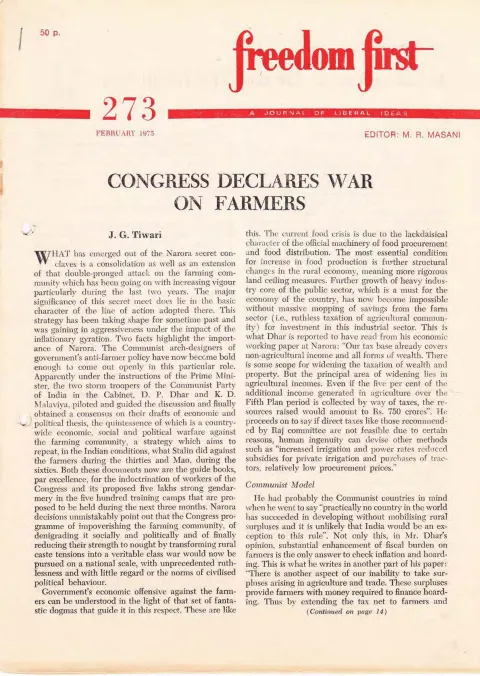
Freedom First
Summary
This February 1975 issue of Freedom First (No. 273), edited by M. R. Masani, opens with J. G. Tiwari’s lead essay “Congress Declares War on Farmers,” which reads the Congress party’s Narora conclave as a Stalin/Mao-style strategy of turning rural caste tensions into class war to expropriate farm surpluses for industrial investment, and singles out D. P. Dhar’s economic paper as the blueprint. The regular “Between You & Me and The Lamp Post” notes column comments on Ambassador Daniel Patrick Moynihan’s criticism of India’s planned economy, Indira Gandhi’s falling popularity, the Vajpayee resignation episode, UNESCO’s exclusion of Israel, and Soviet-bloc “radioizdat” and refugee stories. S. N. Misra, a Congress MP, contributes an angry open letter to Mrs Gandhi naming Congress and Communist Party figures he accuses of financial impropriety and demanding public disclosure of their assets. A reprinted Daily Telegraph editorial defends the US decision to attach conditions to grain aid after India rejected a shipment. Manjula Padmanabhan supplies a light personal account of judging St Xavier’s Boys’ Academy inter-house dramatics competition. The issue reproduces the Liberal International’s Florence policy statement “Man At Work” on economic democracy at the workplace. Two book reviews follow: B. P. Singh on B. R. Shenoy’s P.L. 480 Aid & India’s Food Problems, which argues government price and procurement policy, not weather or farmer inertia, has caused agricultural stagnation; and R. Srinivasan on What Price a Free Press? The Statesman Case, on the newspaper’s failed legal challenge to a government committee probing press economics. The issue closes with reader letters on Israel and the Palestinian conflict, and a compilation of quotations, “With Many Voices,” mostly drawn from The Economist.
Key points
-
J. G. Tiwari’s “Congress Declares War on Farmers” reads the party’s Narora conclave, guided by D. P. Dhar and K. D. Malaviya, as a Stalin/Mao-style plan to deploy 500,000 cadres through 500 training camps to convert caste tensions into class war against independent landholders.
-
The “Between You & Me and The Lamp Post” column reports outgoing Ambassador Moynihan’s criticism of India’s deliberately stagnant, stability-favouring economic policy, Indira Gandhi’s lowest popularity since 1967, and UNESCO’s exclusion of Israel under Arab pressure.
-
Congress MP S. N. Misra’s open letter to Indira Gandhi names Congress and Communist-aligned figures including D. P. Dhar, H. R. Gokhale and K. D. Malaviya, demanding public disclosure of disproportionate wealth and threatening to publicise the letter if unanswered.
-
A reprinted Daily Telegraph editorial defends the US decision to attach re-export conditions to grain aid after India rejected a shipment, citing entrenched corruption in Indian aid distribution.
-
Manjula Padmanabhan’s light personal essay recounts judging St Xavier’s Boys’ Academy’s inter-house dramatics competition, with “The Seekers” declared the winning play.
-
The reprinted Liberal International policy statement “Man At Work,” adopted at its Florence conference, declares economic democracy the necessary corollary of political democracy and calls for enlarging jobs and giving workers a stake in company decision-making.
-
B. P. Singh reviews B. R. Shenoy’s P.L. 480 Aid & India’s Food Problems, citing Ludhiana and Tanjavur data to argue government price and procurement policy, not weather or farmer inertia, is the primary cause of India’s food stagnation, and that rural bank branches act as “suction pumps” draining farm savings to urban use.
-
R. Srinivasan reviews What Price a Free Press? The Statesman Case, arguing Indian press freedom has eroded since independence through advertisement withdrawals and organised harassment of journalists.
-
Reader letters recount repeated Indian government rejections of Israeli agricultural-cooperation offers and protest barring Israel from a World Table Tennis Championship, while a Tibetan refugee’s letter condemns Palestinian violence against civilians while comparing the Tibetan and Palestinian causes.
Essays
Congress Declares War on Farmers
By J. G. Tiwari
J. G. Tiwari argues that the Congress party’s secret Narora conclave marks an escalation of a two-year-old campaign against India’s farming community, guided by Communist ministers D. P. Dhar and K. D. Malaviya, aiming to replicate in India the kind of rural class war Stalin waged against Soviet farmers in the 1930s and Mao waged in China in the 1960s. He describes a 13-point Narora programme that would deploy 500,000 Congress and youth cadres through 500 training camps to convert caste tensions into class conflict, and reports D. P. Dhar’s working paper as advocating heavier taxation of agricultural income and wealth to fund industrial investment, alongside continued reliance on the public sector. The essay (continued from page 1 to page 14, captured in full in these rendered pages) goes on to argue that heavy fiscal burdens on farmers and nationalisation of the grain trade are the “inevitable” consequence of India’s socialist growth path, that viable landholders are being targeted for political liquidation because independent farmers threaten centralised power, and that the Narora strategy risks turning manufactured caste antagonism into a pretext for government-backed intimidation of the farming community.
- Frames the Narora conclave as consolidating a Congress strategy against farmers modeled on Stalinist and Maoist precedents.
- Identifies D. P. Dhar and K. D. Malaviya as the Communist-aligned architects of the strategy within the Cabinet.
- Cites D. P. Dhar’s working paper proposing wider taxation of agricultural income/wealth and other revenue devices as an anti-inflation, anti-hoarding measure.
- Argues heavy farm taxation and grain-trade nationalisation are structurally inevitable outcomes of the current growth model, prioritising public-sector industrial investment.
- Contends that viable, independent landholders are targeted for political liquidation because they generate leadership and resist centralised control.
- Warns that the 13-point Narora programme, mobilising 500,000 cadres via 500 training camps, risks converting rural caste tension into an artificially manufactured class war.
Between You & Me and The Lamp Post (editorial notes column: Satyameva Jayate; Mrs Gandhi a Bad Second; African Neighbourliness; A Pity; Radioizdat; X’mas in USSR; And now UNESCO; Shame!)
The unsigned editorial notes column “Between You & Me and The Lamp Post” covers a run of short items: outgoing US Ambassador Daniel Patrick Moynihan’s parting criticism that India’s stagnant economy reflects a deliberate political choice favouring stability over growth, contrasted with Japan’s private steel sector versus India’s state-owned one; a report that Indira Gandhi’s popularity has fallen to its lowest point since 1967 per an Indian Institute of Public Opinion poll, alongside news that the Illustrated Weekly of India named Jayaprakash Narayan its ‘Indian of the Year’; a wry item on African nations’ aspirations to national airlines illustrated via a Tanzania cartoon; commentary on A. B. Vajpayee’s aborted Lok Sabha resignation and the Jan Sangh’s continued commitment to parliamentary politics; a note on Soviet ‘radioizdat’ (illegal radio broadcasting) as a successor to samizdat and magnitizdat; and criticism of UNESCO’s General Conference for voting to exclude Israel, with reactions from Solzhenitsyn, European governments, and various intellectuals. It closes with items on Christmas price inflation in Moscow, and on Hong Kong’s closing of the escape route for Chinese refugees fleeing to Hong Kong, criticized as ‘despicable’ by columnist Derek Davies.
- Reports Ambassador Moynihan’s view that India’s stagnation reflects a deliberate political trade-off of growth for stability, using the Bokaro steel mill decision as an example.
- Notes Indira Gandhi’s popularity has hit its lowest point since 1967 per an opinion poll, while Jayaprakash Narayan was named ‘Indian of the Year’ by the Illustrated Weekly.
- Covers the Vajpayee resignation-and-retraction episode and the Jan Sangh’s continued attachment to electoral politics.
- Describes Soviet ‘radioizdat’ as a new form of dissident activity following samizdat and magnitizdat, with over 1,000 arrests.
- Criticizes UNESCO for excluding Israel from its regional bodies under Arab pressure, citing Solzhenitsyn’s condemnation of the UN’s moral decline.
- Reports on rising Soviet consumer prices during the Christmas season and Hong Kong’s closure of its refugee route from Communist China.
Open Letter to Mrs. Gandhi
By S. N. Misra
Congress MP S. N. Misra’s open letter to Prime Minister Indira Gandhi, written after an earlier unanswered letter, demands that she compel a list of named Congress and government figures — including D. P. Dhar, H. R. Gokhale, K. D. Malaviya, D. P. Chattopadhyaya, R. K. Khadilkar and others — to publicly declare their current assets and holdings against their status ten to fifteen years ago, alleging they have amassed disproportionate wealth through Communist-aligned patronage. He separately lists a second group of ministry members, including H. D. Malviya, Shashi Bhushan, and Amrit Nahata, whom he accuses of financing anti-Congress and Communist activity to undermine the party. Misra frames the choice starkly as between continued Communist entanglement, which he says will destroy the Congress party and the Gandhi family’s name, or a restoration of democracy, and threatens to make the letter public if no reply is received by 4 December 1974.
- Demands public asset disclosure from named Congress and Communist Party-linked ministers and officials, comparing their current holdings to their status 10-15 years earlier.
- Names a first list of officials (D. P. Dhar, H. R. Gokhale, K. D. Malaviya, and others) alleged to hold ‘red-base’ Communist affiliations and disproportionate wealth.
- Names a second list of ministry figures alleged to be financing anti-Congress and Communist activity.
- Frames Mrs Gandhi’s choice as being between continuance of Communist alliance (leading to Congress’s destruction) or restoration of democracy and the party’s survival.
- Threatens to publicize the letter nationally if no reply is received by 4 December 1974.
India Rejects Food Aid (reprinted Daily Telegraph editorial, 7th January issue)
By Daily Telegraph
A reprinted Daily Telegraph (London) editorial from 7 January 1975 examines India’s rejection of the first 300,000 tons of a resumed US cheap-grain shipment, on the grounds that American conditions — barring re-export (e.g., to the Soviet Union) and requiring the grain reach the poorest — were ‘humiliating.’ The piece argues America is justified in wanting assurance the aid will not simply discharge India’s debt to Russia, given large-scale corruption and inefficiency in Indian aid distribution, and notes President Ford’s refusal at the November World Food Conference to be pressured into pledging more food aid while oil-producing and Communist states offered nothing.
- India rejected 300,000 tons of resumed US grain aid over conditions barring re-export and requiring distribution to the poorest.
- The US sought assurance the grain would not indirectly repay India’s debt to the Soviet Union, which had lent India two million tons.
- The editorial cites entrenched corruption and inefficiency as reasons large amounts of Indian aid go astray.
- President Ford is described as resisting pressure at the World Food Conference to pledge additional food aid while oil-producing states and the USSR offered nothing.
Here Comes the Judge
By Manjula Padmanabhan
Manjula Padmanabhan recounts, in a light personal essay, her experience as one of three judges (with Sean Mahoney and Pheroza Shroff) at St Xavier’s Boys’ Academy’s annual inter-house dramatics competition, ‘D Day.’ She describes the elaborate scoring system devised by teacher-in-charge Amy Billimoria, the comic chaos of judging four amateur plays — including a medieval-set ‘Cobbler’s Wife,’ a moralistic ‘The Seekers’ with grave-diggers confronting Death, and a farce called ‘A Mate in Two’ — and the backstage camaraderie of judging, ending with ‘The Seekers’ declared the winning house to a burst of applause.
- Padmanabhan was one of three judges (with Sean Mahoney and Pheroza Shroff) at St Xavier’s Boys’ Academy’s inter-house dramatics competition.
- Describes the elaborate, philosophically fraught scoring system set up by teacher Amy Billimoria, covering production, acting, diction and interaction.
- Recounts the plots of several student plays performed, including ‘The Cobbler’s Wife,’ ‘A Husband for Breakfast,’ ‘A Mate in Two,’ and ‘The Seekers.’
- ‘The Seekers’ was announced as the winning house amid cheers and garlands.
Man at Work (policy statement of the Liberal International, Florence conference, 3-6 October)
This is the reprinted text of the Liberal International’s policy statement ‘Man At Work,’ adopted at its October 1974 Florence conference by a committee that included the Freedom First editor. It declares economic democracy the corollary of political democracy, recognises negative effects of technological and bureaucratic development on workers (monotony, psychological strain, alienation), and calls for enlarging and enriching jobs, reducing fragmented production-line work, and democratising companies so that employees participate not only in the work but in decision-making, responsibility, and the fruits of expansion, rather than remaining subordinate to capital.
- States that economic democracy is the necessary corollary of political democracy.
- Recognises that most of the world’s population lacks influence at work, and that technological/bureaucratic development brings negative side effects such as monotony and psychological strain.
- Recommends enlarging and enriching jobs and reducing excessively fragmented, production-line tasks.
- Calls for democratised companies where employees participate in the work, in decision-making, and in the results/profits, replacing a purely dependent labour-capital relationship with partnership.
Reviews: Consequence of Misconceived Policies (review of B. R. Shenoy, P.L. 480 Aid & India’s Food Problems)
By B. P. Singh
B. P. Singh, President of the Farmers’ Federation, reviews B. R. Shenoy’s book P.L. 480 Aid & India’s Food Problems. Singh summarises Shenoy’s argument that floods, droughts, and farmer inertia are not the main causes of India’s food scarcity; rather, official price and procurement policy has suppressed agricultural investment and productivity. Shenoy is reported to show, via Ludhiana and Tanjavur high-yield variety programme data, that Indian farmers respond vigorously to incentives, and to fault three government misconceptions: that compulsory procurement can buffer scarcity, that anti-hoarding drives correct price rises, and that ‘reasonable’ industrial-style profit margins are adequate for agriculture. The review also covers Shenoy’s data on the public sector’s disproportionate share of investment resources relative to its contribution to national income, and his finding that rural bank branches act as ‘suction pumps’ withdrawing rural savings to urban/industrial use rather than expanding farm credit. Singh calls the book essential, if imperfect, reading for legislators and anyone concerned with Indian agriculture.
- Shenoy argues that price and procurement policy, not weather or farmer irrationality, is the primary cause of India’s food-production stagnation.
- Cites Ludhiana and Tanjavur HYVP data showing dramatic yield gains once farmers had incentive and access to inputs.
- Identifies three government misconceptions: reliance on compulsory procurement/hoarding controls, and the imposition of ‘reasonable’-profit industrial norms onto agriculture.
- Shows the public sector absorbed a rising, disproportionate share of investment resources (46% to 66% across successive Five Year Plans) versus its contribution to national income.
- Describes rural bank branches as functioning like ‘suction pumps’ draining rural savings toward urban and industrial investment rather than expanding farm credit.
- Singh recommends the book as essential, if not flawless, reading for legislators and anyone concerned with Indian agricultural policy.
Reviews: Bad Old Days Again (review of What Price a Free Press? The Statesman Case, ed. V. V. John and A. B. Shah)
By R. Srinivasan
R. Srinivasan reviews What Price a Free Press? The Statesman Case (ed. V. V. John and A. B. Shah), which examines the Statesman newspaper’s unsuccessful legal challenge to a 1972 government committee, chaired by Professor B. Datta, set up to investigate newspaper economics. The review situates the case within a broader argument that Indian press freedom has eroded since independence through advertisement withdrawals, organised harassment of journalists, and pressure tactics, notwithstanding that the Statesman lost its suit for a writ of mandamus. Srinivasan notes the book references earlier press-freedom battles including the Sakal and Bennett Coleman cases, and calls it a valuable addition to the limited literature on press problems in a ‘developing’ country, noting it was originally published as an entire issue of the journal Quest.
- Reviews What Price a Free Press? The Statesman Case, on the Statesman’s failed suit challenging a 1972 government committee investigating newspaper economics.
- Argues Indian press freedom has eroded since independence through advertisement withdrawal, editor removals, and organised crowd action against newspapers.
- Notes the government committee’s inquiries into the Statesman’s Managing Director’s expenses were seen as an attempt to pressure the paper.
- References the earlier Sakal and Bennett Coleman cases as part of the continuing fight for press freedom.
- Calls the book a valuable, if narrow, addition to literature on press freedom in developing countries; notes it was originally an issue of the journal Quest.
Letters (Churlish; Why This Insult?; On Murdering Children)
By Mihir Sen; R. Sinha Rao; Jamyang Norbu
The Letters section carries three reader contributions. R. Shiva Rao (‘Churlish’) recounts personally witnessed instances of India rejecting Israeli offers of agricultural and technical cooperation — fertiliser and soil-conservation experts in 1947, agricultural university exchange visits during his UGC tenure, and a Jewish farmer’s offer to cultivate dates and citrus in Rajasthan — arguing India has repeatedly spurned Israeli goodwill. A second unsigned letter (‘Why This Insult?’) protests the government’s move to bar Israel from a World Table Tennis Championship on political grounds. Jamyang Norbu, a Tibetan refugee writing from Dharamsala (reproduced from Time), condemns Palestinian attacks on Israeli civilians while drawing a parallel to the Tibetans’ own struggle against Chinese rule, insisting that no nation can be built without a firm moral foundation.
- R. Shiva Rao details repeated Indian government rejections of Israeli offers of agricultural cooperation, including a 1947 fertiliser/soil-conservation offer and a Rajasthan farming proposal.
- A second letter protests India barring Israel from participating in the World Table Tennis Championship for political reasons.
- Jamyang Norbu, writing as a Tibetan refugee (reproduced from Time), condemns Palestinian violence against Israeli civilians while comparing the Tibetan cause to the Palestinian one.
- Norbu argues no nation can be built without a firm moral foundation, criticizing the killing of innocents regardless of the justice of the underlying cause.
With Many Voices (quotations column)
‘With Many Voices’ is a compilation of short quotations, mostly from The Economist (November-December 1974), on global political and economic themes: Greek Prime Minister Karamanlis on demagogy versus tanks as the greater threat to democracy; Rajmohan Gandhi in Himmat on U Thant’s death sparking a popular uprising; Indian Express slogans linking Indira Gandhi to the Mastan smuggling scandal; West German Chancellor Helmut Schmidt on market forces versus regulation; Romesh Thapar in Economic and Political Weekly on Indian egalitarianism; commentary on apartheid-era southern Africa, OPEC oil surpluses, British Leyland’s productivity versus Japan’s Nissan, and a closing Hermann Goering quote on guns versus butter.
- Compiles topical quotations mainly from The Economist covering democracy, inflation, and global economic policy in late 1974.
- Includes Chancellor Helmut Schmidt’s remarks favouring market forces over regulation.
- Includes Romesh Thapar’s comment in Economic and Political Weekly on Indian egalitarianism.
- Notes a comparative statistic on car-manufacturing productivity: British Leyland versus Continental and Japanese (Nissan) producers.
- Closes with a historical Hermann Goering quote contrasting guns and butter.
Generated by the v1.5 extraction pipeline. Awaiting editorial review.
Metadata and summary are AI-extracted from the source PDF and reviewed for editorial accuracy. The original work is available via the Read PDF tab above (where present); paragraph-level citation inside the PDF is deferred to a future engagement.