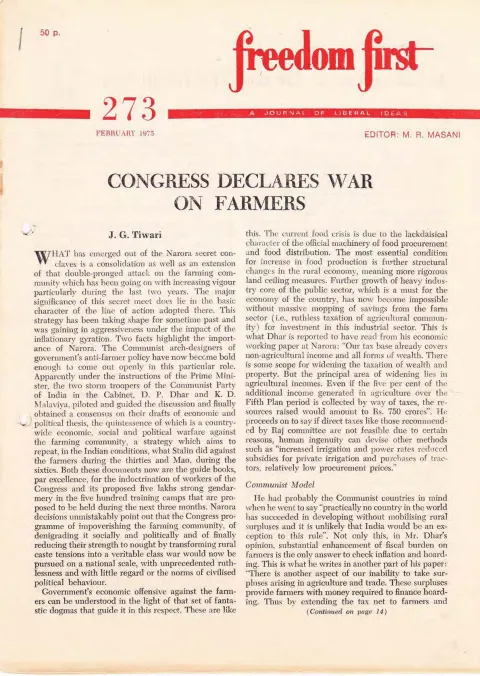
periodical issue
Freedom First
A Journal of Liberal Ideas
By S. P. Aiyar, Ruzbeh Antia, B. P. Singh, Russel Kirk, Col. C. L. Proudfoot (Retd.), Rusi J. Daruwala, Manjula Padmanabhan
Published for the Democratic Research Service by J. R. Patel, Editor: Freedom First, at 127, M. Gandhi Road, Bombay 1... at Inland Press, Bombay 7 · Bombay · 1975
16 pages
Freedom First
Summary
Freedom First No. 274 (March 1975), edited by M. R. Masani, is a miscellany issue of the Bombay-based liberal monthly opening with S. P. Aiyar’s review-essay on N. A. Palkhivala’s book Our Constitution Defaced and Defiled, marking the Indian Constitution’s twenty-fifth anniversary with a warning that one-party dominance and constitutional amendments (notably the Twenty-fourth and Twenty-fifth) have eroded fundamental rights. The issue reprints a Times of London piece on middle-class anger over inflation and taxation in Britain, and carries Ruzbeh Antia’s first contribution on student unrest at St. Xavier’s College, Bombay. B. P. Singh, president of the Farmers’ Federation of India, argues in polemical terms that government procurement pricing and creeping ‘socialisation of agriculture’ — not drought or hoarding — are starving Indian farmers and the country at large. American conservative Russell Kirk contributes a Cold War-inflected essay contrasting Confucian ethics with Maoist Communism in Taiwan and China. The back pages carry two book reviews (on a history of India’s paratroopers, and on a study of anti-inflationary ordinances), a theatre review of a Bombay production of Stoppard’s Rosencrantz and Guildenstern Are Dead by Manjula Padmanabhan, and a closing page of aphoristic press quotations under the title ‘With Many Voices.‘
Key points
-
S. P. Aiyar marks the Constitution’s 25th anniversary by reviewing N. A. Palkhivala’s Our Constitution Defaced and Defiled, endorsing its argument that Parliament’s amending power cannot alter the Constitution’s basic structure, a position vindicated in the Fundamental Rights Case.
-
A reprinted Times of London piece warns that Britain’s middle class, squeezed by inflation, the Capital Transfer Tax, and comprehensive-education reforms, is becoming dangerously aggrieved and risks a serious political backlash against the Labour government.
-
Ruzbeh Antia’s “Diwali in December” describes a St. Xavier’s College student agitation over free expression for student publications, unconditional exam forms, and canteen-committee control, tracing campus unrest to India’s Macaulay-designed, clerk-producing colonial education system.
-
B. P. Singh, President of the Farmers’ Federation of India, rejects the government’s “no famine” semantics and demands a public enquiry into starvation deaths, arguing procurement pricing policy cost farmers an estimated Rs. 400 crores in a single year and accusing Indira Gandhi of a “subtler” Stalinist-style agricultural collectivisation.
-
Russell Kirk’s “Marx Vs Confucius” contrasts the Cultural Revolution’s public burning of Confucian classics at Chufu with Taiwan’s revival of Confucian philosophy, arguing Marxism’s totalising ethical claims require the extirpation of rival moral systems.
-
Col. C. L. Proudfoot reviews K. C. Praval’s India’s Paratroopers as gripping regimental history spanning Burma to the 1971 war, while Rusi J. Daruwala reviews Guruprasad Murthy’s Management by Ordinances, which warns India’s economy is “tottering on the edge of the embankment” toward possible revolution.
-
Manjula Padmanabhan reviews a Bombay production of Stoppard’s Rosencrantz and Guildenstern Are Dead, praising the leads’ witty delivery but concluding the play, unlike Hamlet, has no independent depth of its own.
Essays
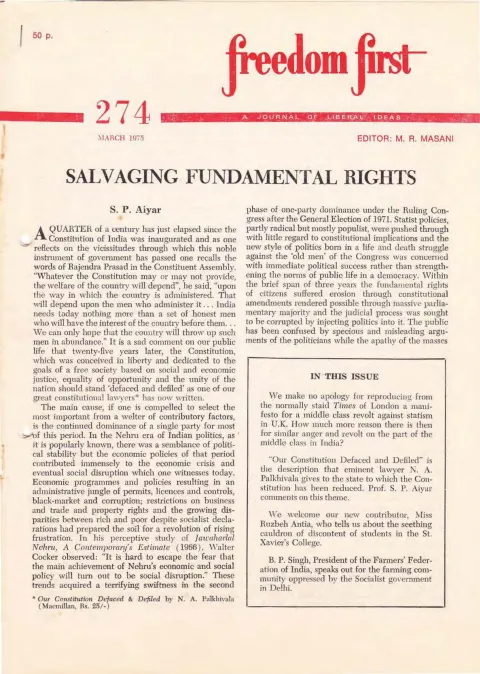
Salvaging Fundamental Rights
By S. P. Aiyar
S. P. Aiyar marks the Indian Constitution’s twenty-fifth anniversary by reviewing N. A. Palkhivala’s Our Constitution Defaced and Defiled, using the book as a vehicle to argue that continuous one-party Congress rule, especially after 1971, produced statist and populist policies that eroded fundamental rights through constitutional amendments (the Twenty-fourth and Twenty-fifth, and the ‘outrage’ of Article 31C) and attempts to make the judiciary ‘made to measure.’ Aiyar endorses Palkhivala’s rejection of the claim that fundamental rights conflict with the Directive Principles, and highlights the book’s central argument that Parliament’s amending power cannot extend to altering the Constitution’s basic structure, vindicated in the Fundamental Rights Case. He closes by calling the book an important contribution to liberal constitutionalism and a passionate plea for freedom.
- Twenty-five years after the Constitution’s inauguration, Aiyar judges it ‘defaced and defiled,’ echoing Palkhivala’s phrase.
- Continued one-party Congress dominance, intensified after the 1971 election, is identified as the chief cause of erosion of rights via constitutional amendments.
- The permit-licence-control regime and restrictions on business, trade and property rights are cited as economic backdrop to the crisis.
- Palkhivala’s book is praised for rejecting any inherent conflict between fundamental rights and Directive Principles.
- The book’s core contribution, per Aiyar, is its defence of a limited amending power: Parliament cannot alter the Constitution’s ‘essential features, basic elements or fundamental principles.’
- The Twenty-fourth Amendment is described as attempting to transfer sovereignty from the people to Parliament.
- Aiyar frames the Supreme Court’s decision in the Fundamental Rights Case as having repudiated Parliament’s claimed competence to alter the Constitution’s basic features.
The Anger of the Middle Class
This reprinted Times of London piece, credited at the end to ‘The Times,’ argues that Britain’s middle class — broadly defined to include professionals, salaried employees, and anyone with career ambitions for themselves or their children — is becoming dangerously angry over inflation, high taxation, and government policies (the Capital Transfer Tax, comprehensive-education reforms) that it sees as eroding its traditional aspirations of self-improvement and intergenerational advancement. It contrasts middle-class economic vulnerability with trade unions’ greater capacity to defend real incomes, and warns the Labour government, and ministers such as Michael Foot and Tony Benn in particular, that ignoring this ‘middle class revolt’ — as Edward Heath ignored the miners — risks a serious political backlash.
- The middle class is defined broadly (roughly half of society) via indicators like education, property, and career mobility rather than as a narrow professional elite.
- Middle-class identity is tied to a doctrine of self-improvement and providing a better start for one’s children through education and inherited security.
- Inflation is singled out as the chief threat, squeezing real incomes, pricing families out of private education, and undermining savings and long-term family planning.
- The piece argues the middle class — especially doctors — has been made to feel like ‘the miners’ of this era: unified, aggrieved, and increasingly organised in its indignation.
- The Capital Transfer Tax and comprehensive education reforms are cited as government policies seen as hostile to middle-class family and educational aspirations.
- The essay closes with a direct warning to the Labour government that a middle-class revolt, if unrecognised, could sweep away good along with bad; governing in a national rather than class sense is called a ‘condition of existence’ for a British party.
Diwali in December
By Ruzbeh Antia
In her first contribution to Freedom First, Ruzbeh Antia describes a December 1974 student agitation at St. Xavier’s College, Bombay, sparked by three grievances: demands for unrestricted freedom of expression in student publications after the college cracked down on an ‘underground’ newsletter called Xavierchute; demands that University examination forms be issued unconditionally regardless of attendance or preliminary exam performance; and demands to make student control of the college canteen committee permanent. Antia situates the unrest within a broader critique of India’s colonial-legacy education system, originally designed by Macaulay to produce clerks, which she argues has failed to adapt to producing graduates equipped for a modern, independent India. She concludes that the agitation ended in a stop-gap compromise (unconditional exam forms) that resolved nothing structurally, leaving the deeper problems of an outmoded examination and educational system unaddressed, and suggests that society’s inflated, purely status-driven valuation of a college education, rather than the students or the administration alone, is ultimately at fault.
- The unrest centred on three demands: freedom of expression for student publications, unconditional issuance of University exam forms, and permanent student control of the canteen committee.
- The crackdown followed the underground newsletter Xavierchute, whose contributors were expelled even after submitting written confessions, hardening the administration’s stance on student publications generally.
- Antia traces the roots of student disaffection to India’s Macaulay-designed colonial education system, built to produce clerks rather than graduates suited to an independent nation’s needs.
- She is skeptical that the exam-form protest reflected genuine grievance rather than ‘laziness and lethargy,’ noting most students simply want the forms without fulfilling attendance conditions.
- The agitation ended once the Principal agreed to grant forms unconditionally, but Antia judges this a hollow victory that leaves the outmoded examination and educational system unreformed.
- She argues society’s inflated, prestige-driven valuation of college education, rather than any one party’s fault, is the underlying cause of recurring campus unrest across India.
No Famine in India?
By B. P. Singh
B. P. Singh, identified elsewhere in the issue as President of the Farmers’ Federation of India, rejects the government’s semantic distinction between ‘famine’ and ‘acute scarcity conditions with malnutrition deaths,’ publicly demanding an open enquiry into starvation deaths, and argues that India’s food crisis is man-made rather than caused by drought or floods, pointing to Dr. Borlaug’s agreement that famine deaths are avoidable. He blames the Congress government’s procurement pricing policy and its drift toward ‘socialisation of agriculture’ — rather than rich farmers, traders, or incapable cultivators — for the crisis, presenting detailed price-parity calculations (citing Prof. B. R. Shenoy) to argue that UP wheat procurement prices should have been far higher than those actually fixed, costing farmers an estimated Rs. 400 crores in a single year. Singh frames government agricultural policy as pursuing two goals: extracting maximum savings from agriculture for use elsewhere, and liquidating politically inconvenient rural classes by squeezing farmers through taxation, terms-of-trade manipulation, and shrinking land ceilings, accusing Prime Minister Indira Gandhi of pursuing a ‘subtler’ form of Stalinist agricultural collectivisation.
- Singh rejects government claims that there is ‘no famine,’ calling the distinction between famine and scarcity-driven malnutrition deaths ‘semantic hairsplitting,’ and demands a public enquiry.
- He cites Dr. Borlaug’s view that starvation deaths in India are avoidable, framing the crisis as man-made rather than driven by nature.
- Singh presents India as agriculturally capable of feeding three times its population if properly irrigated, faulting two decades of planning for raising irrigated cultivated area only from 17 to 22 percent.
- Detailed price-parity calculations (citing Prof. B. R. Shenoy and UP government price indices) argue procurement prices for wheat were fixed far below fair parity, costing farmers roughly Rs. 400 crores in one year on foodgrain transactions alone.
- He argues Indian wheat production more than doubled between 1966-67 and 1970-71, rebutting claims that Indian farmers are agriculturally incapable.
- Singh frames government policy as pursuing twin goals: diverting agricultural savings to other sectors, and liquidating potential rural opponents of the regime through taxation, adverse terms of trade, and shrinking land ceilings.
- He accuses Prime Minister Indira Gandhi of pursuing a subtler, non-Stalinist form of agricultural collectivisation aimed at the same ends as Soviet-style socialisation.
- The Farmers’ Federation of India, per Singh, has not opposed taxing farmers above the general income-tax exemption limit but insists agriculturists’ direct tax burden should not exceed that of non-agriculturists on comparable incomes.
Marx Vs Confucius
By Russel Kirk
American conservative writer Russell Kirk, reporting from a visit to Quemoy and Taiwan, argues that Chinese Communist hostility to Confucius is not merely a proxy attack on Lin Piao (as some observers hypothesized) but a logical necessity of Marxism’s claim to be a total, exclusive ethical system that cannot tolerate a rival moral order. He contrasts the Cultural Revolution’s public burning of Confucian classics at Confucius’s birthplace, Chufu, with Taiwan’s renewed embrace of Confucian philosophy, including a large new temple at Sun Moon Lake, framing this as evidence of a longer ethical and social continuity in Chinese civilization that communism has ruptured on the mainland but that survives in Taiwan and the overseas Chinese diaspora. Kirk closes by describing Confucianism as a philosophy of legitimate government resting on the moral character of rulers, incompatible with Marxist dogma, while cautioning that Confucian ethics prevailing over Marxism in the long run is not guaranteed.
- Kirk frames Quemoy as ‘the farthest-flung defense of civilization’ against Communist China’s Cultural Revolution.
- He recounts the theory that Mao and Chiang Ching’s anti-Confucius campaign was aimed obliquely at discrediting Lin Piao, but argues Communist hostility to Confucius predates and runs deeper than that political maneuver.
- Marxism is described as ‘an inverted religion’ whose totalizing ethical claims require the extirpation of rival systems like Confucianism.
- Confucian classics were reportedly burned publicly at Chufu, Confucius’s birthplace, as part of the Cultural Revolution’s campaign.
- Taiwan is portrayed as reviving Confucian philosophy in response to the mainland campaign, including construction of a major temple at Sun Moon Lake.
- Kirk quotes Confucius on the link between good government, good character in rulers, and popular confidence in the governed.
- He concludes that Confucian ethics and Marxist dogma are irreconcilable, but stops short of predicting the outcome of their long-run contest.
Reviews: Airborne History (India’s Paratroopers by K. C. Praval)
By Col. C. L. Proudfoot (Retd.)
The Reviews section carries two notices. Col. C. L. Proudfoot (Retd.) reviews Major K. C. Praval’s India’s Paratroopers, praising it as a gripping regimental history covering the origin of Indian airborne forces through the Burma campaign, the 1947-48 Jammu and Kashmir war, Korea, Egypt, the liberation of Goa, and the 1965 and 1971 wars with Pakistan, noting its readable style despite a minor binding error. Rusi J. Daruwala reviews Guruprasad Murthy’s Management by Ordinances: An Anti-inflationary Offensive, describing it as a bold application of management and statistical technique (drawing on Reserve Bank of India data on over 1,600 companies) to analyze the government’s post-July-1974 anti-inflation measures, concluding that Murthy warns India’s economy resembles ‘a drunk down a flight of stairs’ at risk of tipping into ‘anarchy and revolution’ without more effective policy.
- Col. C. L. Proudfoot praises India’s Paratroopers by K. C. Praval as gripping regimental history spanning Burma, Jammu and Kashmir (1947-48), Korea, Egypt, Goa, and the 1965/1971 wars.
- The review notes a minor production flaw (interchanged Maps 2 and 6) but calls the book excellent overall, quoting its account of the 1946 disbandment ceremony of the Indian Parachute Regiment.
- Rusi J. Daruwala reviews Guruprasad Murthy’s Management by Ordinances, which studies the government’s anti-inflationary measures since July 1974 using RBI aggregate data on 1,650-plus large and medium companies.
- Murthy’s book concludes that fixed-income, salaried, industrial, and farming classes are all worst hit by inflation and that incomes-policy coverage is inadequate to change price trends.
- Daruwala summarizes Murthy’s warning that India’s economy is ‘tottering on the edge of the embankment,’ at risk of ‘a bloody revolution and political chaos’ absent changed economic management.
Reviews: Our Tottering Economy (Management by Ordinances by Guruprasad Murthy)
By Rusi J. Daruwala
Manjula Padmanabhan reviews a Bombay production by The New Shakespeare Company of Tom Stoppard’s Rosencrantz and Guildenstern Are Dead, describing it as clever, well-performed, and visually striking (with a spare set of black platforms and inventive costuming) but ultimately dependent for its effect on the audience’s intimate knowledge of Hamlet and Shakespeare criticism. She singles out Philip Bowen and Brian Deacon in the title roles for their fast, witty delivery, and the pantomime sequence performed by the players-within-the-play (led by David Dodimead) as a highlight, but questions whether the production’s comic set-pieces overshadowed its intellectual substance, concluding that unlike Hamlet, which endures on its own merit, Stoppard’s play only reflects light from the greater work it depends on.
- The play strips Hamlet of its plot and protagonist, retelling events from the marginal perspective of Rosencrantz and Guildenstern.
- Padmanabhan praises Philip Bowen and Brian Deacon’s rapid, witty delivery in the title roles, and David Dodimead’s troupe for an exceptionally well-performed pantomime sequence.
- She criticizes the production for leaning on broad comedy and mimicry of television talk-show humor rather than sustaining the play’s existential and symbolic ambitions.
- The set design (bare black platforms) and costuming (contrasting Shakespearean satin gowns with the leads’ sober modern-ish dress) are noted as clever and effective choices.
- Padmanabhan questions whether a play so dependent on audience familiarity with Hamlet and its criticism can be considered fully self-sufficient.
- She concludes that Rosencrantz and Guildenstern Are Dead, unlike Hamlet, has no independent depth and would be ‘entirely non-existent’ without the play it reflects.
Generated by the v1.5 extraction pipeline. Awaiting editorial review.
Metadata and summary are AI-extracted from the source PDF and reviewed for editorial accuracy. The original work is available via the Read PDF tab above (where present); paragraph-level citation inside the PDF is deferred to a future engagement.