periodical issue
Freedom First
A Journal of Liberal Ideas
By Jose De Almeida Araujo, Kirtidev D. Desai, Zulie Nakhooda, Arvind A. Deshpande, Rusi J. Daruwala
FREEDOM FIRST, C/o Democratic Research Service, 127, Mahatma Gandhi Road, Bombay 1. · Bombay · 1975
16 pages
Freedom First
Summary
This is issue No. 275 of Freedom First (April 1975), a journal of liberal ideas edited by M. R. Masani and published from Bombay. In the rendered pages, the issue opens with Jose De Almeida Araujo’s first-person account of why he fled Portugal after the April 1974 coup, describing the Communist Party’s infiltration of the Armed Forces Movement and the political persecution that followed President Spinola’s resignation, framed by an editorial note, ‘Portugal Goes Under’, drawing a parallel to Lenin’s dissolution of Russia’s Constituent Assembly. The regular editorial column ‘Between You & Me and The Lamp Post’ surveys current affairs — Marshal Grechko’s visit to Delhi and Soviet pressure tactics in Asia, the TUC’s invitation to former KGB chief Alexander Shelepin, the Indian government’s politicisation of international table tennis, and the erosion of parliamentary democracy in Bangladesh (Sheikh Mujibur Rehman’s one-party constitutional coup) and Ceylon. Kirtidev D. Desai contributes a signed essay on electoral reform, diagnosing vote-seat distortion, money power, and misuse of official machinery as the three central defects of India’s electoral system and proposing proportional representation; this is followed by a verbatim excerpt, ‘Distortion of Popular Will’, from the Report of the Electoral Reform Committee appointed by Jayaprakash Narayan, quantifying seat-vote distortion since 1952 and weighing mixed electoral systems including the West German model. Zulie Nakhooda writes on the state of child welfare in India, arguing that decades of planning neglected human resources in favour of economic development narrowly conceived, and surveys institutional versus non-institutional (adoption, foster care, sponsorship) approaches to destitute children. The issue’s Reviews section carries two pieces: Arvind A. Deshpande on a Diebold Institute study of multinational corporations and developing countries, and Rusi J. Daruwala on David Bonavia’s ‘Fat Sasha and the Urban Guerilla’, a study of Soviet dissidents and the psychological toll of life under a closed political system. The issue closes with ‘With Many Voices’, a page of press quotations on world affairs from Mrs. Thatcher, The Economist, and others.
Key points
-
Jose De Almeida Araujo’s first-person account of fleeing Portugal describes the Communist Party’s infiltration of the Armed Forces Movement, 300 blank arrest warrants used to jail opponents, and President Spinola’s September 1974 resignation, framed by an editorial note comparing it to Lenin’s dissolution of Russia’s Constituent Assembly.
-
The “Between You & Me and The Lamp Post” column reads Marshal Grechko’s Delhi visit as deepening Soviet leverage over Indian defence policy, criticises the British TUC’s invitation to former KGB chief Alexander Shelepin, and reports Sheikh Mujibur Rehman’s constitutional coup establishing a one-party state in Bangladesh.
-
Kirtidev D. Desai’s essay on electoral reform identifies misuse of official machinery, unaccounted money, and first-past-the-post vote-seat distortion as India’s three central electoral defects, proposing an independent Election Commission and proportional representation.
-
A verbatim chapter from the Jayaprakash Narayan-appointed Electoral Reform Committee’s report tabulates Congress’s vote-seat distortion from 1952-1971 (ranging +13.5 to +29.4 points) and recommends studying the West German mixed electoral model.
-
Zulie Nakhooda’s “Whither Child Welfare in India?” argues Indian planning has neglected children in favour of narrow economic development, noting over 60 percent of institutionalised children have living parents driven by poverty rather than orphanhood.
-
Arvind A. Deshpande reviews a Diebold Institute study on multinational corporations, arguing MNCs and private enterprise will survive current criticism and citing Singapore, Mexico, and Brazil as examples of rapid growth under varied MNC strategies.
-
Rusi J. Daruwala reviews David Bonavia’s Fat Sasha and the Urban Guerilla on Soviet dissidents, outlining an eight-point Soviet propaganda playbook against critics and describing Samizdat’s underground publishing network.
Essays
Why I Had to Leave Portugal
By Jose De Almeida Araujo
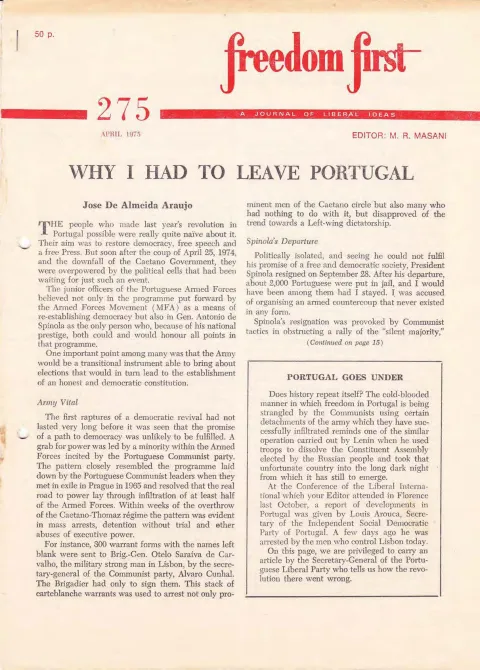
Jose De Almeida Araujo, identified as Secretary-General of the Portuguese Liberal Party, gives a first-person account of the Portuguese revolution’s descent from a promise of democracy into Communist Party domination. He describes how the Armed Forces Movement’s junior officers initially backed General Spinola as a transitional guarantor of free elections, but were outmanoeuvred by Communist infiltration of the military following a pattern set at a 1965 Prague meeting of exiled Portuguese Communist leaders. He recounts mass arrests using blank warrants signed by Brig.-Gen. Otelo Saraiva de Carvalho at the instruction of party secretary-general Alvaro Cunhal, Spinola’s resignation on September 28 after being politically isolated, and his own accusation of plotting a countercoup that never existed. The piece continues (in pages beyond this excerpt’s first page) to describe economic collapse — 80 percent of Portuguese companies unable to meet liabilities, 35 percent inflation, 20 percent unemployment — and argues Portugal’s future lies in integration with the Common Market and Western Europe, closing with an appeal for Britain, France, and West Germany to play a decisive part in that outcome. An unsigned framing note, ‘Portugal Goes Under’, accompanies the piece on its first page, comparing the Communist-infiltrated army’s role to Lenin’s use of troops to dissolve Russia’s Constituent Assembly, and introduces the author as Secretary-General of the Portuguese Liberal Party who addresses how the revolution went wrong.
- The Armed Forces Movement’s junior officers initially believed in a transitional path to democratic elections under General Spinola.
- A minority within the Armed Forces, incited by the Portuguese Communist Party, executed a slow-motion grab for power following a plan laid down at a 1965 Prague meeting.
- 300 blank arrest warrants were issued to the military strongman in Lisbon by the Communist party secretary-general, used to jail not just Caetano-regime figures but anyone opposing a leftward drift.
- President Spinola resigned on September 28, 1974 after being politically isolated; the author was accused of plotting a nonexistent countercoup.
- By April 1975 all key positions in Portugal were under Communist Party control, directly or through the Council of Twenty (Superior Council of the Armed Forces).
- The author estimates the Socialist Party at roughly 25% of the electorate, the Centre-Left Popular Democrats at 30%, Centre-Right Democratic Socialists at 25-30%, and the Communist Party and satellites at 12-15%.
- The author argues Portugal’s only reasonable future is integration into the Common Market, both to solve its economic crisis and to forestall domination by either the USSR or the US.
Between You & Me and The Lamp Post
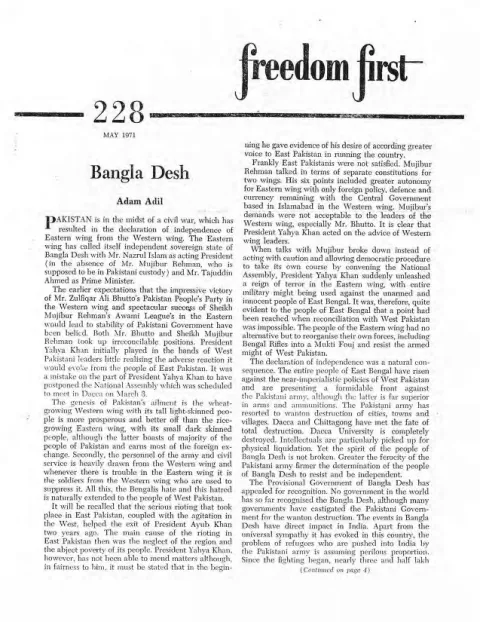
The unsigned ‘Between You & Me and The Lamp Post’ column surveys several current-affairs items. It reads Marshal Grechko’s February 1975 Delhi visit and Soviet stonewalling on arms-spares supply as signs of tightening Soviet leverage over India, recommends A. G. Noorani’s book on ‘The Brezhnev Plan for Asian Security’ as essential background, and criticises Indian opinion-makers (including Jayaprakash Narayan) for objecting to the US lifting its arms embargo on India and Pakistan while India itself buys roughly a billion dollars of arms annually from the USSR. It condemns the British TUC’s invitation to former KGB chief Alexander Shelepin, quoting comparisons to Heinrich Himmler from Conservative MP John Biggs-Davison and Aims of Industry director Michael Ivens. A further item, ‘Politics in Sport Again’, criticises the Indian government for denying visas to South African and Israeli table-tennis players while feting a Chinese team, and for India’s defeat in a vote for Deputy Chairman of the international table tennis body. ‘The Lights Go Out’ describes Sheikh Mujibur Rehman’s constitutional coup establishing a one-party state in Bangladesh (the Bangladesh Krisak Sramik Awami League) modelled on Tanzania, contrasts this with Pakistan Prime Minister Bhutto’s mocking response to Indian opposition leaders who had praised Mujib, and notes Indira Gandhi’s congratulatory telegram to Mujib. A final item, ‘And Now Lanka’, begun on this page, opens discussion of the end of Ceylon’s Parliament and Mrs. Sirimavo Bandaranaike’s constitutional manoeuvres to avoid by-elections.
- Marshal Grechko’s Delhi visit and Soviet handling of arms-spares disputes are read as signs of deepening, and troubling, Soviet leverage over Indian defence policy.
- The column criticises the outcry (including from Jayaprakash Narayan) against the US lifting its arms embargo on India and Pakistan as inconsistent, given India’s own large-scale arms purchases from the USSR.
- The British TUC’s invitation to former KGB chief Alexander Shelepin is likened by British commentators to inviting Heinrich Himmler.
- The Indian government is criticised for barring South African and Israeli table-tennis players from a Calcutta tournament while welcoming a Chinese team, seen as politicised double standards in sport.
- Sheikh Mujibur Rehman’s constitutional coup in Bangladesh establishes a one-party state (the Bangladesh Krisak Sramik Awami League), modelled on Tanzania’s one-party system.
- Pakistan’s Bhutto mocks Indian opposition leaders who had praised Mujib as a champion of democracy, noting the hypocrisy of their silence on his coup.
Electoral Reform
By Kirtidev D. Desai
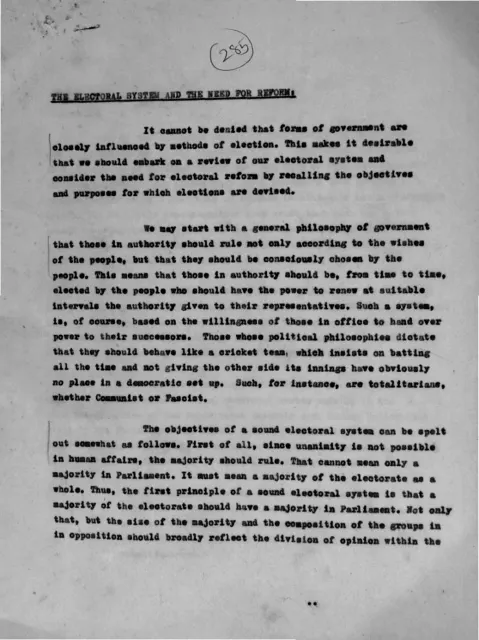
Kirtidev D. Desai’s signed essay argues that electoral reform became a central national issue in 1974-75, driven by growing public disbelief in the fairness of elections after the 1969 presidential election controversy, 1971 rigging allegations, and ‘vulgar and shameless use of money and power’ in the 1974 U.P. elections. He identifies three structural causes of the malady: misuse of governmental machinery for electoral advantage, large-scale use of unaccounted money, and vote-seat distortion inherent in the first-past-the-post system. He proposes a stronger, more independent Election Commission, a caretaker-government convention before elections, converting Radio and Television into autonomous corporations, continuing the ban on company donations to parties, and adopting some form of proportional representation, noting the Committee on Electoral Reform (appointed by Jayaprakash Narayan) had made significant progress in defining these reforms.
- Electoral reform became a central national issue after the 1969 presidential election controversy, 1971 rigging allegations, and the 1974 U.P. election money-power scandal.
- Three structural causes are identified: misuse of official machinery, large-scale money power (citing the Nagarwala episode and Pondicherry licence scandal), and first-past-the-post vote-seat distortion.
- Proposed remedies include a more independent Election Commission, State-level Election Commissions, a caretaker-government convention before elections, and autonomous status for Radio and Television.
- The essay recommends continuing the ban on company political donations and stricter enforcement of election expense ceilings, including party expenses.
- The Committee on Electoral Reform, appointed by Jayaprakash Narayan in August 1974, is credited with articulating alternative proportional-representation methods for national debate.
Distortion of Popular Will (Chapter from the Report of the Electoral Reform Committee)
This is a verbatim chapter, ‘Distortion of Popular Will’, reprinted from the Report of the Electoral Reform Committee appointed by Jayaprakash Narayan. It presents a table showing Congress’s vote-share versus seat-share in Lok Sabha elections from 1952 to 1971, with vote-seat distortion ranging from +13.5 to +29.4 percentage points, and argues this distortion is unparalleled among comparable democracies (citing English elections 1885-1951 and Canadian elections 1925-1940 as points of comparison). It surveys alternative electoral systems — the List System, Single Transferable Vote, Cumulative Vote, and Second Ballot — and recommends further study of ‘mixed’ systems, particularly West Germany’s Bundestag model combining single-member constituencies with party-list seats, while also sketching an original alternative formula devised by the Committee itself. A short unsigned item, ‘Mujib’s Last Card’, follows on the same page, quoting The Economist’s view (February 1) that Sheikh Mujib has played his last card in Bangladesh and has no more convincing alibis left.
- A table of Lok Sabha election data (1952-1971) shows Congress winning disproportionate seat shares relative to its vote share, with distortion figures between +13.5 and +29.4 percentage points.
- The Committee argues India’s vote-seat distortion (24-30 percent) is unparalleled compared to historical English and Canadian elections, where such distortion rarely exceeded 21 percent.
- The report cites consequences: a de facto one-party-dominant system, reduced opposition to a permanent periphery, and the enabling of constitutional amendments on the strength of legislative majorities won on minority votes.
- The Committee recommends studying ‘mixed’ systems, especially the West German Bundestag model, alongside an alternative formula of its own combining single-member constituencies with a list-based top-up of seats.
- An adjoining item, ‘Mujib’s Last Card’, quotes The Economist stating Sheikh Mujib has ‘played his last card’ and will have ‘no more convincing alibis’ after his one-party constitutional coup in Bangladesh.
Whither Child Welfare in India?
By Zulie Nakhooda
Zulie Nakhooda’s essay opens by invoking Urie Bronfenbrenner’s ‘Two Worlds of Childhood’ to frame the question of how a society should be judged by its treatment of children, arguing that Indian planning has neglected human resources — especially children — in favour of narrowly economic development over the preceding twenty years. She cites the 1973-74 child-to-adult population ratio of 3:3 and a birthrate of 1,200 babies per second as symptomatic of an imbalance obstructing economic growth, notes that over 60 percent of the roughly 55,000 children in residential institutions have living parents and families (poverty being the main driver of institutionalisation), and describes the material and educational deprivation of children in substandard homes. She surveys the evolution of non-institutional child welfare services — adoption (limited by the absence of an Adoption Law for non-Hindu communities), foster care (limited by urban housing shortages), and sponsorship (administered through roughly 40 welfare agencies via the India Sponsorship Committee) — concluding that investment in children is investment in a nation’s future and that continued deprivation today will deprive the world of the capable people needed for future peace and progress.
- The essay opens by invoking Urie Bronfenbrenner’s ‘Two Worlds of Childhood’ to argue that a society’s treatment of children is the true test of its capacity to survive and prosper.
- Indian economic planning over the prior 20 years neglected human resources, particularly children, in favour of natural-resource-based economic development.
- The 1973-74 child-to-adult population ratio of 3:3 and birthrate of 1,200 babies per second are cited as unsustainable for balanced economic growth.
- Over 60 percent of the roughly 55,000 children in residential institutions have living parents and families; poverty, not orphanhood, is the main driver of institutionalisation.
- Adoption is constrained by the lack of an Adoption Law applicable to non-Hindu communities in India; foster care is constrained by urban housing shortages; sponsorship (via ~40 welfare agencies coordinated by the India Sponsorship Committee) is presented as the most workable current solution.
Reviews: Importance of MNCs (review of Business and Developing Countries, UBS Publishers and Distributors)
By Arvind A. Deshpande
Arvind A. Deshpande reviews ‘Business and Developing Countries’ (UBS Publishers and Distributors), a Diebold Institute-sponsored study on the role of private enterprise and multinational corporations in economic development. The review describes the study as objective and optimistic, arguing that private enterprise and MNCs will survive the current attack on them and that economic nationalism is unlikely to check the forward march of economic development, citing Singapore, Mexico, Japan, Hong Kong, Taiwan, and Brazil as examples of countries that have doubled real GNP within 15 years under differing strategies toward MNCs. The study identifies education, nutrition, and computerisation as urgent fields for new multinational service corporations, and predicts a coming irrelevance of nationality as people increasingly live where they choose. Deshpande extensively quotes the study’s account of the many bureaucratic hurdles facing an Indian businessman seeking to start an enterprise, and closes by warning that the choice for developing countries is between autarky and mass well-being, and that Gandhiji’s ‘test of thinking of the poorest man’s interests’ can guide the right choice.
- The review covers a Diebold Institute-sponsored study on private enterprise’s role in economic development, priced at Rs. 15 through UBS Publishers.
- The study argues MNCs and private enterprise will survive current criticism, citing Singapore, Mexico, Japan, Hong Kong, Taiwan and Brazil as examples of rapid GNP growth under varied strategies toward multinational capital.
- Education, nutrition, and computerisation are flagged as urgent fields for new multinational service corporations.
- A lengthy quoted passage catalogues the bureaucratic hurdles (foreign exchange permissions, credit rationing, DGTD surveys, licensing) facing an Indian entrepreneur.
- The review closes by invoking Gandhiji’s test of judging policy by ‘the poorest man’s interests’ as a guide for choosing between autarky and mass well-being.
About Soviet Dissidents (review of Fat Sasha and the Urban Guerilla by David Bonavia)
By Rusi J. Daruwala
Rusi J. Daruwala reviews David Bonavia’s ‘Fat Sasha and the Urban Guerilla: Protest and Conformism in the Soviet Union’ (National Academy, Delhi), based on Bonavia’s conversations with Soviet dissidents between 1969 and 1972 during his tenure as the Times of London’s Moscow correspondent. The review describes the book’s account of Khrushchev’s funeral, the KGB’s use of agents posing as sympathetic ‘dissenters’ to foreigners, the eight-point playbook of Soviet propaganda tactics against opponents (from exhausting critics with volume of words to depriving the accused of any chance to defend himself), and the fate of Samizdat, the underground publishing network. Daruwala highlights Bonavia’s argument that Soviet citizens are denied not just the right to hold dissenting views but even the right to imagine that alternative, equally valid answers to political and social questions might exist, and closes by quoting Bonavia’s reflection that Russia’s sadness is ‘built into its literature and its history’ as ‘an element of the nation’s psychology.’
- The book is based on David Bonavia’s conversations and interviews with Soviet dissidents and others from 1969 to 1972, while he was the Times (London) Moscow correspondent.
- Bonavia outlines an eight-point playbook of Soviet tactics against dissenting opponents, from exhausting them with volume of words to depriving the accused of any chance to defend himself.
- The review discusses the KGB’s practice of having agents pose as sympathetic ‘dissenters’ to foreigners in order to extract information about insurgent activities.
- Samizdat, the underground publishing network, is described as thriving because official Soviet publishing — despite claiming to be the world’s largest — consists overwhelmingly of unwanted propaganda.
- The review closes on Bonavia’s reflection that Soviet citizens live at a different, more emotionally suppressed level than people in freer societies, and that Russia’s sadness is embedded in its literature, history, and national psychology.
Generated by the v1.5 extraction pipeline. Awaiting editorial review.
Metadata and summary are AI-extracted from the source PDF and reviewed for editorial accuracy. The original work is available via the Read PDF tab above (where present); paragraph-level citation inside the PDF is deferred to a future engagement.