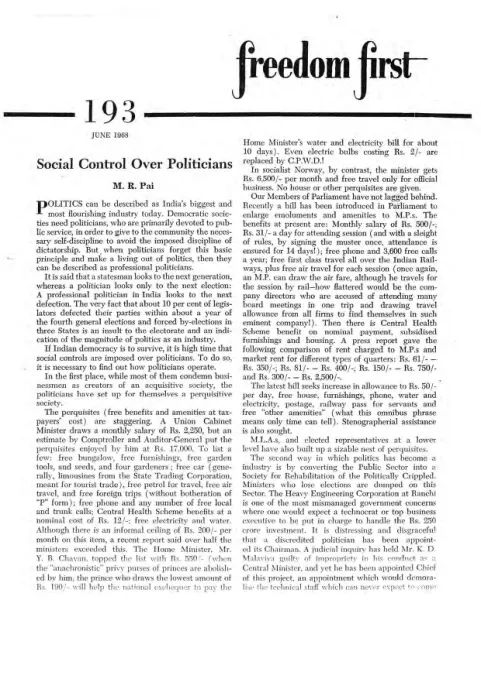
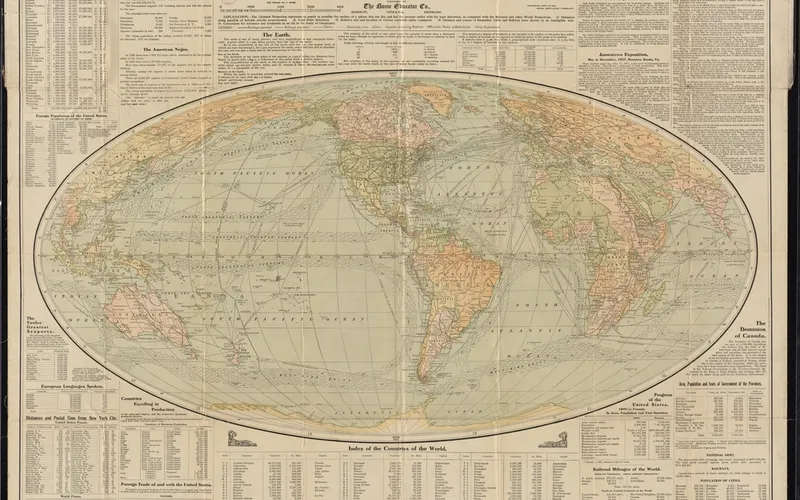
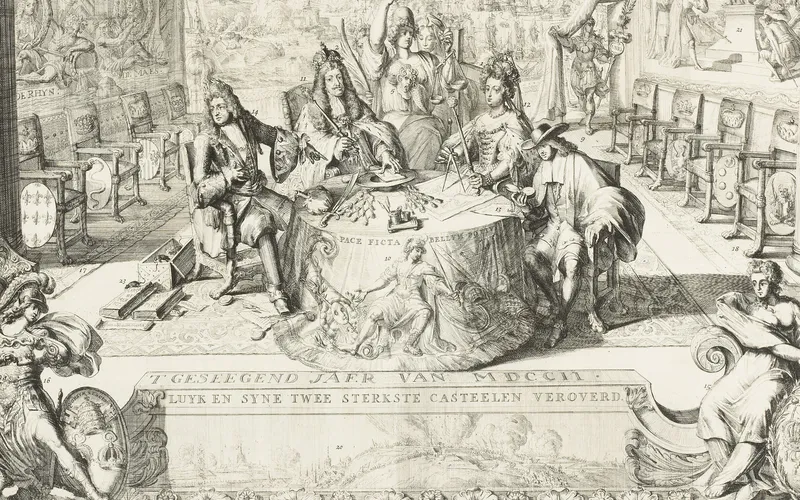
periodical issue
Freedom First
A Journal of Liberal Ideas
By A. G. Noorani, Farok Contractor, A. H. Doctor, Rusi J. Dahowala
Published for the Democratic Research Service by J. B. Patel, Associate Editor, 127, Mahatma Gandhi Road, Bombay 1, and printed by him at Inland Printers, 33 Congress Road, Bombay 2 · Bombay · 1975
16 pages
Freedom First
Summary
Freedom First No. 277 (June 1975), edited by M. R. Masani, is dominated by the Indochina collapse and its regional aftershocks. The unsigned front-page pieces and editorial column ‘Between You & Me and The Lamp Post’ assemble eyewitness dispatches (Jon Swain in Pnom-Penh, a Daily Telegraph report on a massacre of mixed-blood women and children in Nha Trang) alongside polemical commentary on the Sikkim annexation, the Portuguese election, the death of Chiang Kai-shek, Dubcek’s and Havel’s letters from Czechoslovakia, the US Congress’s ‘betrayal’ of South Vietnam, domino-theory warnings for South-East Asia, Delhi’s celebratory reaction to the fall of Saigon, and the arrest of Amnesty International’s Moscow representative. A. G. Noorani contributes a data-driven piece on the India-Pakistan military balance drawing on IISS and SIPRI reports, with a comparative order-of-battle table. Farok Contractor supplies a lighter personal narrative about joining Karwari shark fishermen off Goa. The issue closes with three signed book reviews (M. R. Masani on William Buckley Jr.’s UN memoir, A. H. Doctor on Rounaq Jahan’s study of Pakistan’s break-up, Rusi J. Daruwala on a critical study of an illustrated Aranyaka Parvan manuscript) and a back-page column of pointed quotations, ‘With Many Voices’.
Key points
-
Reprinted eyewitness dispatches from Jon Swain in Pnom-Penh and the Daily Telegraph on an alleged massacre of 185 women and mixed-blood children in Nha Trang document Khmer Rouge and North Vietnamese communist atrocities, framed as correcting a “conspiracy of silence” in the Indian press.
-
The “Between You & Me and The Lamp Post” column condemns India’s annexation of Sikkim, eulogises Chiang Kai-shek as a friend of free India, reports Dubcek’s and Havel’s smuggled protest letters from Czechoslovakia, and excoriates the Lok Sabha and Indira Gandhi’s government for celebrating the fall of Saigon.
-
A. G. Noorani’s “The Military Balance” draws on IISS and SIPRI data to compare India’s and Pakistan’s armed forces, noting India has become a modest arms exporter despite officially citing “self-imposed restraint.”
-
Farok Contractor’s “The Young Men and the Sea” recounts an impromptu overnight shark-fishing trip with Karwari Muslim fishermen off Goa, contrasting romantic expectations with an anticlimactic single catch.
-
M. R. Masani reviews William Buckley Jr.’s United Nations Journal, quoting Buckley’s description of the UN as “the densest collection of oratorical bores in the history of the world” and his barbed characterisation of Indian delegates as compromise-obsessed.
-
A. H. Doctor reviews Rounaq Jahan’s Pakistan: Failure in National Integration, summarising its argument that Pakistan pursued state-building without adequate nation-building or Bengali participation, dooming it to break-up.
-
Rusi J. Daruwala reviews two Asiatic Society of Bombay publications on a 1516-dated illustrated Aranyaka Parvan manuscript, tracing its provenance to Dr. Bhau Daji’s collection and its place in a pre-Mughal Lodi school of painting.
-
The closing “With Many Voices” page quotes “Friedman’s Law” that anything the state does costs twice as much as the free market, and describes the Sarvodaya movement as led by “a saint and a politician,” Vinoba Bhave and Jayaprakash Narayan.
Essays
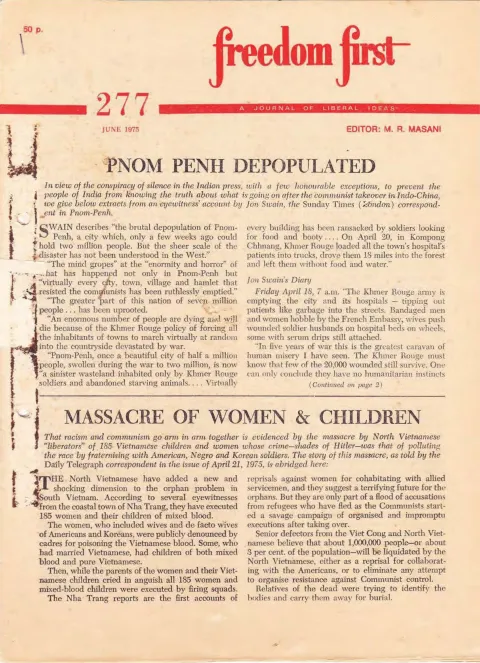
Pnom Penh Depopulated
This unsigned front-page piece reprints extracts from Jon Swain’s Sunday Times eyewitness account of the Khmer Rouge’s forced evacuation of Pnom-Penh, framed by the editors as a corrective to a ‘conspiracy of silence in the Indian press’ about the horrors of the communist takeover in Indochina. Swain describes hospitals emptied of patients, wounded soldiers pushed through the streets on beds, and mass forced marches into a war-devastated countryside, quoting aid workers who call the policy ‘pure and simple genocide.’ The piece continues on page 2 under ‘Continued from page 1’ with further diary extracts describing the abandonment of wounded soldiers and family separations.
- Reprints Jon Swain’s (Sunday Times, London) eyewitness dispatches from Pnom-Penh after the Khmer Rouge takeover.
- Describes the emptying of hospitals and forced march of the population into the countryside.
- Frames the piece as correcting Indian press silence on communist-perpetrated atrocities in Indochina.
- Cites UN Development Project chief Fernand Scheller calling the policy ‘pure and simple genocide.‘
Massacre of Women & Children
An unsigned front-page item reprints a Daily Telegraph account, abridged, of the reported execution of 185 Vietnamese women and their mixed-blood children by North Vietnamese cadres in Nha Trang, framed by the editors as evidence that ‘racism and communism go arm in arm together.’ The piece situates this alongside a broader wave of reprisals against Vietnamese women who had relationships with American, Korean, and other allied servicemen, citing defector estimates that up to a million people could be liquidated or face reprisals under the new regime.
- Reports the alleged execution of 185 women and mixed-blood children in Nha Trang by North Vietnamese forces.
- Sourced from a Daily Telegraph correspondent’s account of April 21, 1975.
- Frames the massacre explicitly as racial reprisal, comparing it to Nazi-era persecution.
- Cites Viet Cong and North Vietnamese defectors estimating up to 1,000,000 people (about 3% of the population) at risk of liquidation or reprisal.
Between You & Me and The Lamp Post (David vs Goliath; Hope Still for Portugal?; “Firm Rock” Till the End; Dubcek Speaks Again; US Congress Betrays Viet Nam; Dominos; Lessons of Viet Nam; Delhi Disgusts; No Amnesty for Them!)
The unsigned editorial column ‘Between You & Me and The Lamp Post’ runs across pages 2, 3, 5, and 6, opening with a section titled ‘David vs Goliath’ that condemns India’s annexation of Sikkim, quoting a New York Times editorial and Sunanda Datta-Ray’s Statesman reportage on the mistreatment of the Kazini of Sikkim and the harassment of Sikkimese opposition leaders. It goes on to praise the free election in Portugal (‘Hope Still for Portugal?’) as a defeat for Communist manipulation, mourns the death of Chiang Kai-shek as a friend of a free India (‘Firm Rock Till the End’), reports Alexander Dubcek’s and Vaclav Havel’s smuggled protest letters against Soviet-imposed repression in Czechoslovakia (‘Dubcek Speaks Again’), condemns the US Congress for failing to honour the 1973 Paris Accord commitments to South Vietnam (‘US Congress Betrays Viet Nam’), warns of a domino effect across South-East Asia (‘Dominos’), draws three lessons from the Vietnam debacle including a comparison to Lal Bahadur Shastri’s 1965 decision to cross the border into Pakistan (‘Lessons of Viet Nam’), excoriates the Indian Parliament and Indira Gandhi’s government for celebrating the fall of Saigon (‘Delhi Disgusts’), and reports the arrest of Amnesty International’s Moscow representative Andrei Tverdokhlebov (‘No Amnesty for Them!’).
- Condemns India’s annexation of Sikkim as a betrayal of the values of Gokhale-Gandhi-era India, citing the New York Times and Sunanda Datta-Ray’s Statesman reports on repression of Sikkimese opposition and the Kazini.
- Welcomes the Portuguese Constituent Assembly election results as a reversal of predicted Communist takeover (‘Hope Still for Portugal?’).
- Eulogises Chiang Kai-shek as one of India’s ‘biggest and best friends’ and credits Taiwan’s land reform and liberal economic policy for its prosperity relative to the Chinese mainland.
- Reports Dubcek’s and Havel’s smuggled open letters protesting continued Soviet-era repression in Czechoslovakia, drawing a parallel to Jayaprakash Narayan’s style of address to Indira Gandhi.
- Blames the US Congress and Kissinger for failing to honour the 1973 Paris Accord’s commitments to South Vietnam, quoting President Ford and General William Westmoreland.
- Warns of a ‘domino theory’ cascade across South-East Asia following the fall of Laos and hedging by Thailand.
- Draws three lessons from the Vietnam debacle, citing Lal Bahadur Shastri’s 1965 decision to invade Pakistan as a contrasting example of resolve.
- Attacks the Lok Sabha and Rajya Sabha’s celebratory reaction to the fall of Saigon and Indira Gandhi’s outreach to the new regime at the Commonwealth Conference in Kingston.
- Reports the arrest of Amnesty International’s Moscow representative Andrei Tverdokhlebov on charges of ‘spreading deliberate falsehoods.‘
The Military Balance
By A. G. Noorani
A. G. Noorani’s ‘The Military Balance’ reviews two recently published reference works, The Military Balance 1974-75 (IISS) and The Arms Trade With the Third World (SIPRI), contrasting their rigour with the Indian Ministry of Defence’s vague 1974-75 Report. Noorani summarises the IISS’s assessment of Chinese nuclear and conventional force posture, notes India’s emergence as a modest arms exporter, and extensively quotes the SIPRI study’s argument that diversification of arms suppliers strengthens recipient-country independence while polarising local conflicts along great-power lines. The piece is accompanied by a comparative India-vs-Pakistan military data table (population, GNP, defence budgets, and force compositions by service).
- Contrasts the analytical rigour of IISS’s The Military Balance and SIPRI’s The Arms Trade With the Third World with the vagueness of India’s official Ministry of Defence report.
- Summarises IISS’s assessment that China’s defence policy operates between nuclear deterrence and ‘People’s War’ mass mobilisation, citing a June 1974 nuclear test.
- Reports that India has become a modest arms exporter (about £5 million/Rs. 10 crores over 12 months) despite officially citing ‘self-imposed restraint.’
- Extensively quotes SIPRI’s argument that diversifying arms suppliers increases recipient countries’ independence but that competing supplier support can polarise local conflicts.
- Cites SIPRI figures that developing countries’ military expenditure (7%/year) and arms imports (8%/year) have grown faster than their GNP (5%/year) since 1950.
- The accompanying India-Pakistan table shows India’s total armed forces (956,000) versus Pakistan’s (392,000), and detailed order-of-battle for army, navy, and air force of each.
India Vs Pakistan
No summary was extracted for this article. Listed for completeness.
The Young Men and the Sea
By Farok Contractor
Farok Contractor’s ‘The Young Men and the Sea’ is a first-person narrative recounting how a Bombay holiday in Goa turned into an impromptu shark-fishing expedition with Karwari Muslim fishermen at Baga beach. Contractor describes the fishermen’s skepticism about two ‘city youths,’ the arduous overnight trip in a frail canoe with four hundred baited hooks, seasickness, and the anticlimactic catch of a single shark, ending with a mock-heroic return to shore under the gaze of onlooking women. The piece is a personal travel essay rather than a political one, offering local colour on the Konkan coast fishing economy.
- First-person account of joining Karwari Muslim shark fishermen from Baga beach, Goa, on an overnight deep-sea fishing trip.
- Contrasts the narrator’s and his friend’s romanticised expectations (invoking ‘Old Man and the Sea’) with the mundane reality of the catch.
- Describes practical details of the trip: canoe construction, baited steel hooks spaced at forty-foot intervals, and rough conditions.
- Ends with the narrator’s seasickness, the anticlimactic single shark catch, and a wry return to shore.
s United Nations Journal: Delegate
By M. R. Masani reviews William Buckley Jr.
M. R. Masani reviews William Buckley Jr.’s United Nations Journal: Delegate’s Odyssey, describing it as an entertaining and often unfair but frequently accurate account of Buckley’s frustrating stint on the US delegation to the UN in 1973. Masani highlights Buckley’s caustic descriptions of the UN as ‘the densest collection of oratorical bores in the history of the world’ and his barbed characterisation of Indian delegates as compromise-obsessed. The review closes by teasing a leaked Daniel Patrick Moynihan cable that Freedom First plans to publish the following month.
- Reviews William Buckley Jr.’s United Nations Journal: Delegate’s Odyssey (G. P. Putnam’s Sons, $7.95).
- Frames the book as Buckley’s ‘sweet revenge’ for the frustrations of his 1973 UN delegate term.
- Quotes Buckley’s description of Indian delegates as compromise-obsessed ‘great compromisers.’
- Notes a confidential Daniel Patrick Moynihan cable revealed in the book, which Freedom First will publish next month.
Reviews: Highwire Artist (United Nations Journal, Delegate’s Odyssey by William Buckley Jr.); The Birth of Bangladesh (Pakistan: Failure in National Integration by Rounaq Jahan)
By M. R. Masani; A. H. Doctor
A. H. Doctor reviews Rounaq Jahan’s Pakistan: Failure in National Integration (Columbia University Press), which argues that Pakistan pursued state-building (centralised political institutions under Ayub Khan) without adequate nation-building or Bengali political participation, dooming the state to break-up. Doctor summarises Jahan’s account of the 1947-58, Ayub, and Yahya periods, the failure of ‘basic democracies’ to bridge East and West Pakistan, and economic disparities favouring the western wing. The review closes by quoting Jahan’s concluding hope that both successor states will prioritise nation-building in the 1970s.
- Reviews Rounaq Jahan’s Pakistan: Failure in National Integration (Columbia University Press, Rs. 60/-).
- Summarises Jahan’s central distinction between state-building and nation-building, applied to Pakistan’s history under Ayub Khan and Yahya Khan.
- Notes the failure of Ayub’s ‘basic democracies’ to create horizontal links between East and West Pakistan’s elites.
- Highlights Jahan’s account of economic disparities and lack of state-sponsored development planning that alienated East Pakistan.
- Quotes Jahan’s concluding call for both Pakistan and Bangladesh to prioritise nation-building in the 1970s.
A Critical Study of a Treasured Manuscript (An Illustrated Aranyaka Parvan in the Asiatic Society of Bombay; Journal of the Asiatic Society of Bombay)
By Rusi J. Dahowala
Rusi J. Daruwala reviews two Asiatic Society of Bombay publications on an illustrated Aranyaka Parvan manuscript of the Mahabharata: An Illustrated Aranyaka Parvan in the Asiatic Society of Bombay by Karl Khandalawala and Moti Chandra, and the Journal of the Asiatic Society of Bombay (Vols. 45-46, 1970-71, edited by Dr. S. N. Gajendragadkar). The review traces the manuscript’s provenance from Dr. Bhau Daji’s collection, its dating to 1516 CE under Sultan Sikandar Lodi via its colophon, and Khandalawala and Chandra’s argument that it represents a pre-Mughal Lodi school of painting and forerunner of the Chaurapanchasika style. Daruwala also notes other articles in the same Journal issue and Dr. Gajendragadkar’s editorial call to broaden the Journal’s disciplinary scope.
- Reviews An Illustrated Aranyaka Parvan in the Asiatic Society of Bombay by Karl Khandalawala and Moti Chandra, and the Journal of the Asiatic Society of Bombay Vols. 45-46 (1970-71), edited by Dr. S. N. Gajendragadkar.
- Traces the manuscript’s provenance to Dr. Bhau Daji’s collection, purchased by the Society from his heirs in 1882.
- Notes the manuscript’s colophon dates it to 1516 CE, during the reign of Sultan Sikandar Lodi, with 362 original folios (a third now missing).
- Summarises the authors’ argument that the manuscript documents a pre-Mughal Lodi school of painting and is a forerunner of the Chaurapanchasika style.
- Describes stylistic features noted by Khandalawala and Chandra: red-dominant backgrounds, contemporary costume depiction, and Western Indian/Gujarati stylistic parallels.
- Notes other contents of the Journal issue, including articles by G. K. Bhat, R. V. Herwadkar, and V. D. Rao.
With Many Voices
The back-page column ‘With Many Voices’ collects pointed quotations from The Economist, Time, Parsiana, and other sources on Trotsky and Lenin, Archbishop Donald Coggan on moral relativism, the Sarvodaya movement’s leadership split between Vinoba Bhave and Jayaprakash Narayan, ‘Friedman’s Law’ on the cost of state provision versus the free market, Chinese foreign-policy categorisation of world blocs, the Soviet Politburo’s gerontocracy, and US conduct in South-East Asia. The subscription coupon for Freedom First appears on the same page.
- A curated column of quotations under the epigraph from Tennyson, ‘The deep / Moans round with many voices.’
- Includes a quotation describing the Sarvodaya movement as led by ‘a saint and a politician’: Vinoba Bhave and Jayaprakash Narayan.
- States ‘Friedman’s Law—Anything the State does costs twice as much as the free market’, attributed to Yesterday, Today and Tomorrow, January 1975.
- Includes commentary from The Economist and Time on Cold War politics, the Soviet Politburo, and US conduct in the Vietnam war’s endgame.
- The Freedom First subscription form (Rs. 5.00 annual, Rs. 3.00 for students) appears alongside the column.
Generated by the v1.5 extraction pipeline. Awaiting editorial review.
Metadata and summary are AI-extracted from the source PDF and reviewed for editorial accuracy. The original work is available via the Read PDF tab above (where present); paragraph-level citation inside the PDF is deferred to a future engagement.