periodical issue
Freedom First
A Journal of Liberal Ideas
By Bernard Levin, James Burnham, J. B. H. Wadia, Nitin G. Raut, Mehra Masani, Rusi J. Daruwala, T. G. Joshi
Published for the Democratic Research Service by J. R. Patel, Associate Editor, Freedom First at 127, M. Gandhi Road, Bombay 1 (Phone: 254341) and printed by him at Inland Printers, 55 Gamdevi Road, Bombay · Bombay · 1976
16 pages
Freedom First
Summary
This is the February 1976 issue (No. 279) of Freedom First, the Bombay-based journal of liberal ideas edited by M. R. Masani, published for the Democratic Research Service. Billed on its own contents page as ‘essentially an international issue — a sort of global tour d’horizon,’ it opens with an unsigned editorial defining the essential features of fascism (prompted by a leftist press attack on an anti-fascist conference in Patna) and moves through a run of short unsigned notes in the ‘Between You & Me and The Lamp Post’ column covering Eldridge Cleaver’s disillusionment with Communist states, a Pravda/L’Humanité spat over a Soviet slave-labour-camp film, NUS internal politics, American self-flagellation over Vietnam and Watergate, Zambian President Kenneth Kaunda’s remarks on Angola, the Angola crisis at the OAU, Indian broadcasting reform, and a satirical note on Soviet grain shortfalls. Masani reproduces, in full, his own July 1975 letter to Indira Gandhi rebutting her Lok Sabha claim that he and Jayaprakash Narayan had solicited army intervention against her government, supplying the ‘missing passages’ from his original interview. Bernard Levin contributes a polemic against The Guardian’s belated discovery that Mozambique’s Frelimo government has turned totalitarian; James Burnham supplies a sequel to his earlier ‘Two Alternatives to Democracy’ essay, refining a totalist/authoritarian/democratic tripartite classification of regimes. J. B. H. Wadia writes on the cultural merits and failings of the Hindi commercial film industry, and Nitin G. Raut critiques the PLO’s ‘secular democratic Palestine State’ slogan as a facade for anti-Semitism and the destruction of Israel. A Reviews section covers Philip Mason’s biography of Rudyard Kipling (by Mehra Masani), Merle Miller’s oral biography of Harry Truman (by Rusi J. Daruwala), and Lord George-Brown’s memoir In My Way (by T. G. Joshi). The issue closes with ‘With Many Voices,’ a compilation of quotations from world press and public figures, and a subscription form.
Key points
-
An unsigned editorial lists nine defining features of fascism — one-party dictatorship, judicial subservience, press censorship, corporate-state economic control among them — prompted by leftist mockery of an anti-fascist conference in Patna, quoting Nehru on fascism making “the State a God.”
-
The “Between You & Me and The Lamp Post” column reports Eldridge Cleaver’s disillusioned recantation after seven years of exile in Communist states, a Pravda-L’Humanité spat over a Soviet slave-labour-camp documentary, and British NUS secretary Susan Slipman’s removal for favouring Communist causes.
-
Zambian President Kenneth Kaunda tells C. L. Sulzberger the Soviet Union bears primary responsibility for the Angola conflict, while a Daily Telegraph editorial accuses the American liberal establishment of corrosive self-criticism over Vietnam and Watergate.
-
Nitin G. Raut critiques the PLO’s “secular democratic Palestine State” slogan, arguing Article 6 of the 1968 Palestine National Covenant would render more than half of Israel’s Jewish population stateless, and calling the PLO’s anti-Zionism “a facade for anti-Semitism.”
-
M. R. Masani reproduces his July 1975 letter to Indira Gandhi rebutting her Lok Sabha claim that he and Jayaprakash Narayan had solicited army intervention, tracing the misquotation to a distorted 1974 New Age rendering of his original “Z” magazine interview.
-
Bernard Levin mocks The Guardian’s belated “discovery” that Mozambique’s Frelimo government has turned totalitarian, distinguishing “hard-headed liberals” from “soft-headed progressives” whose uncritical enthusiasm for revolutionary movements causes harm.
-
James Burnham’s sequel to “Two Alternatives to Democracy” refines his totalist/authoritarian/democratic classification, arguing modern authoritarianism comes more often and more dangerously from the Left because leftist economic measures build toward totalism.
-
J. B. H. Wadia weighs whether Hindi commercial films are “cultural flops,” answering “yes — and no” and citing New Theatres of Calcutta and Prabhat of Poona as a minor but real tradition of culturally valuable film alongside the commercial mainstream.
-
Book reviews cover Philip Mason’s biography of Kipling and his complicated relationship with India, Merle Miller’s oral biography of Truman quoting his view that “power, money and women” ruin a man, and Lord George-Brown’s memoir In My Way.
Essays
Essay 1
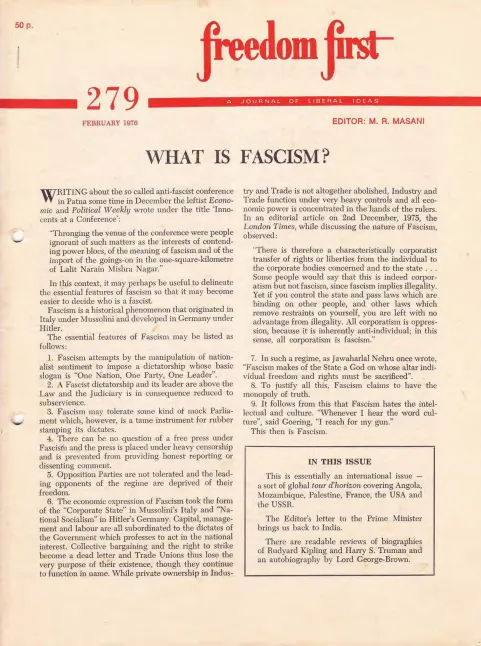
An unsigned editorial, occasioned by a leftist Economic and Political Weekly report mocking attendees of an anti-fascist conference in Patna, sets out nine essential features by which fascism can be identified, from one-nation-one-party dictatorship and subservient judiciaries to press censorship, suppression of opposition, corporate-state economic control, the cult of the leader-state, claimed monopoly on truth, and hostility to intellectual culture. It quotes the London Times’ view that all corporatism is a transfer of rights from individual to state and is therefore inherently oppressive, and closes by invoking Jawaharlal Nehru’s line about fascism making ‘the State a God’ and Goering’s remark about reaching for his gun at the word ‘culture.’
- Written in response to a leftist press mocking attendees of an anti-fascist conference in Patna as ignorant of what fascism means.
- Lists nine defining features of fascism: nationalist dictatorship, judicial subservience, sham parliaments, press censorship, suppression of opposition, corporate-state economic control, deification of the state, claimed monopoly on truth, and hostility to culture.
- Cites the London Times (2 Dec 1975) arguing that corporatism transfers rights from individual to state and is therefore inherently fascist even without formal illegality.
- Quotes Jawaharlal Nehru describing fascism as making ‘the State a God on whose altar individual freedom and rights must be sacrificed.’
- Closes with Goering’s line about reaching for his gun at the word ‘culture’ as an illustration of fascism’s hostility to intellectual life.
Repentant Panther
This unsigned column collects several short items. ‘Repentant Panther’ recounts Eldridge Cleaver’s seven years of exile in Communist and ‘progressive’ states after fleeing US gun-battle charges, and his eventual disillusioned admission that American Black life had improved and that living under dictatorships gave him ‘a more balanced picture’ of the world. ‘Pravda vs. L’Humanite’ describes a public falling-out between the Soviet and French Communist parties over a French TV documentary on a Latvian slave labour camp, with the French Communist leader Georges Marchais defending the broadcast. ‘Birds of a Feather’ recounts how NUS national secretary Susan Slipman, a British Communist Party member, was stripped of her international-affairs role after favoring Communist causes (refusing a protest telegram over India’s Emergency while sending one over Argentina) while running the National Union of Students.
- Eldridge Cleaver, after seven years of exile in Cuba, Algeria, Guinea, North Korea and the USSR, admits American Black life had improved and that living under dictatorship gave him ‘a more balanced picture’ of the world.
- The piece hopes Cleaver’s public recantation will help open the eyes of others ‘as blind as he once was.’
- Pravda and L’Humanité publicly quarrel over a French TV documentary alleging a Soviet slave labour camp in Riga, Latvia, with French Communist Party leader Georges Marchais defending the broadcast’s genuineness.
- British NUS national secretary Susan Slipman, a Communist Party member, was removed from her international-affairs role after favoring Communist-aligned causes, including declining to send a protest telegram over India’s Emergency.
s standing among allies. It is followed by
An unsigned piece republishes a Daily Telegraph editorial castigating the American east-coast liberal establishment for corrosive self-criticism over Vietnam and Watergate that it argues is undermining the CIA, the presidency, and America’s standing among allies. It is followed by ‘Kaunda Speaks Out,’ reporting Zambian President Kenneth Kaunda’s remarks to journalist C. L. Sulzberger that the Soviet Union, not the US, bears primary responsibility for the Angola conflict, since Soviet arms to the MPLA preceded US assistance to the FNLA-UNITA coalition; the piece also cites The Observer and the Swiss Press Review on the moral confusion facing African leaders choosing between apartheid and Soviet-client totalitarianism, and MPLA Minister of Justice Diogenes Boawila’s stated plans for people’s tribunals and labour camps.
- Republishes a Daily Telegraph editorial (3 Jan 1976) accusing the American ‘liberal’ east-coast establishment of corrosive self-criticism that is gutting the CIA and undermining US global standing.
- President Kenneth Kaunda of Zambia, in an interview with C. L. Sulzberger, argues the Soviet Union bears primary responsibility for the Angola conflict and that a non-aligned Africa must condemn Soviet influence there.
- Cites Jeremy Thorpe’s claim that the Soviet Union paid a $50 million bribe to at least one African head of state to secure early recognition of the MPLA regime.
- MPLA Minister of Justice Diogenes Boawila is quoted describing planned people’s tribunals, labour camps, and politically-influenced court verdicts in Angola.
- The Swiss Press Review and The Observer are cited framing the African dilemma as a choice between apartheid and Soviet-client totalitarianism.
s Addis Ababa conference (12 Jan 1976) splitting over recognition of the Luanda MPLA
Continuing the same column, an unsigned item reports the OAU’s Addis Ababa conference (12 Jan 1976) splitting over recognition of the Luanda MPLA ‘government’, with only 22 of 46 members recognizing it, and Liberal leader Jeremy Thorpe’s allegation of a Soviet gold bribe to secure recognition. A separate item, ‘“Independent”?’, discusses the Indian government’s decision to separate Television from All India Radio as an independent department, arguing this misses the real need for independence from government control rather than from AIR. ‘Look Who’s Talking!’ satirizes Soviet Deputy Agriculture Minister Boris Runov’s advice to India on farm size, given the USSR’s own grain shortfall of 78 million tons against its Five Year Plan target, illustrated by a cartoon of a Soviet Bread loaf being sliced up by Kissinger, Ford, and Butz.
- The OAU conference in Addis Ababa (12 Jan 1976) splits, with only 22 of 46 members recognizing the Luanda MPLA government.
- Jeremy Thorpe alleges a $50 million Soviet gold bribe secured early recognition of the MPLA regime by an African head of state.
- The Indian government separates Television from All India Radio as an independent department, which the piece argues misses the real need for independence from government control.
- Soviet Deputy Agriculture Minister Boris Runov’s advice on farm size is mocked given the USSR’s own 78-million-ton shortfall against its Five Year Plan grain target.
Preserving Our Democratic Structure
Editor M. R. Masani reproduces his letter to Prime Minister Indira Gandhi, prompted by discovering a government pamphlet (‘Preserving Our Democratic Structure’) that repeated a misquotation she had used in the Lok Sabha on 22 July 1975, alleging Masani and Jayaprakash Narayan had solicited army intervention ‘to save democracy.’ Masani explains the quotation was drawn from a distorted New Age (14 April 1974) rendering of his actual March 1974 ‘Z’ magazine interview, with sentences deleted and threaded together out of order. He reproduces his own July 1975 letter to the Prime Minister supplying the ‘missing passages’ that made clear he was not advocating military intervention but merely noting it as a historical possibility, and that he considered it ‘a lesser evil’ only relative to a Communist takeover.
- Masani discovered a Government of India DAVP pamphlet repeating Indira Gandhi’s Lok Sabha misquotation of him from 22 July 1975.
- He had already written to the Prime Minister on 25 July 1975, three days after her speech, correcting the record, but the correction was not incorporated.
- The actual source was a distorted New Age (14 April 1974) rendering of his March 1974 ‘Z’ magazine interview, with sentences deleted and re-threaded.
- He reproduces three ‘missing passages’ clarifying he was not advocating military intervention, merely describing it as a historical possibility.
- He states any such intervention would only be ‘a lesser evil’ relative to ‘a treacherous Communist take-over which hands the country over to China or Russia.'
'Cry Long and Hard Your Tears of Repentance’
By Bernard Levin
Bernard Levin’s polemic mocks The Guardian’s belated ‘discovery,’ via its correspondent Antonio de Figueiredo, that Mozambique’s Frelimo government has become totalitarian, with religious persecution, rehabilitation camps, and Chinese/Albanian-style people’s courts. Levin argues the paper’s surprise is itself telling, since it and others had called Frelimo ‘freedom fighters’ without scrutiny, and contrasts ‘hard-headed liberals’ who do good with ‘soft-headed progressives’ who cause harm through uncritical enthusiasm for revolutionary movements that, once in power, reliably become oppressive.
- The Guardian’s correspondent Antonio de Figueiredo reports that Mozambique’s Frelimo government has become totalitarian, with religious persecution and ‘rehabilitation camps.’
- Levin argues The Guardian’s expressed surprise is itself absurd, since ruthless totalitarians behaving like totalitarians should not be shocking.
- He distinguishes ‘hard-headed liberals’ (who do good) from ‘soft-headed progressives’ (who do harm through starry-eyed advocacy for revolutionary regimes).
- He notes that Frelimo produced a document describing the Catholic Church as a ‘reactionary organization’ inciting counter-revolutionary activity.
- He credits The Guardian, despite its faults, with at least admitting to being surprised and alarmed, unlike most who ignore such contradictions entirely.
Greek Philosophers Confirmed
By James Burnham
James Burnham’s essay, a sequel to his May 1975 Freedom First piece ‘Two Alternatives to Democracy,’ proposes classifying governments along a triple distinction — totalist, authoritarian, democratic — rather than the simple dictatorial/democratic binary. He defines totalist (totalitarian) regimes as those integrating all aspects of life into a single power system, while authoritarian regimes exempt some spheres. He works through the fuzziness of the boundary between categories using examples (Libya, Yugoslavia, South Africa, Ceylon, Mexico), notes the distinction is independent of Left-Right positioning, surveys the varying social composition of ruling groups in authoritarian regimes, and argues that today’s authoritarianism, though it can come from either side, arrives more often and more dangerously from the Left because leftist economic measures lay a foundation for generalized statism, whereas Right authoritarianism tends to preserve more economic and religious freedom. He concludes that ‘the Greek philosophers are again confirmed’ in their view that democracy’s defects lead toward its replacement by despotism.
- Proposes classifying regimes on a triple distinction — totalist/authoritarian/democratic — rather than dictatorial/democratic.
- Totalist regimes integrate all spheres of life (economic, cultural, social, personal) into a single power system; authoritarian regimes exempt some spheres.
- Gives examples: China and USSR as totalist; Switzerland and Canada as democratic; Brazil and Peru as authoritarian; notes South Africa is democratic for whites but authoritarian toward non-whites.
- Argues the totalist/authoritarian distinction is independent of Left-Right politics, with both totalist and authoritarian regimes found on either side.
- Concludes that modern authoritarianism, though possible from either side, comes more frequently and dangerously from the Left, since leftist economic measures build toward totalism, while Right authoritarianism preserves more economic and religious freedom.
- Closes by declaring the ancient Greek philosophers’ view — that democracy’s defects lead to its replacement by despotism — ‘again confirmed.‘
A Face-Lift Operation
By J. B. H. Wadia
J. B. H. Wadia, a veteran Hindi film maker, weighs whether Hindi commercial films are ‘cultural flops.’ He argues film is a generic term encompassing many distinct genres (commercial, documentary, newsreel, art film, politically committed film) each with its own role, and that condemning the medium wholesale is an authoritarian impulse akin to denying it freedom. He criticizes both the bureaucratic constraints on India’s documentary Films Division and some ‘New Wave’ Hindi films for merely swapping one imitative glamour (Western/Japanese/communist technical gimmickry) for another rather than achieving genuine cultural value. His qualified answer to whether Hindi films are cultural flops is ‘yes—and no’: true of the overall recent crop, but with a real, if numerically minor, tradition of culturally valuable films (citing New Theatres of Calcutta and Prabhat of Poona) that has run alongside the commercial mainstream throughout the industry’s 55-year history. He closes urging Hindi filmmakers to justify their work on a higher sociological plane.
- Argues ‘film’ is a generic term covering distinct genres — commercial, documentary, newsreel, art film, politically committed film — each with its own legitimate role.
- Cites John Grierson’s definition of documentary as ‘drama of the doorstep’ and criticizes Indian documentary shortfalls as due more to bureaucratic controls than to filmmakers.
- Criticizes some ‘New Wave’ Hindi films for merely imitating American, West European, Japanese, or communist technical gimmickry rather than achieving real cultural value.
- Concludes Hindi films are cultural flops ‘yes—and no’: true of the recent overall crop but not of the whole industry, citing New Theatres of Calcutta and Prabhat of Poona as pioneering exceptions.
- Calls on Hindi filmmakers to justify their existence on ‘a higher sociological plane’ and voluntarily undergo a ‘face-lift operation.’
”Secular Democratic Palestine”
By Nitin G. Raut
Nitin G. Raut critiques the PLO’s slogan of a ‘secular democratic Palestine State,’ arguing that Arab states never recognized Palestine as a separate entity before 1967 and that the slogan is a strategic shift from earlier calls to eliminate Israel outright, now masking the same underlying goal. He explains Article 6 of the 1968 Palestine National Covenant would render more than half of Israel’s Jewish population stateless by only recognizing pre-1917 Jewish residents as ‘Palestinians,’ and quotes PLO Beirut chief Shafiq Al Hut on the limits of Arab willingness to grant Jews democratic rights. Raut also implicates Soviet strategic interest in a prolonged Arab-Israel conflict as a means of securing access to the Indian Ocean via the Suez, and concludes that equating Zionism with imperialism is ‘a monstrous perversion of truth,’ with the PLO’s anti-Zionism serving as ‘facade for anti-Semitism.’
- Argues the Palestine question became a major international issue only after the 1967 Arab-Israeli war, since Arabs had never recognized Palestine as an independent state before, regarding it as ‘Southern Syria.’
- Explains Article 6 of the 1968 Palestine National Covenant would recognize only pre-1917 Jewish residents as Palestinians, rendering more than half of Israel’s Jewish population stateless.
- Quotes PLO Beirut office head Shafiq Al Hut as accepting the ‘secular democratic’ slogan only to blunt criticism, not as genuine willingness to grant Jews full democratic rights.
- Argues the Soviet Union has a strategic interest in prolonging Arab-Israeli conflict to secure access via Suez to the Indian Ocean.
- Concludes that calling Zionism synonymous with imperialism is ‘a monstrous perversion of truth’ and that the PLO’s anti-Zionism is a facade for anti-Semitism.
- Notes only 600,000 of 2.8 million Palestinians (per UNRWA figures) are in refugee camps, arguing the refugee problem is exploited for propaganda purposes.
Review: Kipling: The Glass, The Shadow and the Fire by Philip Mason
By Mehra Masani
Mehra Masani reviews Philip Mason’s biography Kipling: The Glass, The Shadow and the Fire, focusing on Mason’s account of Kipling’s complicated relationship with India and Indians rather than his general literary analysis. The review recounts Mason’s thesis that Kipling’s own de-sensitized, divided childhood shaped a body of work full of violence and vindictiveness yet also deep compassion, and traces how Indian readers came to regard Kipling as anti-Indian and jingoistic (partly on the strength of the misquoted ‘East is East’ line) despite his affection for India shown in early works like Just So Stories and mature ones like Kim, which Nirad Chaudhuri called one of the finest novels in English. The review closes by noting Mason’s hope that a more nuanced understanding will lead more Indians to read Kipling without prejudice.
- Reviews Philip Mason’s Kipling: The Glass, The Shadow and the Fire (Harper & Row, 1975).
- Recounts Mason’s thesis that Kipling’s writing reflects an unresolved inner division between violence/vindictiveness and deep compassion, rooted in a de-sensitizing childhood.
- Notes Indians came to view Kipling as anti-Indian and jingoistic, partly due to the misquoted ‘East is East and West is West’ line, ignoring its reconciliatory later verses.
- Cites Nirad Chaudhuri’s view of Kim as one of the finest English novels, written ‘from deep in the personality and with love.’
- Concludes Mason’s nuanced portrait should encourage more Indians to read Kipling without prejudice.
Review: Plain Speaking. An Oral Biography of Harry S. Truman by Merle Miller
By Rusi J. Daruwala
No summary was extracted for this article. Listed for completeness.
Review: In My Way by Lord George Brown (Bread and Peace)
By T. G. Joshi
No summary was extracted for this article. Listed for completeness.
Essay 8
No summary was extracted for this article. Listed for completeness.
Essay 9
No summary was extracted for this article. Listed for completeness.
Essay 10
No summary was extracted for this article. Listed for completeness.
Essay 11
Rusi J. Daruwala reviews Merle Miller’s Plain Speaking: An Oral Biography of Harry S. Truman, quoting historian Clinton Rossiter’s tribute to Truman’s endearing ‘lapses from dignity’ that opened his door to immortality. The review recounts anecdotes from the taped interviews — Truman’s youth in Independence, Missouri, his career from farmer to haberdasher to politician, his voracious and retentive reading (illustrated by an anecdote about an obscure Alexander the Great reference that stumped Truman’s interviewer and the Library of Congress), and his decisions on Hiroshima, the Marshall Plan, and General MacArthur’s dismissal. The review closes by quoting Truman’s view that ‘power, money and women’ are what most often ruin a man, with a dry aside that Richard Nixon evidently never read his history.
- Reviews Merle Miller’s Plain Speaking: An Oral Biography of Harry S. Truman (Victor Gollancz).
- Quotes historian Clinton Rossiter’s tribute to Truman as a man history will delight to remember despite (or because of) his lapses from dignity.
- Recounts an anecdote in which Truman’s obscure reference to Alexander the Great and ‘thirty-three quarts of wine’ stumped interviewer Hillman and the Library of Congress, until traced to a rare volume on Greek history.
- Notes the book traces Truman’s career from farming and haberdashery through his Senate campaigns, the 1944 campaign, the Hiroshima decision, the Marshall Plan, and the MacArthur dismissal.
- Closes on Truman’s dictum that ‘power, money and women’ most often ruin a man, with the reviewer’s pointed aside that Nixon apparently never learned this lesson from history.
Essay 12
T. G. Joshi reviews Lord George-Brown’s memoir In My Way, noting India rates only a single mention despite the book’s interest for Indian readers on other grounds. The review traces George-Brown’s working-class, trade-unionist upbringing and the formative poverty (bread-and-treacle unemployment relief) that pushed him toward socialism, then follows his political career — Minister of Agriculture, Public Works, Deputy Labour leader, Deputy Prime Minister under Harold Wilson, and Foreign Secretary — through his resignation over what he saw as violations of cabinet collective responsibility. The review closes approvingly on George-Brown’s dictum about ministers bearing responsibility even when misled by officials, framing it as a lesson for India’s tendency to blame bureaucracy for governmental failures.
- Reviews Lord George-Brown’s memoir In My Way (Penguin, Rs. 8), noting India receives only one mention in the book.
- Traces George-Brown’s working-class origins, including his father’s unemployment and reliance on bread-and-treacle relief, as the root of his socialist convictions.
- Follows his career as Minister of Agriculture and Public Works, Deputy Labour leader, Deputy Prime Minister under Harold Wilson, and Foreign Secretary.
- Notes his resignation stemmed from his view that Harold Wilson violated the principle of joint cabinet responsibility.
- Closes with George-Brown’s view that a minister must be so competent as not to be misled by officials, but ultimately ‘carries the can’ regardless — applied as a lesson for India’s tendency to blame bureaucracy.
Essay 13
The closing ‘With Many Voices’ column compiles brief quotations from world press and public figures on a Tennyson epigraph, covering topics from Soviet daily life and James Schlesinger’s dismissal to Franco’s dissident policy, Indira Gandhi’s Emergency, US industrial policy, and Cold War Politburo dynamics. It ends with the subscription form for Freedom First and the issue’s imprint details.
- Compiles short quotations under a Tennyson epigraph on seeking ‘a newer world’ with ‘many voices.’
- Includes Information & Broadcasting Minister V. C. Shukla calling Indira Gandhi ‘one of the greatest leaders of all times.’
- Includes Mr. S. A. Dange (Times of India) claiming ‘The Emergency has saved the country.’
- Includes Time magazine’s December 1975 forecast that Brezhnev is moving toward hardliner Suslov, and Ford toward Reagan.
- Closes with the subscription form (Rs. 5 annual, Rs. 3 for students) and imprint: published for the Democratic Research Service by J. R. Patel, Associate Editor, Freedom First, 127 Mahatma Gandhi Road, Bombay 1.
Generated by the v1.5 extraction pipeline. Awaiting editorial review.
Metadata and summary are AI-extracted from the source PDF and reviewed for editorial accuracy. The original work is available via the Read PDF tab above (where present); paragraph-level citation inside the PDF is deferred to a future engagement.