periodical issue
Freedom First
A Journal of Liberal Ideas
By HP Ranina
Published for Democratic Research Service by J. R. Patel, Associate Editor, Freedom First at 127, M. Gandhi Rd., Bombay 400 023 (Phone: 273914) and printed by him at States' People Press, Ghoga Street, Fort, Bombay-400 001. · Bombay · 1977
16 pages
Freedom First
Summary
Freedom First No. 297 (August 1977), edited by M. R. Masani, opens with H. P. Ranina’s critique of Finance Minister H. M. Patel’s first Budget, arguing that its rural-development and small-industry incentives are too weak and its tax provisions self-defeating. The editorial column ‘Between You & Me and The Lamp Post’ takes up post-Emergency Janata Party politics, the International P.E.N.’s dealings with Moscow, and praise for Milton Friedman’s advice to Britain. The issue reprints an abridged address by U.S. Ambassador Andrew Young urging South African businessmen to expand the market economy to Black South Africans as the route to peaceful change, followed by a symposium of clipped international press comment mocking the newly published Brezhnev Constitution as a cosmetic non-event. A news brief covers Jayaprakash Narayan presiding over the Indian Committee for Cultural Freedom. The ‘World News’ section anthologises wire and press-clipping items on the Commonwealth summit’s Rhodesia debate, the London hearing on Soviet physicist Yuri Orlov, consumer shortages for Soviet car owners, an Agatha Christie-assisted medical diagnosis, Chinese cultural liberalisation, Soviet irritation with President Carter over human rights, and revelations from the Kaplan papers about Stalin’s early-1950s war plans. The issue closes with Letters on India’s electoral system and Janata’s conduct, and a page of quoted one-liners (‘With Many Voices’) on contemporary politics.
Key points
-
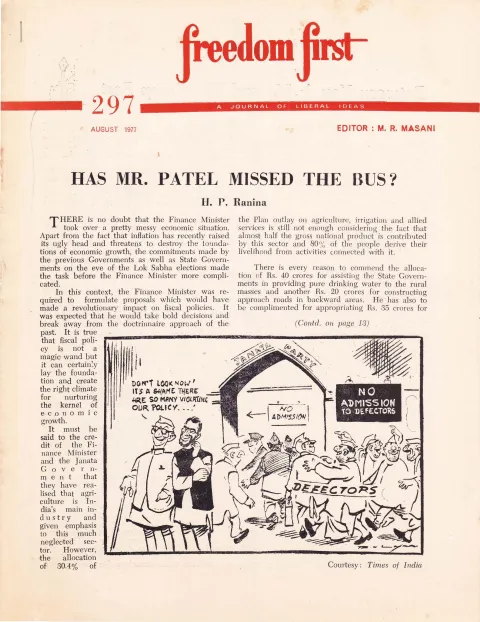
H. P. Ranina’s “Has Mr. Patel Missed The Bus?” critiques Finance Minister H. M. Patel’s Budget, welcoming rural-development allocations and capital-gains reforms against tax evasion but faulting the unworkable section 72A sick-company provision and a surcharge hike that reverses the Wanchoo Committee’s pro-compliance logic, arguing Patel could have become “the Erhard of India”.
-
U.S. Ambassador Andrew Young’s reprinted Johannesburg address urges South African businessmen to expand market-economy opportunity to the Black majority as a nonviolent alternative to revolutionary upheaval, citing the economic integration of Black Americans as transforming the U.S. South.
-
A symposium of clipped international press comment dismisses the new Brezhnev Constitution as cosmetic, noting it grants rights only “as privileges” and that not a single dissenting voice appeared in Pravda’s stage-managed public debate.
-
Masani’s lamp-post column praises West Bengal Janata leader P. C. Sen for resigning rather than ally with the CPI(M), and warns that the International P.E.N.’s outreach to a Soviet-aligned centre risks legitimising the persecution of writers like Solzhenitsyn.
-
A brief news item reports Jayaprakash Narayan chairing the Indian Committee for Cultural Freedom, which resolved to campaign for autonomous broadcasting and repeal of the 42nd Amendment.
-
World News items cover Lee Kuan Yew’s Commonwealth summit warning of a Marxist takeover in post-guerrilla Rhodesia, a London hearing in defence of imprisoned Soviet physicist Yuri Orlov, and newly surfaced “Kaplan papers” describing Stalin’s 1951 plan to prepare for a third world war.
-
Reader letters from D. D. Karve and D. Ghosh debate electoral reform, comparing German proportional representation and the French run-off system, and warn that the Janata Party is already repeating Congress-style factional infighting.
Essays
Has Mr. Patel Missed The Bus?
By HP Ranina
No summary was extracted for this article. Listed for completeness.
American Black Speaks To Third World
By Andrew Young
No summary was extracted for this article. Listed for completeness.
Brezhnev Constitution A Non-Event (A symposium of clipped comments providing a world view)
H. P. Ranina reviews Finance Minister H. M. Patel’s Budget, crediting it for raising rural development allocations (drinking water, approach roads, khadi and village industries) but arguing the incentives are structurally too weak to work. He shows that the section 80-HHA tax deduction for small-scale rural undertakings will not, in practice, run for the full ten years the statute promises, because new units typically post no taxable profit for their first several years. He also attacks section 72A, governing loss set-offs when a healthy company amalgamates with a ‘sick’ one, as so vaguely conditioned (vague revival criteria, annual re-certification, a bar on the healthy company reorganising the sick one’s business) that no rational businessman would use it, and recommends it be scrapped. He welcomes the investment allowance extension and the capital-gains reforms (shortened holding period for short-term assets, updated valuation date, exemption for reinvested proceeds) as steps against under-the-table property transactions, but faults the 50% surcharge increase on income-tax as reversing the pro-compliance logic of the Wanchoo Committee’s rate cuts. He closes by saying Patel could have secured ‘a place in history as the Erhard of India’ had he been bolder.
- Section 80-HHA’s ten-year tax holiday for small-scale rural undertakings will in practice run far shorter, since new units rarely show taxable profit in their first years
- Section 72A on sick-company amalgamation is criticised as too vaguely conditioned to be usable and recommended for deletion
- Rs. 40 crores for rural drinking water and Rs. 20 crores for approach roads in backward areas are welcomed as sound allocations
- Capital-gains reforms (shorter short-term holding period, updated valuation date, reinvestment exemption) are praised as a blow against tax evasion via under-the-table property sales
- The 50% surcharge hike on income-tax is called avoidable and a reversal of the pro-compliance logic behind the Wanchoo Committee’s earlier rate cuts
- Ranina argues money ‘fructifies better in the pockets of individuals than in the coffers of the Government’
Between You & Me and The Lamp Post
This unsigned editorial column (‘Between You & Me and The Lamp Post’) runs seven short items: praise for West Bengal Janata leader P. C. Sen for resigning rather than accept a Delhi-imposed alliance with the CPI(M); alarm at the International P.E.N.’s dealings with a Soviet-aligned P.E.N. centre bid, given the persecution of writers like Solzhenitsyn and Sakharov; a rebuke of the government’s ‘commanding heights’ mixed-economy rhetoric under the heading ‘Swatantra Budget My Foot,’ invoking Milton Friedman’s advice to Britain on auctioning nationalised industries; praise for Durga Bhagwat’s refusal to invite ministers to the Marathi Sahitya Sammelan; commendation of Israeli Prime Minister Menachem Begin’s rescue of Vietnamese refugees; approval of Jean-Paul Sartre and other French intellectuals publicly honouring Soviet dissidents while Brezhnev was being feted in Paris; and a note on Chile trading dissident Vladimir Bukovsky for a Communist prisoner while thousands remain held in East Germany.
- Commends West Bengal Janata leader P. C. Sen for resigning over a Delhi-imposed alliance with the CPI(Marxist)
- Warns that the International P.E.N.’s outreach to Moscow risks legitimising Soviet persecution of writers
- Criticises the ‘commanding heights’ mixed-economy doctrine and cites Milton Friedman’s advice that Britain should auction its nationalised industries
- Praises Durga Bhagwat for refusing to invite ministers to a literary conference
- Praises Israeli PM Menachem Begin for rescuing Vietnamese boat refugees
- Notes the irony of Brezhnev being feted in Paris the same day French intellectuals honoured Soviet dissidents
J.P. Presides at I.C.C.F. Meeting
An abridged, editorially framed reproduction of a speech by U.S. Ambassador Andrew Young, delivered to 200 businessmen in Johannesburg, South Africa. Young argues from his own experience in the American civil rights movement that the free market, not revolutionary doctrine or armed force, is the strongest available force for constructive social change, and that the entry of Black Americans into the U.S. economic system ‘transformed the South from a depressed area to the most dynamic and rapidly growing region.’ He tells his South African audience that time, not external military threat, is their country’s biggest enemy, since new nations and economies elsewhere are absorbing the markets and investment South Africa could otherwise draw, and urges businessmen to expand economic opportunity to the country’s Black majority as a nonviolent alternative to revolutionary upheaval. Freedom First’s editorial framing notes that most of what Young has said elsewhere did not merit quotation, but that this particular address is ‘so constructive’ it could ‘easily have been made with advantage at a meeting of Indian businessmen.’
- Young argues the free market, not ideology or force, is the greatest available force for constructive social change
- Cites the economic integration of Black Americans as transforming the U.S. South into ‘the most dynamic and rapidly growing region’
- Tells South African businessmen that time is their country’s biggest enemy, as global markets and capital move elsewhere while they delay change
- Frames economic inclusion of South Africa’s Black majority as a nonviolent, market-based alternative to revolutionary change
- Freedom First’s editors present the speech as a model that Indian businessmen could also benefit from hearing
s newly published 1977 (
A symposium of clipped press commentary on the Soviet Union’s newly published 1977 (‘Brezhnev’) constitution, assembled from The Guardian, International Herald Tribune, The Statesman, The Economist, and The New York Times. The consensus across contributors is that the document is a cosmetic ‘refurbishing of party doctrine’ rather than a substantive change: it entrenches the Communist Party’s leading role, permits rights only ‘as privileges’ extended by the state, and changes little in practice from Stalin’s 1936 constitution beyond restating theoretical guarantees in greater rhetorical detail. Contributors note the irony of formally guaranteeing a right to secession that no republic could exercise, and compare the document’s promises to the Soviet anthem of Animal Farm (‘Never through me shalt thou come to harm’).
- Multiple international commentators agree the new Soviet constitution changes little of substance from Stalin’s 1936 constitution
- The Economist notes citizens ‘enjoy freedoms only as privileges’ granted and revocable by the party leadership
- The New York Times piece is ‘more puzzled than when we began’ about the purpose of a decade-long drafting effort
- Victor Zorza (International Herald Tribune) reports a stage-managed ‘nationwide debate’ in which not a single dissenting voice was raised in Pravda’s coverage
- The formal right of republics to secede from the U.S.S.R. (Article 71) is highlighted as constitutional theatre with no practical force
- George F. Will situates the 1977 constitution as the fourth Soviet constitution since the ‘Glorious Transition to Socialism’, calling its authors latter-day ‘Benjamin Franklins and James Madisons of Mother Russia’ ironically
restoration of political freedom
A brief news item reporting that Jayaprakash Narayan chaired a meeting of the Executive Council of the Indian Committee for Cultural Freedom at the Express Towers, which observed a minute’s silence for Emergency victims and passed a resolution honouring the many who contributed to the ‘restoration of political freedom’ with Narayan named as the ‘central figure in this story of liberation.’ The Council resolved to hold discussions on civil rights, the role of the press and voluntary agencies, and to campaign for converting All India Radio and television into autonomous corporations and repealing the 42nd Constitutional Amendment, extending such discussions beyond Bombay to mofussil towns. Attendees named include M. R. Masani, Fredie Mehta, Ramu Pandit, S. P. Aiyar, Arvind Deshpande, Sheela Singh, J. B. H. Wadia, and S. V. Raju.
- Jayaprakash Narayan chaired the Indian Committee for Cultural Freedom’s Executive Council meeting
- The Council passed a resolution honouring contributors to the ‘restoration of political freedom’ after the Emergency, naming Narayan its central figure since 1951
- Planned campaigns include converting AIR and TV into autonomous corporations and repealing the 42nd Amendment, as pledged in the Janata Party manifesto
- The Council resolved to extend civil-rights discussions and seminars beyond Bombay city to mofussil towns
World News
The ‘World News’ section anthologises clipped press items from June 1977: Lee Kuan Yew’s contentious address at the Commonwealth summit warning of a Marxist takeover in a post-guerrilla-war Rhodesia, and a rebuttal accusing Commonwealth leaders of racial double standards on Rhodesia versus black-ruled states; a Times report on the London evidentiary hearing (with Ramsey Clark and other witnesses) defending imprisoned Soviet physicist and Helsinki-monitor Yuri Orlov; a Guardian ‘Letter from Moscow’ on the chronic shortages, theft, and bureaucratic absurdities of Soviet car ownership; a Times item describing how a nurse’s reading of an Agatha Christie novel led to the correct diagnosis of thallium poisoning in a critically ill toddler; an Observer piece on the post-Gang-of-Four cultural rehabilitation of Shakespeare in China; a Swiss Press Review item on Soviet media pique over President Carter’s human-rights stance; and a Times report on newly surfacing ‘Kaplan papers’ describing Stalin’s 1951 decision to prepare for a third world war against the West before American military strength could consolidate, a plan later foreclosed by the Soviet economy’s inability to sustain it.
- Lee Kuan Yew warns the 33-nation Commonwealth summit that Marxist guerrillas may seize power in Rhodesia even after majority rule, provoking heated debate
- A Guardian rebuttal accuses Commonwealth leaders (naming Kenneth Kaunda and James Callaghan) of applying a racial double standard, condemning white-ruled Rhodesia’s lack of one-man-one-vote while excusing black-ruled states with the same defect
- The Times reports a London hearing, held because defence counsel John Macdonald was refused a Soviet visa, in defence of imprisoned physicist Yuri Orlov, a founder of the Soviet Helsinki-monitoring group, with testimony from Ramsey Clark, Vladimir Bukovsky, Andrei Amalrik, and Lyudmila Alekseyeva
- A Guardian dispatch details Soviet consumer-goods shortages, car theft, and the compulsory removal of windscreen wipers to prevent theft in Moscow
- China rehabilitates Shakespeare and other ‘bourgeois’ classics as part of post-Gang-of-Four cultural liberalisation under Deng-era reforms
- The Times reports Karel Kaplan’s newly surfacing papers describing a January 1951 Kremlin meeting at which Stalin ordered preparation for a third world war against Western Europe before American rearmament could consolidate; the plan foundered because the Soviet economy could not sustain the demands
- A Swiss Press Review item notes Soviet irony in calling President Carter’s human-rights stance a threat to detente, given many Third World allies of the U.S.S.R. themselves lack basic freedoms
Letters
Two letters to the editor. D. D. Karve argues that India’s first-past-the-post electoral system, inherited from Britain, fails to produce genuinely democratic outcomes once more than two candidates or parties compete, since winners routinely secure less than a majority of votes cast; he surveys German proportional representation and the French two-round run-off system as alternatives and suggests India adopt a French-style system requiring a majority in a second round. D. Ghosh writes to praise an earlier Freedom First piece on ‘volatile loyalties,’ lamenting that the Janata Party, despite its victory, is already showing the same factional infighting and moral compromise as the Congress it replaced, and warns that a party which fails to understand its own shortcomings risks being discarded by the electorate even faster than Congress was.
- D. D. Karve argues first-past-the-post voting has never produced a genuinely majoritarian outcome in India, since more than two parties or many independents routinely split the vote
- Karve surveys Germany’s proportional representation and France’s two-round majority run-off as alternative models
- Karve endorses a Jayaprakash Narayan-appointed Electoral Reform committee’s suggestion of a ‘via media’ partial proportional representation system, but personally prefers the French two-round model
- D. Ghosh warns that Janata Party leaders are repeating Congress-style infighting and moral compromise, and could be discarded by voters even sooner than Congress was
With Many Voices
The closing page, ‘With Many Voices,’ collects short quoted one-liners from contemporary press sources on world affairs: King Hassan of Morocco on American complacency; President Carter on the link between freedom and prosperity; Menachem Begin on Arab oil dependency; a Youth Times item contrasting the post-Independence Muslim community’s lack of a leader of M. R. Masani’s calibre; observations on Janata’s factional ticket-distribution and its stance on Rhodesia versus Uganda; press commentary on the swearing-in of Uttar Pradesh’s new chief minister; and notes on Nikolai Podgorny’s dismissal shortly after touring Africa to advise on ‘state construction.’
- A Youth Times item states no Muslim community leader of Minoo Masani’s calibre has emerged in national politics since Independence
- Multiple clipped quotes address Rhodesia, Commonwealth double standards, and Janata Party’s internal ticket-distribution disputes
- A closing item notes the irony of Nikolai Podgorny’s dismissal from the Soviet presidency shortly after touring Africa to advise on ‘state construction’
- The page is framed by an epigraph from Tennyson: ‘The deep / Moans round with many voices. Come, my friends, ‘Tis not too late to seek a newer world.’
Generated by the v1.5 extraction pipeline. Awaiting editorial review.
Metadata and summary are AI-extracted from the source PDF and reviewed for editorial accuracy. The original work is available via the Read PDF tab above (where present); paragraph-level citation inside the PDF is deferred to a future engagement.