periodical issue
Freedom First
A Journal of Liberal Ideas
By M. R. Masani, M. Murlidhar, Ernest Van Den Haag, Geeta Doctor, Nitin Raut
Published for the Democratic Research Service by J. R. Patel, Associate Editor, Freedom First at 127, M. Gandhi Rd., Bombay 400 023 (Phone: 273914) and printed by him at States' People Press, Ghoga Street, Fort, Bombay-400 001. · Bombay · 1978
16 pages
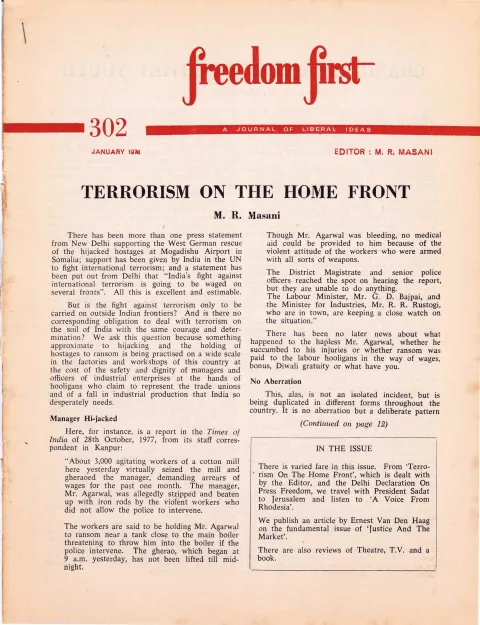
Freedom First
Summary
This January 1978 issue of Freedom First opens with editor M. R. Masani’s editorial ‘Terrorism on the Home Front,’ which argues that India’s professed fight against international terrorism (invoked in response to the Mogadishu hijacking) rings hollow while labour militancy at home takes the form of gheraos, armed intimidation of managers, and factory lockouts, citing detailed press accounts from Brakes India (Madras), Mukund Iron & Steel, and Amar Dye Chem. The issue carries M. Murlidhar’s analysis of the erosion of Marxist ideology among Soviet youth under the pull of consumerism; the ‘Delhi Declaration on Press Freedom,’ a seven-point charter drafted by Indian journalists in consultation with the International Press Institute and the Friedrich-Naumann-Stiftung; a compilation of press reactions to Anwar Sadat’s Jerusalem visit; Ernest van den Haag’s philosophical essay ‘Justice and the Market,’ which argues that market outcomes are not meant to track moral desert and defends market-based inequality against Marxist and redistributive critiques; an anonymous letter from a white Rhodesian objecting to British-brokered majority-rule proposals; a ‘World News’ digest of wire-service clippings on Soviet dissidents, Sino-Soviet polemics, apartheid pass-law reform, and the Pepsi-Vodka barter deal; a theatre review of ‘Man of La Mancha’ by Geeta Doctor; a TV review of a debate between Rafiq Zakaria and Minoo Masani; a book review by Nitin Raut of the Robin Blackburn-edited ‘Explosion in a Subcontinent’; and a closing page of quotations, ‘With Many Voices,’ plus the subscription form.
Key points
-
M. R. Masani’s editorial “Terrorism on the Home Front” contrasts India’s rhetorical support for fighting international terrorism after the Mogadishu hijack with its tolerance of domestic industrial violence, citing gheraos and worker attacks on managers at Brakes India, Mukund Iron & Steel, and Amar Dye Chem, and calling it “Mafia Rule”.
-
M. Murlidhar’s “Changing Values of Soviet Youth” surveys Soviet press accounts of youth increasingly prizing material well-being and consumer goods over Marxist ideals, noting declining rural Komsomol membership and resentment of compulsory Marxism coursework.
-
The seven-point “Delhi Declaration on Press Freedom”, drafted by Indian journalists with the International Press Institute and the Friedrich-Naumann-Stiftung, asserts the press’s adversarial watchdog role and editorial independence, and calls for competitive news agencies and autonomous broadcasting.
-
A compilation of press reactions contrasts Jayaprakash Narayan’s and Sheikh Abdullah’s praise for Anwar Sadat’s Jerusalem visit against the Indian Foreign Ministry’s evasive, Arab-lobby-conscious hedging.
-
Ernest van den Haag’s “Justice and the Market” argues market outcomes track incentives rather than moral desert, engages Hayek’s claim that market distribution is neither just nor unjust, and critiques Marx’s “to each according to his needs” ideal using Christopher Jencks’s research on inborn ability differences.
-
An anonymous letter from a white Rhodesian objects to the Anglo-American favouring of the Patriotic Front over Bishop Muzorewa, warning of collapse and violence, and calling instead for a settlement between Ian Smith and Muzorewa.
-
Geeta Doctor reviews the Theatre Group’s Bombay production of Man from La Mancha, and an unsigned TV review recounts Rafiq Zakaria’s adversarial but ultimately unsuccessful interrogation of Minoo Masani on his autobiography.
-
Nitin Raut reviews the Robin Blackburn-edited Explosion in a Subcontinent, faulting its New Left contributors, including Tariq Ali, for a consistent ideological bias in analysing the 1971 Bangladesh crisis.
Essays
Terrorism On The Home Front
By M. R. Masani
M. R. Masani’s editorial contrasts India’s vocal support for the international fight against terrorism (following the German commando raid on the hijacked Lufthansa jet at Mogadishu) with its tolerance of what he calls domestic terrorism: gheraos, armed intimidation, and violence against factory managers and supervisory staff, carried out under cover of trade-union agitation. He opens with a Times of India report of workers at a Kanpur cotton mill stripping and beating the manager, Mr. Agarwal, and threatening to throw him into a boiler, with police and the District Magistrate unable to intervene because of the workers’ weapons. Masani argues this is ‘no aberration but a deliberate pattern of intimidation and of violence,’ continued in the article’s second part on pages 12-13 with further documented cases (Brakes India, Mukund Iron & Steel, Amar Dye Chem, and the Bombay Khadi Gramodyog Sangh) and a call for the government to show the resolve of the Mogadishu and Entebbe raids against domestic ‘Mafia rule.’
- Contrasts India’s rhetorical commitment to fighting international terrorism with its inaction against domestic industrial violence.
- Opens with a Times of India account of workers at a Kanpur cotton mill gheraoing and beating the manager, Mr. Agarwal, and threatening to burn him.
- Argues that hooliganism and goondaism, not legitimate collective bargaining, are becoming the dominant mode of industrial relations in 1977.
- Documents lockouts at Brakes India (Madras), Mukund Iron & Steel Works, and Amar Dye Chem (Kalyan) using management’s own detailed accounts of worker violence, gheraos, and manufactured weapons.
- Notes that the contagion spread to Khadi Bhandars and the Bombay cloth and drug markets via ‘gumasta’ union goondaism.
- Calls this ‘Mafia Rule’ rather than trade unionism, and blames all parties in office (Janata in U.P., Congress in Bombay, ADMK in Madras) equally for tolerating it.
- Closes by invoking the ‘spirit of Mogadishu and Entebbe’ as the resolve needed to confront domestic terrorism on the industrial front.
Changing Values Of Soviet Youth
By M. Murlidhar
M. Murlidhar surveys Soviet-era research and press accounts (Pravda, Izvestia) suggesting that Soviet youth, shaped by the industrial culture imported alongside Western trade and technical know-how, increasingly prize material well-being, lucrative careers, and consumer goods over Marxist ideals of collective sacrifice. He cites surveys showing declining rural Komsomol membership, complaints from Soviet educators about students avoiding compulsory Marxism coursework, and an anecdote of an American scholar’s conversation with a Moscow student who said ‘we spend our time avoiding’ ideology classes. Murlidhar concludes that Soviet authorities face a structural dilemma: they need Western trade and aid to modernize, but that same exposure to Western consumer culture is eroding the Marxist commitment of their own youth.
- Argues that Soviet engagement with Western trade and technology has imported a ‘purely western’ industrial culture alongside material goods.
- Cites a study finding 55 per cent of young respondents ranked material well-being as a major life aspiration.
- Describes Izvestia’s report of a talented young metal worker unhappy at being denied an engineering post, and Pravda’s disappointment at youth volunteering for construction/agricultural projects for pay rather than socialist conviction.
- Notes declining rural Komsomol membership (halved over five years in the Smolensk region) as youth prefer urban life.
- Reports that compulsory Marxism study is resented and avoided even by science and maths students, with rising absenteeism from ideology courses.
- Concludes the Soviet leadership faces a dilemma: it needs Western aid and trade, but this same exposure erodes the Marxist commitment of Soviet youth.
Delhi Declaration On Press Freedom
This unsigned item reproduces a seven-point ‘Delhi Declaration on Press Freedom,’ drafted by a group of Indian journalists in discussions held around the country under the auspices of the International Press Institute and the Friedrich-Naumann-Stiftung, with input from British, American, Italian, and French participants. Presented at a final meeting in Delhi on 26 November 1977 in the presence of the Minister for Information and Broadcasting, L. C. Advani, the declaration asserts that press freedom is the foundation of all liberty, that the press must have an adversarial watchdog role, that citizens must be free to choose their reading, that editors must have autonomy from management, that a self-regulating Press Council is needed, that multiple competitive news agencies free of government control are essential, and that broadcast media should be run by genuinely autonomous agencies.
- Reproduces a seven-point declaration on press freedom drafted by Indian journalists with international input via the IPI and Friedrich-Naumann-Stiftung.
- States that freedom of the press is ‘at the heart of all liberty’ and that a free press must play an adversarial watchdog role over government.
- Calls for editorial independence from newspaper management/ownership within an agreed policy framework.
- Recommends a Press Council for self-regulation, and multiple competitive news agencies free of government control.
- Calls for free and competitive radio and television regulated by genuinely autonomous agencies, not state monopoly.
- Notes the declaration was presented on 26 November 1977 in Delhi in the presence of Minister L. C. Advani.
Sadat: Contrasting Attitudes
A compilation of press excerpts under the heading ‘Sadat: Contrasting Attitudes,’ juxtaposing Jayaprakash Narayan’s and Kashmir Chief Minister Sheikh Abdullah’s warm praise of President Sadat’s ‘courageous’ and ‘bold’ decision to visit Jerusalem against the Indian Foreign Ministry’s hedging response, which the editors frame as ‘opportunist equivocation masquerading as genuine non-alignment.’ The excerpts are drawn from the Indian Express, Statesman, and Blitz of November 1977.
- Juxtaposes JP Narayan’s and Sheikh Abdullah’s praise for Sadat’s Jerusalem visit against India’s Foreign Ministry’s evasive, non-committal reaction.
- Frames the contrast as one of ‘sincerity and courage’ versus ‘opportunist equivocation masquerading as genuine non-alignment.’
- Reports that the Indian government’s initial welcome of the visit was followed by a retreat into official silence to avoid offending Arab states.
- Notes that the US ambassador and Indian diplomat Palkhivala had prematurely congratulated the Foreign Ministry on its stance before it reversed course.
Justice And The Market
By Ernest Van Den Haag
Ernest van den Haag, professor of social philosophy at New York University, argues that the economic system that produces the greatest output is also the one that most visibly raises the problem of distributive justice, but insists that market value and moral desert are conceptually distinct: the market rewards scarcity and demand, not virtue. Quoting Hayek’s dictum that it is ‘meaningless’ to call market distribution just or unjust, van den Haag partly disagrees — the market is not meaningless but simply irrelevant to moral desert, since it distributes according to incentives rather than justice. He then subjects Marx’s implicit ideal of distribution ‘according to need’ to a three-part critique: the ability to buy and sell is unevenly distributed under both capitalism and socialism (with socialist workers demonstrably no freer or richer); Marx conflated innate differences in ability with unequal opportunity, when evidence (citing Christopher Jencks) shows ability differences are substantially inborn; and pure needs-based redistribution divorced from market incentives would require an increasingly coercive state, eroding both prosperity and political freedom. He concludes that a system must supplement market distribution with fiscal redistribution for the poor without destroying market incentives altogether — a task he judges achievable, and necessary to preserve both efficiency and the popular sense of justice.
- Distinguishes market value (incentive-based) from moral/economic desert, rejecting the idea that market rewards indicate virtue.
- Engages Hayek’s claim that it is ‘meaningless’ to judge market distribution as just or unjust, arguing instead that it is simply irrelevant to justice, not meaningless.
- Critiques Marx’s implicit reliance, in the Critique of the Gotha Program, on the ideal ‘from each according to his ability, to each according to his needs.’
- Cites Christopher Jencks’s research to argue that inequality of earnings owes more to inborn talent and unmeasured ‘luck’ than to unequal social opportunity.
- Argues that existing socialist societies have not equalized power or freedom for workers relative to capitalist societies.
- Warns that any attempt to abolish market-based distribution entirely would require government control over production and consumption, threatening civil liberties.
- Concludes that fiscal redistribution can supplement, without replacing, market-based incentives to address poverty while preserving both efficiency and freedom.
A Voice From Rhodesia
An anonymous letter from a self-described white Rhodesian moderate, reprinted from the Swiss Press Review and News Report, objects to the Anglo-American negotiating position on Rhodesia’s transition to majority rule, arguing that Britain favours the Patriotic Front despite its lack of popular support (compared to Bishop Muzorewa) and that the proposed settlement would strip whites of property and security without guaranteeing protection from Patriotic Front violence. The writer, facing personal ruin at age 48, argues for a settlement between Ian Smith and Bishop Muzorewa that has the support of the country’s black and white population, rather than one imposed by outside powers appeasing the more violent faction.
- Objects to Britain’s and America’s favouring of the Patriotic Front over Bishop Muzorewa despite the Front’s lack of popular support.
- Cites British MP Stephen Hastings’s warning that the British proposals risk ‘total and immediate collapse of law and order’ and civil war.
- Describes personal fears of ruin, job loss, and violence facing white Rhodesians under the proposed settlement.
- References precedents in Angola and Zambia where whites lost businesses and security after majority transitions.
- Argues government legitimacy should not go ‘to those who act violently and wage a terrorist war,’ comparing the Patriotic Front to West Germany’s Baader-Meinhof gang.
- Calls instead for a settlement between Ian Smith and Bishop Muzorewa with broad-based black and white support.
World News
A ‘World News’ compilation of wire-service and newspaper clippings covering: the 60th anniversary of the Russian Revolution and the widening rift between Moscow and ‘Eurocommunist’ parties (illustrated by Spanish Communist leader Santiago Carrillo’s clash with the Kremlin, from the Guardian and William Chislett’s Madrid dispatch); French Communist leader Georges Marchais’s loss of a libel case over his wartime record (Paul Webster, Paris); Pepsico’s vodka-for-Pepsi barter deal with the Soviet Union (Nancy Yoshihara, Los Angeles Times); China’s public defence of its anti-Soviet ‘Three Worlds’ foreign policy (John Gittings); South African Prime Minister Vorster’s promise to scrap black pass-books (Ray Kennedy, Johannesburg); dissident Pyotr Grigorenko’s plan to keep his U.S. trip apolitical to preserve his chance of returning to the USSR; and further commentary on the diplomatic complexities surrounding Sadat’s Jerusalem visit.
- Covers the Kremlin’s clash with Spanish Communist leader Santiago Carrillo around the 60th anniversary of the October Revolution, reflecting the Soviet-Eurocommunist split.
- Reports French Communist leader Georges Marchais losing a libel suit over allegations of his voluntary wartime work in a Nazi aircraft factory.
- Describes Pepsico’s vodka-for-Pepsi barter arrangement with the USSR and plans for new Soviet bottling plants.
- Summarizes China’s published defence of its ‘Three Worlds’ foreign policy doctrine against Brezhnev’s criticism.
- Reports South African PM Vorster’s agreement with black homeland leaders to replace pass-books with travel/identity documents, and Chief Gatsha Buthelezi’s refusal to attend the talks.
- Notes Soviet dissident Pyotr Grigorenko’s statement that he will keep his US trip apolitical to preserve his chance of re-entering the Soviet Union.
- Includes further analysis of the diplomatic stakes of Sadat’s Jerusalem visit for Israeli-Arab relations.
Theatre: A Musical Man-Cha
By Geeta Doctor
Geeta Doctor reviews the Theatre Group’s Bombay production of ‘Man from La Mancha,’ directed by Alyque Padamsee, praising Noel Godin’s performance as Cervantes/Don Quixote and the minimalist staging built around a dungeon-pit set. She reads the play as a nested series of illusions — Don Quixote’s illusion, Cervantes’s authorial illusion, and the theatre company’s illusion for the audience — culminating in the question ‘What is Reality?’, and closes by comparing the play’s ending, in which Sancho Panza persuades the dying Quijana that his quest was not in vain, to the palm tree silhouetted against the Bombay skyline moon outside the theatre after the show.
- Reviews the Theatre Group’s Bombay staging of ‘Man from La Mancha,’ directed by Alyque Padamsee.
- Praises the minimalist dungeon-pit set design and its use of a play-within-a-play structure with Cervantes as narrator/protagonist.
- Frames the play as revolving around ‘a triple series of illusions’ - Don Quixote’s, Cervantes’s, and the Theatre Group’s own performance for the audience.
- Highlights Noel Godin’s performance as Cervantes/Quixote as the production’s central strength.
- Notes Leon D’Souza’s musical direction as key to sustaining the play’s illusion.
TV: Zakaria Comes Off Second Best
An unsigned TV review recounts a Vibrations programme in which Rafiq Zakaria interviewed Minoo Masani about his autobiography, moderated by Khushwant Singh. The reviewer describes Zakaria as heavily prepared with hostile, quotation-laden questions but so absorbed in cross-examining Masani that he ran over time and had to be interrupted by Khushwant Singh, while Masani handled every question with composure, ultimately ‘coming out on top.’
- Reviews a TV ‘Vibrations’ book special in which Rafiq Zakaria interviewed Minoo Masani about his autobiography, moderated by Khushwant Singh.
- Describes Zakaria’s questions as heavily researched and adversarial, quoting extensively to challenge Masani.
- Notes that Zakaria’s questioning ran over time, forcing Khushwant Singh to intervene, and left little room for other participants.
- Concludes that Masani handled the interrogation with composure and ‘came out on top’ despite Zakaria’s preparation.
Books: ‘Explosion In A Subcontinent’ edited by Robin Blackburn
By Nitin Raut
Nitin Raut reviews ‘Explosion in a Subcontinent,’ a Penguin collection of essays from New Left Review edited by Robin Blackburn on the 1971 Bangladesh crisis and its regional aftermath. Raut finds the volume analytically capable but ideologically slanted, faulting its contributors (including Meghnad Desai, Premen Addy, Tariq Ali, and Fred Halliday) for a consistent New Left bias that blames the subcontinent’s crises on the failures of communism and Communist parties rather than offering balanced analysis, singling out Tariq Ali’s claim that Indian intervention in Bangladesh aimed to defeat the Left in West Bengal, and Halliday’s attribution of Sri Lanka’s youth insurrection to an alleged Chinese-Soviet imperial conspiracy.
- Reviews ‘Explosion in a Subcontinent,’ edited by Robin Blackburn (Penguin, 95 pp.), a collection of New Left Review essays on the 1971 Bangladesh crisis and the subcontinent’s politics.
- Notes the book’s introduction argues the region’s only consolation is ‘the evident disarray of the leftwing parties.’
- Summarizes essays by Meghnad Desai on agrarian contradictions, Premen Addy on Bengal politics, Tariq Ali on Pakistan/Bangladesh, and Fred Halliday on Sri Lanka.
- Criticizes Tariq Ali’s claim that Indian intervention aimed to ‘solve the question of who held state power in Bangladesh’ and defeat the Left in West Bengal.
- Faults the volume overall as ‘highly biased’ and bordering on propaganda, reflecting Penguin’s perceived growing affinity with the New Left and Communists.
With Many Voices
The issue’s final page, ‘With Many Voices’ (its epigraph taken from Tennyson’s ‘Ulysses’), reprints a set of short quotations attributed to public figures — including Mrs. Thatcher, Moshe Dayan, President Carter, Adlai Stevenson, Jayaprakash Narayan, Pastor Niemoeller, and Nayantara Sahgal — drawn from October-November 1977 press sources, followed by the Freedom First subscription form (Rs. 5.00 annual) and the publication’s colophon naming J. R. Patel as Associate Editor, published for the Democratic Research Service.
- Compiles short quotations attributed to public figures (Thatcher, Dayan, Carter, Stevenson, JP Narayan, Niemoeller, Sahgal, and others) from October-November 1977 press sources, under the epigraph from Tennyson’s ‘Ulysses.’
- Includes the Freedom First subscription form listing the annual subscription as Rs. 5.00, addressed care of the Democratic Research Service, Maneckji Wadia Bldg., Bombay.
- Colophon states the issue was published for the Democratic Research Service by J. R. Patel, Associate Editor, and printed at States’ People Press, Fort, Bombay.
Generated by the v1.5 extraction pipeline. Awaiting editorial review.
Metadata and summary are AI-extracted from the source PDF and reviewed for editorial accuracy. The original work is available via the Read PDF tab above (where present); paragraph-level citation inside the PDF is deferred to a future engagement.