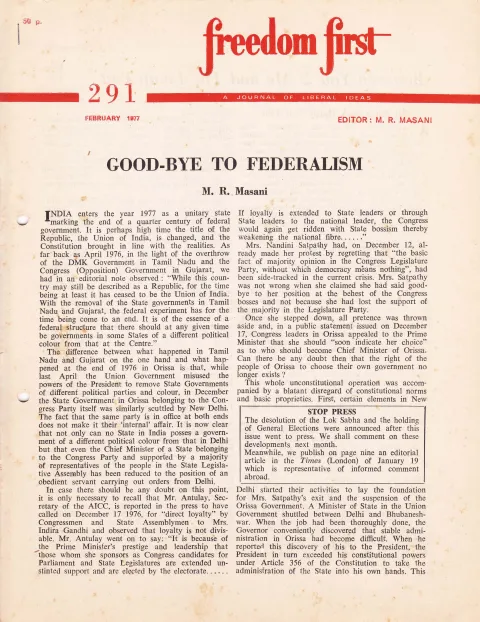
periodical issue
Freedom First
A Journal of Liberal Ideas
By M. R. Masani, K. S. Venkateswaran, James Burnham, Leo Labedz, Bernard Levin, David K. Shipler, Arnold Beichman, K. S. Venkateswaran, Jal Irani
Published for the Democratic Research Service by J. R. Patel, Associate Editor, Freedom First at 127, M. Gandhi Rd., Bombay 400 023 (Phone 273914) and printed by him at States' People Press, Ghoga Street, Fort, Bombay-400 001. · Bombay · 1978
16 pages
Freedom First
Summary
Freedom First No. 303 (February 1978), edited by M. R. Masani, is a compact 16-page issue that opens with Masani’s own editorial on press freedom in India, defending the Delhi Declaration’s affirmation of the press’s ‘adversary role’ against strictures voiced by Information Minister L. K. Advani. The regular ‘Between You & Me and the Lamp Post’ column ranges across the 44th Amendment Bill’s incomplete repeal of the Emergency-era 42nd Amendment, the toppling of the Karnataka government under Article 356, the Janata government’s stance on education and prohibition, and lighter items on the Australian elections and Christmas iconography. The bulk of the issue is a set of syndicated or contributed pieces on international themes selected to illustrate what the magazine sees as double standards in world opinion: James Burnham dissects the international campaign against Rhodesia’s Smith government, Leo Labedz exposes internal Polish censorship directives, Bernard Levin satirises Mongolia’s one-candidate-per-seat elections, David K. Shipler reports on Soviet workers persecuted for lodging grievances, and Harry Oppenheimer’s address on South Africa argues against simple one-man-one-vote solutions. K. S. Venkateswaran contributes a domestic piece on court backlogs and judicial reform. An unsigned tribute marks the death of Michael Josselson of the Congress for Cultural Freedom. The issue closes with a ‘World News’ digest of wire clippings, Arnold Beichman’s tabulated abstract from Jean-François Revel’s The Totalitarian Temptation contrasting what democracies and communist states are respectively permitted to do, readers’ letters, and a page of quoted aphorisms (‘With Many Voices’). All 16 pages of this issue were rendered, so this summary and the accompanying essay entries cover the complete issue.
Key points
-
M. R. Masani’s lead editorial defends the Delhi Declaration’s affirmation of the press’s “adversary role” against Information Minister L. K. Advani’s objections, contrasting Advani’s stance with Prime Minister Morarji Desai’s endorsement of near-absolute press freedom.
-
The lamp-post column criticises the 44th Amendment Bill for repealing only a fraction of the 42nd Amendment’s provisions and condemns the dismissal of the Karnataka government under Article 356 as continuing federal overreach.
-
K. S. Venkateswaran’s “Tackling the Law’s Delays” blames High Court backlogs on unfilled judicial vacancies and an inadequate sanctioned strength of judges, criticising a proposed 15/10-minute hearing time cap as ridiculous.
-
James Burnham’s “Why Rhodesia?” argues that only “white racism” is treated as the unforgivable sin driving the global campaign against Ian Smith’s government, surveying racism in Japan, southern India, and the Soviet Union to make the point.
-
Leo Labedz describes a smuggled cache of internal Polish censorship directives from 1974-76, revealing a totalitarian system that dictates content positively as well as banning it, with self-censorship as its most efficient mechanism.
-
Bernard Levin satirises Mongolia’s one-candidate-per-seat parliamentary elections, and David K. Shipler relays testimony from Soviet workers, including coal miner Vladimir Kelbanov, dismissed and psychiatrically confined for protesting unsafe conditions.
-
An unsigned tribute marks the death of Michael Josselson, longtime chief executive of the Congress for Cultural Freedom, recalling his friendships with Jayaprakash Narayan, Raymond Aron, and Arthur Koestler.
-
Harry Oppenheimer’s address argues U.S. condemnation of apartheid is justified but a simple one-man-one-vote solution is not the answer, while Arnold Beichman’s tabulated abstract from Revel’s The Totalitarian Temptation contrasts what democracies may not do with what Communist states are permitted.
-
Letters from K. S. Venkateswaran and Jal Irani criticise a proposed code of judicial ethics as unconstitutional and Morarji Desai’s rigid stance on Prohibition, respectively.
Essays
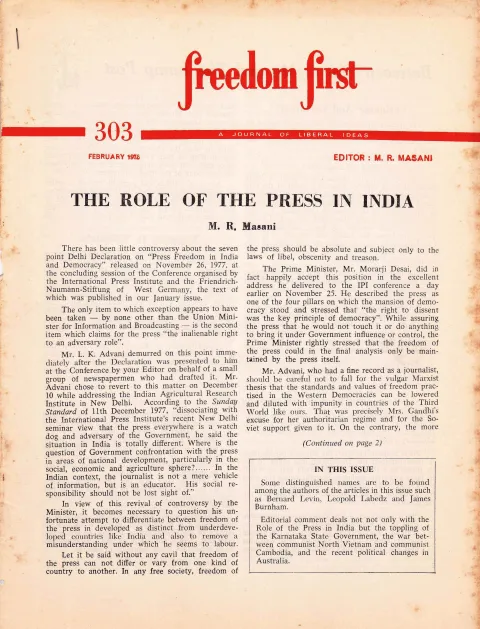
The Role of the Press in India
By M. R. Masani
M. R. Masani’s lead editorial defends the seven-point Delhi Declaration on ‘Press Freedom in India and Democracy’, issued jointly by the International Press Institute and the Friedrich-Naumann-Stiftung in November 1977. Masani takes Information Minister L. K. Advani to task for objecting to the Declaration’s claim that the press has ‘the inalienable right to an adversary role’, arguing that Advani wrongly tries to distinguish India’s needs from those of developed democracies. Masani notes that Prime Minister Morarji Desai, by contrast, had endorsed the principle that press freedom should be absolute subject only to laws of libel, obscenity and treason, and warns Advani against falling into the ‘vulgar Marxist thesis’ that Third World democracies can tolerate diluted press freedom — the same excuse Masani says Indira Gandhi used to justify her authoritarian Emergency regime.
- Defends the Delhi Declaration’s affirmation of the press’s adversary role against government objections
- Criticizes L. K. Advani for taking exception to this clause while addressing the Indian Agricultural Research Institute
- Credits PM Morarji Desai with endorsing near-absolute press freedom subject only to libel, obscenity and treason laws
- Warns against double standards that would excuse weaker press freedom in developing countries
- Frames Indira Gandhi’s Emergency-era press curbs as the same logic Advani risks endorsing
Between You & Me and The Lamp Post
The unsigned ‘Between You & Me and The Lamp Post’ editorial column covers several short items: it criticizes the Janata government’s piecemeal repeal of the Emergency-era 42nd Amendment via the 44th Amendment Bill, which leaves ‘a great many vicious provisions’ intact; it condemns the toppling of the Karnataka Congress government under Article 356 as being of a piece with earlier misuse of the same Article against Mrs. Gandhi’s opponents; it welcomes rising press and public criticism of labour-movement ‘terrorism’ and hooliganism; it mocks the mutual recriminations between communist Vietnam and Cambodia as ‘dog eats dog’; it praises Subramaniam Swamy’s critique of Foreign Minister Vajpayee’s foreign-policy inconsistency; it opposes reviving book censorship despite distaste for ‘instant history’ books about the Emergency; it commends Education Minister P. C. Chunder for resisting suggestions to abolish public schools or remove education from the Concurrent List; it dismisses a new Railway Accidents Inquiry Committee as likely futile, recalling the Editor’s own experience on a similar 1968 committee; it welcomes the Liberal Party’s return to power in Australia and Sir Zelman Cowen’s appointment as Governor-General; and it closes with a wry item on ‘Mother Christmas’ and gender equality.
- Attacks the 44th Amendment Bill for repealing only a fraction of the 42nd Amendment’s ‘vicious provisions’
- Condemns the dismissal of the Karnataka government under Article 356 as continuing a pattern of federal overreach
- Welcomes growing press criticism of trade-union violence and ‘Mafia trends in unionism’
- Treats the Vietnam-Cambodia conflict as an illustration that Hanoi’s regime was itself an aggressor
- Praises Subramaniam Swamy’s criticism of Vajpayee’s foreign policy inconsistency on non-alignment
- Opposes reviving censorship of books on the Emergency despite disliking some of their content
- Praises Education Minister P. C. Chunder for retaining public schools and resisting centralisation of education
- Welcomes the Liberal Party’s Australian election win and the appointment of Sir Zelman Cowen as Governor-General
Tackling the Law’s Delays
By K. S. Venkateswaran
K. S. Venkateswaran argues that the Union Law Ministry’s proposed legislation to reduce High Court case backlogs is misconceived because it ignores the real cause of delay: long-unfilled judicial vacancies. He argues that simply filling vacancies is not enough either — India’s superior courts need a fundamentally larger sanctioned strength of judges, and quality (choosing judges ‘quick in perception, broad in vision, fresh in approach’) matters as much as quantity. He criticizes a proposed cap on hearing time (15 minutes at the admission stage, 10 minutes for related matters) as ‘manifestly ridiculous’ and an affront to advocates’ duty to fully marshal facts before the court. Drawing on M. C. Chagla’s autobiography Roses in December, Venkateswaran argues that judicial despatch should come from judges’ quick grasp of arguments and firm but courteous management of proceedings, not from arbitrary time limits, and closes by praising the exemplary brevity of advocates like Motilal Setalvad.
- Blames High Court backlogs primarily on long-unfilled judicial vacancies, citing F. S. Nariman’s radio remarks
- Argues the sanctioned number of judges itself needs re-assessment, not merely filling of existing vacancies
- Calls for better pay and conditions to attract competent senior advocates to judgeships
- Criticizes a proposed 15/10-minute time cap on hearings as self-defeating and ridiculous
- Cites M. C. Chagla’s view that despatch should come from judges’ quick understanding, not from hustle
- Praises Motilal Setalvad as a model of concise, effective advocacy
Why Rhodesia?
By James Burnham
James Burnham asks why Rhodesia’s Ian Smith government has been singled out by virtually every nation for destruction, and works through a series of candidate explanations — that it is undemocratic, that it threatens peace, that it violates human rights — rejecting each as insufficient because many other, more repressive regimes escape comparable censure. He concludes that the ‘unforgivable’ sin is specifically white racism: ordinary racism, he argues, is pervasive worldwide (citing Japanese treatment of the Ainu, southern Indian Dravidians’ treatment by lighter-skinned northerners, Soviet treatment of Jews, Idi Amin’s treatment of Ugandan Indians, and Kenyatta’s anti-Indian policies) but only when the racism is white is it treated as absolutely unforgivable, a sin proclaimed ‘ex cathedra… by the synod of the United Nations.’ He ends with the ominous suggestion that Rhodesia is merely ‘an appetizer’ rather than the last target of such a crusade.
- Works through and rejects several proposed explanations for the global campaign against Rhodesia (non-democracy, threat to peace, human rights violations)
- Argues that non-democratic and repressive governments are common worldwide and thus cannot explain Rhodesia’s unique treatment
- Surveys racism in Japan, southern India, Soviet Russia, Uganda, Kenya, and Zanzibar to argue racism itself is not unique to Rhodesia
- Concludes that only ‘white racism’ specifically is treated as the unforgivable sin, driving the anti-Rhodesia campaign
- Frames the anti-Rhodesia crusade as proclaimed ‘ex cathedra’ by the United Nations
- Warns that Rhodesia is only ‘an appetizer’ for a larger campaign, not the ‘Last Crusade’
What the Poles May Read
By Leo Labedz
Leo Labedz, editor of Survey, describes a cache of secret internal documents from Poland’s Central Office of Press, Publications and Spectacles Control (COPPSC), covering 1974-1976 and recently smuggled to the West, which reveal in granular bureaucratic detail how Polish censorship actually functions. He characterizes the system as essentially totalitarian, unlimited in scope rather than merely preventive, suppressing entire authors and subjects and operating ‘beyond the reality principle.’ The documents include quarterly Bulletins analyzing censored material, periodic Information Notes, and continuously updated Directives and Recommendations, and show that censorship functions positively (dictating what should be published) as well as negatively (banning material), with editors and writers internalizing the censors’ preferences into pervasive self-censorship.
- Introduces a cache of secret 1974-1976 Polish censorship directives smuggled to the West as an unprecedented direct view into totalitarian control mechanisms
- Names the Central Office of Press, Publications and Spectacles Control (COPPSC) and its various bulletins, notes and directives
- Argues Polish censorship, while more ‘fine-fingered’ than Soviet censorship, remains essentially totalitarian and unlimited in scope
- Describes censorship’s positive function: recommending and dictating content, not just suppressing it
- Details mechanisms of delay and print-run limitation as supplementary tools of control
- Highlights self-censorship by editors and writers as the system’s most efficient mechanism
Elections in Mongolia
By Bernard Levin
In a satirical short piece reproduced from The Times, Bernard Levin mocks the lack of Western press attention to Mongolia’s parliamentary elections to the People’s Great Hural, in which the Central Electoral Commission reported exactly 354 candidates for exactly 354 constituencies — one candidate per seat — and declared the elections to have been held ‘in complete accordance with the requirements of the Mongolian People’s Republic Constitution.’ Levin’s dry, deadpan tone underscores the absurdity of describing a one-candidate election as a genuine electoral contest.
- Satirizes Western media’s neglect of Mongolia’s parliamentary elections
- Notes that the Central Electoral Commission reported exactly 354 candidates for 354 constituencies
- Highlights the Commission’s declaration that the election met all constitutional requirements
- Uses deadpan irony to expose the absurdity of single-candidate ‘elections’
Workers’ Grievances in U.S.S.R.
By David K. Shipler
David K. Shipler, reporting for The New York Times from Moscow, relays testimony from a half-dozen Soviet workers — a coal miner, a waitress, a locksmith, a housing-maintenance supervisor — who describe being insulted, dismissed, or confined to psychiatric institutions after complaining about safety violations, embezzlement, or unfair treatment by their bosses. Vladimir Kelbanov, a Donbass coal miner, was dismissed and committed to a psychiatric hospital for four and a half years after protesting dangerous 12-hour shifts. Nadezha Kurakina, a Volgograd waitress who served Fidel Castro, Brezhnev and Kosygin, lost her job and pension rights after reporting theft by restaurant administrators. Anatoli Poznyakov, a Moscow locksmith, was fired after asking for a raise and told he had ‘forgotten his destiny… was to eat from a pig’s trough’; on a semi-disability pension he was told ‘If you can live. If you can’t, die.’ Because the Soviet state is the only employer, and dismissal is recorded in a worker’s ‘work booklet’, those punished for complaining find themselves permanently unemployable.
- Presents first-hand testimony from Soviet workers persecuted for filing formal complaints against employers
- Describes coal miner Vladimir Kelbanov’s dismissal and four-and-a-half-year psychiatric confinement after protesting unsafe 12-hour shifts
- Describes waitress Nadezha Kurakina’s dismissal and loss of pension after reporting theft at a restaurant that served Brezhnev and Kosygin
- Describes locksmith Anatoli Poznyakov’s dismissal after requesting a raise and his subsequent inadequate disability pension
- Explains how the Soviet state’s monopoly on employment and the ‘work booklet’ system make dismissal for complaint effectively permanent unemployability
- Frames these accounts as evidence of class friction and bureaucratic contempt for workers within a self-described socialist system
Michael Josselson (The Happy Warrior)
An unsigned tribute (evidently by the Editor) marks the death of Michael Josselson in Geneva on 7 January. It recalls Josselson’s tenure as chief executive of the Congress for Cultural Freedom in Paris from its founding in 1950 until his retirement in 1967, during which he supported exiles from communist and other dictatorships and built friendships with figures including Jayaprakash Narayan, Kofi Busia, Sidney Hook, Michael Polanyi, Raymond Aron, Ignazio Silone, Arthur Koestler, Manes Sperber, Leo Labedz and Melvin Lasky. It notes the Indian Committee for Cultural Freedom’s warm relationship with him, and that at his death he had just completed a book on the Russian Field Marshal Barclay de Tolly.
- Marks the death of Michael Josselson in Geneva on 7 January 1978
- Recalls his role as chief executive of the Congress for Cultural Freedom in Paris (1950-1967)
- Lists prominent intellectual friends and allies including Jayaprakash Narayan, Kofi Busia, Sidney Hook, Raymond Aron, Ignazio Silone, Arthur Koestler and Leo Labedz
- Notes the Indian Committee for Cultural Freedom’s appreciation of Josselson
- Mentions his completed but unpublished manuscript on Russian Field Marshal Barclay de Tolly
World News
The ‘World News’ section reproduces a set of short wire-service and press clippings on international affairs: Time magazine’s naming of Anwar Sadat as its 1977 Man of the Year (International Herald Tribune); Ulster Protestant objections to a school staging of The Sound of Music (The Times); Oxford’s Professor Max Beloff joining the Conservative Party after concluding the Liberals had lost their way (The Times); an appraisal of AFL-CIO leader George Meany’s twelfth term and the labour movement’s drift (The Economist); a report on the Soviet Union lowering its 1978 production targets amid harvest setbacks (International Herald Tribune); and a note on Soviet consumers being asked to pay more for better-quality clothes and shoes (Guardian). The section resumes after the Oppenheimer piece with further extracts from Harry Oppenheimer’s South Africa address, including his warnings against comparisons with newly independent African states and his call for study and sympathetic understanding rather than ‘ready-made solutions’.
- Reports Time magazine naming Anwar Sadat its 1977 Man of the Year, with an anecdote about rival photographers
- Reports Ulster Protestant objections to a school production of The Sound of Music as promoting ‘Romanish influences’
- Reports Professor Max Beloff’s move from the Liberals to the Conservative Party over policy disagreements
- Profiles AFL-CIO president George Meany’s twelfth term amid declining union membership and buying power
- Reports lowered Soviet 1978 production targets due to harvest and industrial setbacks
- Reports rising Soviet consumer prices for clothes and shoes despite official claims of no inflation
Double Standard
By Arnold Beichman (abstracted from Jean Francois Revel’s The Totalitarian Temptation)
Harry Oppenheimer, the South African industrialist and mining magnate known for his liberal views and opposition to apartheid-era ‘multi-national development’ policy, argues in extracts from a Foreign Policy Association address in New York that the United States’ condemnation of the South African political system, though justified, should not extend to endorsing a simple one-man-one-vote constitution as the answer. He contends that peaceful change requires convincing white Afrikaners that their identity will not be threatened, and warns that external pressure must be applied with patience, impartial knowledge, and genuine goodwill toward both Blacks and Whites rather than through outside-imposed, previously failed solutions. He criticizes what he sees as an inconsistent American policy toward Angola, Rhodesia and South West Africa that neglects human-rights concerns in favour of backing Black-ruled and armed factions against unarmed Whites and Blacks alike.
- Argues US condemnation of apartheid is justified but a simple one-man-one-vote solution is not the answer
- Contends peaceful change requires reassuring white Afrikaners that their identity will not be threatened
- Calls for external pressure to be applied with patience, impartiality, and goodwill toward both Blacks and Whites
- Warns against imposing ‘ready-made solutions’ that have failed elsewhere in Africa
- Criticizes American policy in Angola, Rhodesia and South West Africa as favouring armed Black factions over human rights
- Notes most Whites are frightened by American policy while most Blacks are doubtful and confused about it
Letters: An Unwanted Code
By K. S. Venkateswaran
Arnold Beichman, an American Liberal associated with the AFL-CIO, abstracts passages from Jean-François Revel’s The Totalitarian Temptation into a two-column table contrasting what democracies are forbidden to do with what the Soviet Union and Communist parties are permitted to do — for example, democracies may not condemn Comecon or interfere in others’ ‘sphere of influence,’ while the USSR may condemn the EEC as imperialist and enforce the Brezhnev Doctrine; democracies may not expose genocide in Cambodia or Laos without being accused of interference, while communist states may explain away atrocities as exceptions. The piece is presented as illustrating a systemic double standard applied by international opinion to democracies versus communist states.
- Abstracts Jean-François Revel’s The Totalitarian Temptation into a tabulated double-standard comparison
- Contrasts prohibitions on democracies (e.g., cannot condemn Comecon, cannot expose Soviet nationality suppression) with license granted to communist states
- Notes Communist parties may denounce the EEC as imperialist while democracies may not reciprocate
- Cites the Brezhnev Doctrine as an example of licensed Soviet interference contrasted with barred Western interference
- Frames Western reluctance to challenge communist claims to victimhood as a systemic bias in international opinion
Letters: Motherless Motherland!
By Jal Irani
Two letters appear in this issue. K. S. Venkateswaran (who also authored the issue’s article on court delays) writes ‘An Unwanted Code’ criticizing the proposed code of ethics for High Court judges as unconstitutional and an affront to judicial independence, arguing it would violate Article 217’s procedure for removing High Court judges and praising the judiciary’s record during the Emergency despite the ADM Jabalpur habeas corpus judgment. Jal Irani writes ‘Motherless Motherland!’ criticizing Prime Minister Morarji Desai’s stance on Prohibition as stubborn and comparing India’s post-independence stagnation unfavourably to West Germany’s rapid postwar recovery through free enterprise, blaming Indian politicians’ self-aggrandizement and cultural nostalgia for the country’s economic failures.
- K. S. Venkateswaran’s letter criticizes the proposed code of judicial ethics as unconstitutional and inimical to judicial independence
- Venkateswaran argues the code’s removal procedure would violate Article 217 of the Constitution
- Venkateswaran praises the High Courts’ record during the Emergency despite criticizing the Supreme Court’s Habeas Corpus judgment
- Jal Irani’s letter criticizes Morarji Desai’s rigid stance on Prohibition as prideful stubbornness
- Irani contrasts West Germany’s rapid free-enterprise-driven postwar recovery with India’s perceived stagnation
- Irani blames Indian politicians for prioritizing personal glorification and cultural nostalgia over practical development
With Many Voices
The closing ‘With Many Voices’ page, prefaced by a Tennyson epigraph, presents a miscellany of quoted aphorisms drawn from the international press, including remarks by Morarji Desai on VIPs, Dr. Johnson on examining assumptions, an Observer item on tax collectors, the Prince of Wales on being kissed versus slapped, President Banda on African identity, Colin Welch on prime ministers’ sleep, Yehiel Kadishai (Prime Minister Begin’s aide) on the welfare state, Dr. John Marsh on multinationals and the approaching end of the century, Alan Paton on missionary activity, Edward Teller on public image, cricketer Bishen Bedi on sportsmanship, George Bernard Shaw on foresight, Henry Kissinger on isolation, and a closing Economist line on Delhi and Katmandu. The page also carries the issue’s masthead colophon identifying Freedom First as published for the Democratic Research Service by J. R. Patel, Associate Editor, at 127 M. Gandhi Road, Bombay, with a subscriber enrolment coupon addressed to the Democratic Research Service at Maneckji Wadia Bldg.
- Presents a curated set of press quotations under the Tennyson-epigraphed title ‘With Many Voices’
- Includes remarks attributed to Morarji Desai, Dr. Johnson, the Prince of Wales, President Banda, Colin Welch, Yehiel Kadishai, Dr. John Marsh, Alan Paton, Edward Teller, Bishen Bedi, George Bernard Shaw and Henry Kissinger
- Closes the issue with the subscription coupon and publication colophon naming J. R. Patel as Associate Editor and the Democratic Research Service as publisher
Generated by the v1.5 extraction pipeline. Awaiting editorial review.
Metadata and summary are AI-extracted from the source PDF and reviewed for editorial accuracy. The original work is available via the Read PDF tab above (where present); paragraph-level citation inside the PDF is deferred to a future engagement.