periodical issue
Freedom First
A Journal of Liberal Ideas
By M. R. MASANI, A. E. Gunawardena, Rama Swarup, Attar Chand, N. C. Zamindar, C. L. Proudfoot, K. S. VENKATESWARAN, GITHA HARIHARAN, B. H. PATANKAR, Nissim Ezekiel
Published for the Democratic Research [Service] by J. R. Patel, Associate Editor, Freedom First at 127, Mahatma Gandhi Road, Bombay 400 023 (Phone: 273914) and printed by him at Kaiser-E-Hind Publishers & Printers 300, Perin Nariman [Street] · Bombay · 1980
16 pages
Freedom First
Summary
Freedom First No. 327 (Feb.-March 1980) is a special post-election issue of the Bombay-based liberal journal, published weeks after Indira Gandhi’s Congress (I) swept back to power. Founder M. R. Masani opens with a long analysis of the result, arguing that Indians voted ‘against’ the Janata leadership’s misgovernance rather than ‘for’ Mrs. Gandhi, that India’s first-past-the-post system grossly exaggerates parliamentary majorities, and that Mrs. Gandhi now faces a stark choice between constitutional government and a repeat of the Emergency-era abuses of power. The rest of the issue widens the lens: A. E. Gunawardena of the Ceylonese Liberal Party reflects on the dangers of an unchecked parliamentary majority in Sri Lanka; three short ‘Voices’ pieces address, respectively, the failures of the Soviet bloc economies, whether Indian political parties should run internal intelligence units on their own members, and a post-mortem on why the non-Congress opposition collapsed so badly. C. L. Proudfoot contributes a nostalgic essay on the decline of amateur sporting values in India. A three-review ‘World of Books’ section covers Krishnabai Nimbkar’s prison-Emergency diary, a personnel-management textbook, and a book on American journalistic ethics. The issue closes with Nissim Ezekiel’s essay condemning the Soviet invasion of Afghanistan as naked aggression and weighing possible international responses, including an Olympics boycott.
Key points
-
M. R. Masani’s “Another Chance for Mrs. Gandhi” analyses Congress (I)‘s 1980 landslide, arguing its 66.85% parliamentary majority on only 42.58% of the vote reflects the distorting first-past-the-post system rather than a personal mandate, and calls for proportional representation and a policy agenda of tax cuts, decontrol and restraint from vindictiveness.
-
A. E. Gunawardena’s “The Experience of Absolutism in Ceylon” reviews Sri Lanka’s 1977 election as a warning of how an unchecked two-thirds parliamentary majority let Sirimavo Bandaranaike’s government abolish the Senate and undermine judicial independence and press freedom.
-
Three “Voices” pieces address Communist bloc economic weakness, citing steep 1979 fuel-price rises across Poland, Hungary, Romania and Bulgaria, a proposal that Indian parties run internal intelligence units to curb corruption and defections, and a post-mortem on the non-Congress opposition’s “bulldozer” defeat blaming Indira Gandhi’s charisma, administrative discontent and Charan Singh’s inflationary budget.
-
C. L. Proudfoot’s “Changing Values in Sports” laments the decline of amateur “Skill and Joy” sporting values in India against cricket’s television-driven commercialisation and the closure of the Anglo-Indian schools that once nurtured hockey talent.
-
The World of Books section reviews Krishnabai Nimbkar’s Emergency-era prison diary, M. N. Rudrabasavaraj’s Dynamic Personnel Administration, and Bruce M. Swain’s Reporters’ Ethics on the gap between journalistic myth and reality.
-
Editor Nissim Ezekiel’s closing essay condemns the Soviet invasion of Afghanistan as unambiguous aggression, rejecting arguments that criticism would “escalate” tension and weighing responses including an Olympics boycott and revision of India’s Soviet friendship treaty.
Essays
Another Chance for Mrs. Gandhi
By M. R. MASANI
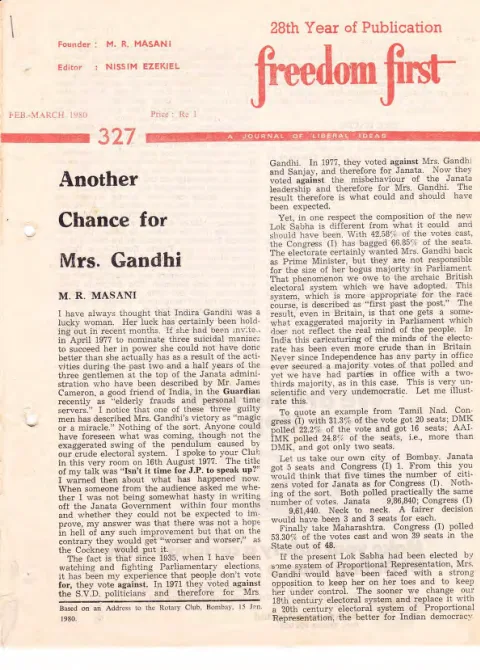
M. R. Masani, founder of Freedom First, analyses Congress (I)‘s landslide return to power in the January 1980 general election. He argues Indian voters consistently vote against incumbents rather than for challengers, and that the scale of Mrs. Gandhi’s parliamentary majority (66.85% of seats on 42.58% of votes) is an artefact of the first-past-the-post system rather than genuine popular mandate, illustrated with vote-versus-seat figures from Tamil Nadu, Bombay, and Maharashtra. He calls for a shift to proportional representation. Masani rejects the idea that Indira Gandhi is a unique threat to democracy, tracing dictatorship instead to the failures of the political class as a whole (comparing the rise of Hitler and de Gaulle), and lists the tasks facing her: restoring law and order without dictatorship, adopting pragmatic economic policies including tax cuts and dismantling controls, and avoiding vindictiveness in victory. He closes by recounting a conversation with Jayaprakash Narayan, who said he would accept Mrs. Gandhi’s election but questioned whether she would ‘obey the Constitution.’
- Congress (I)‘s parliamentary majority (66.85% of seats) vastly exceeds its vote share (42.58%), a distortion Masani attributes to the first-past-the-post electoral system.
- Masani argues voters acted ‘against’ incumbents in 1971, 1977, and 1980 rather than ‘for’ any party, rejecting claims that the result was a personal mandate or ‘miracle’ for Mrs. Gandhi.
- He calls for adoption of proportional representation to correct the distortion.
- Dictatorship is framed as a consequence of political class failure rather than the personal wickedness of any leader, with Hitler and de Gaulle cited as parallels.
- Masani sets out an agenda for Mrs. Gandhi: restore order without dictatorship, cut taxes, dismantle economic controls, and act magnanimously rather than vindictively.
- He recounts a 1978 conversation in which Jayaprakash Narayan said he would accept an Indira Gandhi election victory but wondered whether she would ‘obey the Constitution.‘
The Experience of Absolutism in Ceylon
By A. E. Gunawardena
A. E. Gunawardena, President of the Ceylonese Liberal Party, reviews Sri Lanka’s 1977 general election as an example of democratic breakdown caused by an unchecked two-thirds parliamentary majority. He traces how Sirimavo Bandaranaike’s government extended parliament past its due term, abolished the Senate, undermined judicial independence, nationalised or threatened major newspaper groups, and suppressed dissent, culminating in her decisive 1977 electoral defeat. He argues absolute power, regardless of which party holds it, corrupts democratic norms and warns the incoming J. R. Jayawardene government against repeating the pattern.
- Sri Lanka’s 1977 election was delayed past its constitutional term because the ruling party held a two-thirds majority allowing it to amend the constitution.
- The Bandaranaike government abolished the Senate, compromised judicial independence, and nationalised or threatened major newspaper groups (Lake House, Times, Sun).
- Gunawardena frames the 1970 and 1977 election defeats as evidence of Sri Lankans’ reliance on the ballot rather than coups or insurrection to change government.
- He attributes the country’s political stability to a two-party/two-personality system rooted in the Sinhala Sabha/Freedom Party and the U.N.P.
- The essay closes with a general warning that absolute power is inconsistent with democracy and that the new government should not repeat the pattern of absolutism.
VOICES I: Non-Alignment and Communist Economy
By Rama Swarup
In the ‘Voices I’ column, Rama Swarup surveys the economic troubles of the Communist bloc as of 1979, drawing on a Wall Street Journal report from Prague. He describes rising energy costs, hidden inflation, falling industrial output from absenteeism, and declining export competitiveness across the Soviet Union and Eastern Europe, citing gasoline price rises of 37-94% across Poland, Hungary, Romania, and Bulgaria, and noting that Taiwan and Hong Kong have overtaken Switzerland as the leading watch suppliers to the EEC. He concludes that Communist economies cannot compete with free enterprise.
- Gasoline prices rose 37% in Poland, 63% in Hungary, 84% in Romania and 94% in Bulgaria in 1979, per a Wall Street Journal report cited by the author.
- The Soviet 1980 budget calls for reduced military spending to fund an 8.8% increase in agricultural production.
- Grain harvests fell to among the lowest in recent years, forcing larger imports from the United States.
- Taiwan and Hong Kong displaced Switzerland as the leading watch suppliers to the EEC between 1977 and 1979.
- The essay concludes that communism cannot compete with free enterprise anywhere in the free world.
VOICES II: Should Political Parties Have Intelligence Units
By Attar Chand
In ‘Voices II,’ Attar Chand argues, counter-intuitively, that Indian political parties would benefit from running their own internal intelligence units to monitor party members’ finances, loyalties, and foreign links. He points to the defections that destabilised Morarji Desai’s Janata government and the divided loyalties of former Jan Sangh members retaining ties to the R.S.S. as evidence that parties need dossiers on members’ assets and backgrounds to curb corruption and pre-empt sabotage, while cautioning that such units must not overreach into legitimate party activity.
- Chand proposes that parties maintain internal intelligence units and dossiers on members’ assets, income, and expenditure to detect corruption.
- He cites Morarji Desai’s fall, attributed to defections by Janata members, as the motivating example.
- He argues dual/divided loyalties among former Jan Sangh members retaining R.S.S. ties illustrate the need for such oversight.
- Intelligence on ruling-party members is framed as especially important given their access to monetary gains and extra-constitutional power.
- The essay cautions that such units must not overstep into legitimate political activity.
VOICES III: The Bulldozer Victory
By N. C. Zamindar
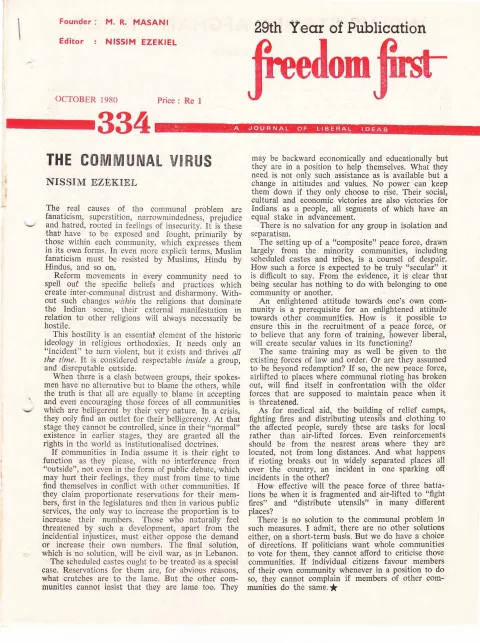
In ‘Voices III,’ N. C. Zamindar offers a post-mortem on the non-Congress opposition’s crushing 1980 defeat, arguing that both Marxist and caste-based analytical models failed to predict the result. He attributes Congress (I)‘s victory to five factors: Indira Gandhi’s personal charisma and campaign stamina; widespread discontent within the administrative machine and police force; the atmosphere of instability and near-anarchy created by non-Congress state ministries; the price shocks caused by Charan Singh’s budget; and a broader breakdown of dialogue between intellectuals and ordinary people.
- Zamindar argues that Marxist and intermediary-caste analytical models both failed to predict the 1980 election outcome.
- He blames non-Congress parliamentarians’ poor record and mud-slinging campaign for their own defeat rather than crediting Congress (I) with a genuine mandate.
- Five reasons are given for the ‘bulldozer victory’: Mrs. Gandhi’s personal charisma, administrative/police discontent, ministry-level instability, Charan Singh’s inflationary budget, and a disconnect between intellectuals and the public.
- Land-reform slogans and lowered land ceilings in Tamil Nadu and Madhya Pradesh are cited as sources of rural uncertainty that hurt the incumbents.
- The essay criticises the press for failing to report realistically, calling it ‘mere coffee-house reporting.‘
Changing Values in Sports
By C. L. Proudfoot
C. L. Proudfoot, a widely-experienced sportsman and former international hockey player for the Indian Army, laments the decline of amateur sporting values in India. He contrasts an older ethic of ‘Skill and Joy’ with the modern commercialisation and television-driven theatrics of cricket, which he calls ‘The Great Indian Tamasha,’ and mourns the decline of hockey, once nurtured in Anglo-Indian boarding schools that have since closed. He closes by questioning why talented young cricketers from schools like Anjuman-I-Islam are not absorbed into corporate and Ranji Trophy cricket, suggesting community bias over merit.
- Proudfoot contrasts an older sporting ethic of ‘Skill and Joy’ with modern self-conscious, television-influenced theatrics in cricket.
- He documents the decline of hockey following the closure of Anglo-Indian boarding schools that once supplied players to the Army, Railways, Telegraphs and Customs.
- He criticises a BSF team’s poor sportsmanship being rewarded with honours as symptomatic of declining standards.
- Anjuman-I-Islam High School in Bombay is cited as a consistent producer of cricket talent whose players are not absorbed into corporate or Ranji Trophy cricket.
- He questions whether ‘Cricket Godfathers’ favour community over skill in team selection.
The World of Books (review section: A Political Dissenter’s Diary Vol. II by Krishnabai Nimbkar; Dynamic Personnel Administration by M. N. Rudrabasavaraj; Reporters’ Ethics by Bruce M. Swain)
By K. S. Venkateswaran / B. H. Patankar / Githa Hariharan
K. S. Venkateswaran reviews Volume II of Krishnabai Nimbkar’s ‘A Political Dissenter’s Diary,’ covering 1970-1978 including the Emergency. The review praises the diary for its condemnation of Emergency-era constitutional amendments and its warnings against complacency about the durability of Indian freedom, while noting a lengthy and possibly indulgent controversy in the book between the author and the ‘Citizens for Democracy’ group. The reviewer highlights Nimbkar’s alarm about creeping socialist indoctrination and communist infiltration in India, illustrated by extended quotation from her book.
- The review covers Volume II of Krishnabai Nimbkar’s diary, spanning 1970-1978 and centred on the Emergency period.
- Nimbkar is quoted condemning the ‘unconscionable amendments to the Constitution,’ referencing the 24th (sic, per review’s numbering) Amendment Bill.
- The review notes a lengthy dispute in the book between the author and the Citizens for Democracy group, covering ‘more than two-score pages.’
- Nimbkar’s warnings about the spread of socialist/communist indoctrination among Indians exposed to ‘radical propaganda’ are quoted at length.
- The reviewer judges the book ‘readable, notwithstanding an apparent shoddiness in print and production.‘
Afghanistan
By Nissim Ezekiel
B. H. Patankar reviews the second edition of Prof. M. N. Rudrabasavaraj’s ‘Dynamic Personnel Administration: Management of Human Resources.’ The review summarises the book’s four-part structure covering personnel administration concepts, manpower planning and employee welfare, industrial relations, and a forward-looking section on HRM trends including computer applications, praising its comprehensiveness while noting it does not address labour unrest or the reasons behind deteriorating union-management relations in recent years.
- The book under review is Prof. M. N. Rudrabasavaraj’s ‘Dynamic Personnel Administration,’ second edition, Himalaya Publishing House, September 1979.
- It is structured in four parts: concept of personnel administration, manpower planning/employee welfare, industrial relations, and futuristic HRM trends.
- The review highlights the book’s treatment of HRM education and computer applications as its most forward-looking material.
- The reviewer criticises the book for not addressing the causes of recent labour unrest or deteriorating union-management relations.
- The review frames the book as useful for corporate managers, consultants, government administrators, and HRM researchers.
Essay 9
Githa Hariharan reviews Bruce M. Swain’s ‘Reporters’ Ethics’ (Iowa State University Press, 1978), which examines the myth versus reality of journalistic objectivity. Drawing on the book’s discussion of Walter Cronkite, the American Society of Newspaper Editors’ code of ethics, and commentary from Edward J. Epstein and Walter Lippmann, the review highlights the tension between the public’s expectation of reporters as truth-tellers and the practical limitations reporters face from biased sources, deadlines, and institutional pressures.
- The book reviewed is Bruce M. Swain’s ‘Reporters’ Ethics’ (Iowa State University Press, 1978, 153pp).
- The review discusses the American ‘cult’ around star journalists such as Walter Cronkite as inflating public expectations of reporters.
- The American Society of Newspaper Editors’ ‘Statement of Principles’ is cited as a formal code of ethics for reporters.
- Edward J. Epstein and Walter Lippmann are quoted on the practical limitations of journalism as ‘circulators of partial information.’
- The review closes by contrasting the comic-book myth of Superman/Clark Kent with the more modest reality of what reporters can accomplish.
Essay 10
Nissim Ezekiel, the journal’s editor, condemns the Soviet invasion of Afghanistan as unambiguous aggression, dismissing all justifications for it as sophistry. He argues foreign troops in an independent nation should support, not supplant, national authority, and rejects arguments that criticism of the invasion will ‘escalate’ tension, framing such arguments as serving the aggressor. He weighs several proposed responses — a boycott of the Moscow Olympics, revision of India’s friendship treaty with the USSR, and India-Pakistan cooperation on border security — and concludes that even symbolic, imperfect resistance is preferable to accepting the Soviet presence as a fait accompli, since passivity would embolden authoritarian tendencies domestically and internationally.
- Ezekiel argues all justifications for the Soviet invasion of Afghanistan are ‘merely sophistry’ and calls the action unambiguous aggression.
- He rejects the argument that opposing the invasion will ‘escalate’ conflict, framing this line as one that serves the aggressor’s interests.
- A boycott of the Moscow Olympics is discussed as a genuine, if imperfect, gesture that could not be hidden from the Russian public.
- Revising India’s friendship treaty with the USSR and India-Pakistan cooperation on border security are floated as further possible responses.
- He concludes that accepting the invasion as a fait accompli under the guise of ‘neutrality’ is actually ‘acquiescence in aggression.’
- The essay frames Afghanistan as ‘not merely a country that has been invaded’ but ‘a symbol of political and human depravity.’
Generated by the v1.5 extraction pipeline. Awaiting editorial review.
Metadata and summary are AI-extracted from the source PDF and reviewed for editorial accuracy. The original work is available via the Read PDF tab above (where present); paragraph-level citation inside the PDF is deferred to a future engagement.