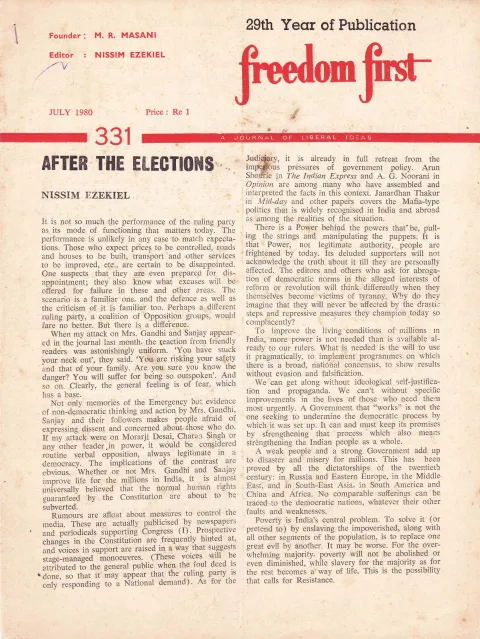
periodical issue
Freedom First
A Journal of Liberal Ideas
By NISSIM EZEKIEL, K. S. VENKATESWARAN, ANITA SETHI, EDUARD NEUMAIER, RAMA SWARUP, NITIN G. RAUT, R. M. LALA, HUTOXI MEHENTI, PREMA RAGHUNATH, GEETA RAMANATHAN, V. V. SUBBARAO, ALOO DALAL
Published for the Democratic Research Service by J. R. Patel, Associate Editor, Freedom First at 127, Mahatma Gandhi Road, Bombay 400 023 (Phone: 273914) and printed by him at Kaiser-E-Hind Publishers & Printers, 300, Perin Nariman Street, Bombay 400 001 · Bombay · 1980
16 pages
Freedom First
Summary
This June 1980 issue of Freedom First (No. 330, the magazine’s 28th year), edited by Nissim Ezekiel, opens with an editorial warning that Indira Gandhi’s return to power, and the looming rise of Sanjay Gandhi, threatens India’s constitutional democracy. The issue then ranges widely: a legal critique of the Official Secrets Act’s press-freedom chilling effect, two pieces on Cuban political repression and comparative authoritarian economics (Cuba vs. Chile), a report on the Soviet Union’s hardened posture after invading Afghanistan, two short ‘Voices’ pieces on Chinese economic stagnation and India’s diplomatic overture to the PLO, an extensive book review section covering six new titles, and the first installment of a two-part investigative series on the crisis of India’s municipal governments.
Key points
-
Nissim Ezekiel’s editorial “Mrs. Gandhi & Sanjay” warns that Indira Gandhi has shown no change in method since returning to power and that a Sanjay Gandhi succession would pose an even graver, harder-to-resist authoritarian threat.
-
K. S. Venkateswaran’s “Press Freedom and Official Secrets” contrasts India’s unreformed Official Secrets Act, 1923 with Britain’s Franks Committee reforms and the US Freedom of Information Act, calling for review in light of India’s obligations under the International Covenant on Civil and Political Rights.
-
Anita Sethi’s “That Hell Called Cuba,” with a reprinted OAS human-rights report, documents torture and over 470 deaths among roughly 1,000 Cuban political “plantados” and contrasts Cuba’s economic collapse with Chile’s growth under Pinochet’s economist Sergio de Castro.
-
Eduard Neumaier’s “Kremlin Shuts the Gate” argues the Soviet Union has offered no genuine concessions in the three months since invading Afghanistan, dismissing Lord Carrington’s neutralisation plan and reading Soviet “contradictions” as a deliberate stalling tactic.
-
Two “Voices” pieces cover Rama Swarup’s argument that three decades of Chinese Communist rule produced destructive upheaval rather than real development, and Nitin G. Raut’s criticism of India’s diplomatic recognition of the PLO office in Delhi as inconsistent given its refusal of full relations with Israel.
-
The World of Books section reviews six titles, including R. M. Lala on Manohar Malgonkar’s Cue From The Inner Voice on business trusteeship from Tata to Gandhi to JP, and critical notices of Balwant Gargi’s memoir, a prison memoir, P. Lal’s poem “Calcutta,” and a small-industries study.
-
Aloo Dalal opens a two-part investigative series on India’s municipal governments, tracing their origins to the Bombay Acts of 1865-1888 and cataloguing the financial and legal weaknesses that leave them unable to keep pace with rapid urbanisation.
Essays
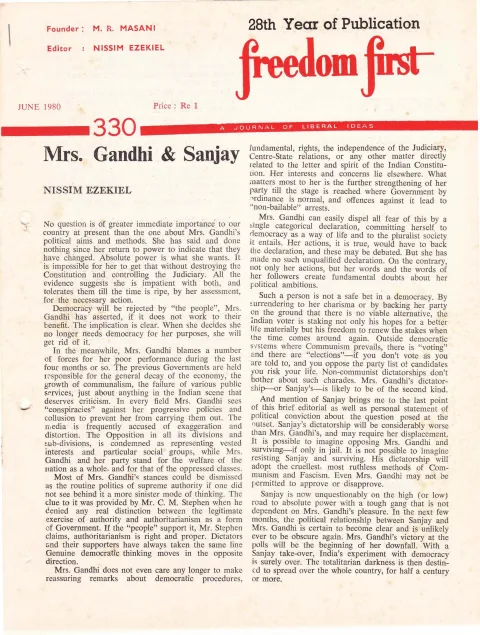
Mrs. Gandhi & Sanjay
By NISSIM EZEKIEL
Nissim Ezekiel’s editorial argues that no question matters more to India than Indira Gandhi’s political aims, since she has given no sign since returning to power of a change in her methods. He contends her rhetoric about serving ‘the people’ masks an authoritarian mode of thinking, endorsed by figures like C. M. Stephen who erase the distinction between legitimate authority and authoritarianism. The piece closes by warning that Sanjay Gandhi’s ascent poses an even graver danger than his mother’s: a Sanjay dictatorship would be harder to resist and survive than Mrs. Gandhi’s, potentially locking India into totalitarian rule for decades.
- Mrs. Gandhi has shown no evidence of a changed approach to power since her return.
- She blames external forces and ‘conspiracies’ for governmental failures rather than accepting responsibility.
- C. M. Stephen’s denial of any distinction between authority and authoritarianism is cited as the ‘sinister mode of thinking’ behind her stance.
- The editorial frames Mrs. Gandhi’s rule as potentially non-communist authoritarianism, distinct from but comparable to Soviet-style control.
- Sanjay Gandhi is described as the greater long-term danger, with a warned-of ‘totalitarian darkness’ if he takes over.
Press Freedom and Official Secrets
By K. S. VENKATESWARAN
K. S. Venkateswaran examines the Official Secrets Act, 1923, particularly its widely criticised Section 5, which criminalises unauthorised disclosure of any information a government official deems confidential. He contrasts India’s unreformed law with British reform efforts following the Franks Committee report and a 1978 White Paper narrowing the scope of official secrecy, and with the US Freedom of Information Act’s much stronger citizen access rights. He notes that India’s own 1948 Press Laws Enquiry Committee and a later Press Commission both declined to recommend real reform, effectively endorsing government as ‘sole judge’ of what counts as secret. The piece calls for a comprehensive review drawing on international precedent and India’s obligations under the International Covenant on Civil and Political Rights.
- Section 5 of the Official Secrets Act, 1923 (modelled on Britain’s 1911 Act) makes disclosure of virtually any official information a criminal offence.
- Britain’s Franks Committee (1972) and a 1978 White Paper moved to narrow the scope of secrecy law and reduce criminal sanctions.
- India’s 1948 Press Laws Enquiry Committee and later Press Commission both declined to push for narrowing Section 5.
- The US Freedom of Information Act (1966, amended 1972 post-Watergate) is held up as a model of citizen access to government information.
- The piece invokes India’s obligations under Article 19 of the International Covenant on Civil and Political Rights as grounds for reform.
That Hell Called Cuba
By ANITA SETHI (with excerpt attributed to ALEXANDER SOLZHENITSYN)
A two-part feature titled ‘That Hell Called Cuba.’ The first part, reprinted from the Swiss Press Review and News Report, describes conditions for Cuba’s roughly one thousand ‘plantados’ — long-term political prisoners who refuse to renounce their beliefs in exchange for release — drawing on a report by the Organisation of American States’ Inter-American Commission on Human Rights that documents torture, malnutrition, and over 470 deaths in Cuban prisons. The second part, by Anita Sethi, argues that Cuba’s supposed happiness under Castro is a myth exposed by the mass rush of Cubans into the Peruvian Embassy, and draws an extended contrast with Pinochet’s Chile, crediting economist Sergio de Castro with an economic turnaround that Western liberal commentators, she argues, unfairly withhold comparable credit for.
- Roughly 1,000 Cuban political prisoners (‘plantados’) have refused repatriation in exchange for renouncing their beliefs, per an OAS Inter-American Commission on Human Rights report.
- The report describes systematic beatings, malnutrition, and torture, with more than 470 deaths documented.
- Sethi argues the 10,000 Cubans crowding into the Peruvian Embassy disprove propaganda about Cuban contentment under Castro.
- The piece draws a pointed comparison between Cuba’s economic collapse and Chile’s growth under Pinochet and economist Sergio de Castro.
- A boxed pull-quote from Alexander Solzhenitsyn on Communism’s use of detente closes the feature.
Kremlin Shuts the Gate and Lives up to its Name
By EDUARD NEUMAIER
Eduard Neumaier surveys Soviet behaviour in the three months following the invasion of Afghanistan, arguing the Kremlin has ‘lived up to its name’ (fortress) by shutting out Western appeals and offering no genuine concessions. He details contradictory Soviet justifications for the invasion, Moscow’s rejection of proposals like Lord Carrington’s neutralisation plan, and argues that apparent Soviet uncertainty is really a tactic to buy time and preserve detente’s economic and strategic benefits to the USSR while giving nothing back.
- The Kremlin has offered no genuine concessions in the three months since invading Afghanistan.
- Soviet justifications for the invasion have shifted and contradicted each other depending on audience.
- Proposals such as Lord Carrington’s neutralisation plan for Afghanistan were dismissed or scorned by Moscow.
- The author argues Soviet ‘contradictions’ are a deliberate tactic to parry Western criticism while stalling for time.
- Detente is characterised as having brought the USSR economic benefit, military prestige, and strategic gains rather than genuine political accommodation.
Voices I: China: No Progress
By RAMA SWARUP
Under the ‘Voices I’ heading, Rama Swarup argues that three decades of Chinese Communist rule have produced ‘changes’ rather than genuine ‘development,’ citing a cycle of destructive campaigns (the Great Leap Forward, the Cultural Revolution) that consumed thirteen years, against only five years of actual construction. Drawing on People’s Daily and other official Chinese sources, the piece catalogues the mainland economy’s technological backwardness, manual agricultural production, low industrial productivity, and low worker skill levels as of the late 1970s.
- Chinese Communist economic history divides into seven stages from 1950-1981, alternating recovery/construction with periods of ‘destruction’.
- Thirteen years were consumed by destructive upheavals (Great Leap Forward, Cultural Revolution) versus five years of actual construction.
- Official sources admit Chinese industrial technology lags 15-20 years behind developed nations.
- Agricultural production remains largely manual and dependent, in the words of People’s Daily, on ‘the mercy of heaven.’
- Worker skill levels are low, with most workers having under ten years’ experience and only a tenth reaching Grade 5 or above.
Voices II: Delhi Support to PLO
By NITIN G. RAUT
Under ‘Voices II’, Nitin G. Raut criticises India’s decision to grant diplomatic status to the PLO office in New Delhi, calling it inconsistent given India’s continued refusal of full diplomatic relations with Israel. He argues India has not reckoned with the PLO’s Covenant, which calls for the destruction of the state of Israel, and that Foreign Minister P. V. Narasimha Rao’s parliamentary statement on the matter failed to address this. Raut contends India’s stance reflects a broader double standard, given its silence on China’s occupation of Tibet, Soviet control of Eastern Europe, and Pakistan’s hold on Kashmir.
- India granted diplomatic status to the PLO office in New Delhi even as it maintains only a consular office (not full relations) with Israel.
- The Palestinian National Covenant, per Article 19, declares the 1947 UN partition and the establishment of Israel ‘null and void’.
- Foreign Minister P. V. Narasimha Rao’s parliamentary statement did not address India’s stance on the PLO Covenant’s call to destroy Israel.
- Raut charges India with selective application of anti-occupation principles, citing China/Tibet, USSR/Eastern Europe, and Pakistan/Kashmir as unremarked-upon parallels.
- PLO shadow foreign minister Farouk Khaddoumi is quoted describing a three-phase strategy culminating in a ‘democratic State of Palestine.‘
The World of Books: Cue from the Inner Voice (review of Manohar Malgonkar)
By R. M. LALA
The World of Books section carries five reviews. R. M. Lala reviews Manohar Malgonkar’s ‘Cue From The Inner Voice,’ on the philosophy and practice of business trusteeship from Jamsetji Tata through Gandhi to J. P. Narayan’s 1965 seminars, noting most Indian companies remain indifferent to the idea despite some (Tata Steel, Levers, ITC) making gestures toward it. Hutoxi Mehenti pans Balwant Gargi’s autobiographical novel ‘The Naked Triangle’ as pseudo-intellectual and self-indulgent. Prema Raghunath reviews C. A. Balan’s prison memoir ‘In the Shadow of the Gallows,’ finding its jail-life descriptions authentic but its overall craft uneven. Geeta Ramanathan critiques P. Lal’s book-length poem ‘Calcutta’ as failing to evoke the city through overcrowded, unsharp language. V. V. Subbarao reviews Vasant Desai’s ‘Organisation and Management of Small Scale Industries,’ praising its systems-approach emphasis on technology but faulting its optimism about small-scale industry’s prospects.
- Malgonkar’s book traces the trusteeship idea from Jamsetji Tata through Gandhi’s teachings to J. P. Narayan’s 1965 seminars on business social responsibility.
- Lala’s review notes that of 100 companies surveyed for a 1965 social-responsibility declaration, only the Tata and Bajaj groups showed real willingness.
- Gargi’s ‘The Naked Triangle’ is criticised for arrogant, pseudo-intellectual prose despite some genuine warmth in passages about his children.
- Balan’s prison memoir is praised for authentic depictions of jail life and police brutality but criticised as tonally uneven and unresolved.
- P. Lal’s long poem ‘Calcutta’ is faulted for relying on overcrowded adjectives rather than sharp, economical imagery.
- Desai’s book on small-scale industries is praised for its emphasis on technology but critiqued as overly optimistic given high small-unit mortality rates.
The Naked Triangle (review of Balwant Gargi)
By HUTOXI MEHENTI
Aloo Dalal opens a two-part investigative series on India’s municipal governments, tracing their origin to British-era legislation (the Bombay Acts of 1865, 1872, and 1888) and arguing that municipal government, though a colonial creation, embodies the core democratic idea of popular local representation. The piece catalogues why municipal bodies function poorly today: outdated legal frameworks, weak organisational and managerial capacity, the strain of rapid urbanization on already-stretched services, chronic financial crises, and an ever-widening gap between resources and civic needs, with state governments encroaching on municipal tax resources rather than helping.
- India’s municipal government system originates in the Bombay Acts of 1865, 1872, and 1888, which introduced elected representation into city government.
- Rapid urbanization has strained municipal services (water, transport, sanitation) beyond capacity, contributing to slum proliferation.
- Municipal corporations suffer from stagnant finances, still relying on octroi and property tax as mainstays.
- Constitutional limits, such as Article 276’s cap on professional taxes, work against progressive taxation for municipalities.
- State governments have used draconian default, rescission, and supersession powers against municipal bodies since colonial times.
Generated by the v1.5 extraction pipeline. Awaiting editorial review.
Metadata and summary are AI-extracted from the source PDF and reviewed for editorial accuracy. The original work is available via the Read PDF tab above (where present); paragraph-level citation inside the PDF is deferred to a future engagement.