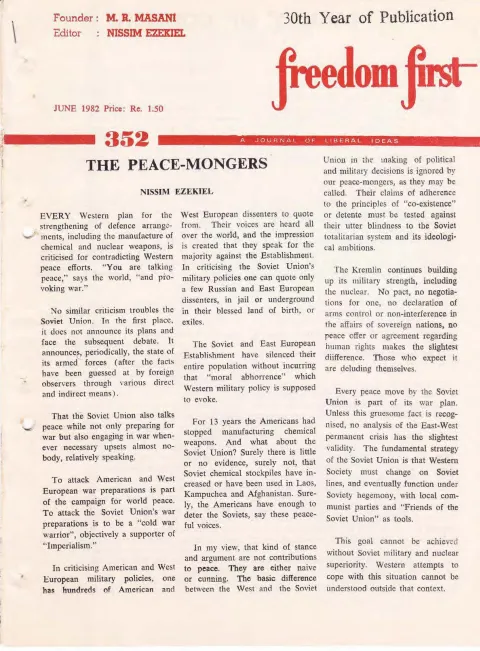
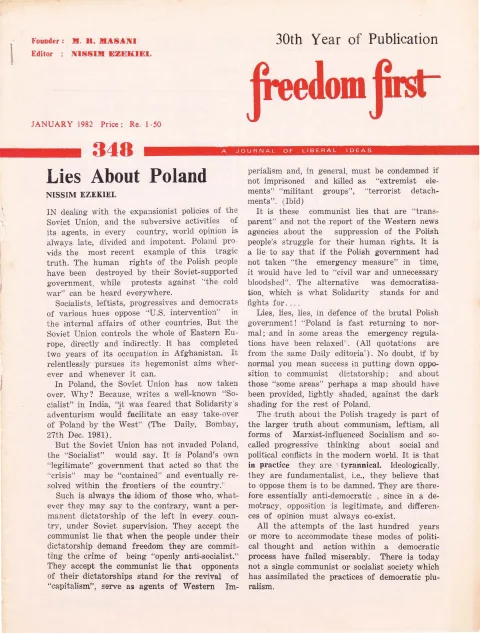
periodical issue
Freedom First
A Journal of Liberal Ideas
By NISSIM EZEKIEL, P. N. LEKHI, K. S. VENKATESWARAN, IAN TICKLE, INDU SARAIYA, GEETA DOCTOR, RASHMI TANEJA, FEROZA VAGHAIWALLA, HAVOVI ANKLESARIA
Published for the Democratic Research Service by J. R. Patel, Associate Editor, Freedom First at 127, Mahatma Gandhi Road · Bombay · 1982
16 pages
Freedom First
Summary
Freedom First No. 348 (January 1982) opens with editor Nissim Ezekiel’s editorial “Lies About Poland” and a report on advocate P. N. Lekhi’s Bombay address “Betrayal of Poland,” both using the Solidarity crisis and General Jaruzelski’s martial law to indict Soviet-backed communism, drawing an explicit parallel to Indira Gandhi’s 1975 Emergency. K. S. Venkateswaran’s “A Variety of Comment” column takes up judicial integrity in the wake of the Delhi High Court judges controversy, a Maharashtra circular mandating a civic pledge in colleges, and the neglected centenary of P. G. Wodehouse. A three-part “Voices” section carries short pieces on the war in Angola (Ian Tickle), a Doordarshan poetry programme review (Indu Saraiya), and a satirical column on communal one-upmanship titled “Oh to be an Indian!” (Geeta Doctor). Rashmi Taneja reports on the Crosby by-election and the rise of the SDP-Liberal Alliance as a challenge to Britain’s two-party system. “The World of Books” reviews Humayun Kabir’s reissued novel Men and Rivers (Feroza Vaghaiwalla) and Vaikom Basheer’s story collection Me Grandad ‘Ad an Elephant (Havovi Anklesaria). The issue closes with a Sarvodaya Press Service report on Raj Inqalab, a Bihar-movement activist held without trial and on a prolonged fast in Bhagalpur jail.
Key points
-
Nissim Ezekiel’s “Lies About Poland” argues Western and Indian commentary on Poland has been captured by propaganda recasting Soviet-backed repression of Solidarity as a legitimate internal matter.
-
P. N. Lekhi’s “Betrayal of Poland” traces Polish worker uprisings from Poznan 1956 to Solidarity’s 1980 founding, drawing an explicit parallel between General Jaruzelski’s martial-law broadcast and Indira Gandhi’s 1975 Emergency broadcast.
-
K. S. Venkateswaran’s “A Variety of Comment” covers the erosion of judicial integrity after two Delhi High Court judges were not confirmed, questions a Maharashtra circular mandating a patriotic pledge in colleges, and notes P. G. Wodehouse’s neglected Indian centenary.
-
Three “Voices” pieces cover Jonas Savimbi’s UNITA movement in Angola, a critical review of a Doordarshan poetry programme, and a satire on communal double standards toward Muslims voicing political criticism.
-
Rashmi Taneja’s “Major Change in British Politics” analyses Shirley Williams’s Crosby by-election win for the new SDP-Liberal Alliance as a sign Britain’s two-party system may be ending.
-
Book reviews cover Humayun Kabir’s reissued novel Men and Rivers and Vaikom Basheer’s story collection Me Grandad ‘Ad an Elephant.
-
A Sarvodaya Press Service report describes Raj Inqalab, a Bihar-movement activist held without trial and on a years-long fast in Bhagalpur jail, warning his death could trigger unrest.
Essays
Lies About Poland
By NISSIM EZEKIEL
Editor Nissim Ezekiel’s editorial argues that Western and Indian commentary on Poland has been captured by communist propaganda that recasts Soviet-backed repression of Solidarity as a legitimate internal matter. He contends that all attempts to reconcile Marxist and progressive politics with democratic pluralism have failed, since in practice such regimes are tyrannical and anti-democratic.
- World opinion on Soviet expansionism and Poland is described as late, divided and impotent.
- The editorial rejects the framing that Solidarity’s actions risked an ‘easy take-over of Poland by the West’.
- Argues the Daily editorial’s language (‘normal’, ‘relaxed emergency regulations’) obscures continued repression.
- Frames the Polish crisis as part of a larger truth about communism and Marxist-influenced socialism being tyrannical in practice.
- Concludes that no communist or socialist society has assimilated the practices of democratic pluralism.
Betrayal of Poland
By P. N. LEKHI
P. N. Lekhi’s address, delivered at a Bombay public meeting on Indian solidarity with Poland, traces the history of Polish worker uprisings from Poznan 1956 through Gdansk 1970 to the 1980 founding of Solidarity, and explicitly parallels Gen. Jaruzelski’s martial-law broadcast justifying Poland’s emergency with Indira Gandhi’s 26 June 1975 broadcast imposing the Indian Emergency, arguing both were dressed in the same propagandistic language documented by the Shah Commission. He further argues that Soviet military presence in Angola, Russian troop involvement in India-adjacent affairs, and Indo-Soviet treaty ‘consultation’ clauses show a pattern of Soviet interference comparable to its actions in Poland.
- Traces Polish worker revolts of 1956 (Poznan), 1970 (Gdansk) and 1976, culminating in Solidarity’s founding in September 1980.
- Cites Solidarity’s membership (8-10 million of 16 million Polish workers) and its demands: end of censorship, release of political prisoners, independent trade unions.
- Draws a direct parallel between Jaruzelski’s martial-law broadcast and Indira Gandhi’s 26 June 1975 Emergency broadcast, both examined via ‘brilliant lies’ per Lekhi’s account of the Shah Commission findings.
- Compares Pravda’s and Tass’s justifications for the Polish emergency to CPI paper New Age’s 1975 ‘Fascist Conspiracy Crushed’ framing of the Indian Emergency.
- Cites a population imbalance in Poland (17 million males vs 18.1 million females) as evidence of genocide via wartime deportations, referencing the Genocide Convention.
- Argues Russian troop presence and arms sales in India (over 13,000 Russian advisors, four-fifths of weapons imports) mirror Soviet designs on Poland.
- Notes Brezhnev’s 12 November 1968 Warsaw speech (the Brezhnev Doctrine of limited sovereignty) as the ideological basis for Soviet intervention.
A Variety of Comment (Judicial Integrity / The Stature of Wodehouse / Honour Thy Elders)
By K. S. VENKATESWARAN
K. S. Venkateswaran’s regular comment column covers three topics: the erosion of judicial integrity following the non-confirmation of two Delhi High Court judges and Maharashtra Chief Minister A. R. Antulay’s proposal to abolish the Bombay High Court’s Original Side; a Maharashtra government circular mandating a twice-yearly patriotic pledge in colleges on Republic Day and Independence Day, which the column questions on principle even while conceding the pledge’s content is unobjectionable; and the neglected centenary of P. G. Wodehouse in India, noted alongside Dr. M. N. Sharma’s new critical study Wodehouse, The Fictionist.
- References the 1973 and 1976 ‘supersession’ episodes when independent judges were bypassed for top judicial appointments on political grounds.
- Criticizes the 1980 episode of a Supreme Court judge sending an admiring letter to the Prime Minister, and the recent controversial non-confirmation of two Delhi High Court judges.
- Reports Antulay’s proposal to abolish the Bombay High Court’s Original Side as wasting judicial time, which the column calls unsound.
- Describes a Maharashtra Directorate of Education circular requiring students to take a patriotic pledge twice yearly, and questions whether patriotism should be compulsory rather than voluntary.
- Cites U.S. Justice Jackson’s opinion that no official may prescribe orthodox belief and that patriotism should be voluntary, not a compulsory routine.
- Notes Wodehouse’s birth centenary passed largely unremarked in India apart from Auberon Waugh’s controversial Observer piece and Dr. M. N. Sharma’s new study.
Voices-1: The Real Battle in Angola
By IAN TICKLE (Swiss Press Review and News Report)
Ian Tickle’s short ‘Voices’ piece on Angola argues that the Western press has overlooked Jonas Savimbi’s UNITA movement, which controls southern Angola and fights against Soviet and Cuban-backed forces, following a South African incursion that killed and captured Soviet military personnel. It frames UNITA as a genuine popular movement with 80,000 guerrillas building fledgling democratic institutions, and predicts a northward offensive toward Luanda.
- South Africa’s incursion into southern Angola killed, captured, and routed Soviet military personnel.
- UNITA, led by Jonas Savimbi, holds the eastern half of the Angola frontier and fights Communist-backed MPLA forces, receiving diesel fuel aid from South Africa despite Savimbi’s opposition to apartheid.
- UNITA fields 11 infantry battalions and 80,000 guerrillas, with arms captured from MPLA or supplied by China.
- Saudi Arabia is described as UNITA’s biggest funder.
- The piece frames UNITA’s fledgling democratic institutions as the only democratic institutions Angola has ever had.
Voices-2: Tele-Review
By INDU SARAIYA
Indu Saraiya reviews a Doordarshan programme, ‘Vibrations,’ featuring poet Saleem Peeradina interviewed by Shanta Gokhale, with actors Naseeruddin Shah and Tom Alter reciting his poems. She judges the show flawed by over-production and excessive visual staging that undercut the poems, and criticizes the interviewer for offering her own critical interpretations rather than letting Peeradina explain his own work.
- The 12 December 1981 Doordarshan programme combined recitation of Saleem Peeradina’s poems by actors Naseeruddin Shah and Tom Alter with an interview conducted by Shanta Gokhale.
- Saraiya argues visual staging and lighting effects distracted from poems like ‘Marriage Manual’, ‘Tree’ and ‘Finalities’.
- Criticizes Gokhale for supplying her own critical readings of the poems rather than letting Peeradina fully articulate his own view.
- Argues anterior criticism by an interviewer generates self-consciousness and defensive attitudes in the poet being interviewed.
Voices-3: Oh to be an Indian!
By GEETA DOCTOR
Geeta Doctor’s satirical piece describes a Madras ‘parlour game’ called ‘Who is an Indian?’ in which Hindus freely criticize the government among themselves, but a Muslim who voices identical criticism is challenged to prove his national loyalty. She extends the satire to loudspeaker wars between temples and mosques, and to the differing treatment of NRI professionals in the US versus unskilled Gulf migrant workers, noting the latter group draws suspicion specifically because its members are mostly Muslim.
- Describes an informal game in Madras newspaper columns where Muslims voicing standard political complaints are challenged with ‘Are you an Indian?’ while Hindus voicing the same complaints face no such challenge.
- Extends the satire to competitive loudspeaker use between temples and mosques in Indian cities.
- Contrasts NRI professionals who emigrated to the USA (mostly upper-caste, from the South) with Gulf migrant labourers, noting the latter remit money home faithfully yet face suspicion.
- Notes that suspicion of Gulf remittances intensified specifically because that migrant group is predominantly Muslim.
Major Change in British Politics
By RASHMI TANEJA
Rashmi Taneja analyses the Crosby by-election victory of Shirley Williams for the new Social Democratic Party (allied with the Liberals) as a sign that Britain’s traditional two-party system may be ending. She surveys Margaret Thatcher’s unpopular monetarist policies amid rising inflation and unemployment, dissent from ‘wet’ cabinet ministers like Sir Ian Gilmour, and Labour’s internal split between the moderate right (Denis Healy) and the radical left (Tony Benn), concluding that the SDP-Liberal Alliance could be unstoppable unless either major party changes course.
- Shirley Williams won the Crosby by-election for the SDP by over 5,000 votes in a previously safe Conservative seat, with Labour’s candidate losing his deposit.
- Thatcher’s monetarist policies had produced 11.5% inflation and unemployment nearing 3 million; she dismissed dissenting ‘wet’ ministers in September.
- Sir Ian Gilmour, a dismissed ‘wet’ and former deputy Foreign Secretary, accused Thatcher of ‘steering full speed ahead for the rocks’.
- Labour is described as split between Denis Healy’s moderate right and Tony Benn’s radical left, with a party policy document favouring EEC withdrawal without referendum and unilateral nuclear disarmament while remaining in NATO.
- SDP co-founder Roy Jenkins insists the SDP is ‘not a Mark II Labour Party’, noting 24 of its 25 MPs are former Labour members and one former Tory.
- Concludes the SDP-Liberal Alliance’s rise may be unstoppable unless Benn abandons the radical left or Thatcher reverses her strategy.
The World of Books: Men and Rivers (review)
By FEROZA VAGHAIWALLA
Feroza Vaghaiwalla reviews the 1982 Orient Longman reprint of Humayun Kabir’s 1945 novel Men and Rivers, a story of rural friendship turned enmity between Nazu Mia and Asgar Mia, whose children Malek and Nuru fall in love only to discover they share a mother, a revelation that shatters Malek’s world. The reviewer praises the novel’s vivid depiction of village life and its parallel between human fate and the unpredictable river, but finds the principal characters one-dimensional compared to vividly drawn minor figures like the faqir and the hakim, and judges it a simple, worthwhile period piece.
- The novel centers on the broken friendship of Nazu Mia and Asgar Mia and the forbidden love of their children Malek and Nuru, who share a mother.
- Nazu drowns in the river during a storm just as Malek’s life is upended by learning the truth of his parentage, reinforcing the novel’s Nature/Fate parallel.
- The reviewer finds principal characters one-dimensional but praises vivid minor characters, especially the faqir and the hakim.
- Malek’s encounter with river pirates is criticized as melodramatic and out of keeping with the novel’s otherwise plain, direct style.
- The review frames the book as valuable chiefly as a benchmark for how far Indian English fiction has progressed in the 35 years since first publication.
The World of Books: Me Grandad ‘Ad an Elephant (review)
By HAVOVI ANKLESARIA
Havovi Anklesaria reviews Me Grandad ‘Ad an Elephant, a UNESCO-published English translation of three Muslim-life stories from Kerala by Vaikom Basheer. She praises Basheer’s unpretentious, unideological authenticity and his gift for depersonalized, unmanipulative storytelling, singling out the title story’s naive heroine Kanjupattumma, the tragic ‘Childhood Friend’, and the comic, autobiographical ‘Pathumna’s Goat’.
- The collection contains three stories of Muslim life in South India, all set in Basheer’s native Keralite Muslim milieu.
- The reviewer credits the stories’ success in translation to Basheer’s universality as a writer with no ideological axe to grind.
- ‘Childhood Friend’ is called the most tragic story, involving heroine Suhra’s death from T.B., though its melodrama is muted compared to Hindi cinema conventions.
- The title story follows Kanjupattumma, whose insular world and family status decline alongside her father’s income and power.
- ‘Pathumna’s Goat’, largely autobiographical, is described as funny, ironical and self-deprecating.
Raj Inqalab’s Life and Death Struggle in Bhagalpur Jail
By Sarvodaya Press Service
A Sarvodaya Press Service report describes the plight of Raj Inqalab, a young artist and songwriter from the 1974 Bihar movement, held without trial in Bhagalpur jail for three years and on a fast unto death for about two and a half years amid forced feeding. It traces his organizing work among villagers in the Rajaun division, his conflict with local strongman Govind Jethi (who was later murdered), the sixteen-person case built around him despite his not being named the main accused, and appeals for outside help to save his life.
- Raj Inqalab composed protest songs during the 1974 Bihar movement and toured Patna with a full-size portrait of Jayaprakash Narayan.
- He organized villagers in Nawada and Neema (Rajaun division, Bhagalpur district) around building a bridge, dam, road and sluicegate.
- Conflict with local strongman Govind Jethi, who later helped police arrest him in 1978 in exchange for being allowed to keep his firearms, led to his continued detention; Jethi was later murdered for unknown reasons.
- Sixteen persons were implicated in the case, with one Naresh Singh as main accused; Raj himself faces charges under thirty-two sections across seven cases.
- He was produced in court only twice in three years and has refused bail on principle, demanding either prosecution or release.
- A citizens’ committee at Bhagalpur, aided by Rama Saran of the People’s Sangharsh Vahini, is working for his release, and the report warns he may die without urgent outside help.
- The report explicitly warns his death in jail could trigger unrest and inspire further hunger strikes, comparing the situation to Bobby Sands.
Generated by the v1.5 extraction pipeline. Awaiting editorial review.
Metadata and summary are AI-extracted from the source PDF and reviewed for editorial accuracy. The original work is available via the Read PDF tab above (where present); paragraph-level citation inside the PDF is deferred to a future engagement.