periodical issue
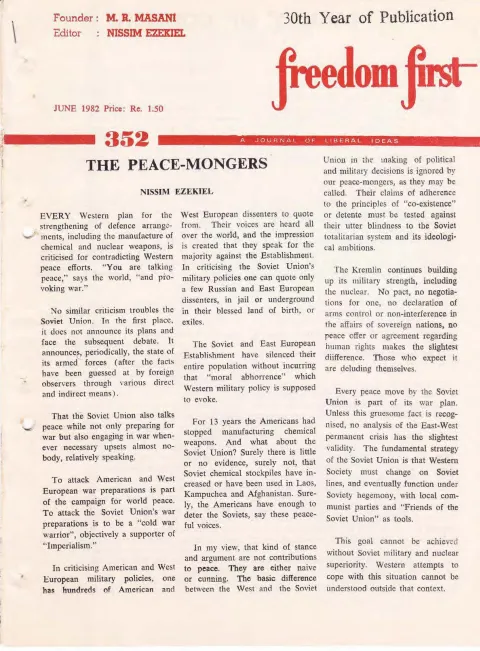
Freedom First
A Journal of Liberal Ideas
By K. S. Venkateswaran, Rama Swarup, S. S. Bankeshwar, Pran Nath Lekhi, Laeeq Futehally, Juan Fercsey, N. K. Somani, A. James McAdams, Bela Varga, S. K. Tripathi, B. G. Verghese
Published for the Democratic Research Service by J. R. Patel, Associate Editor, Freedom First at 127, Mahatma Gandhi Road, Bombay 400 023 (Phone: 273914) and Printed by him at The Popular Press (Bom.) Pvt. Ltd, 35C Tardeo Road, Bombay 400 034 · Bombay · 1982
16 pages
Freedom First
Summary
Freedom First issue 350 (April 1982) opens with an unusually personal note: founder-chairman M. R. Masani’s “Mea Culpa,” apologising to readers for the journal’s recent lapses in punctuality caused by printing-press failures, and announcing that the magazine (marking its 30th year of publication) will continue under new management rather than suspend. The rest of the issue is a typical Freedom First miscellany of signed political commentary, foreign-affairs analysis, reader letters, and a book review, unified by a Cold War-era classical-liberal and anti-Soviet vantage point. Contributors range across the Judges’ Case controversy in the Indian judiciary, India’s growing trade dependence on the USSR, the coherence (or myth) of non-alignment, alleged KGB penetration of Indian politics, a satirical airport vignette on Indian institutional culture, European reactions to the nuclear-freeze/peace movement, proposals for governmental reform in India, the twentieth anniversary of the Berlin Wall, and letters commemorating the 1956 Hungarian uprising. The issue closes with B. G. Verghese’s review of D. R. Mankekar’s book on the New World Information Order and a short wire item on Pakistan’s re-imagining of Jinnah’s dress in official portraiture.
Key points
-
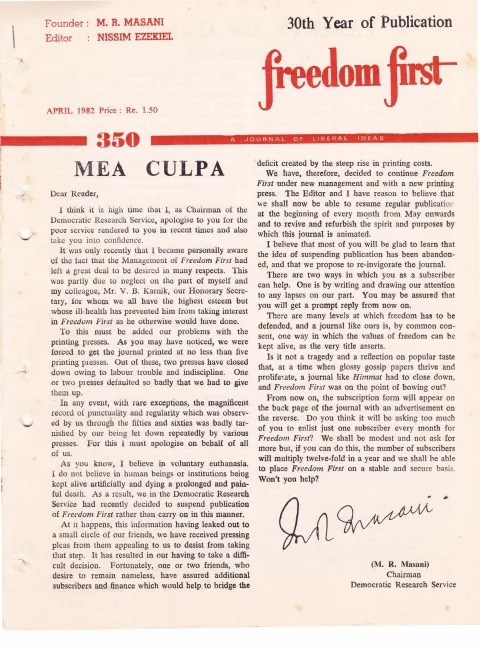
M. R. Masani’s “Mea Culpa” apologises for the journal’s recent irregularity, reveals the Democratic Research Service had decided to suspend Freedom First before reversing course, and announces resumption of monthly publication under new management.
-
K. S. Venkateswaran’s “A Variety of Comment” questions the propriety of a Supreme Court judge informally discussing a pending judgment with journalist Arun Shourie, and asks how Indian prison conditions compare to improved amenities in Northern Ireland’s Maze and Armagh prisons.
-
Rama Swarup examines India’s deepening trade dependence on the Soviet Union, its largest trading partner by 1981, questioning whether Moscow’s purchases reflect genuine demand or strategic aims.
-
S. S. Bankeshwar argues non-alignment is largely a myth since every ostensibly non-aligned country is effectively dependent on one superpower camp, citing India’s selective silence on Soviet interventions.
-
Pran Nath Lekhi warns of KGB infiltration of Indian political life, citing a CPM leak allegedly traced to Soviet sources and claiming 14,000 Russian advisers are active in India without public scrutiny.
-
A satirical airport vignette reads Bombay’s contradictory rules and unreliable information as symptomatic of a deeper Indian cultural indifference to logical consistency and follow-through.
-
A survey of German, French and British press opinion argues the Western European nuclear-freeze movement is substantially shaped by Soviet-aligned Communist organising rather than being purely spontaneous.
-
A. James McAdams marks the Berlin Wall’s twentieth anniversary, tracing how East Germany transformed a structure privately conceded even by Khrushchev to be “ugly” into a source of state pride and economic stability.
-
Reprinted letters mark the 25th anniversary of the 1956 Hungarian uprising, drawing a line from Hungary through the Soviet invasions of Czechoslovakia and Afghanistan to pressure on Poland, while a review of D. R. Mankekar’s book covers the New World Information Order debate.
Essays
Mea Culpa
By M. R. Masani
M. R. Masani, Chairman of the Democratic Research Service (Freedom First’s publisher), apologises to readers for the poor service and irregular publication of the journal in recent times, attributing this to neglect, the ill health of Honorary Secretary V. B. Karnik, and repeated failures by five different printing presses (two of which shut down amid labour trouble). He reveals that the Democratic Research Service had decided to suspend Freedom First altogether, in keeping with his stated belief in “voluntary euthanasia” for institutions rather than prolonging decline, but reversed the decision after friends pledged additional subscribers and finance. He announces the journal will resume regular monthly publication from May onward under new management and a new press, and appeals to readers to help multiply subscriptions twelve-fold over the year.
- Masani apologises as Chairman of the Democratic Research Service for the poor service and irregularity of Freedom First.
- Blames neglect and the ill health of Honorary Secretary V. B. Karnik, plus the failure/closure of multiple printing presses.
- States he believes in ‘voluntary euthanasia’ for institutions rather than a prolonged, painful decline.
- The Service had decided to suspend the journal, but reversed course after friends promised additional subscribers and funding.
- Announces resumption of regular monthly publication from May onward under new management and a new printing press.
- Contrasts Freedom First’s near-closure with the actual closure of the journal Himmat, framing it as a reflection on public taste.
- Appeals to readers to recruit one new subscriber a month to multiply circulation twelve-fold in a year.
A Variety of Comment (1. The Judges’ Case; 2. Irish Prisons)
By K. S. Venkateswaran
K. S. Venkateswaran’s regular column takes up two unrelated topics. In “The Judges’ Case,” he discusses the controversy sparked by Arun Shourie’s Indian Express series “By What Are Judges Bribed?”, which analysed inconsistencies in Supreme Court rulings, including those of Justice P. N. Bhagwati; Venkateswaran raises the ethical question of whether it is proper for a sitting judge to discuss a pending judgment informally with a journalist. In “Irish Prisons,” he reviews a British government booklet, Day to Day Life in Northern Ireland Prisons, describing improved prisoner clothing, vocational training, and recreational facilities in Maze and Armagh, and pointedly asks how conditions in Indian prisons compare, given that the described amenities are extended to people convicted of terrorism.
- Discusses Arun Shourie’s Indian Express serial ‘By What Are Judges Bribed?’ critiquing Supreme Court judgments’ inconsistency.
- Notes Justice P. N. Bhagwati discussed his own judgment informally, and sent Shourie a specially prepared summary, raising propriety concerns.
- Questions whether journalists should publicise private conversations with judges even when well-intentioned.
- Reviews the British government booklet on Maze and Armagh prisons in Northern Ireland, describing eased dress codes and vocational training.
- Highlights a prisoner who won City and Guilds craft distinctions and a Worshipful Company prize while incarcerated.
- Closes by asking how Indian prison conditions compare to the described British/Irish prison standards.
Easy and Dangerous Dependence
By Rama Swarup
Rama Swarup examines India’s rapidly deepening trade dependence on the Soviet Union, which had by 1981 become India’s largest trading partner with a turnover of about Rs. 2,500 crores. The essay questions whether Moscow pays fair prices, whether Soviet purchases are reliable and long-term, and cites erratic patterns in tea and groundnut-extraction exports as evidence that reliance on the USSR is risky. It notes the 1982 trade protocol projecting a 22% rise in Indian exports to the USSR, and closes by asking whether India’s trade profile, especially in light of the IMF loan, reflects an unhealthy dependence on a single market.
- The USSR became India’s largest trading partner in 1981 with turnover of about Rs. 2,500 crores.
- Questions whether Moscow’s purchases reflect genuine demand or serve Soviet strategic ends, and whether prices are fair.
- Cites erratic Soviet purchases of Indian tea (fluctuating tonnages 1976-1981) and groundnut extractions (halted 1976-80, resumed 1980-81).
- Notes speculation that the USSR re-exports Indian groundnut extractions and tea to third countries.
- The 1982 trade protocol envisages Indian exports to the USSR rising 22% to Rs. 1,760 crores.
- Argues India must diversify markets and increase competitiveness rather than rely on the ‘easy’ Soviet outlet.
- Frames the concern explicitly in the context of India’s contemporaneous IMF loan.
The Non-Alignment Movement - Myth or Reality?
By S. S. Bankeshwar
S. S. Bankeshwar argues that non-alignment is largely a myth: every so-called non-aligned country is in practice dependent on and identifiable with one superpower camp or the other, and foreign policy is driven by pragmatism and self-interest rather than ideology. He points to India’s silence over Soviet interventions in Czechoslovakia, Hungary, and Afghanistan (contrasted with vocal condemnation of American actions) as proof that India’s own non-alignment is selective, driven by dependence on Soviet support at the UN over Kashmir and on Arab oil supplies. He also discusses Pakistan’s strategic position as a buffer state and concludes that a Pakistan-India-Bangladesh alliance is essential given Afghanistan’s loss as a buffer to Soviet annexation, warning that a war with India would be catastrophic for Pakistan.
- Claims no non-aligned country is genuinely non-aligned; all are effectively ‘non-aligned (R)’ pro-Russia or ‘non-aligned (A)’ pro-America.
- Argues India’s silence on Soviet aggression in Czechoslovakia, Hungary, and Afghanistan stems from dependence on Soviet UN support over Kashmir.
- States India cannot be neutral in Israel-Arab disputes because of dependence on Arab oil.
- Argues foreign policy is guided by pragmatism and national interest, not ideology, citing USSR-USA and USA-China relations as proof.
- Frames Pakistan as India’s new buffer state against Russia following Afghanistan’s annexation.
- Warns that a war between India and Pakistan would end with both nations reduced to satellite status of Russia or China.
- Concludes the viability of non-alignment as a policy depends entirely on the superpowers, not on non-aligned nations themselves.
VOICES-1: K.G.B. In India
By Pran Nath Lekhi
In the Voices column, Pran Nath Lekhi warns of KGB infiltration of Indian political life, citing the suspension of CPM leader Shiva Pada Sen Gupta for allegedly leaking party secrets to India’s Intelligence Bureau, which the CPM learned of from Soviet KGB sources. Lekhi argues this reveals active KGB involvement with Indian political parties and government intelligence apparatus, criticises the Indian government’s acceptance of the Cuban ambassador Mr. Novoa (previously expelled from Ethiopia over KGB links), quotes the CPI’s 1974 thesis on the political role of the army in developing countries as evidence of preached sedition, and states that 14,000 Russian advisers are currently active in India with no public scrutiny of their influence.
- CPM suspended Comrade Shiva Pada Sen Gupta for allegedly leaking party secrets to India’s Intelligence Bureau.
- The CPM’s information about the leak reportedly came from Soviet KGB sources.
- Criticises Indian government’s acceptance of Mr. Novoa as Cuban ambassador despite his prior expulsion from Ethiopia over KGB links.
- Cites the CPI’s 1974 thesis on the army’s political role in developing countries as evidence of a subversive strategy.
- Claims 80% of foreign KGB recruits are drawn from Communist Party ranks worldwide.
- States 14,000 Russian advisers are currently active in India, embedded across government activity.
- Frames Soviet influence in Afghanistan as a direct warning to India.
VOICES-2: Our Culture Today - A Viewpoint
By Laeeq Futehally
In the second Voices piece, Laeeq Futehally recounts a farcical personal experience at a Bombay airport, where confusing parking rules, an unreliable flight information board, and staff unable to give a straight answer about a delayed flight illustrate what she calls a broader Indian cultural pattern: intention divorced from execution, and a habitual indifference to logical consistency and truth. She argues this reflects deeper flaws in Indian institutional culture and thought-habits, rooted in a preoccupation with ‘Appearance and Reality’ rather than practical follow-through, and calls for a shift toward valuing ‘mere functioning’ and small, working improvements over grand but unfulfilled intentions.
- Recounts a real airport experience: contradictory rules on parking enclosures, and staff giving inconsistent flight-delay information.
- Uses the anecdote as a ‘contemporary version’ of the classic Indian philosophical preoccupation with Appearance versus Reality.
- Argues Indian culture prizes the passing of an order or intention over its actual execution.
- Extends the critique to Indian temple sculpture, dance forms and rituals, arguing quality of human material/institutions goes unexamined.
- Attributes many everyday difficulties to muddled thought-habits rather than corruption alone.
- Calls for starting reform from small, functional things rather than grand abstractions.
”Peace Without Weapons Is An Illusion”: German, French and British Press Opinions
By Juan Fercsey
Juan Fercsey surveys German, French, and British press opinion on the Western European nuclear-freeze/peace movement, arguing that it is heavily shaped by Soviet-aligned Communist parties and organising networks rather than being purely spontaneous. He quotes West German Chancellor Helmut Schmidt and opposition leader Helmut Kohl defending NATO’s ‘dual decision’ and warning against neutralism, cites Le Monde on Communist influence within the French peace movement, and quotes Le Figaro, the Daily Telegraph, and the Observer describing Soviet orchestration of the peace rallies, culminating in The Economist’s assessment that Moscow wants a friendly Western Europe that accepts Soviet definitions of its own interests, achieved through intimidation of various kinds. As rendered, the piece appears to be cut off mid-sentence at the end of page 10.
- West German Chancellor Helmut Schmidt defends NATO’s ‘dual decision’ on countering Soviet SS-20 missiles while pursuing arms-control talks.
- Opposition leader Helmut Kohl warns against neutralism and states ‘peace without weapons is an illusion’.
- Le Monde highlights strong French Communist Party influence on the French peace movement and its pro-Soviet slogans.
- Le Figaro argues Soviet strategy aims to get Western Europe to abandon Euro-missile deployment while leaving SS-20s largely intact.
- The Daily Telegraph and Observer describe the peace movement’s foot soldiers as young, idealistic, and exploited by Communist-linked organising networks.
- The Economist concludes Soviet policy seeks a ‘friendly’ Western Europe achieved via arm-twisting, sabre-rattling, or direct intervention.
A Few Suggestions For A Better Government
By N. K. Somani
N. K. Somani offers a set of policy proposals for improving Indian governance, arguing that post-independence governments have been too cautious to pursue bold reforms. He calls for reducing bureaucratic interference in citizens’ lives, decentralising decision-making away from Delhi and state capitals, modernising outdated data-collection methods and civil/criminal laws dating to the 19th century, targeting agricultural and industrial surpluses to eliminate price and distribution controls, rationalising subsidies (citing kerosene and furnace oil pricing anomalies), reforming outdated labour laws that make dismissing unproductive workers nearly impossible, improving education to support family planning acceptance (citing Kerala as a model), and reducing India’s political culture of hero-worship in favour of ideology-and-teamwork-based governance.
- Argues governments have lacked courage for bold, creative policy due to excessive caution.
- Calls for decentralisation so citizens need not travel to Delhi or state capitals for routine matters.
- Urges modernising data collection and government organisation using new technology (cites silicon chip data storage).
- Proposes targeting 10-15% production surpluses in agriculture/industry to eliminate price and distribution controls.
- Cites kerosene sold below international price (Rs. 1,400 vs Rs. 2,625 per KL) and furnace oil sold above cost as pricing anomalies.
- Calls for reform of outdated 19th-century civil and criminal laws.
- Advocates reforming labour law to allow dismissal of unproductive workers under proven circumstances.
- Argues education reform would ease family-planning acceptance, citing Kerala’s success.
- Calls for moving away from personality-centred, hero-worship politics toward ideology and teamwork.
The Focus in East Germany: Twenty Years of the Berlin Wall
By A. James McAdams
A. James McAdams marks the 20th anniversary of the Berlin Wall by examining how East German leaders have transformed a structure once conceded even by Khrushchev and Ulbricht to be an ‘ugly thing’ into an object of state pride, marked by annual August 13 celebrations rivaling May Day. He traces official East German justifications for the Wall (halting a supposed Western assault, stopping ‘spies, smugglers and kidnappers’, achieving ‘clarity’ after confusion) against the more candid admission, in a 1970 Neues Deutschland editorial, that sealing the border stopped a ruinous population drain of skilled workers essential to economic stability. He argues the Wall gave the GDR both economic breathing room and a form of proof of sovereignty the Soviet Union itself could never fully confer, and traces how the Wall’s symbolic meaning has shifted from Cold War flashpoint to a cornerstone of the two-bloc European status quo, invoked by East Germans in every phase of East-West relations up to détente.
- Both Khrushchev and Ulbricht privately conceded the Wall was an ‘ugly thing’ and a ‘defect’ immediately after its 1961 construction.
- East Germany later transformed the Wall into a source of state pride, marked by annual celebrations on August 13.
- Official GDR justifications include stopping a supposed Western assault and halting ‘spies, smugglers and kidnappers’.
- A 1970 Neues Deutschland editorial more candidly credited the Wall with stopping the drain of skilled workers that threatened economic collapse.
- The GDR’s mid-1960s economic improvement (‘Wirtschaftswunder’) is attributed by the regime partly to the Wall’s construction.
- The Wall gave the GDR proof of sovereignty that had previously been denied it internationally.
- Neues Deutschland’s 1976 statement declared the GDR’s border ‘not open to debate’.
- The Wall’s symbolism shifted over time from Cold War flashpoint to a foundation of the European status quo, invoked through SALT and the Helsinki Conference era.
- Piece appears to conclude with Erich Honecker’s 20th-anniversary address framing the Wall as a warning to the West about superpower confrontation.
Remembering Hungary 1956 (letters: to Freedom First from Bela Varga; to Prime Minister Gandhi from S. K. Tripathi enclosing correspondence)
By Bela Varga / S. K. Tripathi
This section reprints two letters occasioned by the 25th anniversary of the 1956 Hungarian uprising. The first, from S. K. Tripathi (Director, Antar-Sanchar, New Delhi) to the Editor of Freedom First, encloses a booklet titled ‘Hungary 1956’ and asks Freedom First to comment on the desirability of Hungarian independence; it includes a letter to Prime Minister (Indira) Gandhi recounting the 1956 revolution, the Soviet military crushing of the uprising despite prior negotiation promises, and the UN’s 14 condemnatory (but ignored) resolutions, and drawing a direct line from Hungary 1956 to the Soviet invasions of Czechoslovakia (1968) and Afghanistan (1979). The second letter, a formal statement by Bela Varga (former Speaker of the Hungarian Parliament, 1946-47, and Chairman of the Hungarian Committee), draws parallels between the Hungarian and Polish independence struggles, warns the Hungarian government against participating in any Soviet action against Poland, and invokes historical Hungarian sympathy for Poland (including wartime refuge for Polish refugees) as grounds for solidarity.
- S. K. Tripathi of Antar-Sanchar sends Freedom First a booklet, ‘Hungary 1956’, marking the uprising’s 25th anniversary.
- An accompanying letter to Prime Minister Gandhi recounts the 1956 revolution, the Soviet promise to negotiate withdrawal, and the subsequent crushing attack on November 4, 1956.
- Notes the UN passed 14 resolutions condemning the Soviet Union over Hungary, all ignored by Moscow and the installed regime.
- Draws a line from Hungary 1956 to the Soviet invasions of Czechoslovakia (1968) and Afghanistan (1979), and rising pressure on Poland.
- Notes 70,000 Soviet occupation troops remain ‘temporarily’ in Hungary 35 years after 1956, a cost borne by Hungary.
- Bela Varga’s statement links the Hungarian and Polish struggles for independence, historically and currently.
- Varga warns the Hungarian government not to assist any Soviet action against Poland, citing historical Polish-Hungarian solidarity including Hungary’s shelter of Polish refugees during WWII.
Book Review: Whose Freedom? Whose Order? (review of D. R. Mankekar’s book)
By B. G. Verghese B. G. Verghese reviews D. R. Mankekar’s book Whose Freedom? Whose Order? (Clarion, Rs. 55), which examines the debate over a New World Information Order. Verghese summarises Mankekar’s argument that global information and communication flows constitute a form of power dividing the world into information-rich and information-poor nations, that Western fears of the ‘new order’ demand as regulation/censorship were initially a product of ethnocentric misunderstanding, and that a more balanced flow is both necessary and compatible with freedom of information. He praises Mankekar’s support for the MacBride Commission and proposal for an independent World Press Institute of journalists to adjudicate matters like the Right of Reply, but identifies three weaknesses: confusing use of ‘a new order’ vs ‘the new (world) information order,’ omission of TASS from scrutiny of propagandistic news services, and inadequate attention to information imbalances within nations and among developing countries themselves. Verghese concludes the book nonetheless adds value to a major international debate.
- Reviews D. R. Mankekar’s Whose Freedom? Whose Order? (Clarion, 234pp, Rs. 55) on the New World Information Order debate.
- Mankekar attributes Western initial alarm over the new information order to ethnocentricity and a false either/or debate about censorship.
- Discusses the shift in concept from ‘free flow’ to ‘free and balanced flow’ to a ‘right to communicate’ (two-way).
- Notes emerging concepts of a ‘right to privacy’ and ‘right not to know’ as products of the electronics revolution.
- Mankekar supports the MacBride Commission and proposes a journalist-run World Press Institute to adjudicate international news disputes.
- Verghese flags Mankekar’s confusing use of ‘a new order’ versus ‘the new (world) information order’ as an unintended slip.
- Verghese criticises the omission of TASS from scrutiny of state-linked propaganda/news services.
- Verghese’s key critique: inadequate treatment of information imbalance within nations and among developing countries, not just between rich and poor blocs.
Redressing history (unsigned filler item on Jinnah portraiture, credited to The Times, London)
A short filler item reprinted from The Times, London, reports that Pakistani President Zia Ul-Haq, having already ordered civil servants into national dress, is now sponsoring a competition (prize £2,500) to produce an official portrait of Muhammad Ali Jinnah dressed in a sherwani rather than his customary Western suit, cuffs, and two-tone shoes, for use on government offices and banknotes.
- President Zia Ul-Haq is sponsoring a painting competition to depict Jinnah in a sherwani rather than Western dress.
- The competition prize is £2,500, with the president selecting the winning portrait.
- The winning portrait is intended to become the official portrait for Pakistani government offices and banknotes.
- Jinnah is historically remembered as a fastidious dresser who favoured Western suits, cuffs, and two-tone shoes and spats.
Generated by the v1.5 extraction pipeline. Awaiting editorial review.
Metadata and summary are AI-extracted from the source PDF and reviewed for editorial accuracy. The original work is available via the Read PDF tab above (where present); paragraph-level citation inside the PDF is deferred to a future engagement.