periodical issue
Freedom First
A Journal of Liberal Ideas
By Nissim Ezekiel, K. S. Venkateswaran, Rama Swarup, Geeta Doctor, V. V. Deshpande, P. M. Kamath, Mary Thomas, P. M. Dias, J. N. Singhi
Published for the Democratic Research Service by J. R. Patel, Associate Editor, Freedom First at 127, Mahatma Gandhi Road, Bombay 400 023 (Phone: 273914) and Printed by him at The Popular Press (Bom.) Pvt. Ltd, 35C Tardeo Road, Bombay 400 034 · Bombay · 1982
16 pages
Freedom First
Summary
This is issue No. 356 of Freedom First (October 1982, Re. 1.50), in its 30th year of publication, founded by M. R. Masani and edited by Nissim Ezekiel, published for the Democratic Research Service by J. R. Patel. The issue opens with Ezekiel’s editorial attacking Farooq Abdullah’s abrupt post-succession cabinet purge in Kashmir as symptomatic of a broader Indian culture of arbitrary power grabs dressed up as reform. It continues with K. S. Venkateswaran’s regular comment column on Palestinian anger at the PLO’s conduct in Lebanon, Indian journalists’ selective outrage over the Bihar Press Bill, and Western scholarly reluctance to confront China’s persecution of intellectuals; Rama Swarup’s analysis of a leaked Chinese internal briefing paper on Peking’s anti-Soviet, pro-American ‘card’ diplomacy; two ‘Voices’ pieces (a reported vignette on child flower-sellers in Sri Lanka by Geeta Doctor, and V. V. Deshpande’s promotional essay on the Leucaena tree for rural development); two book reviews (P. M. Kamath on A. Appadorai’s study of the domestic roots of Indian foreign policy, and Mary Thomas on the Minute of Dissent to the Second Press Commission Report); a Letters page debating Morarji Desai’s post-Janata political standing; and the back-page ‘With Many Voices’ column of press quotations.
Key points
-
Nissim Ezekiel’s “Welcome Farooq Abdullah!” sarcastically attacks the new Jammu & Kashmir Chief Minister’s dismissal of his father’s entire cabinet within 48 hours as symptomatic of a wider Indian pattern of purges dressed up as demonstrating leadership.
-
K. S. Venkateswaran’s “A Variety of Comment” cites first-hand Lebanese testimony of PLO abuses in Sidon, criticises Indian journalists’ selective outrage over the Bihar Press Bill given their own Emergency-era record, and notes the global human-rights movement’s relative silence on persecuted Chinese intellectuals.
-
Rama Swarup’s “Peking’s Foreign Relations” analyses a leaked 1980 Chinese internal briefing paper describing Beijing’s simultaneous “American card,” latent “Soviet card” and “Europe-Japan card” diplomacy while demanding an end to US arms sales to Taiwan.
-
Geeta Doctor’s “A Boy Named Satyam” recounts an encounter with a Sri Lankan flower-selling orphan boy near Nuwara Eliya, reflecting on the guilt provoked by tourism-driven child begging.
-
V. V. Deshpande’s “A Wonder Tree” promotes mass cultivation of the fast-growing, nitrogen-fixing Leucaena tree for rural development, citing Maharashtra’s adoption of it for social forestry.
-
P. M. Kamath reviews A. Appadorai’s Domestic Roots of India’s Foreign Policy, endorsing its thesis that India’s non-alignment and Arab-friendly foreign policy are substantially explained by domestic factors like the size of its Muslim population.
-
Mary Thomas reviews the Second Press Commission’s “Minute of Dissent,” detailing the four dissenting members’ opposition to delinking newspaper ownership and other majority recommendations, situating the debate against the Bihar Press Bill controversy.
Essays
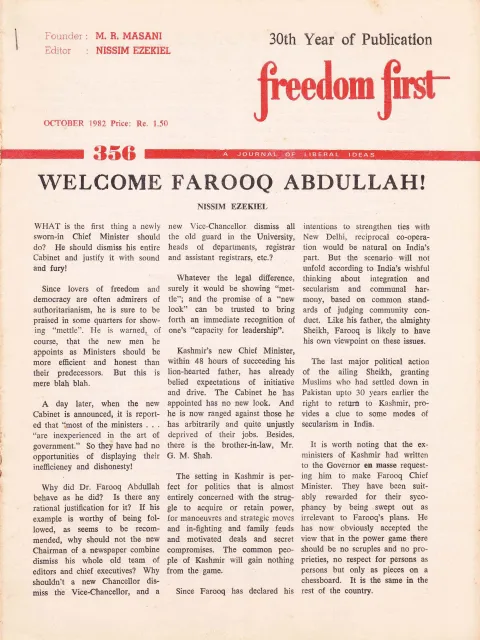
Welcome Farooq Abdullah!
By Nissim Ezekiel
Nissim Ezekiel’s front-page editorial, ‘Welcome Farooq Abdullah!’, is a sarcastic attack on the new Jammu & Kashmir Chief Minister’s decision to sack his father’s entire cabinet within 48 hours of succeeding Sheikh Abdullah. Ezekiel likens this to a general Indian pattern of new leaders (university vice-chancellors, newspaper chairmen) purging predecessors’ appointees under the guise of showing ‘mettle’, regardless of competence. He notes the removed ministers had themselves begged the Governor to install Farooq, and were rewarded with dismissal as a demonstration that in the pursuit of power there is ‘no respect for persons as persons but only as pieces on a chessboard’ — a pattern he says is ‘the same in the rest of the country’. He closes by linking this to Sheikh Abdullah’s final major act (allowing Muslims who had resettled in Pakistan to return to Kashmir) as a case study in the limits of Indian secularism.
- Farooq Abdullah dismissed his entire cabinet within 48 hours of becoming J&K Chief Minister, following his father Sheikh Abdullah.
- Ezekiel frames this as evidence of a wider Indian tendency to equate ruthless purges with demonstrating leadership ‘mettle’.
- The dismissed ministers had themselves petitioned the Governor en masse to make Farooq Chief Minister, and were purged regardless.
- Ezekiel draws a parallel to Farooq’s brother-in-law G. M. Shah, who was also sidelined.
- He questions whether Farooq’s likely push for closer ties with New Delhi will proceed smoothly given Kashmir’s realpolitik.
- The piece closes on Sheikh Abdullah’s decision to let long-settled Muslims return from Pakistan as a comment on Indian secularism.
A Variety of Comment (Palestinian Excesses; Press Freedom; Intellectuals in China)
By K. S. Venkateswaran
K. S. Venkateswaran’s ‘A Variety of Comment’ column covers three unrelated items. First, on ‘Palestinian Excesses’, he argues that international media narratives sympathetic to departing PLO fighters in Lebanon ignore first-hand Lebanese testimony (from Muslim, Christian, and Shiite residents of Sidon) describing PLO abuses — harassment, theft, and violence — that made the occupation itself feel like a relief to be rid of. Second, on ‘Press Freedom’, he criticizes the Indian press’s opportunistic outrage over the Bihar Press Bill as inconsistent given many journalists’ own history of servility during the Emergency, while still concluding that some restriction of government overreach on press freedom is necessary. Third, on ‘Intellectuals in China’, he notes the comparative silence of the global human-rights movement on Chinese intellectuals’ persecution under Mao, quoting an American commentator’s candid admission that Cold War-era sympathy for Chinese communism blinded Western scholars to its cruelties.
- First-hand Lebanese accounts described PLO forces’ abuses in Beirut/Sidon — harassment, theft, and violence — contradicting sympathetic media narratives about the PLO’s exit.
- Venkateswaran criticizes Indian journalists’ selective, ad hoc opposition to the Bihar Press Bill given their own compromised record during the Emergency.
- He nonetheless argues some restrictions on the press are a ‘necessary evil’ if abuses of media freedom by proprietors are to be checked.
- Global human rights attention has neglected the persecution of intellectuals in China relative to other authoritarian regimes.
- An American literary commentator is quoted attributing this neglect to Cold War-era sympathy for Chinese Communism overriding concern for persecuted intellectuals.
Peking’s Foreign Relations
By Rama Swarup
Rama Swarup’s ‘Peking’s Foreign Relations’ analyzes a classified Red Chinese internal briefing paper (from January 1980) said to reveal candid party thinking behind China’s foreign policy. The piece argues China’s alignment with the US since the 1971 ping-pong diplomacy and 1979 normalization was a matter of strategic necessity against the Soviet Union, intensified by the 1969 Sino-Soviet border clashes and 1979 Soviet invasion of Afghanistan. It describes China playing multiple ‘cards’ simultaneously — an ‘American card’ against the USSR, an occasional hint of a ‘Soviet card’ to pressure Washington on Taiwan arms sales, and a ‘Europe-Japan card’ to diversify weapons and technology suppliers — while insisting there is ‘no room for compromise’ on ending US arms sales to Taiwan. The document also frames China’s modernization drive as a core consideration shaping its foreign-policy engagement with the West.
- A classified January 1980 Red Chinese internal briefing paper is the source for the analysis.
- China’s rapprochement with the US (1971 ping-pong diplomacy to 1979 normalization) is framed as strategic necessity against Soviet military build-up.
- The 1969 Sino-Soviet border clashes and 1979 Afghanistan invasion are cited as key breaking points ending any sense that the Sino-Soviet split was merely ideological.
- China is described as playing an ‘American card’, a latent ‘Soviet card’, and a ‘Europe-Japan card’ simultaneously in its diplomacy.
- China demands an end to US arms sales to Taiwan with ‘no room for compromise’, even as it courts American, European, and Japanese weapons and technology suppliers for modernization.
Voices-1: A Boy Named Satyam
By Geeta Doctor
Geeta Doctor’s ‘Voices-1: A Boy Named Satyam’ is a reported personal narrative from a hill-country car trip in Sri Lanka, describing an escalating roadside encounter with a group of children (tourism-industry flower-sellers) near Nuwara Eliya, centered on one boy selling Gerbera flowers who chases the car across several hairpin bends demanding five rupees. The piece dwells on the discomfort and guilt the narrator feels at the mix of desperation, performance, and commerce in the children’s begging, culminating in a final exchange where the boy, who says he is an orphan named ‘Satyam’ (Truth), refuses to simply be given money and insists on completing the flower transaction, leaving the narrator with the sense of having failed him even in the moment of paying him what he demanded.
- Sri Lanka’s tourism boom in the hills around Nuwara Eliya coexists with a declining tea industry, itself hurt by drought and deforestation.
- A group of poor children, led by a boy holding Gerbera flowers, pursue the narrator’s car across several hairpin turns demanding five rupees.
- The narrator feels increasing guilt and unease at the desperation on display, comparing it to a ‘beggar’s chant’.
- The boy refuses an unconditional handout and insists on completing the flower sale for the full five rupees he named.
- The boy identifies himself as an orphan named Satyam, meaning ‘Truth’ — the narrator ends feeling they ‘cheated him of his victory’ by finally paying rather than continuing to refuse.
Voices-2: A Wonder Tree
By V. V. Deshpande
V. V. Deshpande’s ‘Voices-2: A Wonder Tree’ is a promotional, semi-technical essay on Leucaena leucocephala (known in India as ‘Su-Babul’), advocating its mass cultivation for rural development. It describes the tree’s fast growth, nitrogen-fixing properties, and multiple uses (firewood, fodder, timber, paper pulp, cocoa-like drink, soil reclamation), and lists policy measures needed for large-scale adoption — crash nurseries, seed import licences, bank financing, and inter-departmental coordination — noting that the Government of India plans to import 2.5 tonnes of seed over five years and that Maharashtra has adopted the tree for its social forestry programme with per-village and per-taluka planting targets.
- Leucaena leucocephala (‘Su-Babul’ in India) is promoted as a fast-growing (up to 65 feet in four years), multi-use tree for rural development.
- Uses cited include firewood, animal fodder, timber, paper pulp, a cocoa-like drink, nitrogen fixation for soil, and reclamation of saline lands.
- The Government of India is reported to plan importing 2.5 tonnes of Leucaena seed over the next five years.
- Maharashtra Government has adopted it for social forestry, targeting five lakh trees per taluka and 2,000 trees per village.
- Maharashtra State Cooperative Bank and other banks are said to offer term loans of Rs. 2,000 per acre at 6% interest, repayable over five years.
Book Review: Domestic Roots of India’s Foreign Policy, 1947-1972 (by A. Appadorai)
By P. M. Kamath
P. M. Kamath reviews A. Appadorai’s ‘Domestic Roots of India’s Foreign Policy, 1947-1972’ (Oxford University Press, 1981). The review summarizes Appadorai’s central thesis that the old post-war dichotomy between domestic and foreign policy has collapsed amid growing interdependence and democratization, so that India’s foreign-policy choices (non-alignment, ties with the Arab world, support for Bangladesh’s secular liberation) are substantially explained by domestic factors — geography, the size of India’s Muslim population, and internal political currents — rather than by international structure alone. Kamath praises the book as a rare, well-documented Indian contribution to a subject otherwise dominated by Western national case studies, and reports Appadorai’s own indication that this is only an introductory study, with further work anticipated.
- Appadorai’s book argues the domestic/foreign-policy dichotomy that prevailed until WWII has become obsolete due to interdependence and democratization.
- Nehru’s Constituent Assembly remark, ‘External affairs will follow internal affairs,’ is cited as an early statement of this thesis.
- India’s Arab-friendly foreign policy is explained partly by the size of its Muslim population, per a 1967 Indira Gandhi observation.
- India’s support for the Bangladesh liberation war is linked to its likely effect on Indian Muslims’ domestic standing.
- A 1971 quote from Bangladesh Mission head H. R. Choudhury on secular nationhood is reproduced as evidence for the era’s mood.
- Kamath calls the book ‘a singular contribution’ to Indian IR literature and a ‘must’ for students and policymakers, and anticipates further volumes from Appadorai.
Book Review: In Defence of Press Freedom - Minute of Dissent to the Report of the Second Press Commission, 1982
By Mary Thomas
Mary Thomas reviews ‘In Defence of Press Freedom: Minute of Dissent to the Report of the Second Press Commission — 1982’ (A Statesman Publication, Calcutta), a dissenting report by four Press Commission members (Justice Sisir Kumar Mukherjea, Rajendra Mathur, Girilal Jain, and H. K. Paranjape) against the Commission majority’s recommendations. She lays out both sides’ positions on delinking newspaper ownership from other businesses, applying the MRTP Act, price-page schedules, and advertising limits, quoting the Majority’s view that dedicated newspaper owners are more likely to defend press principles against the Minority’s counter that owners should be willing to absorb losses for journalism’s sake. The review closes by endorsing some restriction on the press industry as a ‘necessary evil’ while criticizing the Minority’s implicit prioritization of commercial viability over stated ideals of press freedom, and references the contemporary Bihar Press Bill controversy as a related test case.
- The Minute of Dissent was authored by four Second Press Commission members: Justice Sisir Kumar Mukherjea, Rajendra Mathur, Girilal Jain, and H. K. Paranjape.
- Cushrow Irani’s Preface states the dissenters ‘disagree thoroughly’ with the Majority Report’s assumptions and conclusions.
- Majority recommendations include delinking newspapers from other businesses, MRTP Act coverage, a price-page schedule, and advertising-space limits tied to circulation.
- The Minority opposes the price-page schedule and import duty on newsprint but accepts a progressive tax on advertisement revenue.
- Both Majority and Minority favour an outside Advisory Board overseeing editorial appointments, though they differ on how its members should be chosen.
- The review situates the debate against the ongoing Bihar Press Bill controversy as evidence some press restriction may be a ‘necessary evil’.
Generated by the v1.5 extraction pipeline. Awaiting editorial review.
Metadata and summary are AI-extracted from the source PDF and reviewed for editorial accuracy. The original work is available via the Read PDF tab above (where present); paragraph-level citation inside the PDF is deferred to a future engagement.