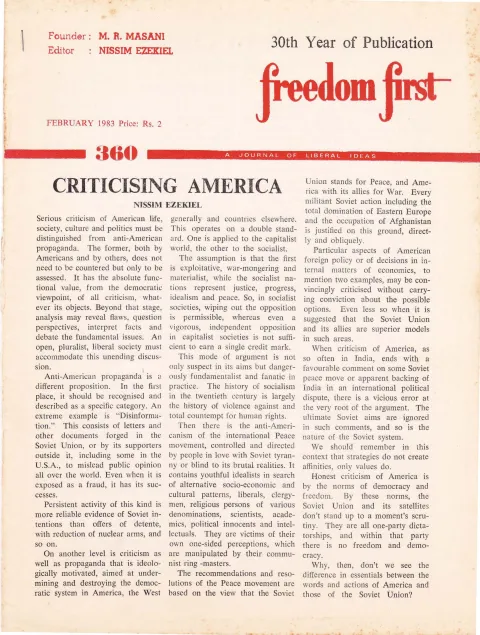
periodical issue
Freedom First
A Journal of Liberal Ideas
By Minoo Masani, Arvind Deshpande
Published for the Democratic Research Service by J. R. Patel, Associate Editor, Freedom First at 127, Mahatma Gandhi Road, Bombay 400 023 (Phone: 273914) and Printed by him at The Popular Press (Bom.) Pvt. Ltd, 35C Tardeo Road, Bombay 400 034 · Bombay · 1983
16 pages
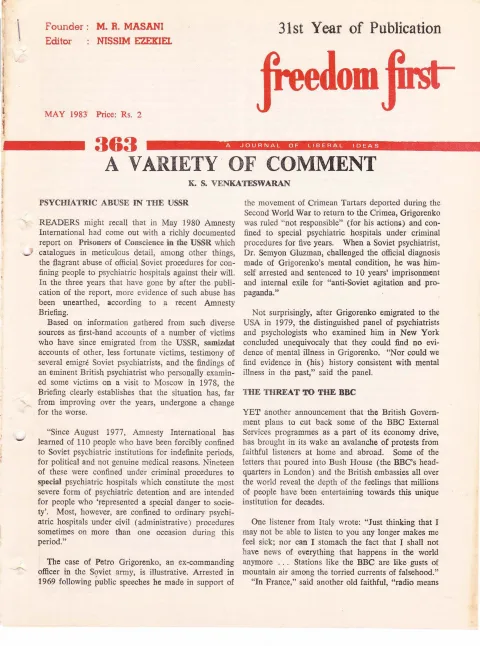
Freedom First
Summary
Freedom First No. 363 (May 1983) is a monthly issue of the Bombay-based liberal journal founded by M. R. Masani, edited by Nissim Ezekiel. Across its rendered 16 pages it runs the regular “A Variety of Comment” column by K. S. Venkateswaran (on Soviet psychiatric abuse, threatened BBC External Services cuts, and child malnutrition in the developing world, citing Nani Palkhivala and UNICEF), a short trade-policy piece on the India-USSR trade impasse by “Sagittarius,” Minoo Masani’s regular “As I See It” column (an obituary tribute to Constantine FitzGibbon, warnings about Vietnamese-communist expansion into Thailand and Indira Gandhi’s stance as Non-Aligned Movement chair, and commentary on octroi as a regressive local tax and on capital punishment in the Joshi-Abhyankar murder case), a reprinted Bernard Levin essay from The Times of London arguing Marx bears responsibility for the tyrannies enacted in his name, a note on a change of editorship at the journal Opinion, two book reviews (of Modern Liberalism, edited by Frits Bolkestein, reviewed by Mehra Masani; and of Lawrence Lader’s Power on the Left, reviewed by Nitin G. Raut), a reader’s letter on the Bombay textile strike, and the back-page “With Many Voices” quotations column. The issue is padded with numerous full-page commercial advertisements (Walchand Group, Mukand Steel, Orient Fans, Raymond suitings, Godrej Cinthol, Kaycee Industries, Brakes India, Consolidated Coffee, Sundaram Finance, Nachiketa Publications) typical of the magazine’s format.
Key points
-
K. S. Venkateswaran’s “A Variety of Comment” covers continued Soviet psychiatric confinement of dissidents such as Petro Grigorenko, proposed BBC External Services cuts, and UNICEF’s finding that roughly 40,000 children die daily from malnutrition.
-
Writing as “Sagittarius,” a piece on “Indian Aid to USSR?” argues the Soviet Union, having honoured only 40 per cent of its trade commitments against India’s 70 per cent, is effectively receiving short-term aid from India and threatening jobs in export industries like Ludhiana hosiery.
-
Minoo Masani’s “As I See It” mourns novelist Constantine FitzGibbon, warns that Vietnamese-backed forces threaten Thailand after Laos and Cambodia, and opposes abolishing octroi while supporting the death sentence in the Joshi-Abhyankar murder case.
-
Bernard Levin’s reprinted essay “Karl Marx: The Tyranny that Feeds on his Name” argues Marx’s personal intolerance and the doctrine of the dictatorship of the proletariat gave later dictators, from Lenin to Castro, the intellectual scaffolding for repression.
-
Mehra Masani reviews “Modern Liberalism,” Frits Bolkestein’s collection of interviews with European liberal politicians including Minoo Masani, summarising shared liberal commitments to individual freedom, decentralisation and scepticism of both unrestrained laissez-faire and the welfare state.
-
Nitin G. Raut reviews Lawrence Lader’s “Power on the Left: American Radical Movements since 1946,” criticising the author’s own sympathy for radicalism as a source of bias in the account.
-
A satirical reader’s letter from C. Cardoz, S. S. Bankeshwar, Saby Pinto and P. M. Dias proposes an ironic five-point “formula” mocking the standard face-saving pattern by which the ongoing Bombay textile strike would eventually be withdrawn.
Essays
A Variety of Comment
By K. S. Venkateswaran
K. S. Venkateswaran’s regular column covers three unrelated items of liberal commentary: continuing Soviet abuse of psychiatric confinement against dissidents (citing Amnesty International’s follow-up briefing and the case of Petro Grigorenko), British government proposals to cut BBC External Services language broadcasts and the international backlash against the cuts, and the scale of child malnutrition in developing countries as reported by UNICEF, with Nani Palkhivala’s warning that proposed changes to Sections 35CC/35CCA of the Income Tax Act would harm India’s rural development funding.
- Amnesty International’s follow-up briefing documents continued Soviet confinement of political dissidents to psychiatric hospitals under criminal procedures.
- Petro Grigorenko, an ex-Soviet army officer, was ruled ‘not responsible’ and confined for five years; the psychiatrist who challenged his diagnosis, Dr. Semyon Gluzman, was himself imprisoned for 10 years.
- A panel of American psychiatrists who examined Grigorenko after his 1979 emigration found no evidence of mental illness.
- Britain’s proposed BBC External Services cuts to seven language broadcasts (French, Italian, Spanish, Somali, Portuguese, Maltese, Burmese) drew an international outcry from listeners.
- UNICEF’s ‘State of the World’s Children’ report states roughly 40,000 children die daily from malnutrition and related disease.
- Nani Palkhivala warned that proposed Income Tax Act changes (Sections 35CC, 35CCA) would politicize rural development funding by forcing contributions through the Prime Minister’s Rural Development Fund.
- Nutritionist Dr. C. Gopalan’s estimate: of 23 million children to be born in India in 1983, 20 million were expected to be physically or mentally impaired by malnutrition.
Indian Aid to USSR?
By “Sagittarius”
Writing under the pseudonym ‘Sagittarius,’ this short piece argues that the Soviet Union, not India, is responsible for a trade impasse: the USSR has contracted for only about 40% of its annual purchase commitments from India (versus India fulfilling roughly 70% of its own commitments), creating unemployment in export-oriented Indian industries such as Ludhiana hosiery and the Kandla Free Trade Zone. The author contends the USSR’s claimed Rs. 500 crore trade deficit is really a form of ‘reverse aid’ from India, and calls on the Indian government to press the USSR to honor its trade protocol obligations, particularly on crude oil, petroleum products, and fertilizers.
- The USSR signed contracts for only about 40% of its Rs. 1800 crore annual purchase commitment, versus India’s roughly 70% fulfillment.
- The Soviet-claimed trade deficit is characterized as effectively a short-term loan/aid from India to the USSR.
- Indian export industries (Ludhiana hosiery, Kandla Free Trade Zone) face unemployment risk from the Soviet embargo-like behavior.
- The article calls for the Indian government to press the USSR against a total purchase embargo, especially on woollen hosiery, cashewnuts, and carpets.
- The USSR is criticized for failing to supply crude oil, petroleum products, and fertilizers as obligated under the Annual Trade Protocol.
As I See It
By Minoo Masani
In this instalment of his regular column, Minoo Masani mourns the death of writer Constantine FitzGibbon, recalling their friendship since 1960 and FitzGibbon’s anti-communist novel ‘When The Kissing Had to Stop.’ He then turns to foreign policy, warning that the fall of South Vietnam to North Vietnamese forces set a ‘domino’ precedent that now threatens Thailand, and argues Indira Gandhi, as both Indian PM and chair of the Non-Aligned Movement, has an obligation to denounce Vietnamese aggression, noting Singapore’s Foreign Minister Dhanbalan has voiced disappointment at India’s silence. Masani closes with domestic commentary: he opposes abolition of octroi as a ‘pernicious’ regressive tax, endorses replacing it with a turnover tax or sales-tax surcharge as his own Masani Committee had recommended, and discusses capital punishment, expressing support for the President’s rejection of a clemency plea for four men sentenced to death in the Joshi-Abhyankar murders.
- Masani recalls his friendship with the late Constantine FitzGibbon, author of the anti-communist novel ‘When The Kissing Had to Stop.’
- He warns that after South Vietnam’s fall, North Vietnamese-backed forces threaten Thailand next, following Laos and Cambodia.
- He argues Indira Gandhi, as Non-Aligned Movement chair, is obligated to denounce Vietnamese aggression and break relations with the Heng Samrin regime in Cambodia.
- Singapore’s Foreign Minister Dhanbalan reportedly said Singapore would be disappointed if India stays silent on the Thai incursion.
- Masani opposes abolition of octroi (a municipal entry tax) as regressive and corruption-prone, citing findings of the Keskar Committee and National Council of Applied Economic Research on enforced truck idling and fuel waste.
- The Masani Committee (chaired by him) had recommended octroi be discontinued and merged into general sales tax; he criticizes Maharashtra and Gujarat for foot-dragging on reform.
- He supports the President’s rejection of a clemency petition for four men convicted in the 1976 Joshi-Abhyankar family murders in Poona.
Karl Marx: The Tyranny that Feeds on his Name
By Bernard Levin
A reprint (courtesy The Times, London) of Bernard Levin’s essay arguing that Karl Marx bears real responsibility for the totalitarian regimes carried out in his name. Levin rejects the defence that Marxist states have ‘nothing Marxist about them,’ contending instead that Marx’s personal intolerance, his all-explaining historicist theory, and the doctrine of the dictatorship of the proletariat together supplied the intellectual scaffolding later dictators used to justify mass repression. He names Lenin, Stalin, Brezhnev, Ulbricht, Jaruzelski, Rakosi, Mao, and Castro as ‘not aberrations from Marxism, but its most perfect flowers.’
- Levin frames the paradox that nearly half the world lives under self-declared Marxist governments that are more repressive than any capitalist system, despite Marx’s stated goal of freeing the individual.
- He rejects the ‘no true Marxism’ defence used by Western apologists for communist tyranny.
- Marx’s personal intolerance of dissent within his own camp is cited as prefiguring later political purges.
- The theory of historicism — that history moves toward a predetermined end — is blamed for justifying ruthless suppression of perceived ‘enemies of the people.’
- The dictatorship of the proletariat, combined with Rousseau’s theory of a general will, gave rulers a ready justification for authoritarian rule in the proletariat’s supposed interest.
- Levin names specific rulers (Lenin, Stalin, Brezhnev, Ulbricht, Jaruzelski, Rakosi, Mao, Castro) as the fullest expression of Marxism rather than its betrayal.
Opinion — The New Look
By Arvind Deshpande
A brief editorial note announcing that Jehangir Patel became the new editor of the weekly Opinion starting with the February 1983 issue, succeeding A. D. Gorwala, who remains proprietor and continues to personally cover the publication’s deficit. The note, signed by Arvind Deshpande, pays tribute to Gorwala’s record of public service.
- Jehangir Patel became editor of Opinion starting with the February 1983 issue.
- A. D. Gorwala remains proprietor and continues to fund the publication’s deficit from personal income.
- The note expresses confidence that Patel will help the weekly achieve financial break-even.
Book Reviews: Modern Liberalism (Conversations With Liberal Politicians), ed. F. Bolkestein
By Mehra Masani
Mehra Masani reviews ‘Modern Liberalism’ (Conversations With Liberal Politicians), edited by Frits Bolkestein and published under the auspices of the Professor B. M. Telders Foundation. The book collects interviews with eight prominent European liberal politicians, including Giovanni Malagudi and Jo Grimond, and one Indian, Minoo Masani. The review summarizes shared liberal positions surfaced across the interviews: freedom as a fundamental right, primacy of the individual, decentralization, scepticism toward unrestrained laissez-faire alongside support for free enterprise, caution about the welfare state’s effect on personal responsibility, support for equality of opportunity without rigid quotas, and a cautious attitude toward trade unions and socialism. The review closes admiring the book’s production quality while criticizing Indian publishers’ comparatively poor standards.
- The book compiles interviews conducted by Fritz Bolkestein, Dutch Minister of Trade, with eight European liberal politicians and one Indian (Minoo Masani).
- Interviewees include Giovanni Malagudi (Italian liberal) and Jo Grimond, three of whom have been Presidents of Liberal International.
- Shared liberal positions identified: freedom as a fundamental human right, primacy of the individual, and support for decentralization of government.
- Liberals interviewed favour free enterprise and market economy but do not endorse complete laissez-faire, believing there is a role for public intervention balanced against individual autonomy.
- The liberal attitude toward the welfare state emphasizes individual responsibility over excessive security, warning that overreach breeds self-defeating bureaucracy.
- Masani is quoted specifically to note the Indian objection to non-brahmins being given hiring priority over qualified brahmins in Madras, ‘regardless of qualifications.’
- The review criticizes the poor production quality of Indian publishers by contrast with this book’s quality get-up and printing.
Book Reviews: Power on the Left. American Radical Movements since 1946 by Lawrence Lader
By Nitin G. Raut
Nitin G. Raut reviews Lawrence Lader’s ‘Power on the Left: American Radical Movements since 1946’ (W. W. Norton). The review summarizes the book’s chronicle of the American Left from the end of World War II through the more passive late 1970s, covering the 1946 anti-Communist backlash against labour, the persecution of figures like Henry Wallace and Vito Marcantonio, and the Congressional purge of Communists from American politics in the book’s chapters 5-7. Raut criticizes Lader’s evident sympathy for radicalism and Communism as biasing the account, and faults the author for failing to explain how the ‘New Left’ differs philosophically from the Old Left.
- The book traces changing ideological patterns of the American Left from orthodox communism to the New Left across the postwar decades.
- Chapter 1 covers ‘The Campaign against Labour and the Left, 1946,’ when American business and press branded anti-Communist labour leaders as themselves Communist.
- Chapters 2-3 discuss Congressman Vito Marcantonio being labelled Communist for espousing ethnic-minority causes, versus Henry Wallace, an actual Communist sympathizer who served in Truman’s administration.
- Chapters 5-7 cover the purge of Communists from American politics via what the reviewer calls ‘judicial persecution’ through Court indictments.
- Raut criticizes Lader’s own admitted participation in the 1946-1950 American Left as a source of bias in the book.
- Raut faults Lader for not explaining how the New Left differs philosophically from the Old Left, beginning only with the Berkeley campus revolt without addressing its causes.
A Letter: The Textile Strike
By C. Cardoz, S. S. Bankeshwar, Saby Pinto, P. M. Dias
A satirical reader’s letter signed by C. Cardoz, S. S. Bankeshwar, Saby Pinto, and P. M. Dias on the ongoing Bombay textile strike, arguing strikes have become a ‘nuisance’ that inevitably end without benefit to workers, and proposing a five-point ‘formula’ (no victimization, permanent status for badli workers, a cash advance, a salary increase, and arbitration by retired judges) framed ironically as the standard face-saving pattern by which strikes are always withdrawn.
- The letter argues strikes and morchas have become a recurring ‘nuisance’ in Bombay with no lasting benefit to workers.
- It claims 99% of strikes in the last thirty years have ended in total failure and humiliating withdrawal.
- The authors satirize standard justifications used for withdrawing strikes (appeals from leaders, no-victimization assurances).
- They propose a five-point formula to end the ongoing textile strike: no victimization, permanency for badli workers, a Rs. 2000 advance, a Rs. 100 salary increase, and referral of other disputes to retired judges.
Generated by the v1.5 extraction pipeline. Awaiting editorial review.
Metadata and summary are AI-extracted from the source PDF and reviewed for editorial accuracy. The original work is available via the Read PDF tab above (where present); paragraph-level citation inside the PDF is deferred to a future engagement.