periodical issue
Freedom First
A Journal of Liberal Ideas
By Minoo Masani
Published for the Democratic Research Service by J. R. Patel, Associate Editor, Freedom First at 127, Mahatma Gandhi Road, Bombay 400 023 (Phone: 273914) and Printed by him at The Popular Press (Bom.) Pvt. Ltd., 35C Tardeo Road, Bombay 400 034 · Bombay · 1983
16 pages
Freedom First
Summary
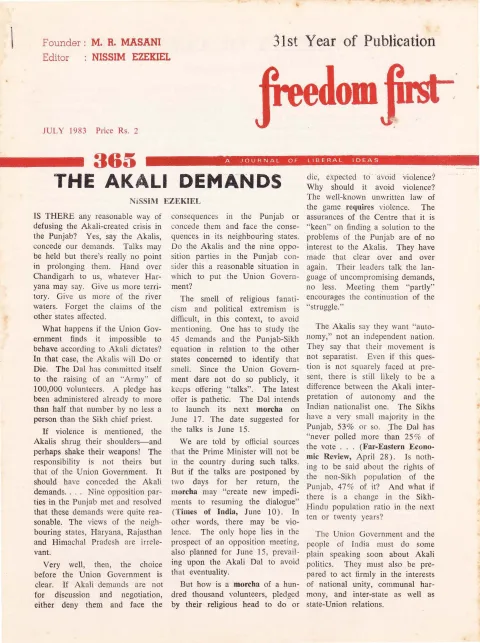
Freedom First issue 365 (July 1983) opens with Nissim Ezekiel’s editorial “The Akali Demands,” a hard-edged critique of the Akali Dal’s Punjab agitation, questioning the reasonableness of the party’s 45 demands and warning the Union Government against conceding under threat of violence. K. S. Venkateswaran’s regular “A Variety of Comment” column takes up Western foreign-aid orthodoxy (drawing on Peter Bauer and Basil Yamey), the endemic violence within the Arab world as a counter to conventional Middle East narratives, and Soviet destabilisation efforts in Southern Africa. The issue carries an extended extract from Bernard Levin’s Times interview with Alexander Solzhenitsyn on suffering, Western complacency, unilateral disarmament, and the coming struggle with communism. Minoo Masani contributes a reprinted Statesman column, “Two Cheers for the British Electorate,” analysing the June 1983 UK general election and the distortions of the first-past-the-post system. Anita Gupta’s “Freedom for Teachers” argues for greater professional autonomy for schoolteachers, and Nitin G. Raut reviews John Laffin’s book The P.L.O. Connection. A boxed notice announces Venkateswaran’s move from columnist to editor of the magazine, succeeding Ezekiel from the August 1983 issue. The issue closes with the “With Many Voices” quotations page and subscription details.
Key points
-
Nissim Ezekiel’s editorial “The Akali Demands” frames the Akali Dal’s Punjab agitation as non-negotiable maximalism, citing its pledge of a 100,000-strong volunteer “army,” and calls on the Union Government to act firmly for national unity.
-
K. S. Venkateswaran’s “A Variety of Comment” endorses Peter Bauer’s argument that foreign aid fails to relieve poverty, catalogues endemic violence within the Arab world independent of the Arab-Israeli conflict, and reports Soviet arms and funding to destabilise Southern Africa.
-
A boxed notice announces Nissim Ezekiel’s resignation as editor after three years, with K. S. Venkateswaran to succeed him from the August 1983 issue.
-
An extended extract from Bernard Levin’s Times interview with Alexander Solzhenitsyn distinguishes universal suffering from Soviet oppression, criticises Western leaders like Willy Brandt and Olof Palme for weakening resistance to communism, and rejects unilateral nuclear disarmament as moral cowardice.
-
Minoo Masani’s “Two Cheers for the British Electorate” welcomes the Conservative landslide in the June 1983 UK election while deploring the first-past-the-post system’s distortion of the SDP-Liberal Alliance’s 26 per cent vote share into only 4 per cent of seats.
-
Anita Gupta’s “Freedom for Teachers” argues that excessive rules and oversight have left schoolteachers “paid, but not trusted,” calling for the autonomy enjoyed by public-school teachers to be extended more broadly.
-
Nitin G. Raut reviews John Laffin’s “The P.L.O. Connection,” recounting an anecdote of Yasser Arafat wringing a chicken’s neck and concluding the PLO Covenant explicitly aims at the destruction of Israel rather than genuine national liberation.
Essays
The Akali Demands
By Nissim Ezekiel
Nissim Ezekiel’s lead editorial argues there is no reasonable way to defuse the Akali-created crisis in Punjab short of capitulation, since the Akali Dal treats any partial concession as encouragement to continue its “struggle.” He lays out the Dal’s demands (handover of Chandigarh, more territory, more river waters) and its threat of a 100,000-strong volunteer “army,” and questions whether the movement is truly non-separatist given the Sikhs’ minority status (about 53% of Punjab’s population) in the state. He calls on the Union Government to act firmly in the interests of national unity and communal harmony.
- Frames the Akali Dal’s demands as non-negotiable maximalism rather than a basis for talks
- Notes the Dal’s pledge of a 100,000-volunteer ‘Army’ administered by the Sikh chief priest
- Cites the Far Eastern Economic Review (April 28) figure that the Dal has never polled more than 25% of the vote
- Questions the claim that the Akali movement is not separatist given Punjab’s near-even Sikh-Hindu population split (53%/47%)
- Criticises the Union Government’s offer of talks as pathetic and warns that further postponement risks violence
- Calls for firm government action to protect national unity, communal harmony, and inter-state relations
A Variety of Comment (The Myths About Aid; Violence in the Middle East; Soviet Meddling in Southern Africa)
By K. S. Venkateswaran
K. S. Venkateswaran’s “A Variety of Comment” column covers three subjects. First, he endorses Peter Bauer and Basil Yamey’s Times argument that official foreign aid has failed to relieve Third World poverty or win goodwill for the West, applying the thesis to India’s own decades of aid receipt. Second, drawing on a Wall Street Journal article by Benjamin Netanyahu, he argues that violence is endemic to the Arab world independent of the Arab-Israeli conflict, citing military rule and repression across Egypt, Libya, Algeria, Morocco, Saudi Arabia, Syria, Jordan and Iraq, and criticises Western commentary for focusing exclusively on Israeli ‘recalcitrance.’ Third, he cites a Pretoria government study published in The Star (May 21) quantifying Soviet military and financial support to Angola, Zimbabwe, Mozambique, Tanzania and Botswana, and the resulting civilian and armed-personnel death toll from Soviet-trained terrorist groups in the region, while acknowledging South Africa’s own abuses.
- Cites Peter Bauer and Basil Yamey’s Times article arguing official aid neither relieves poverty nor buys Western goodwill
- Applies Bauer’s thesis to India, questioning whether three decades of foreign aid improved living standards for the poor
- Draws on a Benjamin Netanyahu Wall Street Journal article cataloguing endemic Arab-on-Arab political violence and military rule
- Argues Western discourse wrongly focuses solely on Israeli ‘recalcitrance’ while ignoring intra-Arab repression
- Reports a Pretoria-government study (published in The Star, May 21) quantifying Soviet arms and funding to Angola, Zimbabwe, Mozambique, Tanzania and Botswana
- Cites casualty figures: at least 40,000 civilians and 83,000 armed personnel dead over five years, and R690 million in sabotage costs to Southern Africa
- Cautions that highlighting Soviet destabilisation does not excuse Pretoria’s own domestic and regional abuses
Levin Interviews Solzhenitsyn
A short boxed editorial notice, signed by M. R. Masani as Chairman of the Democratic Research Service, announces that Nissim Ezekiel has resigned as editor of Freedom First after more than three years, citing the burden of academic work and frequent absences from Bombay, though he remains on the Editorial Board and will continue to write. K. S. Venkateswaran, already familiar to readers through his “Variety of Comment” column, will take over as editor from the August 1983 issue.
- Announces Nissim Ezekiel’s resignation as editor after three-plus years, due to academic workload and absences from Bombay
- Ezekiel remains on the Editorial Board and will continue writing for the journal
- K. S. Venkateswaran appointed as incoming editor effective the August 1983 issue
- Notice signed by M. R. Masani, Chairman, Democratic Research Service
Two Cheers for the British Electorate
By Minoo Masani
An extended extract, reprinted with acknowledgement to the Times (London) and journalist Bernard Levin, from Levin’s interview with Alexander Solzhenitsyn. Solzhenitsyn distinguishes suffering (universal and potentially redemptive) from oppression (as in the USSR, which he says exceeds ordinary suffering and has spiritually strengthened its survivors while making him more pessimistic about the West’s resolve). He argues war in some form is inevitable, criticises Western leaders (naming Brandt, Palme, and Papandreou) for weakening resistance to communism, and argues unilateral nuclear disarmament reflects moral cowardice and a failure to recognise the Soviet Union and Comintern’s decades-old declared hostility to the West, tracing this back to 1917 Bolshevik funding of demonstrations and Stalin’s peace-movement financing.
- Solzhenitsyn distinguishes universal, potentially redemptive suffering from the singular horror of Soviet oppression
- Says nine years in the West have made him a pessimist about Western resolve against communism, contrary to his expectations from the East
- Argues freedom and oppression cannot be transferred between peoples merely through literature; only lived experience truly conveys it
- Considers a form of war (including internal ‘liberation wars’) inevitable, and criticises Willy Brandt, Olof Palme and Andreas Papandreou for weakening Western resistance
- Attacks the Western unilateral disarmament movement as concealing moral cowardice and ignoring decades of Soviet organisational involvement in peace movements, tracing this back to Lenin, Trotsky and the 1919 Comintern
- Rejects ‘better red than dead’ as a false choice, arguing surrender to communism means a ‘slow death’ as ‘moribund slaves’
Freedom for Teachers
By Minoo Masani
Minoo Masani, writing in a piece reprinted from The Statesman (Calcutta), analyses Britain’s June 9, 1983 general election. He welcomes the Conservative landslide and Labour’s rout as evidence of Labour’s obsolescence as a ‘19th century socialist party,’ but deplores that the SDP-Liberal Alliance won 26% of the vote yet only 4% of seats under first-past-the-post, comparing this distortion to India’s own electoral system. He credits Thatcher’s re-election with enabling continued fiscal discipline, privatisation of loss-making public enterprises, and a firm anti-Soviet alliance with Reagan, and argues Britain’s working class has become largely bourgeois in values.
- Welcomes the Conservative landslide and Labour’s defeat as confirmation that Labour has become an obsolete ‘19th century socialist party’
- Deplores the Alliance’s 26% vote share yielding only 4% of Commons seats, and draws a parallel to India’s own first-past-the-post distortions
- Notes that on second-place finishes, Roy Jenkins would today be Prime Minister
- Credits Thatcher’s re-election with enabling trade union reform, privatisation of ‘white elephant’ public enterprises, and a firm Reagan-aligned anti-Soviet stance
- Argues British society has undergone a values shift, with the working class merging into a bourgeois middle class
- Cites Bernard Levin’s Times argument for the value of a non-socialist parliamentary alternative to Conservatism
Book Review: The P.L.O. Connection by John Laffin (Corgi Books)
By Nitin G. Raut
Anita Gupta reflects on judging school magazines and the talented young contributors she encountered, using this as a springboard to argue that education has become overly confused with instruction and hemmed in by rules, leaving teachers ‘paid, but not trusted.’ She contrasts the relative liberty enjoyed by public (boarding) school teachers with the constant oversight faced by teachers in primary and city schools, and argues that granting teachers greater autonomy and status, akin to public-school freedom, would improve both morale and educational outcomes, while acknowledging the risk that some teachers might abuse such freedom.
- Opens with an anecdote about judging school magazines and the talent of contributors aged roughly ten to sixteen
- Argues education has been wrongly reduced to instruction, and that excessive rules and oversight strangle teachers’ judgment
- Contrasts the relative freedom of public/boarding school teachers with the surveillance faced by city and primary school teachers
- Calls for exempting good teachers from excessive supervision and increasing their status and authority rather than only their pay
- Acknowledges the risk that removing supervision is a ‘gamble’ since some teachers are simply bad, but argues liberty would improve most
- Concludes that historically it was the autonomous school-master who built the foundation of an educated country
With Many Voices (quotations column)
Nitin G. Raut reviews John Laffin’s The P.L.O. Connection (Corgi Books), praising it as a well-compiled, thoroughly researched exposure of the PLO’s organisation, ideology, propaganda, terrorist methods and diplomatic strategy. The review recounts Laffin’s account of Yasser Arafat’s brutality (illustrated by an anecdote of Arafat wringing a chicken’s neck to demonstrate the mindset behind the Munich massacre), the PLO’s disunity as a coalition of Arab-state-sponsored factions, its well-funded international propaganda campaign, and its explicit commitment via the PLO Covenant to the destruction of the State of Israel rather than genuine national liberation.
- Describes Laffin’s book as unmasking ‘The Many Faces of the PLO’ and its network of international terror
- Recounts an anecdote of Arafat wringing a chicken’s neck during a personal conversation with Laffin, illustrating the ruthlessness behind the Munich massacre
- Notes the PLO’s estimated £1,000 million annual income, funded by Arab states for mixed motives including insurance against PLO extremism
- Highlights chapters on ‘The Multi-Barrel Propaganda Weapon’ and ‘The European Connection’ describing the PLO’s propaganda success in Europe
- Recounts Laffin’s chapter on PLO terrorist training (‘Schools for Terror’) as systematic and professionalized
- Concludes the book exposes the PLO Covenant’s explicit aim as the annihilation of the State of Israel, not liberation
Generated by the v1.5 extraction pipeline. Awaiting editorial review.
Metadata and summary are AI-extracted from the source PDF and reviewed for editorial accuracy. The original work is available via the Read PDF tab above (where present); paragraph-level citation inside the PDF is deferred to a future engagement.