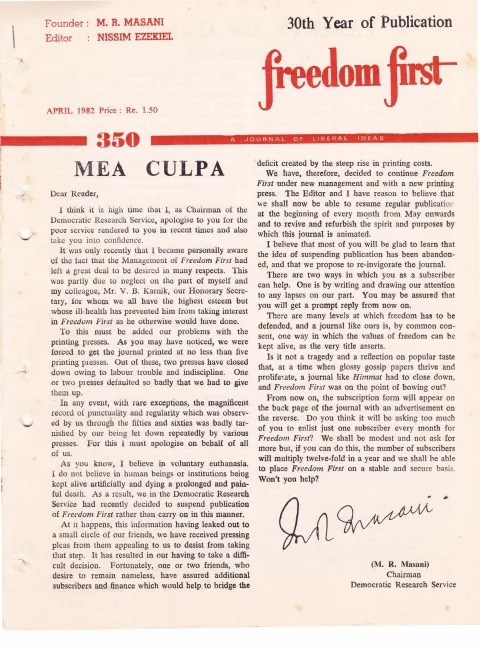
periodical issue
Freedom First
A Journal of Liberal Ideas
By Minoo Masani
Published for the Democratic Research Service by J. R. Patel, Associate Editor, Freedom First at 127, Mahatma Gandhi Road, Bombay 400 023 (Phone: 273914) and Printed by him at The Popular Press (Bom.) Pvt. Ltd., 35C Tardeo Road, Bombay 400 034 · Bombay · 1983
16 pages
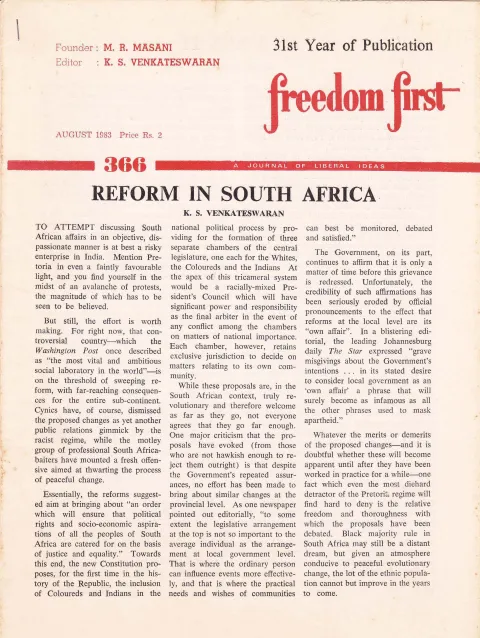
Freedom First
Summary
Freedom First No. 366 (August 1983) is the monthly issue of the Bombay-based liberal journal, edited by K. S. Venkateswaran with M. R. Masani as founder. The issue opens with an editorial on constitutional reform proposals in apartheid-era South Africa, then runs Masani’s regular “As I See It” column reflecting on the Pope’s second visit to Poland, the Solidarity movement, and the newly formed International Democratic Union of conservative parties. The remaining articles form a strongly anti-Soviet cluster: a critique of Soviet agricultural failure and dependence on Western grain imports, a history of the Soviet secret police from the Cheka to the KGB under Andropov, and a report on continued Soviet economic exploitation of occupied Afghanistan. The issue closes with a review of Bruce Grant’s book on Indira Gandhi-era India and the 1975 Emergency (with a comparison to Australia’s 1975 constitutional crisis), and the recurring “With Many Voices” page of quotations.
Key points
-
K. S. Venkateswaran’s editorial “Reform in South Africa” examines proposed constitutional reforms creating a tricameral legislature for Whites, Coloureds and Indians, noting critics call the changes cosmetic since they stop short of local government.
-
Minoo Masani’s “As I See It” reflects on the Pope’s second visit to Poland and the Solidarity movement, and reports the founding of the International Democratic Union of conservative parties in London, joining Thatcher, Kohl and Chirac.
-
S. K. Bain’s “Soviet Agriculture” documents the USSR’s growing grain-import dependence and a decline in output since 1978, attributing the crisis to centralised planning, poor incentives and bureaucratic waste.
-
Juan Fercsey’s “The Frightening Story of the Soviet Secret Police” traces the lineage of the Soviet secret police from Dzerzhinsky’s 1917 Cheka through the KGB under Yuri Andropov, noting most of its chiefs were themselves eventually purged.
-
Rama Swarup’s “Continued Soviet Exploitation of Afghanistan” reports the collapse of Afghan tax revenue, Mujahiddin destruction of much of the country’s infrastructure, and Soviet extraction of over 95 per cent of Afghan natural gas output.
-
M. R. Masani reviews Bruce Grant’s “Gods and Politicians,” disputing its claim that Moscow backed Delhi against China in 1962 and arguing the true parallel to Australia’s 1975 dismissal of Gough Whitlam is between Whitlam and Indira Gandhi as populists, not between Governor-General Kerr and Gandhi’s imprisonment of Morarji Desai and Jayaprakash Narayan.
Essays
Reform in South Africa
By K. S. VENKATESWARAN
K. S. Venkateswaran’s editorial examines South Africa’s proposed constitutional reforms, which would create a tricameral legislature with separate chambers for Whites, Coloureds, and Indians under a racially-mixed President’s Council. The piece surveys criticism that the reforms are cosmetic and do not extend to the provincial and local levels where ordinary citizens engage most with government, quotes the Johannesburg daily The Star’s skepticism about the government’s promises, but concludes that the debate itself, conducted with unusual freedom for South Africa, may improve conditions for the country’s population over time even though black majority rule remains a distant prospect.
- Proposes a tricameral parliament for Whites, Coloureds, and Indians, with a racially-mixed President’s Council as final arbiter.
- Critics say the reform stops short because similar changes have not been extended to provincial and local government.
- The Johannesburg daily The Star is quoted expressing ‘grave misgivings’ about the government treating local government as its ‘own affair’.
- The author argues the relative freedom and thoroughness of the public debate is itself notable, whatever the reforms’ ultimate merits.
As I See It
By MINOO MASANI
Minoo Masani’s ‘As I See It’ column reflects on Pope John Paul II’s second visit to Poland and its entanglement with the Solidarity movement led by Lech Walesa, discussing a controversy over an article in the Vatican paper L’Osservatore Romano suggesting the Pope had advised Walesa to step down. Masani surveys Western press reaction (the Guardian, William Safire in the Times) and notes General Jaruzelski’s receipt of the Order of Lenin in Moscow as a sign the Kremlin is satisfied with its ‘stooge.’ The column closes with a note on the founding, in London on 24 June 1983, of the International Democratic Union, an international federation of conservative parties involving Margaret Thatcher, Helmut Kohl, Jacques Chirac, and George Bush, which the London Times wryly dubbed the ‘Conintern.’
- Discusses the Pope’s second visit to Poland and his moral rather than military approach to confronting Soviet-controlled Eastern Europe.
- Covers the controversy over an Osservatore Romano article suggesting the Pope urged Lech Walesa to step down as Solidarity leader, which both the Pope and Walesa denied.
- Notes Jaruzelski’s Order of Lenin as evidence the Kremlin approves of his handling of Poland.
- Reports the founding of the International Democratic Union in London on 24 June 1983, joining conservative parties including Thatcher’s Conservatives, Kohl’s Christian Democrats, and Chirac’s Gaullists.
- Observes that the Liberal International, of which Masani is a Patron, was founded in 1947, decades before this new conservative bloc.
Soviet Agriculture
By S. K. BAIN
S. K. Bain’s article on Soviet agriculture contrasts official Soviet self-congratulation about collective farming with the increasingly candid Soviet press acknowledgment of a deepening agricultural crisis. Drawing on Moscow’s own Soviet Union magazine and on the work of American food-policy expert Lester R. Brown, the piece documents the USSR’s growing dependence on grain imports (rising from the 1975 US-Soviet grain agreement to a projected 160,000 tons import target), a decline in agricultural output since 1978, and structural causes including centralised planning, lack of incentives, poor mechanization, and waste, concluding that the Soviet leadership’s ideological rejection of structural reform is a ‘dangerous self-made and self-sustained trap.’
- Soviet publications commemorating the USSR’s 60th anniversary conspicuously omit agriculture from their coverage of state achievements.
- The Soviet Union magazine admits ‘the USSR has the worst climate for crop farming’ and that returns from investment have been inadequate.
- Lester R. Brown’s study ‘U.S. and Soviet Agriculture: The Shifting Balance of Power’ is cited on the 1982 grain harvest shortfall and Soviet import needs of roughly 40 million tons of grain.
- Soviet agricultural output is said to have peaked 1975-1978 and declined since, a decline too pervasive to blame on weather alone.
- Centralised planning, lack of incentives, poor mechanization, and bureaucratic waste are identified as structural causes, contrasted with the individual-farmer model of US agriculture.
- The article warns that continued food import dependence threatens the legitimacy of Soviet leadership, citing reported work stoppages and consumer protests.
The Frightening Story of the Soviet Secret Police
By JUAN FERCSEY
Juan Fercsey’s article, credited to Antar-Sanchar, traces the history of the Soviet secret police from the Cheka founded by Feliks Dzerzhinsky in 1917 through its successive renamings (GPU, OGPU, NKVD/NKGB, MGB, KGB) under a chain of chiefs including Menzhinsky, Yagoda, Yezhov, and Beria, most of whom were themselves eventually purged and executed. The piece recounts the Cheka’s 1918 ‘Red Terror’ decree authorizing extrajudicial arrest and execution, the deaths of millions in farm collectivization and the 1930s purge trials, Beria’s assassination after Stalin’s death, and the organization’s modern form under Yuri Andropov, who led the KGB for fifteen years before becoming General Secretary, closing with a quote from journalist Brian Freemantle that ‘the Soviet Union needs the KGB because without it there would not be a Soviet Union.’
- Traces the secret police lineage: Cheka (1917) to GPU to OGPU to NKVD/NKGB to MGB to KGB (1954).
- The 1918 ‘Red Terror’ decree authorized the Cheka to arrest and execute suspects without courts or trials.
- Genrikh Yagoda’s OGPU/NKVD administered farm collectivization, with a death toll estimated between 3.5 and 5.5 million.
- Successive secret police chiefs (Yagoda, Yezhov, Beria, Abakumov, Merkulov) were themselves purged and executed, often in Lubyanka prison.
- Yuri Andropov headed the KGB for 15 years before becoming General Secretary, dedicating a monument to Dzerzhinsky in 1977.
- The article estimates the KGB employs 250,000 agents and calls it the largest espionage network and prison/labour-camp system in history.
Continued Soviet Exploitation of Afghanistan
By RAMA SWARUP
Rama Swarup’s article details continued Soviet economic exploitation of occupied Afghanistan as of the fifth anniversary of the Communist takeover in April 1983. It reports Prime Minister Soltan Ali Keshtmand’s admission that state property tax revenue collapsed from 280 million Afghanis (1978-79) to 16 million (1981-82), that the Mujahiddin have destroyed three-quarters of the country’s communications network and half its schools and hospitals, and that Kabul is increasingly dependent on Soviet grain imports (projected at 160,000 tons in 1983) and high-interest Soviet loans. The piece also describes Soviet extraction of natural gas (over 95% of Afghan gas production consumed by the USSR) and secretive uranium prospecting near Herat, concluding that Moscow has ‘shown that they know how to assure their own interests and their own strategic goals’ regardless of Afghanistan’s economic collapse.
- Afghan PM Soltan Ali Keshtmand admits the state can no longer levy property taxes effectively; revenue fell from 280 million Afghanis (1978-79) to 16 million (1981-82).
- Mujahiddin resistance has destroyed three-quarters of Afghanistan’s communications network and half its schools, hospitals, and power stations.
- Afghan grain imports from the Soviet Union are projected to reach 160,000 tons in 1983, up from 74,000 tons in 1981.
- The Soviet ‘scorched earth’ policy of destroying harvests is described as an attempt to starve out the freedom-fighters.
- The USSR is reported to consume over 95% of natural gas produced at the Jarqaduq and Khwaja Gogerdak fields in northern Afghanistan.
- Secretive uranium prospecting near Herat and Shinand, with ore reportedly helicoptered into the Soviet Union, is also reported.
Book Review: Gods and Politicians by Bruce Grant; Allen Lane; 1982; Pp. 198
By M. R. Masani
M. R. Masani reviews Bruce Grant’s ‘Gods and Politicians’ (Allen Lane, 1982), based on Grant’s tenure as Australian High Commissioner to India from 1973-76. Masani praises Grant as a good raconteur but faults his claim (drawing on A. G. Noorani’s 1965 Opinion article and a Peking People’s Daily editorial) that Moscow supported Delhi against China in 1962, when in fact Khrushchev was shown to have privately endorsed the Chinese position before the attack. Masani’s central objection is to Grant’s parallel between the Australian constitutional crisis of 1975 (Governor-General Sir John Kerr’s dismissal of PM Gough Whitlam) and India’s 1975 Emergency under Indira Gandhi, arguing the true parallel is between Whitlam and Gandhi as populist leaders who treated heads of state as rubber stamps, not between Kerr’s principled dismissal of Whitlam and Gandhi’s unconstitutional imprisonment of Morarji Desai and Jayaprakash Narayan without trial.
- Grant’s book covers his 1973-76 tenure as Australian High Commissioner to India and treats Indian politics with what Masani calls fairness bordering on over-forgiveness.
- Grant errs in claiming Moscow backed Delhi against China in 1962; Masani cites A. G. Noorani’s 1965 Opinion article and a Peking People’s Daily editorial showing Khrushchev privately endorsed China’s position days before the attack.
- Masani argues President Fakhruddin Ali Ahmed should have dismissed Indira Gandhi and called elections in June 1975, just as Governor-General Kerr dismissed Whitlam in Australia — but the Indian President did not act.
- Masani’s key objection to Grant: the real parallel is between Whitlam and Gandhi as populists who treated heads of state as rubber stamps, not between Kerr’s dismissal of Whitlam and Gandhi’s imprisonment of Morarji Desai and Jayaprakash Narayan without trial.
- The review closes with an assertion that democratic checks and balances (Head of State, courts, free press) exist precisely to restrain leaders who mistake a temporary parliamentary majority for a mandate to disregard them.
Generated by the v1.5 extraction pipeline. Awaiting editorial review.
Metadata and summary are AI-extracted from the source PDF and reviewed for editorial accuracy. The original work is available via the Read PDF tab above (where present); paragraph-level citation inside the PDF is deferred to a future engagement.