periodical issue
Freedom First
A Journal of Liberal Ideas
By Minoo Masani
Published for the Democratic Research Service by J. R. Patel, Associate Editor, Freedom First at 127, Mahatma Gandhi Road, Bombay 400 023 (Phone: 273914) and Printed by him at The Popular Press (Bom.) Pvt. Ltd., 35C Tardeo Road, Bombay 400 034 · Bombay · 1984
16 pages
Freedom First
Summary
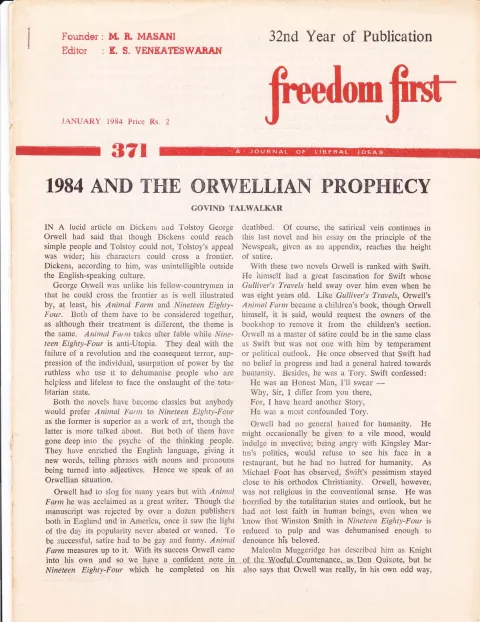
This is the January 1984 issue (No. 371, 32nd year of publication) of Freedom First, the Bombay-based journal of liberal ideas founded by M. R. Masani and edited by K. S. Venkateswaran. The issue is anchored by a long cover essay marking Orwell’s titular year, alongside a tribute to two recently deceased liberal intellectuals, a review of a Gandhi anthology, a roundup of Bombay’s cultural scene, and the magazine’s regular closing column of quoted press excerpts.
Key points
-
Govind Talwalkar’s cover essay “1984 and the Orwellian Prophecy” traces the books that shaped Orwell’s totalitarian imagination and argues that, while 1984 has not literally arrived, the growth of state power and industrial lobbies vindicates his fears.
-
Minoo Masani’s tribute “Freedom Loses Two Champions” memorialises Raymond Aron, recalling his role countering pro-Marxist currents among French intellectuals led by Jean-Paul Sartre, and Leonard Schapiro, the LSE’s leading Western analyst of Soviet affairs.
-
S. I. Clerk’s “Cultural Roundabout” surveys Bombay’s arts and theatre scene, including Pearl Padamsee’s production of “Children of a Lesser God” and a Gujarati stage adaptation of “Fiddler on the Roof” titled “Dholido.”
-
A book review signed Arun Gandhi covers “The Gandhi Reader,” edited by Homer A. Jack, using the occasion to argue that contemporary Hindus who invoke Gandhi to defend cow protection or oppose the abolition of untouchability misread his actual, more expansive views.
-
The reviewer, recalling his father Manilal’s decades of correspondence with Gandhi, quotes Gandhi’s chapter on Hinduism describing untouchability as “repugnant to reason and to the instinct of pity or love.”
Essays
1984 and the Orwellian Prophecy
By Govind Talwalkar
Govind Talwalkar’s cover essay, ‘1984 and the Orwellian Prophecy’, uses the arrival of the year 1984 to assess how much of Orwell’s dystopia in Nineteen Eighty-Four has come to pass. He traces the novel’s roots alongside Animal Farm, situates Orwell against Swift and Kafka, and recounts the biographical and political experiences (the Spanish Civil War, his break with pro-Soviet fellow-travellers, his reading of Zamyatin’s We, Borkenau’s The Spanish Cockpit, and Burnham’s The Managerial Revolution) that shaped his anti-totalitarian outlook. The essay surveys how Soviet and East European writers (Eugenia Ginzburg, Czeslaw Milosz) and critics (Arthur Koestler, Isaac Deutscher, Malcolm Muggeridge, Richard Rees) read Orwell’s insight into totalitarianism, and closes by arguing that, while 1984 has not literally arrived, the growth of state power, industrial conglomerates and organised lobbies vindicates Orwell’s fears, with only the possibility of ‘robbers falling out with each other’ (as in Poland) offering hope for individual freedom.
- Frames Animal Farm and Nineteen Eighty-Four as a single meditation on the failure of revolution and the totalitarian usurpation of power.
- Traces the three books that shaped Orwell’s totalitarian imagination: Zamyatin’s We, Borkenau’s The Spanish Cockpit, and Burnham’s The Managerial Revolution.
- Recounts Orwell’s disillusionment with Soviet-aligned progressives after the Spanish Civil War and his refusal to be ‘anti-Fascist without being anti-totalitarian.’
- Surveys Soviet and East European readings of Orwell (Ginzburg, Milosz) versus Western critics (Koestler, Deutscher, Muggeridge) to argue Orwell’s insight into totalitarian psychology was validated from inside the system.
- Contends that with 1984 arrived, the Orwellian prophecy has not literally come true, but the growth of state power, industrial lobbies, and union pressure show his fears were justified.
- Closes on Orwell’s own caveat, quoted from a letter to Francis Henson, that the book is a satire and warning rather than a prediction.
Amnesty’s Indictment
By K. S. Venkateswaran
No summary was extracted for this article. Listed for completeness.
Freedom Loses Two Champions
By Minoo Masani
Minoo Masani’s tribute, ‘Freedom Loses Two Champions’, memorialises Raymond Aron, who died on 16 October 1983, and Leonard Schapiro, both intellectuals Masani knew personally. Masani recalls Aron’s fluency across English and French at Congress for Cultural Freedom meetings in Paris, his lifelong role countering pro-Marxist currents among French intellectuals led by Jean-Paul Sartre, and the commercial and critical success of his final book, Memoirs: 30 Years of Political Reflection. He also briefly memorialises Leonard Schapiro, a leading Western analyst of Soviet affairs and LSE professor from 1955 to 1975, son-in-law of Salvador de Madariaga.
- Masani recalls his personal friendship with Raymond Aron through bilingual debates at Congress for Cultural Freedom meetings in Paris in the 1950s-60s.
- Aron’s intellectual role was to counter pro-Marxist trends among French intellectuals led by Jean-Paul Sartre.
- Aron’s final book, Memoirs: 30 Years of Political Reflection, sold 300,000 copies in three weeks and topped French bestseller lists.
- Aron moved from being a scholarly Marxist and Socialist to a liberal pluralist after studying economics and witnessing the horrors of totalitarianism.
- Leonard Schapiro, the second subject, was a leading Western analyst of Soviet affairs and LSE professor (1955-1975), and son-in-law of Salvador de Madariaga.
Cultural Roundabout
By S. I. Clerk
S. I. Clerk’s ‘Cultural Roundabout’ column surveys Bombay’s arts and theatre scene: Pearl Padamsee’s direction of Mark Medoff’s Children of a Lesser God with Ronnie Screwvala and Farida Pedder; a Gujarati-stage adaptation of Fiddler on the Roof titled Dholido by Chorus Unit; a group art exhibition of five Madras-based artists at Jehangir Art Gallery sponsored by Mahindra and Mahindra; a Korean ceramics exhibition at the Jehangir Nicholson Museum of Modern Art; and a wind-music concert by the New London Wind Trio.
- Reviews Pearl Padamsee’s production of Children of a Lesser God (Mark Medoff), praising leads Ronnie Screwvala and Farida Pedder.
- Reviews Dholido, a Gujarati-stage adaptation of Fiddler on the Roof by Chorus Unit, transposing the fiddler into an untouchable drummer, Bhalo Bhagat.
- Covers a group exhibition of five Madras-based artists (from the Cholamandal Artists’ Village) at Jehangir Art Gallery, sponsored by Mahindra and Mahindra as an instance of corporate arts patronage.
- Notes a ‘Korean Ceramics Today’ exhibition at the Jehangir Nicholson Museum of Modern Art, organised by the Indian Council for Cultural Relations with the NCPA.
- Reviews a wind-music concert by the New London Wind Trio, co-sponsored by the British Council, National Centre, and Hong Kong Bank.
Arun Gandhi
A book review, signed ‘Arun Gandhi’, covers The Gandhi Reader, edited by Dr. Homer A. Jack (Affiliated East-West Press, Madras, Rs. 90), a reprint of a 1956 anthology reissued amid renewed interest in Gandhi following Richard Attenborough’s film. The reviewer, who recalls meeting Jack in the early 1950s and discusses his own father Manilal’s long engagement with Gandhian thought, praises the book’s depth and readability while criticising its unattractive jacket design. He uses the review as an occasion to reflect at length on Gandhi’s own writings on untouchability, Hinduism, and the ‘holy cow’ question, arguing contemporary Hindus who invoke Gandhi to defend cow protection or oppose untouchability abolition misread Gandhi’s actual, more expansive views on both subjects.
- The Gandhi Reader, edited by Homer A. Jack, is described as an unofficial ‘autobiography’ of Gandhi covering the period after his own Experiments With Truth (which stops in 1920).
- Reviewer criticises the plain, unattractive book jacket despite praising the content as ‘eminently readable, facile and lucid.’
- Reviewer (signed Arun Gandhi) recounts personal history: his father Manilal’s decades of correspondence and discussion with Gandhi on satyagraha and racism, and his own first meeting with editor Homer Jack in South Africa in the early 1950s.
- Extended discussion of Gandhi’s actual position on the ‘holy cow’: that ‘protection’ meant protecting all sub-human creation from cruelty and neglect, not merely banning slaughter, and that the cow itself holds no special status in Hinduism per se.
- Quotes Gandhi’s chapter on Hinduism arguing untouchability is ‘repugnant to reason and to the instinct of pity or love’ and that Hindus who retain the taint of untouchability do not deserve freedom.
- Criticises both cow-protection activists (‘tallow-baiters’) and religious-yatra organisers (‘yatris’) for misapplying Gandhi’s teaching.
Generated by the v1.5 extraction pipeline. Awaiting editorial review.
Metadata and summary are AI-extracted from the source PDF and reviewed for editorial accuracy. The original work is available via the Read PDF tab above (where present); paragraph-level citation inside the PDF is deferred to a future engagement.