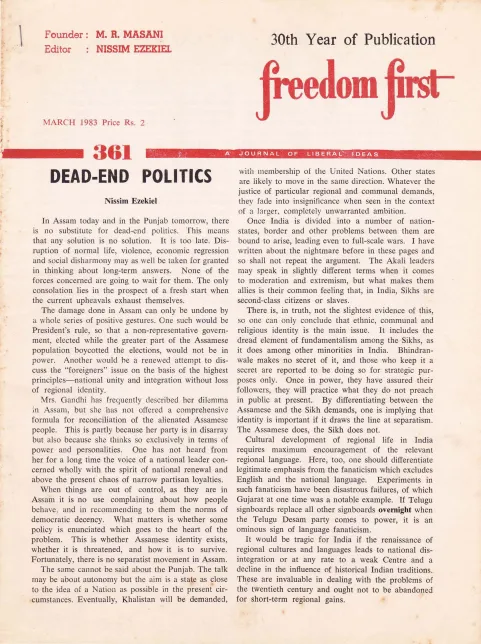
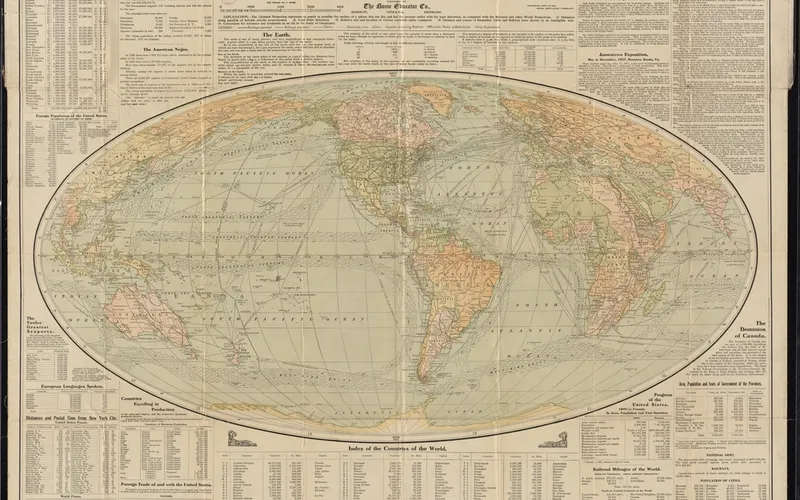
periodical issue
Freedom First
A Journal of Liberal Ideas
By Minoo Masani
Published for the Democratic Research Service by J. R. Patel, Associate Editor, Freedom First at 127, Mahatma Gandhi Road, Bombay 400 023 (Phone: 273914) and Printed by him at The Popular Press (Bom.) Pvt. Ltd., 35C Tardeo Road, Bombay 400 034 · Bombay · 1984
16 pages
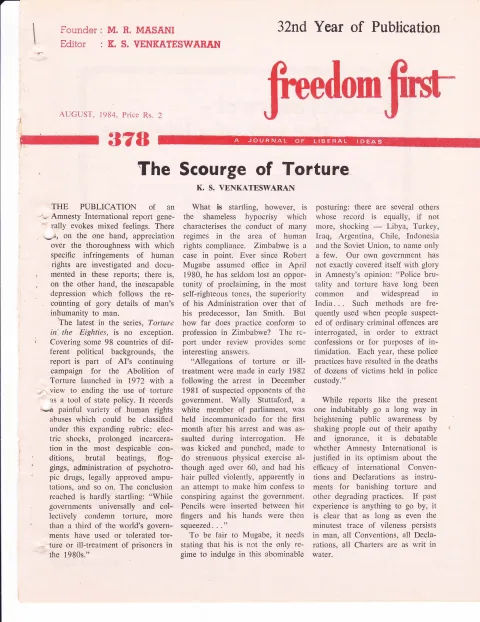
Freedom First
Summary
This is the August 1984 issue (No. 378, 32nd year of publication) of Freedom First, the Bombay-based journal of liberal ideas founded by M. R. Masani and edited by K. S. Venkateswaran. Published in the immediate aftermath of Operation Blue Star, the issue is dominated by reflections on the storming of the Golden Temple and its implications for Sikh communalism, Indian secularism, and press freedom, alongside a substantial book-review symposium on P. T. Bauer’s development economics. Contributors include the editor, founder Minoo Masani, and Irish political theorist Conor Cruise O’Brien writing from a comparative perspective on martyrdom and nationalism.
Key points
-
K. S. Venkateswaran’s “The Scourge of Torture” reviews Amnesty International’s “Torture in the Eighties” report on 98 countries, singling out Zimbabwe’s Mugabe government for hypocrisy while noting India’s own police are cited for routine custodial brutality.
-
Minoo Masani’s “As I See It” condemns press censorship in Punjab following the storming of the Golden Temple and criticises Doordarshan and All India Radio for one-sided coverage compared with foreign outlets.
-
Conor Cruise O’Brien’s “Potent Medicine of the Martyrs” disputes the claim that storming the Golden Temple was a blow against communalism, comparing Sant Bhindranwale’s death to Patrick Pearse’s 1916 martyrdom and warning it could sanctify Sikh nationalism.
-
B. P. Adarkar reviews P. T. Bauer’s “Reality and Rhetoric,” finding it verbose and inconclusive, while Ashley J. Tellis reviews Bauer’s “Equality, the Third World and Economic Delusion” admiringly for its demolition of foreign-aid orthodoxy.
-
M. R. Masani’s closing comment on the Bauer symposium sides with Tellis, recalling the Swatantra Party’s 1959 manifesto rejecting official foreign aid.
-
The “With Many Voices” column compiles quotations on Sikkim politics, Ayatollah Khomeini, and Soviet consumer shortages, including an Economist quip on the USSR “rolling itself up like a hedgehog.”
Essays
The Scourge of Torture
By K. S. VENKATESWARAN
K. S. Venkateswaran’s editorial ‘The Scourge of Torture’ reviews Amnesty International’s report ‘Torture in the Eighties’, covering 98 countries. He highlights Zimbabwe’s Mugabe government as a case study in hypocrisy on human rights, quoting the report’s account of the torture of MP Wally Stuttaford, then notes that India’s own police are cited in the same report for routine custodial brutality. The piece closes on a skeptical note about whether international conventions can meaningfully curb torture where the underlying will to abuse power persists.
- Reviews Amnesty International’s report ‘Torture in the Eighties’, covering 98 countries
- Report catalogues abuses: electric shocks, prolonged incarceration, beatings, floggings, forced drugging, amputations
- Zimbabwe under Mugabe singled out for hypocrisy given his condemnation of predecessor Ian Smith
- Quotes report’s description of the torture of Wally Stuttaford, a white Zimbabwean MP
- Notes India’s own police cited by Amnesty for routine brutality and custodial deaths
- Concludes that conventions and declarations against torture are ‘writ in water’ absent genuine will to change
As I See It
By MINOO MASANI
Minoo Masani’s ‘As I See It’ column condemns press censorship in Punjab following the storming of the Golden Temple, arguing (citing Bernard Shaw) that pre-censorship is always wrong and that blocking a free press only fuels rumour. He cites Ramoji Rao of Eenadu on desertions in the Indian Army arising from press restriction, criticizes Doordarshan and All India Radio for selective and propagandistic coverage compared to foreign outlets like The Times and the New York Times, and objects to Doordarshan’s coverage of protests against the BBC. He closes with a personal recollection from his London School of Economics days of expelling two communist students, one of whom, Freda Utlay, later endured the Soviet system’s refusal to disclose whether her purged husband was alive, a story he links to the Kremlin’s continued silence over the whereabouts of Andrei and Elena Sakharov.
- Condemns pre-censorship of the press in Punjab after the Golden Temple storming, invoking Bernard Shaw’s arguments against censorship
- Cites Ramoji Rao (Eenadu) linking army desertions to lack of a free press on the Punjab situation
- Criticizes Doordarshan and All India Radio for one-sided coverage versus foreign press (The Times, Guardian, New York Times)
- Questions government’s charge that BBC was biased for reporting Dr. Jagjit Singh’s remarks
- Recounts expelling two communist students from the LSE Labour Party group in the 1930s, including Freda Utlay
- Freda Utlay’s husband was purged/executed in Stalin’s USSR; Soviet authorities refused to confirm his fate
- Draws a parallel to the Kremlin’s ongoing refusal to disclose the whereabouts of Andrei and Elena Sakharov
Potent Medicine of the Martyrs
By CONOR CRUISE O’BRIEN
Conor Cruise O’Brien’s ‘Potent Medicine of the Martyrs’ (reprinted courtesy The Observer, London) critiques the claim, made in The Times, that the storming of the Golden Temple was a blow against communalism and a victory for secularism. O’Brien argues it is instead likely to be seen by Hindus as a communal victory, and may push young Sikhs toward nationalism rather than away from it. He draws two extended historical analogies: assimilated European Jews (Herzl) confronting rising anti-Semitism, and Patrick Pearse’s 1916 Easter Rising, arguing that Sant Bhindranwale, by seizing the Golden Temple and being killed there, achieved a martyrdom comparable to Pearse’s that could sanctify Sikh nationalist insurrection much as Pearse’s memory sanctified Irish Catholic separatism. He cautions that analogies have limits (citing Biafra) and expresses sympathy for both Khushwant Singh and for the difficult position of Sikhs generally, concluding that their fate depends on relations with the Indian government, not on Western sympathy.
- Disputes The Times’ framing of the Golden Temple storming as a defeat for communalism and win for secularism
- Argues it is more likely a Hindu-communal victory that could push Sikhs toward nationalism
- Compares Sant Bhindranwale’s death in the Golden Temple to Patrick Pearse’s martyrdom in the 1916 Easter Rising
- Argues martyrdom can transform a community’s political outlook, citing Pearse’s effect on Irish Catholic separatism
- Draws a second, more limited analogy to assimilated European Jews (Herzl) confronting anti-Semitism
- Notes analogies can mislead, citing the failed Biafra secession as a cautionary parallel
- Concludes that Sikhs’ fate depends on relations with India’s government, not on ‘world opinion’ or Western sympathy
Book Reviews: Controversial Lord Bauer — review of Reality and Rhetoric by P.T. Bauer
By B. P. Adarkar
A book-review symposium, ‘Controversial Lord Bauer’, pairs two reviews of works by development economist P. T. Bauer: B. P. Adarkar reviews ‘Reality and Rhetoric’ (Weidenfeld & Nicolson) and finds it verbose and inconclusive, criticizing Bauer’s attacks on Myrdal, Keynes and others as more rhetorical than substantive, though he concedes value in the chapters on Africa. Ashley J. Tellis reviews ‘Equality, the Third World and Economic Delusion’ (Methuen) far more admiringly, praising Bauer’s empirical demolition of egalitarian and foreign-aid orthodoxies, his takedown of the ‘population explosion’ thesis using the counter-examples of Hong Kong, Taiwan, South Korea and Singapore, and his argument that foreign aid often functions as an opiate that entrenches Third World dependency rather than curing poverty. The section closes with a comment from M. R. Masani, who sides substantially with Tellis and Bauer, invoking his own history opposing Nehru’s planning model and the Swatantra Party’s 1959 manifesto rejecting official aid.
- Adarkar’s review of ‘Reality and Rhetoric’ calls it verbose, repetitive, and short on a positive theory of development
- Adarkar credits Bauer’s chapters on Black Africa/Nigeria with historical detail but finds them light on useful conclusions
- Tellis’s review of ‘Equality, the Third World and Economic Delusion’ praises Bauer’s critique of egalitarianism and foreign aid as empirically rigorous
- Tellis highlights Bauer’s demolition of the ‘population explosion’ myth via Hong Kong, Taiwan, South Korea, Singapore
- Tellis credits Bauer with arguing aid functions as an opiate, entrenching poverty rather than curing it
- Amartya Sen is quoted describing Bauer as ‘the foremost conservative’ development economist
- M. R. Masani’s closing comment endorses Bauer/Tellis over Adarkar and recalls the Swatantra Party’s 1959 manifesto rejecting official aid
Book Reviews: Controversial Lord Bauer — review of Equality, the Third World and Economic Delusion by P.T. Bauer
By Ashley J. Tellis
‘With Many Voices’ is the issue’s closing miscellany of topical quotations drawn from the international press (The Observer, The Times, Indian Express, Pravda, The Economist, International Herald Tribune), touching on Sikkim politics, Ayatollah Khomeini, Soviet life and gender inequality, inflation, and the Afghan resistance.
- Compiles topical quotations from The Observer, The Times, Indian Express, Pravda, The Economist and the International Herald Tribune
- Includes deposed Sikkim Chief Minister Nar Bahadur Bhandari on Congress (I) corruption
- Includes Ayatollah Khomeini quoted on America
- Includes commentary on Soviet consumer shortages and lack of sex education
- Includes an Economist quip on the Soviet Union ‘rolling itself up like a hedgehog’
Generated by the v1.5 extraction pipeline. Awaiting editorial review.
Metadata and summary are AI-extracted from the source PDF and reviewed for editorial accuracy. The original work is available via the Read PDF tab above (where present); paragraph-level citation inside the PDF is deferred to a future engagement.