periodical issue
Freedom First
A Journal of Liberal Ideas
By Minoo Masani, Achyut Patwardhan
Published for the Democratic Research Service by J. R. Patel, Associate Editor, Freedom First at 127, Mahatma Gandhi Road, Bombay 400 023 (Phone: 273914) and Printed by him at The Popular Press (Bom.) Pvt. Ltd., 35C Tardeo Road, Bombay 400 034 · Bombay · 1984
16 pages
Freedom First
Summary
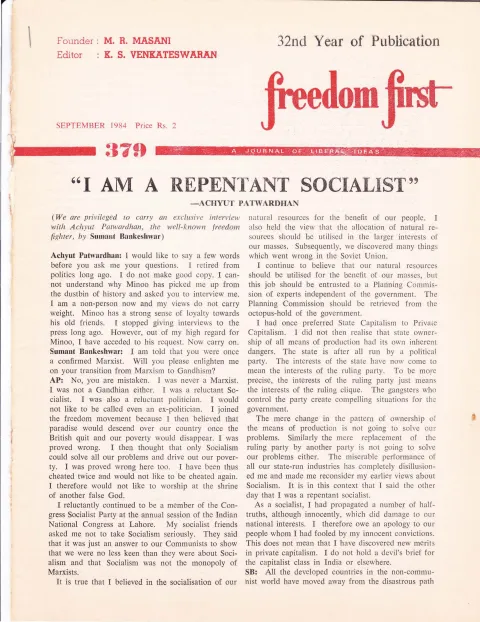
Freedom First No. 379 (September 1984) is the monthly journal of liberal ideas founded by M. R. Masani and edited by K. S. Venkateswaran, published by the Democratic Research Service, Bombay, in its 32nd year of publication. This issue leads with an interview with the freedom fighter and former socialist Achyut Patwardhan, who renounces his earlier Marxist-influenced convictions and calls himself a “repentant socialist,” followed by Minoo Masani’s regular column on the proposed withdrawal of a common civil code for Goan Muslims and a new anti-terrorism ordinance, Govind Talwalkar’s analysis of the army’s repeated deployment to quell civil and communal disorder across Indian states, a Delhi Letter column on a PUCL meeting on press censorship, three book reviews (on Raymond Aron’s American foreign-policy study, two Bernard Levin essay collections, and a history of the Soviet Union), and a closing page of quotations titled “With Many Voices.” In the rendered pages, the volume’s argumentative centre is a sustained liberal critique of the Indira Gandhi government’s authoritarian drift — reversal of secular civil-code gains, misuse of ordinance powers, and the breakdown of civil administration that forces reliance on the army.
Key points
-
In an interview with Sumant Bankeshwar, freedom fighter Achyut Patwardhan disavows his earlier Marxist-influenced convictions, calling himself a “repentant socialist” who was “cheated twice” by the promises of independence and of socialism.
-
Minoo Masani’s “As I See It” protests a Congress(I) move to withdraw Goa’s common civil code for Muslim women, recalling his own Constituent Assembly advocacy for a uniform civil code, and condemns a new Ordinance shifting the burden of proof in “terrorism-affected” areas.
-
Govind Talwalkar’s “Dangerous Portents” traces the army’s repeated deployment to quell civil and communal disorder in Assam, Gujarat, Karnataka and Bhiwandi, warning that reliance on the army erodes democratic legitimacy.
-
Komala Sarathy’s “Delhi Letter” reports a PUCL meeting on censorship at which Soli Sorabjee praised Freedom First and Himmat for resisting censorship during the Emergency.
-
M. G. Bailur reviews Raymond Aron’s “The Imperial Republic,” praising its account of America’s shift from post-WWI isolationism to postwar global engagement through the Marshall Plan.
-
K. S. Venkateswaran reviews Bernard Levin’s collections “Speaking Up” and “Enthusiasms,” highlighting Levin’s essay on the “seesaw of freedom” contrasting Soviet dissidents with complacent citizens of free countries.
-
Dr. M. Muralidhara reviews Basil Dmytryshyn’s “A History of Russia,” noting the difficulty of studying closed societies given scarce authentic information and history’s tendency to be rewritten.
Essays
”I Am a Repentant Socialist” (interview with Achyut Patwardhan)
By Achyut Patwardhan
In an exclusive interview conducted by Sumant Bankeshwar, freedom fighter Achyut Patwardhan disavows being a Marxist or a Gandhian, describing himself instead as a reluctant socialist who now calls himself a “repentant socialist.” He recounts his disillusionment with both the promise that independence would end poverty and the promise that socialism would solve India’s problems, criticizes the nationalisation of banks and industries as having been captured by the ruling party’s own interests, and argues that a country’s peasant-proprietors are the true backbone of its economy. He closes by dismissing the selection of political leaders by ‘consensus’ as a fraud that lets ruling cliques bypass genuine elections.
- Patwardhan denies ever having been a true Marxist or Gandhian; calls himself a reluctant socialist and reluctant politician.
- He says he was ‘cheated twice’ — first by the promise of independence, then by the promise of socialism — and now calls himself a ‘repentant socialist’ who owes the public an apology for propagating half-truths.
- He once favoured state control of natural resources and bank nationalisation but says experience showed the state is run by ‘a political party’ whose interests become those of a ‘ruling clique.’
- He argues technology, not ideology, is now the main force reshaping society, and that peasant-proprietors are the backbone of the economy.
- He criticizes the nationalised banks’ ‘mass loan melas’ as an unscrupulous misuse of the credit system.
- He dismisses party leadership selection by ‘consensus’ as a sham that sidesteps elections, citing the Janata party leadership selection as an example.
As I See It
By MINOO MASANI
In his regular ‘As I See It’ column, Minoo Masani protests a move by the Congress (I) government in Goa to withdraw Muslim women’s access to the territory’s common civil code (a legacy of Portuguese rule) and replace it with Muslim personal law, a change opposed by the newly formed Goa Muslim Women’s Association led by Rashida Muzawar. Masani recalls his own long-standing advocacy, since the Constituent Assembly, for a uniform civil code across India, noting he was supported by Rajkumari Amrit Kaur, Hansa Mehta, and Dr. Ambedkar but defeated by an all-Hindu majority including Acharya Kripalani and K. M. Munshi. He then turns to a new Ordinance President’s-assent Ordinance shifting the burden of proof from prosecution to defence in cases certified as ‘terrorism-affected,’ calling it undemocratic and hoping the Supreme Court will strike it down, as it did with the 1968 Banks Nationalisation Ordinance.
- Goa’s Muslim women, led by Rashida Muzawar of the Goa Muslim Women’s Association, are campaigning against a Congress (I) move to end the territory’s common civil code for Muslims.
- Masani cites Chief Justice Y. V. Chandrachud’s 1979 praise of Goa’s uniform civil code as a precedent worth preserving.
- The All India Muslim Personal Law Board is pushing to extend the Shariat Act to Goa and exempt Muslims from compulsory marriage registration.
- Masani recounts his own role as a Constituent Assembly Advisory Sub-Committee member arguing (in a minute of dissent) for a uniform civil code within five to ten years, backed by Amrit Kaur, Hansa Mehta and Ambedkar but defeated by an all-Hindu majority.
- Masani condemns the new Terrorist Affected Areas (Special Courts) Ordinance 1984 for reversing the presumption of innocence in certified ‘disturbed’ areas, and hopes the Supreme Court will strike it down as it did the 1968 Banks Nationalisation Ordinance.
Dangerous Portents
By GOVIND TALWALKAR
Govind Talwalkar’s ‘Dangerous Portents’ traces the growing post-independence pattern of Indian governments deploying the army to handle civil and communal unrest — in Assam, Gujarat, Karnataka, Baroda, Bombay and Bhiwandi — arguing that this reflects the collapse of civil administration and policing rather than a deliberate policy choice. He faults chronic political instability, frequent leadership changes, over-population, black money, smuggling, and political interference in police postings for the deterioration of law and order, and warns that repeated reliance on the army both erodes democratic legitimacy and risks encouraging ambitions within the armed forces.
- The army was used heavily in Assam and Punjab, including an incident of Sikh soldiers revolting and trying to reach Amritsar, straining its secular character.
- Talwalkar catalogues repeated army deployments for civil unrest: Assam (1980, 1983), Gujarat/Ahmedabad police revolt (1979), Bangalore (1981), Baroda (1982), Bombay police revolt, and Bhiwandi (1984).
- He notes the Congress Working Committee itself in 1979 condemned reliance on the army as a sign a government was ‘losing its democratic and political legitimacy’ — a resolution it later ignored once back in power.
- He attributes police failure to over-population, unmanageable city growth, black money, smuggling, and protection of gangsters and slumlords by politicians (citing the Haji Mastan protest in Bhendi Bazar).
- Political interference in police appointments, promotions and transfers has demoralised and politicised the force, and intelligence reports are tailored to please those in power.
- He warns that frequent use of the army for domestic order is dangerous both because it isn’t the army’s proper role and because it may inspire ambitions among ‘ambitious elements’ in the armed forces.
Delhi Letter
By KOMALA SARATHY
Komala Sarathy’s ‘Delhi Letter’ reports on a PUCL (People’s Union for Civil Liberties) meeting on ‘Censorship — Overt and Covert’ held in Delhi on April 27, addressed by Rajendra Mathur, Soli Sorabjee, O. V. Vijayan and Arun Bose, at which Soli Sorabjee praised Freedom First and Himmat for standing up to censorship during the Emergency. The column also reports the founding of a new organisation, Nav Nirman, by admirers of the late Piloo Mody, and notes the apparent fizzling of an earlier Piloo Mody Memorial Lecture Series and Piloo Mody Trust.
- PUCL organised a meeting on censorship in Delhi on April 27, prompted partly by Foreign Office difficulties faced by a Delhi University economics lecturer over his book.
- Speakers included Rajendra Mathur (editor, Navbharat Times) on telephone tapping and misuse of censorship powers, Soli Sorabjee on the dangers of wartime censorship powers being misused in peacetime, and O. V. Vijayan and Arun Bose on self-censorship.
- Soli Sorabjee praised Freedom First and Himmat for standing up to censorship during the Emergency.
- Ironically, the meeting itself faced an apparent attempt to be gagged when a microphone was reportedly unavailable at the last minute.
- A new organisation called Nav Nirman was formed by admirers of the late Piloo Mody, convened by Bheem Singh Rathore of Udaipur, while an earlier Piloo Mody Memorial Lecture Series and Piloo Mody Trust appear to have fizzled after a single lecture by C. R. Irani.
Book Review: The Imperial Republic by Raymond Aron
By M. G. Bailur
M. G. Bailur reviews Raymond Aron’s ‘The Imperial Republic’ (Prentice Hall of India), a study of American foreign policy from the end of World War II to 1973, praising Aron’s balance as a scholar who is sympathetic without being uncritical. The review summarises Aron’s account of America’s shift from post-WWI isolationism to post-WWII global engagement (the Marshall Plan), his caustic view of the Suez crisis, and his thesis that postwar American diplomacy sought to fill the vacuum left by the collapse of Pax Britannica with an approximation of a Pax Americana, while faulting the translation-quality praise given to translator Frank Jellinek.
- Aron’s study covers American foreign policy from the end of WWII to 1973 and is praised as illuminating and balanced.
- The review contrasts America’s isolationist retreat after WWI with its full engagement after WWII, crediting the Marshall Plan’s success in rebuilding Western Europe.
- Aron is described as caustic about the American ‘let-down’ of allies during the Suez crisis but sympathetic to the constraints imposed by Western Europe’s need for American protection.
- Aron’s central thesis is that postwar American diplomacy sought to fill the vacuum from the collapse of Pax Britannica with something approaching a Pax Americana.
- The review closes praising translator Frank Jellinek for unusually lucid prose.
Book Review: Speaking Up and Enthusiasms by Bernard Levin
By K. S. Venkateswaran
K. S. Venkateswaran reviews two 1983 Bernard Levin collections, ‘Speaking Up’ and ‘Enthusiasms,’ praising Levin as the most perceptive and controversial journalist of his time. The review highlights Levin’s essay defending the seesaw of freedom against Soviet oppression, his stinging rejoinder in The Times to critics of exposed Soviet spy Anthony Blunt, and ‘Enthusiasms’ as an unusually personal collection revealing Levin’s private passions (opera, Shakespeare, painting, cuisine, travel), closing with regret that the book’s high price may deter readers until a paperback edition appears.
- Speaking Up (1983) is the sequel Levin promised after his 1979 collection Taking Sides, covering politics, sport, sociology, music and human rights.
- The review highlights Levin’s essay on the ‘seesaw of freedom,’ contrasting brave dissidents in the Soviet Union with those in free countries who wish to be relieved of the burdens of liberty.
- Levin’s rejoinder in The Times defends distinguishing right from wrong even when a ‘gifted and distinguished’ man like Anthony Blunt is revealed as a Soviet spy.
- Enthusiasms (1983) is praised as unusually personal, revealing Levin’s passions for opera, Shakespeare, painting, haute cuisine, walking, reading and cities.
- The reviewer’s only complaint is the prohibitive price, hoping a paperback edition will follow.
Book Review: A History of Russia by Basil Dmytryshyn
By Dr. M. Muralidhara
Dr. M. Muralidhara reviews Basil Dmytryshyn’s ‘A History of Russia’ (Prentice-Hall of India, 1981), calling it a fact-rich but interpretively thin textbook. The review argues that studying closed, authoritarian societies is inherently difficult given scarce authentic information and history’s tendency to be rewritten with each change of regime, citing the shifting historiographical treatment of Stalin and the unresolved debate over whether Mao was a liberator or dictator, and concludes the book is useful for general readers but disappoints specialists for lacking issue-oriented discussion of dissent and Party ideology.
- The review frames studying closed/authoritarian societies as inherently difficult due to scarce authentic information and frequent historical rewriting.
- It cites Stalin’s role being ‘redefined so many times’ in Russian historiography, and the unresolved debate over whether Mao was a liberator or a dictator.
- The book is described as rich in facts about the Soviet Union but lacking objective interpretation or issue-oriented discussion of Party dissent and ideology.
- Overall verdict: a good, comprehensive textbook for general readers but disappointing for specialists.
With Many Voices
The closing ‘With Many Voices’ page is a compilation of short quotations on politics, feminism, censorship and free speech drawn from international press sources dated June-August 1984, including Geraldine Ferraro, Sheila Kennedy, Khushwant Singh, Anne Sofer, Roger Scruton, Katharine Whitehorn and Rupert Murdoch.
- Includes Geraldine Ferraro’s quote ‘A Woman’s place is in the White House’ from the International Herald Tribune, July 26, 1984.
- Attorney Sheila Kennedy criticizes using feminism to justify censorship/book-banning.
- Khushwant Singh remarks in Debonair (August 1984) that there is no self-respect left in talking to Indira Gandhi.
- Katharine Whitehorn argues fairness requires a check-and-appeals mechanism wherever there is power.
- Rupert Murdoch speculates Shakespeare would today be a television scriptwriter for mass audiences.
Generated by the v1.5 extraction pipeline. Awaiting editorial review.
Metadata and summary are AI-extracted from the source PDF and reviewed for editorial accuracy. The original work is available via the Read PDF tab above (where present); paragraph-level citation inside the PDF is deferred to a future engagement.