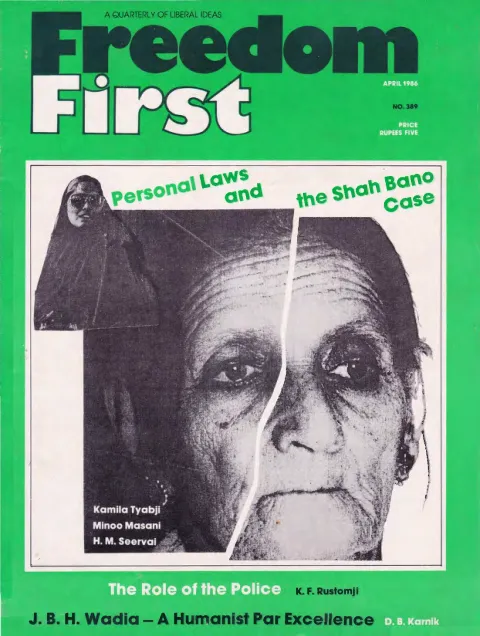
periodical issue
Freedom First
A Quarterly of Liberal Ideas
By Minoo Masani
Published by J.R. Patel for the Democratic Research Service and printed by him at Parsiana Publications Pvt. Ltd., 300 Perin Nariman Street, Bombay 400 001. Democratic Research Service, 4th floor, Maneckji Wadia Bldg., 127, Mahatma Gandhi Road, Bombay 400 001. · Bombay · 1987
56 pages
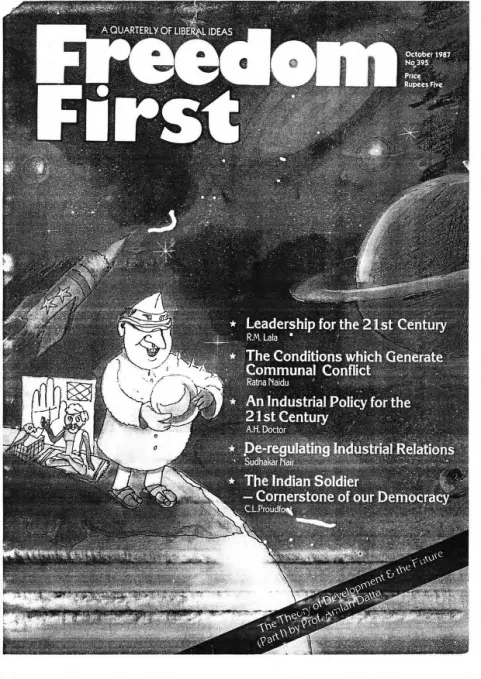
Freedom First
Summary
This is the October 1987 issue (No. 395) of Freedom First, “A Quarterly of Liberal Ideas,” published by the Democratic Research Service in Bombay under founder Minoo Masani and editors S.V. Raju and R. Srinivasan. In the rendered pages the issue opens with an editors’ note lamenting India’s lack of leadership amid communal frenzy, and a “With Many Voices” page of press quotations. The regular “Of Cabbages and Kings” column (bylined SVR/RS) covers a Masani-Chatterjee writ petition against the AIR/Doordarshan broadcasting monopoly, a teachers’ strike, the Vayudoot courier fiasco, and drought as a man-made policy failure. Feature essays in the rendered portion address leadership for the coming century (R.M. Lala), the sociological roots of communal conflict (Ratna Naidu), minority rights and the case for a national civil code (Lionel Fernandes), industrial policy priorities for the 21st century (A.H. Doctor), and Kamal Wadhwa’s account of advocate Ram Jethmalani’s public interrogation of Prime Minister Rajiv Gandhi over the Bofors affair. Minoo Masani’s regular “Masani Viewpoint” column takes up the persecution of writer Rama Swarup, the 45th anniversary of Quit India, V.P. Singh, and Swiss bank account secrecy. The issue’s cover also lists further articles (an industrial-relations piece by Sudhakar Nair, a piece on the Indian soldier by C.L. Proudfoot, and Amlan Datta’s essay on development theory) that were not reached in the rendered pages.
Key points
-
R.M. Lala’s “Leadership for the 21st Century” argues India’s post-independence leadership has not matched the Constituent Assembly generation, invoking Akbar’s shift from conquest to consent and calling for devolution of power from the Prime Minister’s Office to the Cabinet and states.
-
Ratna Naidu’s “The Conditions which Generate Communal Conflict” identifies three structural conditions generating communal conflict — threatened class privilege, adverse demographic spread, and accumulated historical hatred — using Jat Sikh landlord anxieties after the Green Revolution as her Punjab case study.
-
Lionel Fernandes’s “De-mythifying Minority Rights” argues minority protection cannot extend to fundamentalist practices exempt from rational civil regulation, and proposes a voluntary, secular National Civil Code as a pilot step.
-
A.H. Doctor’s “An Industrial Policy for the 21st Century” names four pillars of industrial policy — technology transfer, import substitution, quality improvement via competition, and manpower planning — and flags computer software as a strategic industry that could reverse brain drain.
-
Kamal Wadhwa’s “The ‘Dog’ that Barks” surveys public reaction to Ram Jethmalani’s month-long public interrogation of Prime Minister Rajiv Gandhi over the Bofors affair, including former CM A.R. Antulay’s “barking dog” defence and the ensuing “canine jurisprudence” debate.
-
Minoo Masani’s regular column publishes writer Rama Swarup’s account of persecution under the Official Secrets Act, reflects on the poorly-attended 45th anniversary of Quit India, and discusses Swiss bank secrecy, arguing (via A.G. Noorani) that India’s own laxity, not Berne, blocks disclosure of illicit deposits.
Essays
Leadership for the 21st Century
By R.M. Lala
R.M. Lala argues that the demands on political and social leadership have grown far more complex than in the era of Roosevelt, Adenauer, or Churchill, while India’s own leadership has shrunk in stature since the Constituent Assembly generation. He contends that India’s future leader must command the confidence of minorities and lower castes the way the Nehru family once did, invoking Akbar’s shift from rule by the sword to rule by consent (citing Percival Spear’s History of India) as the historical template for legitimate rule over a religiously diverse polity. Lala closes by urging devolution of power from the Prime Minister’s Office to the Cabinet and states, warning that continued centralisation under a “democratic monarchy” model makes India harder, not easier, to govern.
- Leadership challenges have multiplied since the Roosevelt/Adenauer/Churchill era due to nuclear weapons, terrorism, pollution and other new pressures.
- India’s post-independence leadership has not matched the calibre of the Constituent Assembly and first Parliament.
- A future Indian leader must hold the confidence of minorities, especially Muslims and lower castes, citing Akbar’s shift from conquest to consent as the historic template.
- Quotes Percival Spear’s History of India (Pelican Vol. II) on Akbar’s creative, humane leadership as a model for holding a mixed population together.
- Calls for devolution of power away from the Prime Minister’s Office to the Cabinet and states as essential to governability.
- Cites British columnist Peregrine Worsthrone on the pettiness of contemporary leaders versus their capacity to inspire.
The Conditions which Generate Communal Conflict
By Ratna Naidu
Sociologist Ratna Naidu distinguishes communal conflict from regional or caste conflict, arguing that unlike regionalism, communalism resists resolution through dialogue because it involves geographically intermingled communities. She identifies three social conditions that generate communal conflict: a class’s perceived threat of withdrawal of privileges (illustrated by upper-class Muslims’ fears before Partition and by Jat Sikh landlords’ anxieties after the Green Revolution), demographic spread patterns that make territorial solutions to Sikh-Hindu conflict in Punjab unworkable, and the cumulative deepening of inter-communal hate lodged in collective memory. She closes by drawing parallels to Malaysia, Sri Lanka, and Assam, and calls for halting both state and popular terrorism.
- Distinguishes ‘minorities by will’ (regional/linguistic/religious) from ‘minorities by force’ (caste-based), arguing only the former is a source of true communal conflict.
- Identifies three structural conditions generating communal conflict: perceived threat to a class’s privileges, adverse demographic spread patterns, and accumulated historical hatred.
- Uses the Green Revolution and Jat Sikh landlord anxieties as the case study for how economic class interests get channeled into communal ideology in Punjab.
- Argues Punjab’s demographic distribution (Sikh rural majority, urban Hindu majority) makes any territorial partition into Khalistan unworkable.
- Draws comparative examples from Malaysia (Malay-Chinese) and Sri Lanka (Sinhalese-Tamil) to generalize the thesis.
- Concludes that halting both state terrorism and inter-communal terrorism is essential.
De-mythifying Minority Rights
By Lionel Fernandes
Lionel Fernandes argues that while minorities deserve constitutional protection of their distinct identities, this protection cannot extend to a right to perpetuate fundamentalist or obscurantist practices, or to exemption from rational, uniform civil regulation. He warns that a rising, often uncritical, ‘minority consciousness’ is eroding national cohesion, citing examples where minority-community practices conflict with sexual equality, public order, hygiene norms, or clerical control over lay members. Fernandes calls for a voluntary, secular National Civil Code as a pilot step toward a genuinely enlightened common civil framework that would apply equally to majority and minority communities.
- Minorities have a legitimate right to recognition and protection of group identity, rooted in hard lessons of majority-minority strife.
- Questions whether minority rights extend to self-governing ‘states within the State’ — exacting levies, imposing sanctions, or resisting civil jurisdiction.
- Cites conflicts between some minority practices and sexual equality, public-order norms, hygiene, and clerical authority over lay members.
- Argues pluralism is welcome in culture and religion but civil law must remain a common, rational domain not fragmented among communities.
- Proposes a voluntary, secular National Civil Code as a pilot project toward eventual uniform civil law.
An Industrial Policy for the 21st Century
By A.H. Doctor
A.H. Doctor lays out four components of an industrial policy that would let India enter the 21st century as a significant industrial power: judicious technology transfer, a time-conscious import-substitution strategy, product-quality improvement through competition, and long-range manpower/human-resource planning. He criticizes private-sector technology imports aimed merely at consumer goods (citing cars, televisions, even potato chips) and argues government should restrict technology imports to bridging genuine gaps in the capital-goods sector, while building negotiating skill to access strategically significant, closely-guarded technologies. He also flags computer software as an industry where India could retain talent and reverse brain drain.
- Names four pillars of a 21st-century industrial policy: technology transfer, import substitution, product-quality improvement via competition, and manpower/human-resource planning.
- Criticizes vested interests benefiting from imported consumer-goods technology (cars, TVs, even potato-chip production) at the expense of capital-goods modernization.
- Urges developing strong negotiating skills to access strategic technologies that developed nations do not offer freely, especially in defence-related industry.
- Advocates fundamental R&D rather than one-off process substitution, citing drought-resistant and early-maturing crop varieties as agricultural examples.
- Calls for allowing firms to grow to scale sufficient to sustain meaningful R&D and innovation.
- Flags computer software as a strategic industry that could retain India’s brightest graduates and reverse brain drain, noting Tata Burroughs and Computronics India’s early success in the US market.
The ‘Dog’ that Barks
By Kamal Wadhwa
Kamal Wadhwa surveys the public reaction to Ram Jethmalani’s 300-plus-question, month-long public interrogation of Prime Minister Rajiv Gandhi over the Bofors, Fairfax, and submarine-deal allegations, arguing it has set a healthy precedent by rallying scattered anti-Gandhi opposition around the single issue of corruption. The piece catalogues abusive and supportive letters Jethmalani received, former Maharashtra Chief Minister A.R. Antulay’s ‘barking dog’ defence of the Prime Minister, and the ensuing ‘canine jurisprudence’ debate — including Upendra Baxi’s essay in Lex et Juris parsing whether citizens are ‘sleeping dogs’ or ‘watch-dogs’ under the Constitution. Wadhwa concludes that Jethmalani’s campaign shows what wealth and education can achieve in a poor country, and speculates about whether the moment could crystallize into an organized anti-corruption opposition front.
- Details Jethmalani’s month-long questioning of Rajiv Gandhi via the press over Bofors, Fairfax, and submarine-deal corruption allegations.
- Surveys hostile anonymous letters accusing Jethmalani of being a ‘traitor’ and ‘street dog,’ alongside supportive letters praising his ‘crusade against corruption.’
- Recounts former Maharashtra CM A.R. Antulay’s defence of Rajiv Gandhi’s ‘barking dog’ jibe, escalating into personal attacks on Jethmalani.
- Details the ‘canine jurisprudence’ debate, including Congress-I spokesman G.K. Moopanar’s and jurist Upendra Baxi’s dueling interpretations of whether citizens are constitutionally ‘sleeping dogs’ or ‘watch-dogs.’
- Frames Jethmalani’s campaign as a potential rallying point for a fragmented anti-Congress opposition, though uncertain whether it will produce an organized political alternative.
- Concludes that India needs more wealthy, independent citizens capable of funding accountability exercises like Jethmalani’s.
The Masani Viewpoint
By Minoo Masani
In his regular column, Minoo Masani publishes an appeal from writer Rama Swarup describing his persecution under the Official Secrets Act — 28 police guards around his house, frozen bank accounts, and a burgled office — and asks readers to contribute funds via Freedom First. Masani also reflects on the poorly-attended 45th anniversary of the Quit India resolution, criticizing Aruna Asaf Ali’s later turn to communism while noting her charm during the underground years, briefly assesses V.P. Singh as personable but limited by his Congress background, and discusses Swiss bank secrecy law, arguing (via A.G. Noorani) that the obstacle to disclosure of Indians’ Swiss accounts lies in New Delhi’s own laxity, not in Berne.
- Publishes Rama Swarup’s letter describing severe restrictions under police guard, frozen accounts, and appeals for financial help to fight charges under the Official Secrets Act.
- Reflects on the poorly-attended 45th anniversary of Quit India, noting most surviving freedom fighters (Achyut Patwardhan, Morarji Desai, S.M. Joshi, Ushaben Mehta) declined to attend.
- Recalls working underground with Aruna Asaf Ali from 1942, criticizing her later turn to ‘communist fellow traveller’ politics and Soviet Peace Prize.
- Tells an anecdote about General S.S. Sokhey declining to pass on a peace-prize award to a local communist party functionary (Romesh Chandra).
- Gives a mixed assessment of V.P. Singh as personable and intelligent but limited by his Congress/U.P. background.
- Discusses Swiss bank account secrecy, citing A.G. Noorani, arguing India’s own lack of a treaty basis (not Swiss law) blocks disclosure of illicit deposits.
Generated by the v1.5 extraction pipeline. Awaiting editorial review.
Metadata and summary are AI-extracted from the source PDF and reviewed for editorial accuracy. The original work is available via the Read PDF tab above (where present); paragraph-level citation inside the PDF is deferred to a future engagement.