periodical issue
Freedom First
A Quarterly of Liberal Ideas
By S. V. Raju, Minoo Masani, Bhanu Pratap Singh
Democratic Research Service, 4th floor, Maneckji Wadia Bldg. 127, Mahatma Gandhi Road, Bombay 400 001. Published by J.R. Patel for the Democratic Research Service and printed by him at Parsiana Publications Pvt. Ltd. 300 Perin Nariman Street, Bombay 400 001. · Bombay · 1990
56 pages
Freedom First
Summary
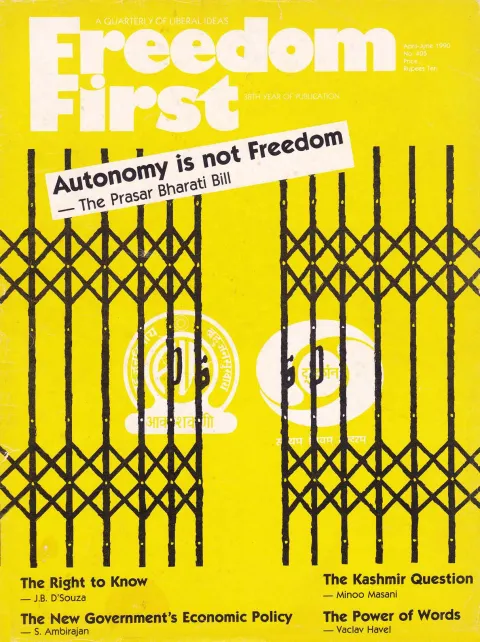
S.V. Raju’s cover article dissects the Prasar Bharati (Broadcasting Corporation of India) Bill, 1989, arguing that despite its stated aim of freeing Akashvani (All India Radio) and Doordarshan from State control, the Bill recreates a government-style bureaucracy under a new name. In the rendered pages, Raju walks through the Bill’s structure (an eleven-member Board of Governors appointed effectively by the government, an Executive Governor equivalent to a managing director), notes that the word ‘autonomy’ never appears in the Bill’s text, criticises the government’s retained ‘power to give directions’ and total control of funding, and reports on the March 3 ICCF seminar’s conclusion that the Bill fails to free media from state control and that competition among channels, not a single monopoly corporation, is the only real safeguard of media freedom. The piece is interspersed with boxed sidebars quoting the Bill’s Statement of Objects and Reasons, comparanda from the UK broadcasting White Paper, the seminar’s participant list, and outside commentary (A.G. Noorani on the superior 1978 Verghese Committee proposals, Sumit Mitra on Doordarshan’s reach, Chanchal Sarkar and Louella Lobo Prabhu on press self-censorship in cases like ‘The City of Joy’ and the ‘Newstrack’ video magazine).
Key points
-
The Prasar Bharati Bill was introduced in the Lok Sabha on 29 December 1989 and would take effect 1 January 1991, replacing Akashvani and Doordarshan as government departments with a single wholly government-owned Corporation.
-
The Bill’s eleven-member Board of Governors is effectively appointed by the government (via the Vice-President as Rajya Sabha Chairman, the Press Council Chairman and a Presidential nominee), which Raju says ‘vitiates the very concept of autonomy’.
-
The word ‘autonomy’ does not appear anywhere in the Bill’s text, despite that being its stated purpose.
-
A ‘power of Central Government to give directions’ clause (Chapter IV) and total government funding leave Prasar Bharati financially and operationally dependent on the I&B Ministry.
-
The ICCF seminar (Bombay, 3 March 1990) concluded unanimously that the Bill does not free media from state control because Prasar Bharati remains a monopoly with both direct and indirect government control.
-
Raju and seminar participants argue competition among broadcasters, not the ‘autonomy’ of a single corporation, is the only real guarantee against government interference — pointing to the BBC’s independence despite government funding as a partial counter-model.
Generated by the v1.5 extraction pipeline. Awaiting editorial review.
Metadata and summary are AI-extracted from the source PDF and reviewed for editorial accuracy. The original work is available via the Read PDF tab above (where present); paragraph-level citation inside the PDF is deferred to a future engagement.