periodical issue
Freedom First
A Quarterly of Liberal Ideas
Published by J.R. Patel for the Democratic Research Service and printed by him at Parsiana Publications Pvt. Ltd., 300 Perin Nariman Street, Bombay 400 001. Publishers: Democratic Research Service, 4th floor, Maneckji Wadia Bldg. 127, Mahatma Gandhi Road, Bombay 400 023. · Bombay · 1992
52 pages
Freedom First
Summary
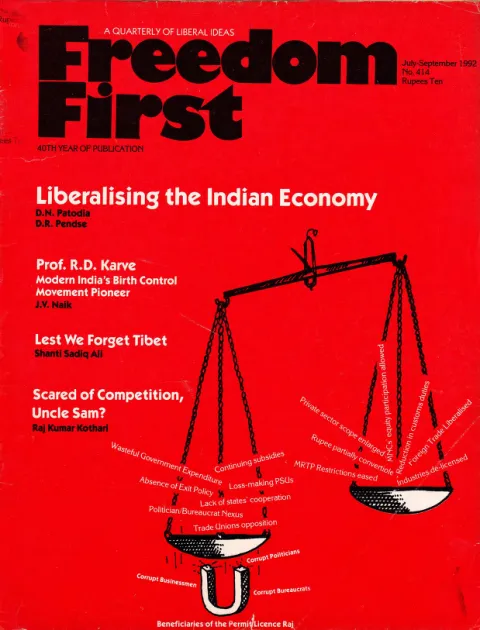
This is issue No. 414 of Freedom First (July-September 1992), the Bombay-based quarterly of liberal ideas founded by Minoo Masani, published in its 40th year by the Democratic Research Service under editors S.V. Raju and R. Srinivasan. The issue’s cover package is ‘Liberalising the Indian Economy’, assessing the first year of the Narasimha Rao government’s reforms: industrialist D.N. Patodia surveys the reforms undertaken (delicensing, MRTP easing, rupee devaluation and partial convertibility, liberalised foreign investment) and argues what remains — cutting wasteful government expenditure, rationalising the tax structure, developing infrastructure, and reforming employment policy — while economist D.R. Pendse, interviewed by the US quarterly Economic Reforms Today, discusses the case for privatisation, the need for an independent public-policy think tank, and cautious optimism about India’s medium-term prospects. In the rendered pages the volume also carries Minoo Masani’s regular ‘The Masani Viewpoint’ column (on Pakistan’s treatment of an Indian diplomat, Article 368 amendment debates, judicial supremacy, and telephone tariffs), S.V. Raju’s report on a communal controversy over the Bharatiya Vidya Bhavan’s use of Anjuman-i-Islam premises, A.G. Nadkarni’s analysis of the Harshad Mehta securities scam (‘The Mother of All Indian Scams?’), and the start of M.S. Srinivasan’s essay ‘Cutting Politicians Down to Size’ arguing for constraining politicians’ role via specialist national commissions, alongside a reprinted extract from David McCullough on American self-reliance.
Key points
-
D.N. Patodia’s “The Reforms so Far — What Remains to be Done” credits the Rao government with delicensing roughly 80% of industries and permitting up to 50% foreign equity, while arguing further work is needed on cutting wasteful expenditure and reforming education and employment policy.
-
D. R. Pendse, interviewed by Economic Reforms Today, calls for an independent, Washington-style think tank to build public support for reform and expresses confidence India could be a major Asian economic force by 2005-2010 given consistent policy.
-
Minoo Masani’s regular column condemns Pakistan’s torture of an Indian diplomat, recalls his own 1960s Road Transport Reorganisation Committee recommendation to abolish octroi on petrol, and calls India’s population growth to 844 million a symptom of the government’s “utter failure” to control it.
-
A.G. Nadkarni analyses the Harshad Mehta securities scam — the largest Indian financial fraud since the 1950s Mundhra scandal — attributing it to systemic bank-nationalisation failures and calling for denationalisation of banking.
-
M.S. Srinivasan proposes cutting politicians’ role down to properly political matters, delegating economic, social and educational policy to specialist independent commissions such as a forty-member National Economic Commission barred to politicians.
Essays
The Reforms so Far — What Remains to be Done
By D.N. Patodia
Industrialist D.N. Patodia surveys, in the rendered pages, the economic reforms carried out in the first eight months of the Narasimha Rao/Manmohan Singh government and lists supporting measures still needed. He credits the reforms with delicensing about 80 percent of industries, removing MRTP restrictions on assets, liberalising foreign trade, devaluing and partially converting the rupee, and permitting up to 50 percent foreign equity. He then argues, in the rendered pages, that further work is required on cutting wasteful government and public-sector expenditure, curbing internal and external borrowing, rationalising the tax structure (including gold and silver import duties), developing infrastructure, and reforming education and employment policy so that industry is not asked to be the primary employment provider.
- Forty years of state control left India with multiple controls, restrictive regulation, and a savings apparatus diverted to subsidise loss-making public enterprises.
- By 1989 the balance-of-payments crisis and foreign-exchange depletion pushed the country to the brink of default, prompting the reforms of 1991-92.
- Reforms so far: ~80% of industries delicensed, MRTP asset restrictions removed, foreign trade liberalised, rupee devalued and partially convertible, up to 50% foreign equity permitted in most sectors.
- Government wage bills consume 40% of aggregate central/state receipts; central government employee numbers and remuneration are both projected to rise rather than fall despite stated cutbacks.
- Author proposes: selling/closing loss-making public sector commercial enterprises, disinvesting up to 49% of profit-making PSU shares, curbing internal debt (exceeding Rs 2,60,000 crores in 1990-91), rationalising tax/customs duty (bringing gold import duty down from 15% to under 10%), and legalising silver import to curb smuggling.
- Population growth and a defective education system are identified as central constraints on employment; industry alone cannot absorb the unemployed.
”Awakening the Sleeping Giant”
By D. R. Pendse
This is a reprint of an interview with economist D.R. Pendse conducted by John Zemko, editor of the US quarterly Economic Reforms Today, on India’s new economic policy. In the rendered pages, Pendse argues that the reform process must be made politically durable by educating public opinion — he calls for an independent, non-official think tank on the model of Washington policy institutes, invoking Lincoln’s dictum that ‘a man who molds public sentiment goes deeper than the man who makes statutes.’ He characterises the reforms as driven jointly by crisis management and a genuine intellectual shift, distinguishes privatisation from mere promotion of the private sector, and describes India’s peculiar model of privatisation (partial disinvestment of PSU equity rather than full sale, given the historically reserved industrial sectors). He also discusses continuing constraints — a nationalised financial sector starved of long-term capital, and private-sector reluctance to enter newly opened areas like power generation and road construction. On the future outlook, Pendse expresses confidence that India could be a major economic force in Asia by 2005-2010 if entrepreneurship (which he judges plentiful) is matched by consistent policy, arguing natural resources are secondary to policy and entrepreneurial capacity.
- Public sentiment does not yet grasp why reforms are necessary; Pendse calls for a Washington-style independent think tank to educate opinion, citing his talks with CIPE (Center for International Private Enterprise).
- Reforms are both crisis management and part of a wider intellectual shift toward market-oriented policy in India.
- Indian privatisation ≠ mere private-sector promotion; the government is disinvesting up to 49% of equity in profit-making PSUs (about Rs 25 billion raised) rather than selling full ownership as Mrs Thatcher did in Britain.
- Government has reserved seven industries for the public sector under the new industrial policy, down from a much larger prior list; 278 ‘commercial enterprises’ of government exist, many perennial loss-makers, which Pendse says should be sold off, restructured or closed.
- Private sector has been slow to respond even where sectors like power generation and road construction have been opened, partly because transmission networks remain state-controlled and price caps discourage new entrants.
- The financial sector is ‘basically nationalized’, starving private long-term (10-15 year) capital projects like power plants of funding.
- Pendse is confident that within 15 years (by 2005-2010) India will be seen as a major Asian economic force, provided consistent policy support continues; he rates entrepreneurship and policy above natural-resource endowment as growth drivers.
The Masani Viewpoint
Minoo Masani’s regular column, in the rendered pages, covers several unrelated topical items. He condemns the torture of an Indian diplomat by Pakistani police and urges India to press Amnesty International’s findings on Pakistan; dismisses as ‘absolute nonsense’ the government’s claim that a constitutional amendment by Indira Gandhi makes secularism and socialism unamendable, arguing constitutional amendment (even of India’s frontiers) is a legitimate right of political parties; endorses A.G. Noorani’s warning against curbing judicial review in favour of the Speaker; approves of monitored, metered local telephone calls; recounts his own 1960s role chairing the Road Transport Reorganisation (‘Masani’) Committee, which recommended abolishing octroi on petrol (still unimplemented thirty years on) and criticises the 1992 truckers’ strike settlement as a postponement of the underlying problem; laments Britain’s first-past-the-post election result as a lost opportunity for proportional representation; and closes with alarm at India’s population reaching 844 million (23% growth in ten years), calling for fiscal disincentives such as higher income tax for a third child.
- Condemns Pakistan’s ‘primitive and brutal’ torture of Indian diplomat Rajesh Mittal and urges tougher diplomatic response, while criticising India’s own past dismissiveness of Amnesty International findings against India.
- Rejects the claim that a Prime Minister’s constitutional amendment can place secularism/socialism beyond further amendment, calling this ‘absolute nonsense’ and defending the amendability of even India’s frontiers by legitimate political process.
- Backs A.G. Noorani’s Statesman article warning against amendments that would subordinate judicial review to the Speaker and state legislatures, citing the Supreme Court’s ‘basic structure’ doctrine.
- Recalls chairing the Road Transport Reorganisation Committee (~1960) which recommended abolishing octroi on petrol due to waste and corruption at check-posts; thirty years later the recommendation remains unimplemented outside Union Territories.
- Criticises the 1992 resolution of the All India Motor Transport Congress truckers’ strike as a mere postponement, urging state/municipal governments be stripped of octroi-levying power.
- Views the British 1992 general election result (Conservative 42% of vote, Labour 35%, Liberal Democrats 18%) as a missed opportunity for proportional representation and coalition government.
- Calls India’s population growth (844 million, +23% in a decade) a symptom of the government’s ‘utter failure’ to control population and proposes financial disincentives, e.g. higher income tax for parents of a third child.
Tamilnadu’s Politics of Spectacle
By R. Srinivasan
A.G. Nadkarni analyses the 1992 Harshad Mehta securities scam, the largest Indian financial fraud since the 1950s Mundhra scandal. He explains the modus operandi — brokers exploiting banks’ government-bond trading (via unphysically-transferred Banker’s Receipts) to divert bank funds into stock-market speculation — and cites the Janakiraman Committee’s findings of glaring internal-control deficiencies at multiple banks, with the scam’s scale estimated at Rs 3,542.78 crores. Nadkarni argues the failure is systemic rather than personal, rooted in bank nationalisation’s combination of inefficiency and corruption, and calls for denationalisation of banking and free, fair competition as the remedy.
- The scam (named for broker Harshad Mehta) is described as the largest since the 1950s Mundhra Life Insurance Corporation scandal.
- Banks must hold over a third of deposits in government bonds (SLR); daily bond trading exceeds Rs 1000 crores, often via brokers using Bank Receipts (BRs) rather than physical securities transfer.
- Modus operandi: Mehta swapped low- for high-yielding bonds with banks like SBI on reverse-swap agreements, shortsold high-yield bonds anticipating new issuances, and used borrowed BRs as collateral for stock-market speculation loans.
- The scheme unraveled when the RBI’s Securities General Ledger revealed a shortfall of over Rs 600 crores in the SBI account.
- Janakiraman Committee findings: National Housing Bank, State Bank of Saurashtra, SBI-Capital Markets and Standard Chartered Bank made payments without matching SGL notes/BRs worth Rs 1,795.66 crores; Standard Chartered, Canbank Financial Services and Canbank Mutual held BRs from Bank of Karad/Metropolitan Bank unbacked by securities worth Rs 1,282.97 crores.
- Mehta’s dealings with SBI alone between July 1991 and April 1992 totalled about Rs 17,000 crores; his personal wealth was estimated by tax authorities at around Rs 4,000 crores.
- Nadkarni’s remedy: denationalisation of the banking industry and free, fair competition, framing the scam as evidence of systemic failure rather than a few bad actors.
R.D. Karve: Modern India’s Birth Control Movement Pioneer
By J.V. Naik
M.S. Srinivasan argues, in the rendered pages, that India’s politicians have accumulated an unsustainable burden of decision-making authority for which most are unqualified, resulting in a string of policy failures (Kashmir, Punjab, Sri Lanka, defence procurement) and demoralised institutions. He contends ordinary voting mechanisms cannot check this because ‘every man has his price’ in the political market, and proposes cutting politicians’ role down to matters of properly political concern while delegating economic, social, educational and technical policy to specialist, independent bodies — starting with a forty-member National Economic Commission staffed mostly by professional economists and technologists, insulated from ministerial control, that would take binding decisions on economic policy. This is followed (or accompanied) by a reprinted extract from David McCullough arguing that America’s national achievements came from work and self-reliance rather than politicians or charity — introduced by M.S. Srinivasan as a provocation asking whether India, whose politicians are not comparably ‘educated’ or oriented to national progress, should not similarly reduce reliance on its political class.
- Argues politicians are overburdened with decisions spanning defence procurement, agriculture, health, industry and diplomacy, despite frequently lacking relevant expertise (‘barely literate’ in Srinivasan’s framing).
- Cites Kashmir, Punjab, Sri Lanka, and defence-equipment deals as examples of decisions ‘proved to be wrong’.
- Argues voting cannot discipline this class because political actors treat power and wealth as the sole objective, unconstrained by an honest/dishonest distinction within a ‘casteless, classless’ political fraternity.
- Proposes a National Economic Commission (40 members, at least 30 professionals: economists, engineers, technologists) as an independent, continuing authority over economic policy — growth, resource mobilisation, borrowing, foreign exchange, imports/exports, development projects — explicitly barring politicians (including as Chairman) from holding office in it.
- Envisions parallel National Social, Education, Technology and Judicial Commissions restricting politicians to expressing (not implementing) the people’s views.
- The accompanying McCullough extract argues American national achievement (institutions, wealth, freedoms, moon landings, the Panama Canal) came from work and self-reliance, not from politicians or charity, and that citizens should not expect politicians to solve their problems for them.
Generated by the v1.5 extraction pipeline. Awaiting editorial review.
Metadata and summary are AI-extracted from the source PDF and reviewed for editorial accuracy. The original work is available via the Read PDF tab above (where present); paragraph-level citation inside the PDF is deferred to a future engagement.