periodical issue
Freedom First
A Quarterly of Liberal Ideas
By S. V. Raju
Indian Committee for Cultural Freedom, 3rd floor, Army & Navy Building, 148, Mahatma Gandhi Road, Mumbai 400001 · Mumbai · 1996
52 pages
Freedom First
Summary
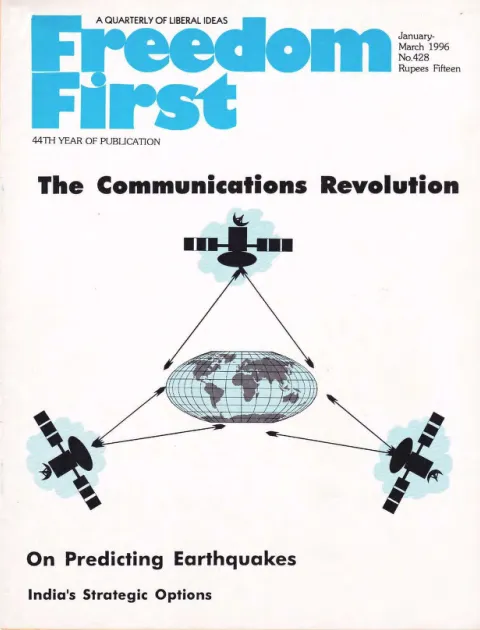
This is issue No. 428 of Freedom First (January–March 1996, 44th year of publication), the Bombay-based quarterly of liberal ideas founded by Minoo Masani in 1952 and edited by S. V. Raju. In the rendered pages, the issue opens with an obituary tribute to the jurist H. M. Seervai (died 26th January 1996), followed by the regular ‘With Many Voices’ page of press quotations and the satirical column ‘Of Cabbages and Kings’ (this instalment eviscerating Mother Teresa’s reputation via Christopher Hitchens-adjacent claims about her homes for the dying). A piece on the Tibetan freedom movement marking the 10th March anniversary follows. The bulk of the rendered pages are given to the cover package, ‘The Communications Revolution,’ four essays examining India’s telecom and broadcast liberalisation of the 1980s-90s: S. V. Raju on the lived experience of the shift from valve radios to the internet; T. H. Chowdary on communications satellites and India’s self-defeating uplinking restrictions; Amita Malik on Doordarshan’s fumbling response to satellite-channel competition; and Namita Unnikrishnan on a study of television’s effect on Indian children and advertising. The issue also carries a special section marking Minoo Masani’s 90th birthday, with tributes from his son Zareer Masani and from Khushwant Singh, plus a promotional notice for a commemorative volume of Masani’s writings. The final rendered essay, J. B. D’Souza’s ‘Delusions of Progress,’ is a critique of GNP/GDP and the Human Development Index as measures of national well-being, drawing on a San Francisco think tank’s ‘genuine progress indicator’ research. Further contents listed in the table of contents but not reached in the rendered pages include essays on populism and the Indian economy, gender debate, South Asian society and politics, religious fundamentalism, earthquake prediction, India’s strategic options, and China, plus book reviews.
Key points
-
An unsigned obituary marks the death of jurist H. M. Seervai, tracing his 65-year Bombay Bar career, his 17-year tenure as Advocate General, his treatise on the Constitutional Law of India, and his decade as president of the PUCL, Bombay.
-
The cover package “The Communications Revolution” opens with S. V. Raju’s “Changing the Way We Live”, a nostalgic survey of India’s shift from valve radios and manual telephone exchanges to computers, mobile phones and the internet.
-
T. H. Chowdary’s “Communications Satellites” argues India’s ban on domestic uplinking to foreign satellites is self-defeating and costs foreign exchange, calling for de-monopolising the spectrum and privatising INSAT’s commercial functions.
-
Amita Malik’s “Doordarshan: Responding to Competition” surveys the broadcaster’s history from the SITE satellite experiment through Emergency-era subordination to government control, criticising its delayed coverage of Indira Gandhi’s assassination and its imitative response to satellite rivals like Zee TV.
-
Namita Unnikrishnan’s “Children and The New Information Environment” summarises a Delhi study finding that migrant labourer families prioritise renting a TV over adequate meals, that a “silent family” phenomenon replaces conversation, and that 75% of surveyed children aged 8-15 wanted products they saw advertised.
-
A special section marks Minoo Masani’s 90th birthday with Zareer Masani’s “A Son’s Tribute”, recalling his father’s formative anti-communism and belief in federalism including a right to secession, and Khushwant Singh’s “Walk Alone”, invoking Tagore’s “Ekla Chalo” to praise Masani’s independence of mind.
-
J. B. D’Souza’s “Delusions of Progress”, cut off mid-argument in the rendered pages, critiques GNP and the Human Development Index as measures of well-being, citing a “genuine progress indicator” study showing a roughly 45% decline in genuine American progress since 1970 despite rising GDP.
-
The “Of Cabbages and Kings” column mounts a sharp critique of Mother Teresa’s homes for the dying, drawing on The Missionary Position and a Lancet report describing primitive medical conditions.
Essays
Essay 0
An unsigned obituary tribute to H. M. Seervai (1906–1996), the Bombay jurist and constitutional lawyer, who died on Republic Day, 26th January 1996, in his 90th year. It traces his life from a Parsi Zoroastrian upbringing and boyhood ordination as a fire-temple priest, through Elphinstone College, to a 65-year career at the Bombay Bar beginning in 1929. It highlights his major cases (Keshav Singh’s Case, Keshavananda Bharati’s Case, the Kerala arguments before a 13-judge Supreme Court bench, and the 1981 Judges Transfer Case), his 17-year tenure as Advocate General of Bombay from 1957, his monumental treatise on the Constitutional Law of India (first published 1967, later in its 4th edition), his honours (Padma Vibhushan 1972, Dadabhoy Naoroji Award 1980, Living Legend of the Law 1994), and his decades as a civil libertarian and president of the PUCL, Bombay (1983-1993). It closes by dwelling on his character: absolute honesty, love of poetry and literature, and inflexible devotion to truth.
- Seervai died on 26th January 1996 (Republic Day) at age 89, in his 90th year
- Born in Bombay, 5 December 1906, into a priestly Parsi Zoroastrian family; ordained a fire-temple priest at age 8
- Joined the Bar in 1929, worked under Sir Jamshedji Kanga; career spanned over 65 years
- Served as Advocate General of Bombay for over 17 years starting 1957, a record for the post in Maharashtra
- Authored the classic treatise on Constitutional Law of India, first published 1967
- President of the PUCL, Bombay, for 10 years (1983-1993), reflecting his civil-liberties commitment
- Received Padma Vibhushan (1972), Dadabhoy Naoroji Award (1980), and Living Legend of the Law (1994)
Many Voices
The ‘With Many Voices’ page, a recurring feature collecting notable or provocative quotations from the contemporary Indian and international press (November 1995 - March 1996), including remarks by M. J. Akbar, Bal Thackeray, L. K. Advani, Biju Patnaik, Nani Palkhivala, Amartya Sen, and Princess Diana, among others, generally used to illustrate hypocrisy, cynicism, or communalism in Indian public life.
- Compiles press quotations from November 1995 to March 1996
- Several quotes target Congress politicians’ opportunism and the hawala scandal’s implication of all parties
- BJP leaders L. K. Advani and Bal Thackeray are quoted on Hindutva and religious appeal in politics
- Amartya Sen is quoted from a Satyajit Ray Memorial Lecture defending India’s cultural openness against conservative purism
- Nani Palkhivala is quoted lamenting the erosion of legal certainty in India
Of Cabbages and Kings
The ‘Of Cabbages and Kings’ column (signed ‘RS’) is a sharply critical piece on Mother Teresa, prompted by the book The Missionary Position (Harper Collins) and by Dr. Robin Fox’s 1994 Lancet report on her Calcutta medical centre. It alleges primitive medical conditions, absence of strong analgesics, dogmatic resistance to modern hospital practice, and troubling accounts from her homes in San Francisco, New York, and elsewhere involving cold, punitive conditions for residents and controversial ‘baptising’ of the dying, contrasted with Mother Teresa’s own recourse to expensive European medical care when she herself fell ill.
- Cites The Missionary Position (Harper Collins) as a critical exposé of Mother Teresa
- References Dr. Robin Fox, editor of The Lancet, and his 1994 visit to Calcutta describing primitive medical conditions
- Describes alleged conditions in Mother Teresa’s homes in San Francisco and New York, including lack of amenities and forced conversions/baptisms of the dying
- Notes the irony that Mother Teresa sought expensive private medical treatment in Europe for her own heart trouble
- Column signed only with initials ‘RS’
The Movement for Tibetan Freedom
‘The Movement for Tibetan Freedom’ recounts the history of Tibetan resistance to Chinese rule, from China’s 1949/50 invasion and the forced 1951 17-point treaty, through the armed resistance of the 1950s, to the 10th March 1959 Lhasa uprising and the flight of the Dalai Lama into exile in India along with roughly 80,000 Tibetans. It describes the government-in-exile based in Dharamshala and frames the 10th March commemoration as an annual affirmation that Tibetan sacrifices for freedom were not in vain, noting that over 1.2 million Tibetans have died as a result of the Chinese occupation since 1959.
- China invaded Tibet in 1949/50; Tibet was coerced into signing the 17-point treaty in 1951
- The 10th March 1959 Lhasa uprising was suppressed by the People’s Liberation Army within about three days
- China’s own estimate cited: about 87,000 Tibetans killed in central Tibet alone during the suppression campaign
- The Dalai Lama fled to India along with his government and about 80,000 Tibetans
- The Tibetan government-in-exile, based in Dharamshala, pursues a non-violent resistance movement
- Since 1959, more than 1.2 million Tibetans are said to have died as a result of the occupation
Changing the Way We Live
By S. V. Raju
S. V. Raju’s ‘Changing the Way We Live’ opens the Communications Revolution cover package with a personal, nostalgic survey of India’s communications history: manual typewriters giving way to electric, electronic, and computer word processing; valve radios yielding to transistors; the era of All India Radio’s dominance and Radio Ceylon’s popularity; and the transformation of telegraphs, telephones (from shouted manual exchanges to digital and optic-fibre lines), cordless and mobile phones. A companion note on ‘Of Chips and Satellites’ explains how silicon chips underlie satellites and computers, and introduces ‘Internet’ to readers via an extracted definition, announcing a new regular column, ‘The Communications Revolution,’ to demystify the changes ahead.
- Traces a personal history from manual typewriters to computers and from valve radios to transistors
- Recalls All India Radio’s 9 pm news and the popularity of Radio Ceylon’s ‘Binaca Geet Mala’
- Describes the evolution of Indian telephone service from manually shouted exchanges to digital switching and optic fibre
- Introduces cordless and mobile (‘cellular’) phones and pagers as recent developments
- A sidebar explains silicon chips as the basis of satellites and computers and introduces the concept of the Internet
- Announces a new recurring Freedom First column titled ‘The Communications Revolution’
Communications Satellites
By T. H. Chowdary
T. H. Chowdary’s ‘Communications Satellites: Revolutionary Developments and Trivialising Uses’ explains the science of geostationary satellites (invoking Arthur C. Clarke’s 1945 proposal and Arnold Toynbee’s hopeful remarks at the 1963 launch of Telstar), traces thirty years of technical progress (rising payloads, longer satellite lifespans, cheaper ground equipment), and argues that India’s regulatory posture is self-defeating: the government bans domestic uplinking to foreign satellites, forcing Indian broadcasters to uplink from abroad and lose foreign exchange, while INSAT remains uncorporatised and unable to compete commercially. Chowdary calls for de-monopolising the radio spectrum, privatising INSAT’s commercial functions, and ending restrictions that prevent India from becoming an international satellite-services provider like Thailand or Hong Kong.
- Opens with Arthur C. Clarke’s 1945 ‘Wireless World’ proposal for geostationary communications satellites
- Cites Arnold Toynbee’s hope, expressed at the 1963 Telstar launch, that global communication would foster mutual human understanding
- Details 30 years of technical progress: satellite circuit capacity rose from 240 (1965) to 120,000 (1992), lifespan from 1.5 to 15 years
- Argues India’s ban on uplinking from Indian soil to foreign satellites is ‘senseless’ and causes needless foreign-exchange losses
- Calls for corporatisation and eventual privatisation of ISRO’s INSAT business
- Frames Indian government satellite/spectrum policy as ‘ostrich-like’
Doordarshan : Responding to Competition
By Amita Malik
Amita Malik’s ‘Doordarshan: Responding to Competition’ surveys Doordarshan’s history from its amateurish, earnest beginnings and the SITE satellite experiment through the Emergency-era subordination to government control (recalling Indira Gandhi’s dismissive ‘Credibility? What is credibility?’ remark) to its slow, defensive response to satellite-channel competition from the late 1980s onward. Malik criticises Doordarshan’s news failures (delayed reporting of Indira Gandhi’s assassination and the Nagpur stadium tragedy), its abandonment of the promising Channel 3 experiment by prime ministerial fiat, and its imitative, poor-quality response to entertainment competitors like Zee TV and MTV, concluding that its future depends on offering distinctive quality programming rather than joining a ‘commercial rat race.’
- Recalls Doordarshan’s amateurish, enthusiastic early years and the 1975-76 SITE satellite broadcasting experiment
- Cites Indira Gandhi’s remark dismissing the idea of broadcaster credibility during the Emergency
- Criticises Doordarshan’s delayed and inadequate news coverage of Indira Gandhi’s 1984 assassination and a Nagpur stadium tragedy
- Describes the aborted ‘Channel 3’ experiment, cancelled by an overnight PMO directive
- Argues Doordarshan’s response to satellite competition has been imitative (a sanitised MTV clone, plagiarism of Zee TV formats) rather than distinctive
- Concludes Doordarshan’s future should rest on quality and difference, not competing on satellite channels’ own terms
Children & The New Information Environment
By Namita Unnikrishnan
Namita Unnikrishnan’s ‘Children and The New Information Environment’ summarises a Delhi-based study (soon to appear in book form) on television’s impact on children and the advertising they are exposed to. It finds that Indian children’s relationship to television varies sharply by class, with affluent children sometimes owning personal TV sets while migrant labourer families prioritise renting a TV/VCR even over adequate meals; documents a ‘silent family’ phenomenon in which television replaces conversation; and reports that TV advertising, riddled with fantasy and hyperbole, drives consumerist aspirations even among children who cannot afford advertised products. The essay closes with recommendations for critical evaluation of television and its advertising codes, given children’s vulnerability as an audience.
- Draws on a Delhi study of TV’s impact on children across affluent, middle-income, and poor households
- Reports the rise of a ‘silent family,’ where separate personal TV sets replace shared family interaction
- Notes some upper-class children own personal TVs but watch less than middle-class peers, per the survey
- Documents that migrant labourer families in Delhi prioritise renting a TV/VCR over adequate meals
- Finds 75% of children aged 8-15 surveyed wanted to own products advertised on TV
- Advertising to children incorporates fantasy and hyperbole; some ads misrepresent products or promote unsafe behaviour
- Calls for critical evaluation of TV and stricter appraisal of advertising aimed at children
A Son’s Tribute
By Zareer Masani
Zareer Masani’s ‘A Son’s Tribute,’ part of the special ‘Minoo Masani 90’ section, is a personal and political reflection by Minoo Masani’s son on his father’s life and character. It recounts Masani’s anti-communism as a formative influence on his household, Zareer’s own youthful rebellion into socialism and later disillusionment, and their many political disagreements. It credits Masani with unwavering conviction, internationalism, rejection of national chauvinism, championship of minorities, and belief in federalism (including support for a right to secession), while noting his stubbornness may have cost him potential allies against the Indian left.
- Minoo Masani was twelve when the Bolshevik Revolution occurred and later rejected Stalinist autocracy in the 1930s
- Masani founded Freedom First in 1952 and led the Swatantra Party’s economic liberalism agenda in the 1960s
- The essay frames Masani’s defining conviction as fierce, career-long anti-communism
- Zareer Masani recalls his own youthful swing to socialism and opposition to the Vietnam War at Oxford, later returning to more liberal views
- Credits his father with internationalism, minority rights advocacy, and belief in federalism including a right to secession
- Notes Masani’s stubbornness as both his strength and weakness, potentially costing him allies
Walk Alone
By Khushwant Singh
Khushwant Singh’s ‘Walk Alone,’ also part of the Minoo Masani 90 tribute section, reflects on Masani’s independence of mind, invoking Tagore’s ‘Ekla Chalo’ and a couplet by Majrooh Sultanpuri on walking a lonely path until others join. Singh recounts his personal connections to the Masani family (Minoo’s father Sir Rustom, sister Mehra, first wife Shakuntala, son Zareer, and wife Sheela) and praises Masani’s clear-headed political analysis and foresight, closing with Masani’s own self-description as a lifelong non-conformist (‘If you are not a socialist at 20 … you have no head’).
- Invokes Tagore’s song ‘Ekla Chalo’ (Walk Alone) and a Majrooh Sultanpuri couplet as framing for Masani’s independence of mind
- Recounts Khushwant Singh’s personal acquaintance with several generations of the Masani family
- Praises Masani’s clear-headed analysis of world events and Indian politics and his foresight
- Notes the essay is reprinted from Mid-Day, February 3, 1996
- Accompanied by a promotional notice for a commemorative 100-page ‘Minoo Masani 90’ volume of his writings, priced Rs.150 (Rs.100 for Freedom First subscribers)
Delusions of Progress
By J. B. D’Souza
J. B. D’Souza’s ‘Delusions of Progress’ (seen only through its opening, page 17-18 of a longer piece) argues that GNI/GDP is a poor and misleading measure of national well-being. Citing a San Francisco think tank’s ‘genuine progress indicator’ (GPI) research, D’Souza shows that while conventional GDP suggests steady American progress since the 1950s, the GPI reveals roughly a 45% decline since 1970 once social costs are properly counted. He details specific distortions in GDP accounting: it credits spending on crime prevention and repair, environmental destruction and clean-up, diet industries addressing overeating, and wasteful VIP security and bureaucratic travel, while ignoring household and community labour and income distribution.
- India’s per capita national income roughly doubled between the early 1950s and early 1990s (Rs.1127 to Rs.2240 in 1980 prices), a much slower rate of growth than South Korea’s
- Cites a 1993 UN human development ranking of 173 countries and the shortcomings of the Human Development Index (HDI) as an improvement on but still inadequate replacement for GDP
- Introduces the ‘genuine progress indicator’ (GPI), developed by San Francisco analysts, as a closer measure of a nation’s true condition
- The GPI shows a roughly 45% decline in genuine American progress since 1970, despite GDP’s steady rise
- GDP counts money spent fixing crime damage, environmental destruction and its clean-up, and the diet industry addressing overeating as economic ‘growth’
- In the seen portion, the essay is not yet complete; it continues past page 18 given the table of contents shows it running to around page 19
Generated by the v1.5 extraction pipeline. Awaiting editorial review.
Metadata and summary are AI-extracted from the source PDF and reviewed for editorial accuracy. The original work is available via the Read PDF tab above (where present); paragraph-level citation inside the PDF is deferred to a future engagement.