periodical issue
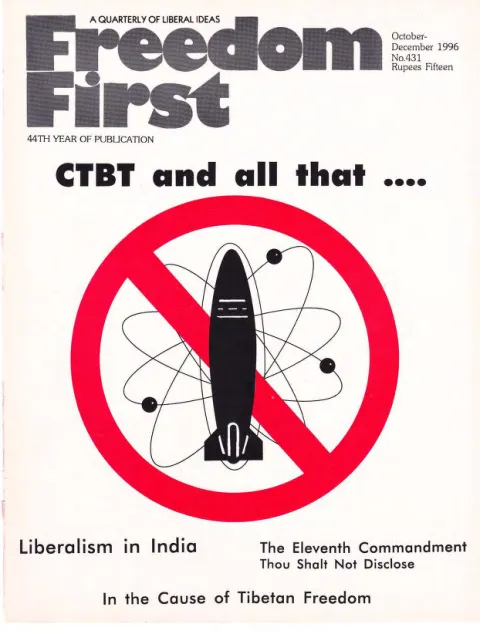
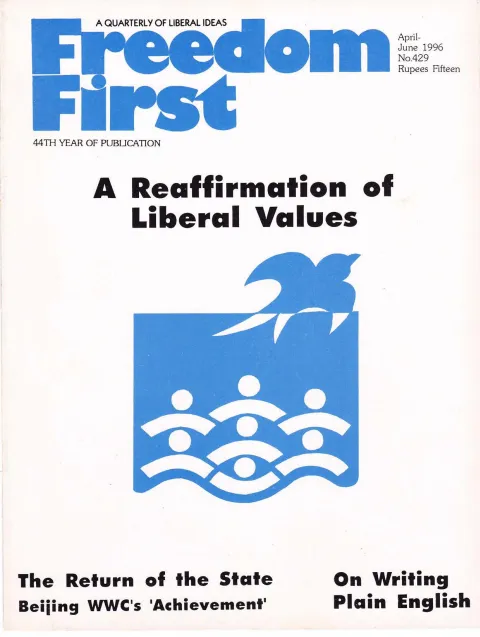
Freedom First
A Quarterly of Liberal Ideas
Published by J. R. Patel for the Indian Committee for Cultural Freedom and printed by him at Kaiser-E-Hind Private Ltd., 300, Perin Nariman Street, Mumbai 400 001 · Mumbai · 1996
52 pages
Freedom First
Summary
Freedom First No. 429 (April-June 1996), the 44th-year quarterly of the Indian Committee for Cultural Freedom, leads with a report and documents from a Convention on Liberal Values held in New Delhi in January 1996, organised by the Friedrich-Naumann-Stiftung. The issue’s editorial (‘Between Ourselves’) frames the Convention as a ‘reaffirmation of liberal values’ against a backdrop of criminalised politics and eroding public morality in India. In the rendered pages, contributors range from FNSt South Asia figures (Geeta Lal reporting on the Convention) to European liberal statesmen (Otto Graf Lambsdorff on protectionism as a disguised imperialism) to regular Indian columnists (Sharad Joshi excoriating the Beijing Fourth World Women’s Conference as a vehicle for state expansion, and Tavleen Singh defending her criticism of NGO activists like Medha Patkar). Recurring departments include ‘With Many Voices’ (a page of quotations from the press), ‘Of Cabbages and Kings’ (an editorial column on corruption, democracy and civil liberties), and an open letter from international PEN protesting the imprisonment of Chinese dissident Wei Jingsheng.
Key points
-
The issue leads with Geeta Lal’s report on the Convention on Liberal Values held in New Delhi in January 1996, attended by roughly 200 economists, scientists and journalists, at which speakers including Vice-President K. R. Narayanan and Sir David Steel affirmed liberal principles and called for a “slim and strong state, not a fat one”.
-
The Convention’s concluding consensus statement on “Basic Liberal Principles” distinguishes liberalism from laissez-faire, holding that the state must uphold rule of law and provide education, healthcare and infrastructure while otherwise keeping markets open and competitive.
-
Otto Graf Lambsdorff’s “Protectionism the Modern Face of Imperialism” traces the anti-imperialist roots of Manchester free-trade liberalism and argues that today’s “fair trade”, eco-imperialist and WTO “social clause” advocates repeat the coercive imperial logic under moralised cover, blaming the Smoot-Hawley Tariff Act of 1930 for deepening the Great Depression.
-
Sharad Joshi’s essay on the Beijing Fourth World Women’s Conference argues it marginalised grassroots activism in favour of a professionalised NGO class, contending genuine gender inequality lies in differential degrees of freedom rather than power or wealth, and that liberalisation rather than state intervention is the true antidote.
-
P. R. Dubhashi’s essay covers the Emergency-era experience in a southern Indian state.
-
The issue carries an open letter from international PEN protesting the imprisonment of Chinese dissident Wei Jingsheng, alongside the regular “With Many Voices” and “Of Cabbages and Kings” columns on corruption, democracy and civil liberties.
Essays
Protectionism the Modern Face of Imperialism
By Otto Count Lambsdorff
A report by Geeta Lal, Assistant Editor of Liberal Times (published by the Friedrich-Naumann-Stiftung’s South Asian regional office), on the Convention on Liberal Values held in New Delhi, January 5-7, 1996. The report describes the convention’s aims — presenting liberalism as a comprehensive philosophy, tracing its roots in Indian tradition, and applying it to contemporary problems — and summarises addresses by speakers including Vice-President K. R. Narayanan, Sir David Steel, Otto Graf Lambsdorff, Jurgen Axer, and Soli Sorabjee. Themes covered include the universality of human rights, the limited but essential role of the state (a ‘slim and strong state, not a fat one’), and the tension between social justice rhetoric and genuine poverty alleviation through market mechanisms. A sidebar quotes Minoo Masani describing ‘India’s New Liberalism’ as a fusion of Western liberalism and Gandhian teachings on trusteeship and minimal government.
- Convention on Liberal Values held in New Delhi, 5-7 January 1996, organised by the Friedrich-Naumann-Stiftung (FNSt), attended by roughly 200 economists, social/political scientists, journalists, and activists
- Core liberal principles affirmed: individual liberty, tolerance, universality of human rights, pluralism, minimal state interference, liberal democracy, market economy, free trade, and rule of law
- Speakers stressed a ‘slim and strong state, not a fat state’ — limited to national security, environment, and essential infrastructure, education and healthcare provision
- Social justice and free markets framed as complementary rather than contradictory; existing redistributive bureaucracies criticised as serving political elites rather than the poor
- Minoo Masani’s sidebar frames Indian liberalism as combining Western liberal thought with Gandhian trusteeship
The Return of the State / Beijing WWC’s ‘Achievement’
By Sharad Joshi
Text of the concluding consensus statement adopted at the Convention on Liberal Values, laying out ‘Basic Liberal Principles,’ the relationship between democracy, human rights and liberalism, and the role of the state in economic development. The statement affirms individual liberty as bounded by responsibility, defines liberalism as rooted partly in Vedantic tolerance, and asserts that political liberalism is not to be confused with laissez-faire: the state must maintain rule of law, prevent monopoly, separate powers, guarantee an independent judiciary, and ensure education, healthcare and infrastructure while otherwise leaving markets open and competitive.
- Individual liberty is not absolute but carries responsibility and must not interfere with others’ freedom
- Liberalism is distinguished from laissez-faire: it requires democracy, human rights, market economy AND rule of law together, not any one element alone
- The state’s economic role should be a ‘slim and strong state, not a fat one’ — keeping markets competitive, preventing monopoly, and providing infrastructure/education/healthcare
- Poverty alleviation should not mean charity but strengthening the poor’s ability to compete as equals in a free market
- Excessive redistributive bureaucracy is criticized as creating patronage networks that fail to reach the truly disadvantaged
On Writing Plain English
By A.K.R.Hemmady
Otto Graf Lambsdorff (former German Minister for Economic Affairs and FNSt chairman) argues that protectionism, not free trade, is the true modern heir of 19th-century imperialism. He traces the 19th-century Manchester Liberal free-trade movement (Adam Smith, Richard Cobden) as originally anti-imperialist, contrasts it with Sir John Seeley’s openly imperialist justification of free trade as requiring expansionist state power, and argues that today’s ‘fair trade’ advocates, eco-imperialists, and WTO ‘social clause’ proponents repeat the same coercive logic under moralized cover. He cites Keynes’s description of the pre-1914 liberal economic order, criticizes Friedrich List’s infant-industry protectionism, invokes Milton Friedman’s boat-drilling metaphor against retaliatory tariffs, and blames the Smoot-Hawley Tariff Act of 1930 for deepening the Great Depression and fostering totalitarianism. He concludes that protectionism, however dressed up in the language of fairness or environmentalism, is ‘the modern face of imperialism.’
- 19th-century Manchester Liberals (Cobden, citing Adam Smith) were the first movement to link free trade explicitly to anti-imperialism and world peace
- Sir John Seeley’s imperialist theory held that free trade requires an expansionist state to secure markets by force — Lambsdorff argues this logic persists in modern ‘harmonisation’ demands from bodies like the European Commission
- Modern protectionism disguises itself as ‘fair trade,’ ‘eco-imperialism,’ or WTO ‘social clauses,’ but functions the same way as historical imperialism: coercively imposing one country’s preferences on others
- The Smoot-Hawley Tariff Act (1930) triggered a collapse in international trade (60% below 1929 levels by 1938) that may have contributed to the rise of totalitarianism and World War II
- Milton Friedman’s parable of two people drilling holes in a boat illustrates why retaliatory counter-protectionism only compounds economic damage
- Friedrich List’s ‘infant industry’ argument for protecting developing-country industries is dismissed as having had disastrous historical consequences
The Emergency in a Southern State
By P. R. Dubhashi
Sharad Joshi (of the Shetkari Sanghatana) attacks the Fourth World Women’s Conference held in Beijing in September 1995 as an exercise in expanding state power under feminist cover. Comparing it unfavourably with earlier UN women’s conferences (Mexico 1975, Copenhagen 1980, Nairobi 1985), Joshi argues that the Beijing NGOs — unlike the more independent activists of earlier decades — are salaried employees dependent on government and international funding, and that both governments and NGOs have converged on demanding an expanded, protective state to counter their own eroding relevance as economic liberalisation proceeds worldwide. He argues that true gender inequality lies in differential degrees of freedom, not power or wealth, and that genuine liberation for women comes through liberalisation and market-driven dismantling of the domiciliary/non-domiciliary divide in labour, not through a state-sponsored ‘empowerment of women’ that is really a bid by NGOs and bureaucracies to preserve their own institutional survival.
- The Beijing Fourth World Women’s Conference (September 1995) is portrayed as marginalising genuine grassroots activism in favour of a professionalised NGO class dependent on government/international funding
- Joshi argues ‘the State shall replace father, husband and son’ became the feminists’ effective demand at Beijing, a demand governments eagerly endorsed to counter their own disempowerment amid economic liberalisation
- Gender inequality is reframed as a matter of differential degrees of freedom and choice, not of power, wealth, or income, per an empirical test cited from a UNDP-style report on gender preference at birth
- Liberalisation, not state intervention, is presented as the true ‘antidote’ to gender division of labour by dismantling barriers that confine women to domiciliary work
- The demand to measure and value women’s unwaged domestic work in GNP accounting is criticised via Prof. A. C. Pigou’s paradox about a bachelor marrying his maid
Generated by the v1.5 extraction pipeline. Awaiting editorial review.
Metadata and summary are AI-extracted from the source PDF and reviewed for editorial accuracy. The original work is available via the Read PDF tab above (where present); paragraph-level citation inside the PDF is deferred to a future engagement.