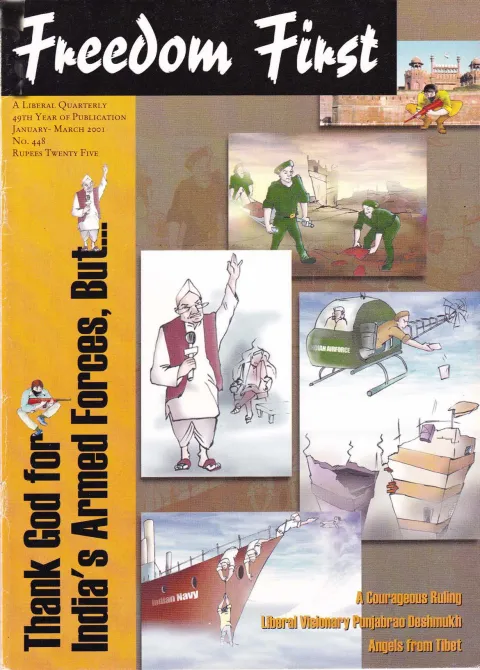
periodical issue
Freedom First
Dams and the Environment
By B. R. Ambedkar, K. M. Munshi, Nani Palkhivala, Mangesh Kulkarni
Published by J. R. Patel for the Indian Committee for Cultural Freedom and printed by him at Kaiser-E-Hind Private Ltd., 300, Perin Nariman Street, Mumbai 400 001. · Mumbai · 1997
52 pages
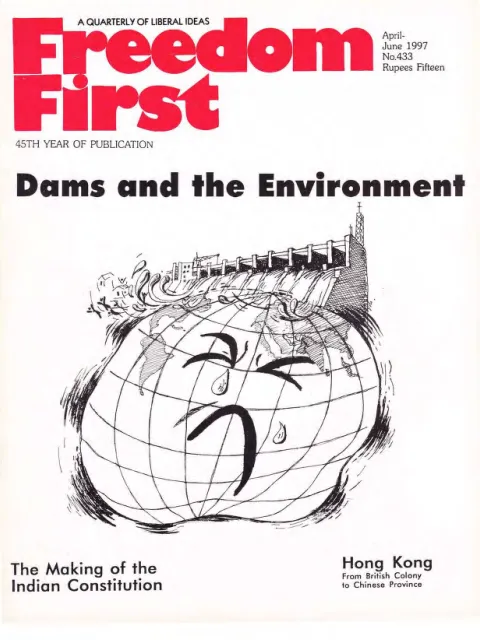
Freedom First
Summary
This is the April–June 1997 issue (No. 433) of Freedom First, marking the magazine’s 45th year of publication, edited by S. V. Raju with R. Srinivasan as Associate Editor. The cover feature is ‘Dams and the Environment,’ assembled around a query the editors put to A. K. R. Hemmady (retired Deputy Director General, Geological Survey of India) after receiving two American reprints on Himalayan seismicity and the ecological costs of dam-building. Hemmady’s framing essay and responses from civil engineer M. N. Bery, Deputy Director General of the Geological Survey M. Ramakrishnan, journalist Shahnaz Anklesaria Aiyar (on the Narmada Valley Project), and Justice K. S. Puttaswamy (arguing courts should not interfere with dam construction) debate whether India should keep building large dams like Tehri and Narmada given seismic risk, siltation, and displacement, or shift to smaller, distributed hydro schemes. In the rendered pages the issue then opens a second feature, ‘The Making of the Indian Constitution,’ commemorating the fiftieth year of the Constitution’s drafting with reprinted extracts from framers including B. R. Ambedkar, K. M. Munshi, M. R. Masani, and N. A. Palkhivala; the editors’ introduction invokes founder Minoo Masani’s role as one of the Constitution’s architects and quotes E. M. Forster’s ‘Two Cheers for Democracy.’ The ‘With Many Voices’ page of quotations and the ‘Of Cabbages and Kings’ editorial column (on VIP culture and the assault on Martin Massey) are also part of this issue. The regular front matter also carries a short World Environment Day piece by Hemmady and, unusually, a page reproducing part III of an unrelated ‘Tibet: The Facts’ feature (likely a stray scan from another issue) ahead of the masthead/contents page.
Key points
-
The cover feature “Dams and the Environment” opens with A. K. R. Hemmady summarising the geological case, drawing on Roger Billham’s research, that the Himalayan belt is overdue for a major earthquake near the Tehri Dam site that could affect 100-200 million people, and reviewing evidence of siltation and ecological damage from dam-building generally.
-
M. Ramakrishnan of the Geological Survey of India counters that environmental objections to dams are sometimes exaggerated, arguing small dams cannot collectively replace large dams’ storage and flood-control capacity and calling for a mixed strategy alongside better seismic data.
-
Shahnaz Anklesaria Aiyar’s piece on the Narmada Valley Project, an estimated Rs. 15,000-crore scheme that will submerge 350,000 hectares and about 237 villages, argues both Gujarat’s proponents and displaced-community activists overstate their case, coining opponents’ extremism “ecofundamentalism”.
-
Justice K. S. Puttaswamy argues dam construction should be decided by expert investigation rather than judicial intervention, supporting completion of the Tehri Dam given sunk costs while criticising the Supreme Court’s involvement in the Narmada Dam case.
-
A second feature, “The Making of the Indian Constitution”, marks the Constitution’s fiftieth year with reprinted extracts from framers including B. R. Ambedkar, whose closing Constituent Assembly address warns that political democracy is incomplete without social and economic democracy and cautions against both hero-worship of leaders and abandoning constitutional methods for grievance.
-
The issue also carries a talk by Martin Lee of Hong Kong’s Democratic Party on Hong Kong’s 1997 handover from British colony to Chinese province, alongside the regular “With Many Voices” and “Of Cabbages and Kings” columns.
Essays
Between Ourselves …
By Editor
The editorial ‘Between Ourselves’ explains the choice of cover story: weighing fifty years of the Constitution’s drafting against dams and earthquakes, the editors picked the latter as a subject of universal, non-partisan concern, timed to World Environment Day (June 5). It also flags the Constitution feature drawing on extracts from Ambedkar, Munshi, Masani, and Palkhivala, and introduces a talk on Hong Kong’s 1997 handover by Martin Lee of Hong Kong’s Democratic Party.
- Editors chose ‘Dams and the Environment’ over the Constitution anniversary as the cover story, citing its universal, borderless relevance.
- The choice was made consistent with founder Minoo Masani’s belief in ‘One World.’
- The Constitution feature draws on extracts from Ambedkar, K. M. Munshi, M. R. Masani, and N. A. Palkhivala.
- The issue also covers Hong Kong’s transfer from British colony to Chinese province via a talk by Martin Lee.
A ‘Catch 22’ Situation
By A. K. R. Hemmady
A. K. R. Hemmady’s cover essay recounts how the editors sent him two American reprints — ‘The Coming Himalayan Catastrophe’ (Discover, 1995) on Tehri Dam seismicity and ‘The Trouble with Dams’ (Atlantic Monthly, 1995) on the ecological costs of dam-building generally — and asked him to comment in light of recent earthquakes (Iran, Baluchistan, Yerevan, Jabalpur). Hemmady summarizes the geological case that the Himalayan belt is overdue for a major quake near the Tehri Dam site, cites Roger Billham’s call to scrap Tehri Dam in favour of smaller hydro projects, and reviews Devine’s argument that America’s own dam-building boom left an underappreciated legacy of ecological damage. The essay continues into siltation and erosion effects (Aswan Dam, Bhakra Dam) and health hazards from man-made lakes.
- Two US reprints on Himalayan seismicity and general dam ecology prompted the editors’ query to Hemmady.
- Roger Billham (University of Colorado) argues the Tehri Dam should be scrapped in favour of a series of smaller hydro projects.
- A single major Himalayan earthquake could affect 100-200 million people as far as Calcutta and Bombay.
- US dam-building peaked and declined by 1980 due to cost, pork-barrel politics, and growing awareness of ecological harm.
- Siltation has cut reservoir capacity dramatically worldwide (Grand Reservoir, Harba Reservoir, Anchikaya Hydro Project) and is a known issue at India’s Bhakra Dam.
- Loss of silt downstream of dams (e.g. Aswan) has damaged coastal fisheries by increasing erosion and cutting sediment-fed nutrients.
- Man-made lakes raise health hazards from bilharzia-carrying snails, filaria-causing flies, and malarial mosquitoes.
The Need to Strike a Balance
By M. Ramakrishnan
Dr. M. Ramakrishnan, Deputy Director General of the Geological Survey of India, argues that environmental concerns about dams are sometimes exaggerated or considered in isolation from the benefits of water resource development. He contends smaller dams carry lower seismic and environmental risk individually but cannot collectively replace large dams’ storage capacity, flood control, and regulated discharge functions, and calls for an integrated approach combining storage dams with smaller run-of-river schemes alongside better seismic data and design.
- Argues environmental objections to dams are sometimes exaggerated or viewed without weighing benefits.
- Small dams individually pose less seismic/environmental risk but cannot match large dams’ storage and flood-mitigation capacity in aggregate.
- Calls for a mixed strategy of storage dams plus smaller river schemes for sustainable development.
- Notes India uses only about 22% of its estimated hydro power potential.
- Urges better seismicity data and engineering knowledge rather than abandoning hydro development.
The Narmada Valley Project
By Shahnaz Anklesaria Aiyar
Shahnaz Anklesaria Aiyar’s piece (extracted from The Economic Times), titled ‘The Narmada Valley Project,’ lays out the scale and controversy of the project — 3,000 minor, 30 major, and 135 medium irrigation schemes across Gujarat, Maharashtra, and Madhya Pradesh, costing an estimated Rs. 15,000 crores — and the competing claims of Gujarat (as chief beneficiary promising drinking water and irrigation) versus displaced tribal communities and activist groups like the Chhatra Yuva Sangarsh Vahini. She argues both sides overstate their case: the project will not deliver all the water benefits Gujarat claims, but ecological objections that ignore drinking-water and irrigation needs amount to a self-destructive ‘ecofundamentalism.’
- The Narmada Valley Project envisages 3,000 minor, 30 major, and 135 medium irrigation schemes at an estimated cost of Rs. 15,000 crores.
- It will submerge 350,000 hectares of forest and agricultural land and about 237 villages.
- The Chhatra Yuva Sangarsh Vahini, a J.P.-inspired activist group, has led resettlement campaigns since 1979.
- Author argues Gujarat’s claims of solving drinking water for 129 cities and 4,500 villages are overstated.
- Coins the project’s opponents’ extremism as ‘ecofundamentalism,’ equally self-destructive as ecological illiteracy.
Need to Avoid Doctrinaire Approach
By K. S. Puttaswamy
Justice K. S. Puttaswamy (retired), Chairman of the Backward Classes Commission, argues that courts should not interfere with dam construction decisions, which he says are matters for expert investigation guided by the principle of ‘greatest good to the greatest number.’ He supports rehabilitation of the displaced but opposes halting projects like the Tehri Dam given the resources already sunk, and criticizes the Supreme Court’s intervention in the Narmada Dam matter as legally unsound.
- Argues dam construction should be decided by expert investigation, not judicial intervention.
- Supports continuing the Tehri Dam given the resources already invested, while favoring smaller dams going forward.
- Criticizes the Supreme Court’s interference in the Narmada Dam case as legally unsound.
- Invokes the utilitarian principle of ‘greatest good to the greatest number’ as the guiding standard.
- Cites Sir Visveswaraiah’s Krishna Rajasagar Dam as a historical example of successful dam-driven regional transformation.
Preserving the Constitution
By B. R. Ambedkar
B. R. Ambedkar’s ‘Preserving the Constitution’ reprints his closing address to the Constituent Assembly on 25 November 1949, the eve of the Constitution’s adoption. He warns that India’s newly regained democracy could again lapse into dictatorship if citizens abandon constitutional methods for grievance (invoking ‘Grammar of Anarchy’ for civil disobedience and satyagraha once constitutional means are open), cautions against hero-worship of political leaders quoting John Stuart Mill, and insists that political democracy must be joined with social and economic democracy or risk collapse from the contradiction between formal equality (‘one man, one vote’) and continued social and economic inequality. He also stresses the need to build a genuine sense of Indian nationhood to overcome caste division, and closes with a story via James Bryce about the fragility of national solidarity even in the United States.
- Speech delivered on the final day before the Constitution’s adoption (26 January 1950 being the date the Constitution would come into force).
- Warns democracy in form could give way to dictatorship in fact if citizens neglect constitutional methods.
- Invokes John Stuart Mill’s caution against hero-worship of even great leaders in politics.
- Argues political democracy is incomplete without social and economic democracy, given India’s stark social and economic inequality.
- Describes the persistence of caste as an obstacle to Indians becoming a true ‘nation,’ illustrated via Bryce’s anecdote about American national solidarity.
- Calls liberty, equality, and fraternity inseparable: none can be sacrificed without undermining the others.
Politics of Corruption
By Mangesh Kulkarni
No summary was extracted for this article. Listed for completeness.
Hong Kong: From British Colony to Chinese Province
By Martin Lee
No summary was extracted for this article. Listed for completeness.
Generated by the v1.5 extraction pipeline. Awaiting editorial review.
Metadata and summary are AI-extracted from the source PDF and reviewed for editorial accuracy. The original work is available via the Read PDF tab above (where present); paragraph-level citation inside the PDF is deferred to a future engagement.