periodical issue
Freedom First
Stability In Diversity
By Minoo Masani
Published by J. R. Patel for the Indian Committee for Cultural Freedom and printed by him at Kaiser-E-Hind Private Ltd., 300, Perin Nariman Street, Mumbai 400 001. · Mumbai · 1998
52 pages
Freedom First
Summary
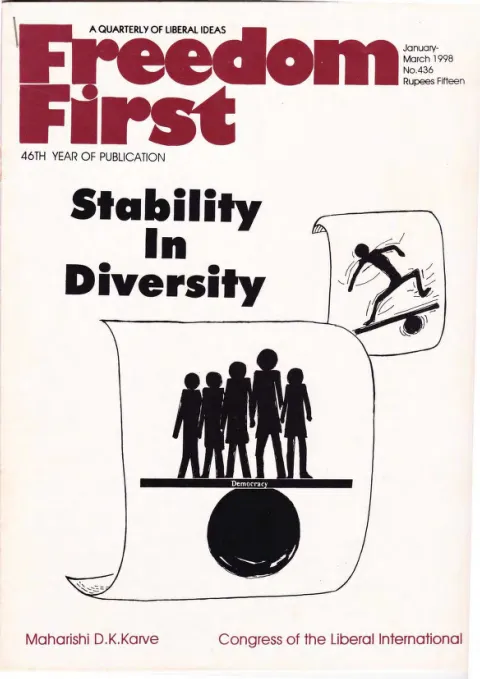
This is issue No. 436 of Freedom First (January-March 1998), a quarterly of liberal ideas published by the Indian Committee for Cultural Freedom in Bombay, marking the magazine’s 46th year of publication. The issue’s cover theme is “Stability in Diversity,” and its centerpiece is a symposium of the same name examining coalition politics, federalism, and constitutional design in India on the eve of the 12th Lok Sabha general elections. In the rendered pages, contributors include Lionel Fernandes on participatory democracy, Nagindas Sanghavi and the pseudonymous “Deepak” offering opposing views on whether coalitions can work, Santishree D. N. B. Pandit on reorienting Indian federalism, Minoo Masani (in an archival interview) on the President’s constitutional powers, and Jiban K. Mukhopadhyay on economic growth amid political instability. The issue opens with short editorial features (“Of Cabbages and Kings,” “With Many Voices” — a page of quotations from the Indian press) and a tribute to the late Dr. Krishnabai Nimbkar. The masthead lists S. V. Raju as editor, R. Srinivasan as associate editor, and Minoo Masani as founder.
Key points
-
The cover symposium “Stability in Diversity” examines coalition politics, federalism and constitutional design on the eve of the 12th Lok Sabha elections, with Lionel Fernandes arguing genuine democracy must be participatory rather than a periodic ritual of casting ballots, listing alertness, concern, sensitivity, openness, honesty and courage as its requirements.
-
Nagindas Sanghavi argues the rise of coalition politics reflects a genuine and welcome democratisation of the party system, crediting state-level coalition experience since the 1950s with building administrative maturity and channelling the Communist Party into democratic participation.
-
Writing pseudonymously as “Deepak”, a contrary essay argues coalitions are a symptom of divisive social forces rather than political maturity, proposing a two-round national election in which only the top two vote-getting parties would contest a run-off to force single-party majorities.
-
Santishree D. N. B. Pandit traces the strong unitary bias built into the Constitution and Article 356’s repeated misuse to dismiss non-Congress state governments, recommending binding status for Inter-State Council decisions and fairer revenue-sharing to make India a genuinely federal polity.
-
A republished interview with Minoo Masani argues the Indian President is not a mere rubber stamp but holds real reserve powers under Articles 74 and 75 to decline Cabinet advice, attributing Presidents’ failure to exercise these powers to personal timidity rather than constitutional constraint.
-
Jiban K. Mukhopadhyay traces GDP growth from 3.5% annually before 1979-80 to roughly 7% before 1997-98, crediting the United Front coalition’s Common Minimum Programme and Finance Minister P. Chidambaram’s 1997-98 “dream budget” with sustaining reform momentum despite coalition instability.
Essays
Many Voices
Lionel Fernandes argues that genuine democracy must be participatory, not merely a periodic ritual of casting ballots, and lays out six requirements for participatory democracy to flourish in India: alertness/awareness, concern, sensitivity, openness, honesty, and courage. He surveys the current weakness of each in Indian public life, criticizes the reduction of public institutions to “form without substance,” and warns that structural adjustment imposed by the IMF can hollow out participatory democracy by demoralizing the populace. He closes by calling for attitudinal change alongside institutional reform, urging that political leaders be cut down to size, the media expose impropriety relentlessly, and voters’ committees conduct ongoing political audits of elected representatives.
- Defines participatory democracy against a merely ritualized, ballot-casting version of democracy
- Identifies six essential inputs: alertness, concern, sensitivity, openness, honesty, and courage
- Diagnoses a ‘psychological realm’ of impediments (parochial loyalties, indifference to social evils) alongside a ‘structural realm’ (caste system, feudal/colonial legacies)
- Criticizes IMF-style structural adjustment for weakening popular participation by debasing living standards
- Calls for a vigorous, multi-front campaign of civic reform involving families, media, and voluntary associations
- Proposes pre- and post-election voters’ committees to scrutinize party programmes and conduct ongoing political audits
Of Cabbages & Kings
Nagindas Sanghavi surveys the rise of coalition politics in India, arguing that the decline of Congress’s single-party dominance and the rise of regional parties reflects a genuine and welcome democratization of the party system rather than mere instability. Comparing Indian coalitions unfavorably to European models, he notes Indian coalitions more often form to keep a disliked dominant party out of power rather than to govern constructively, but nonetheless credits coalition experience since the 1950s (PEPSU, Andhra, Bengal, Kerala) with building administrative maturity, cushioning the transition from one-party rule, and channeling once-revolutionary parties like the Communists into democratic participation.
- Presents a table of Congress/BJP/Janata Dal vote and seat shares from 1989-1998 showing decline of single-party dominance
- Distinguishes ‘foreign’ (European) coalitions, formed to govern, from Indian coalitions, often formed to keep a rival out of power
- Credits state-level coalition experience (PEPSU 1952, Andhra 1954, Bengal, Kerala) with building administrative capacity and democratic confidence
- Argues coalition governance helped tame the Communist Party’s revolutionary politics into parliamentary participation
- Concludes current Union-level instability reflects the weakness of a minority ministry, not a failure of coalition politics as such
Stability In Diversity - The Relevance of Participatory Democracy
By Lionel Fernandes
Writing under the pseudonym “Deepak,” the author takes the opposite view from Sanghavi, arguing that coalition politics in India is a symptom of divisive social forces rather than a sign of political maturity. He rejects the analogy to Italy and Japan as inapplicable given India’s scale, diversity, and lower education levels, and describes 13-party coalitions like the Gujral government as inherently paralytic, unable to take decisions with any connection to national governance. He proposes a two-round national electoral system in which only the top two vote-getting parties would contest all Lok Sabha seats in a run-off, to force single-party majorities and discourage splinter parties, while cautioning that any electoral reform must respect the Constitution’s basic structure.
- Argues coalition politics reflects a ‘bankruptcy of ideas’ rather than genuine ideological pluralism
- Rejects comparisons to Italian and Japanese coalition politics as inapplicable to India’s scale and diversity
- Criticizes splinter parties as clashes of personality with no real ideological content (‘the smaller the splinter group, the longer its name’)
- Proposes a two-step national election: an initial round open to all parties, followed by a run-off between the top two vote-getters for all Lok Sabha seats
- Cautions that reforms must respect the Constitution’s basic structure and cannot abolish adult suffrage or the freedom to form new parties
Will Coalitions Works
By Nagindas Sanghavi
Santishree D. N. B. Pandit examines the paradigm shift in Indian federalism brought about by Centre-level coalitions dependent on regional parties like the TDP, DMK, and AGP. She traces the strong unitary bias built into the Constitution (Articles 3, 4, 352, 356, 360, and Schedule VII), the history of Article 356’s misuse to dismiss opposition-run state governments (from E. M. S. Namboodripad’s Kerala government in 1959 onward), and the DMK’s evolving position from secessionism to demands for regional autonomy via the 1971 Rajamannar Committee and 1983 Sarkaria Commission. She argues decentralisation and a reoriented federal structure — including binding status for Inter-State Council decisions, repeal or narrowing of Articles 356/257/365, and fairer revenue-sharing per the Tenth Finance Commission — would make India a genuinely federal polity rather than a unitary one with token federal features.
- Describes India’s ‘republican monarchy’ under single-family Congress dominance as historically atypical of true federalism
- Cites B. R. Ambedkar’s Constituent Assembly explanation that neither the Union nor the states are subordinate to each other under the Constitution
- Chronicles Article 356’s repeated misuse to dismiss non-Congress state governments, from 1959 Kerala onward
- Traces the DMK’s shift from a 1962 renunciation of secession to autonomy demands via the Rajamannar Committee (1971) and Sarkaria Commission (1983)
- Recommends binding constitutional status for Inter-State Council/National Development Council decisions and revised centre-state revenue sharing
- Frames the reform goal as a federal polity ‘with unitary features, rather than a unitary system with some federal features’
A Contrary View
By Deepak
This is an extract from an interview of Minoo Masani conducted 15 years earlier by S. S. Bankeshwar, republished for its renewed relevance amid coalition politics. Masani argues, drawing on his Constituent Assembly membership, that the Indian President is not a titular rubber-stamp head of state like the British monarch but occupies a position ‘half-way’ between the British Crown and the American President, empowered under Articles 74 and 75 to decline Cabinet advice, dismiss a Prime Minister, and call fresh elections. He attributes Presidents’ failure to exercise these powers to personal lack of courage rather than constitutional constraint, cites Rajendra Prasad’s 1960 public criticism of the convention that the President must always follow ministerial advice, and discusses autonomy for border states and the risks of manufactured political consensus.
- Argues the Indian President is not a mere rubber stamp but holds real reserve powers under Articles 74 and 75
- Cites the Oxford Dictionary definitions of ‘aid’ and ‘advise’ to argue presidential advice can be accepted or rejected
- Blames the personal timidity of past Presidents, not the Constitution, for the convention of automatic compliance with Cabinet advice
- Cites President Rajendra Prasad’s 1960 Indian Law Institute address questioning the binding nature of ministerial advice
- Discusses sympathy for greater autonomy for sensitive border states like Kashmir, Mizoram, and Nagaland without endangering national unity
- Distinguishes genuine political consensus from consensus that is ‘fabricated and forced,’ which he calls a fraud and a sham
Reorienting Indian Federalism
By Santishree DNB Pandit
Jiban K. Mukhopadhyay opens an analysis of whether India’s post-1991 GDP growth acceleration can survive an era of frequent government changes and shifting coalition economic strategies. He traces growth from a lacklustre 3.5% annual average through 1979-80, up to 5.5% in the 1980s, and to roughly 7% in the three years before 1997-98 following the 1991 liberalisation reforms, and asks whether a 9%+ growth rate needed to double per-capita GDP in a decade (matching China) is sustainable given a possible slowdown to 5.5% in 1997-98. In the portion rendered, he credits the two short-lived United Front coalition governments (1996-97) with continuing liberalisation via Finance Minister P. Chidambaram’s well-received 1997-98 “dream budget,” despite the CMP’s promise being cut short when the Congress Party twice withdrew support.
- Traces GDP growth from 3.5%/year (to 1979-80) to 5.5% (1980s) to roughly 7% in the three years before 1997-98
- Notes per-capita growth rising from 1.5% (pre-1970s) to over 5% in the post-liberalisation years
- Argues a 7.2% GDP growth rate is needed to double per-capita GDP in a decade, matching China’s record
- Warns growth may fall to around 5.5% in 1997-98, raising doubts about sustaining the higher rate
- Credits the United Front’s Common Minimum Programme and Chidambaram’s 1997-98 budget with continuing reform momentum despite coalition instability
- Notes the UF’s economic momentum was interrupted when the Congress Party twice withdrew support, precipitating the 12th General Elections
Generated by the v1.5 extraction pipeline. Awaiting editorial review.
Metadata and summary are AI-extracted from the source PDF and reviewed for editorial accuracy. The original work is available via the Read PDF tab above (where present); paragraph-level citation inside the PDF is deferred to a future engagement.