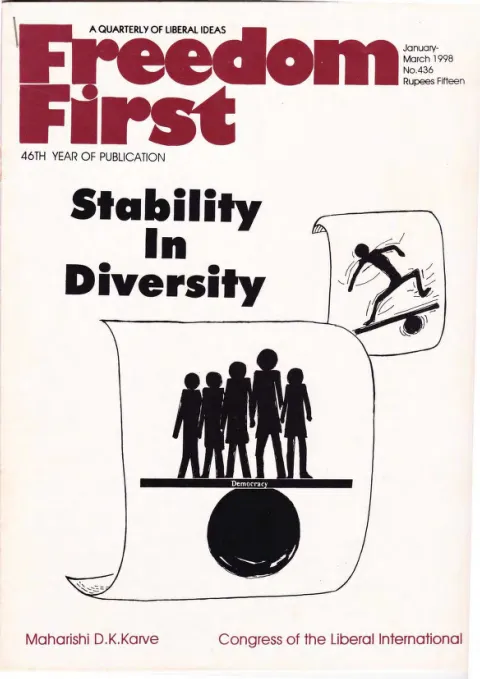
periodical issue
Freedom First
A Quarterly of Liberal Ideas
Edited by S. V. Raju
Published by J. R. Patel for the Indian Committee for Cultural Freedom and printed by him at Kaiser-E-Hind Private Ltd., 300, Perin Nariman Street, Mumbai 400 001. · Mumbai · 1998
52 pages
Freedom First
Summary
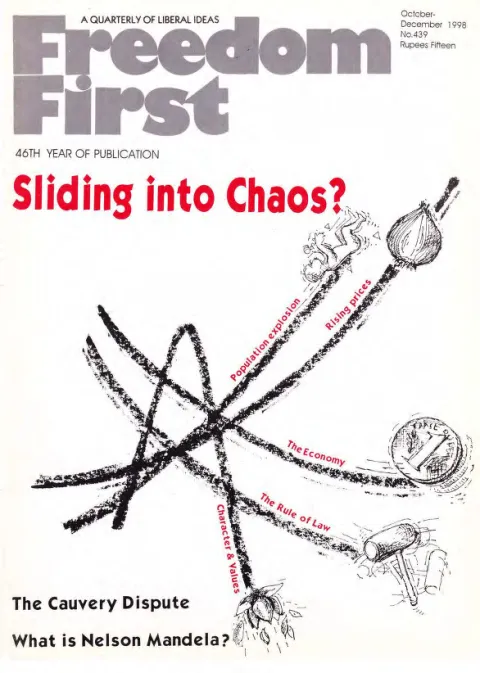
This is No. 439 of Freedom First (October–December 1998, 46th year of publication), the Bombay-based quarterly of liberal ideas founded by Minoo Masani, edited by S. V. Raju with Associate Editor R. Srinivasan, published by the Indian Committee for Cultural Freedom. The cover feature, “Sliding into Chaos?”, frames the issue’s central concern: population explosion, rising prices, a weakening economy, erosion of the rule of law, and declining character and values in India. The editorial (“Between Ourselves”) worries openly about a breakdown in law and order (citing Bombay’s crime wave and gangster impunity) and mocks the Uttar Pradesh government’s move to make Sanskrit compulsory as a distraction from real governance failures. In the rendered pages, the cover package opens with Deepak’s “The Crippling of the Indian Mind,” arguing that population growth, weak education, and complacent liberalisation have left India a stunted democracy, and continues with Jiban K. Mukhopadhyay’s “Must We Remain a Destitute Economy?”, which argues India needs sustained 9%+ GDP growth (not the customary 5%) to meaningfully reduce poverty, and diagnoses the post-1991 reform slowdown as a failure of political will once IMF-driven urgency passed. J. B. D’Souza’s “The Indian State Vs. Its Citizens: An Unequal Contest” surveys human-rights violations in India — bonded and child labour, caste oppression, and abuses by the army, paramilitary, and police under draconian laws such as the Preventive Detention Act and TADA — arguing that state violations are more severe than societal ones because they are perpetrated under colour of law and go unredressed. The regular “Of Cabbages and Kings” column comments on politicians’ shared superstitions (citing the timing of Nehru’s and Indira Gandhi’s swearings-in and Narasimha Rao’s deference to astrology), a controversy over a Delhi church serving wine being reclassified as a liquor outlet, and a tribute to the late Swatantra Party stalwart S. S. Mariswamy. “With Many Voices” compiles topical newspaper quotations from figures including Sonia Gandhi, J. Jayalalitha, Girish Karnad, and V. P. Singh. The table of contents also lists further essays not reached in the rendered pages: ‘Our Own Animal Farm’ by S. Ambirajan, ‘The Indian Army and the Enemy Within’ by E. D’Souza, ‘When the Courts Worked Overtime’ by Yatindra Singh, ‘The Cauvery Dispute’ by A. K. R. Hemmady, ‘India and the Changing Global Economic World Order’ by Adi H. Doctor, ‘Freedom of Expression and Public Order’ by Louella Lobo Prabhu, ‘What is Nelson Mandela?’ by Kusum Choppra, a profile of Vamanrao Patwardhan by J. S. Apte, and book reviews. Page 3 of the rendered set also reproduces a ‘Joint Statement Against Nuclear Tests and Weapons’ issued on Gandhi’s birth anniversary (October 2, 1998) by retired Pakistani, Indian, and Bangladeshi armed-forces personnel, calling for the two countries to renounce nuclear weapons and resolve disputes peacefully.
Key points
-
The cover feature “Sliding into Chaos?” frames population explosion, rising prices, a weakening economy, and erosion of the rule of law as the issue’s central concerns, with the editorial citing Bombay’s crime wave and gangster impunity as evidence of a breakdown in law and order.
-
Deepak’s “The Crippling of the Indian Mind” argues India remains physically crippled by population growth and mentally crippled by inadequate education, predicting “sanguinary chaos” within two decades absent reform, and crediting rising living standards and female education, citing Kerala’s literacy record, as the real solvents to high birth rates.
-
Jiban K. Mukhopadhyay’s “Must We Remain a Destitute Economy?” argues India needs sustained growth above 9% annually, not the customary 5%, to meaningfully reduce poverty, noting 53% of over 965 million Indians live below the World Bank’s poverty line, and blames lack of political will for stalled reforms in PSU privatisation and labour law.
-
J. B. D’Souza’s “The Indian State Vs. Its Citizens: An Unequal Contest” surveys human-rights violations including bonded and child labour and caste oppression, arguing state violations by the army, paramilitary and police under laws like TADA are more severe than societal ones because they occur under colour of law and go unredressed.
-
The “Of Cabbages and Kings” column comments on politicians’ shared superstitions around astrologically timed swearings-in, a controversy over a Delhi church serving wine, and a tribute to the late Swatantra Party stalwart S. S. Mariswamy.
-
The issue reproduces a “Joint Statement Against Nuclear Tests and Weapons” issued on Gandhi’s birth anniversary by retired Pakistani, Indian and Bangladeshi armed-forces personnel calling for both countries to renounce nuclear weapons.
Essays
Many Voices
In the rendered pages, Deepak’s essay argues that India remains a ‘crippled nation-state’ — physically crippled by relentless population growth and mentally crippled by inadequate education — and that current trends, if unaddressed, will produce ‘sanguinary chaos’ within two decades. The essay reviews the failure of India’s 1951 family-planning policy, argues that raising living standards above the threshold at which a birth is felt as an economic burden (rather than coercive limits) is the real solvent to population growth, and credits female education (citing Kerala’s literacy and low birth rate) as the second solvent. It closes the rendered portion on a note of qualified optimism that reform ‘will all work — one day — given time.’
- Frames India as physically crippled by population growth and mentally crippled by poor education.
- Predicts sanguinary chaos within two decades absent a change of course, while hoping to be proved wrong.
- India’s population rose from 353 million (undivided, pre-Partition) to about 950 million by the time of writing.
- Argues coercive family planning was rightly rejected, but no real urgency followed the 1951 national policy.
- Identifies raising living standards above an economic ‘threshold’ as the true solvent to high birth rates.
- Credits female education and literacy (citing Kerala’s 100% literacy and lowest birth rate) as the second solvent.
- Notes life expectancy rose from 29 years at Independence to about 59 years three decades later.
- Credits post-1991 liberalisation and nine successive good monsoons with boosting industrial growth, though gains have not reached the poorest.
Of Cabbages & Kings
Jiban K. Mukhopadhyay argues that India’s post-1991 market reforms produced a brief high-growth window (above 7% GDP growth for three years through 1996-97) but that growth has since reverted to the historic 5% rate once IMF-driven compulsions passed. He contends India needs sustained growth above 9% per year to double per-capita income within a decade and meaningfully reduce poverty, noting that 53% of over 965 million people live below the World Bank’s PPP poverty line. The essay (in the rendered portion) begins to enumerate why sustained high growth is politically difficult, starting with a lack of political will to pursue the ‘harder’ unfinished reforms — PSU reform, large-scale privatisation, infrastructure development, labour reform, and subsidy reduction — in a pluralistic, multi-regional democracy where consensus on such issues is elusive.
- Post-1991 reforms produced GDP growth above 7% for three years through 1996-97, then reverted to the customary 5% rate.
- Argues 7.2% growth is needed just to double per-capita income in 10 years; over 9% growth is the actual desirable target.
- 53% of over 965 million Indians live under $1/day on a PPP basis, per World Bank poverty-line criteria.
- Contrasts India’s stalled reforms with communist China’s success in doubling per capita income within 10 years.
- Identifies lack of political will as the first of several factors blocking further reform, given India’s pluralistic, multi-regional, multi-ethnic democracy.
- Lists unfinished ‘harder’ reforms as PSU reform, large-scale privatisation, infrastructure development, labour reform, and reduction of uneconomic subsidies.
Sliding into Chaos: The Crippling of the Indian Mind
By Deepak
J. B. D’Souza opens by invoking Eleanor Roosevelt’s 1948 UN Human Rights Commission remarks on rights beginning ‘in small places, close to home,’ then surveys human-rights failures in India: bonded and child labour (citing a study that one in three Indian children under 16 is forced into child labour, despite inflated official school-enrolment figures), caste-based oppression that survives despite constitutional abolition, and domestic violence hidden behind closed doors. In the rendered portion, the essay pivots to argue that violations by state agencies — the army, paramilitary forces, and police — are more severe than societal violations because they are committed under colour of law and go unredressed; it cites Nehru’s Preventive Detention Act and its successor TADA (which permitted confessions to police as evidence and could jail a person for six months for an ‘innocent utterance’), and recounts a Punjab High Court judge’s arrest, handcuffing, and forced standing in summer heat after lecturing in support of civil liberties.
- Opens with Eleanor Roosevelt’s 1948 UN Human Rights Commission dictum that rights begin ‘in small places, close to home.’
- Cites a study finding one in three Indian children under 16 forced into child labour, contrasted with implausible official school-enrolment figures.
- Argues caste-system oppression persists despite constitutional abolition in 1950.
- Distinguishes societal rights violations (domestic violence, bonded labour) from state violations, arguing the latter are more severe because committed under colour of law with no redress.
- Traces detention-without-trial laws from Nehru’s Preventive Detention Act to TADA, which allowed police-obtained confessions as evidence.
- Recounts the arrest and public humiliation of a Punjab High Court judge for lecturing in support of civil liberties.
Generated by the v1.5 extraction pipeline. Awaiting editorial review.
Metadata and summary are AI-extracted from the source PDF and reviewed for editorial accuracy. The original work is available via the Read PDF tab above (where present); paragraph-level citation inside the PDF is deferred to a future engagement.